
AI Content Clustering for SEO: Build a Topic Cluster That Actually Ranks

Thu
AI SEO Specialist, Full Stack Developer

AI content clustering for SEO means using AI to group related keywords, search intents, existing URLs, and content gaps into a clear topic cluster. The end result should not be a giant spreadsheet of blog ideas. I want a usable content map: one pillar page, several focused cluster pages, and internal links that show readers and search engines how the topic fits together.
That matters more now because search is becoming less keyword-by-keyword. Google's own AI Overviews and AI Mode materials describe query fan-out, where Google can issue multiple related searches for one complex question. In practice, I see this as a shift from "Can this page rank for a keyword?" to "Does this site clearly cover the topic from enough useful angles?"
TL;DR
| Question | Short answer |
|---|---|
| What is AI content clustering? | It is the process of using AI to organize keywords, pages, and intents into a connected SEO topic cluster. |
| What should a cluster include? | A pillar page, focused cluster pages, clear internal links, and a content map that defines what each page is responsible for. |
| Where does AI help most? | Keyword grouping, content audits, gap analysis, brief creation, internal-link suggestions, and refresh planning. |
| Where is human judgment still needed? | Choosing the pillar, separating overlapping intents, checking business value, editing claims, and deciding whether to update, merge, redirect, or create pages. |
| What is the fastest win? | Audit the content you already have before creating new pages. Many sites already have pieces of the cluster, but the pages are disconnected. |
If I were building a cluster today, I would start with the audit, not the keyword list. A keyword tool can give you hundreds of ideas in minutes. The harder and more valuable work is deciding which ideas deserve separate pages, which existing URLs should be improved, and how the whole cluster should guide a real reader.
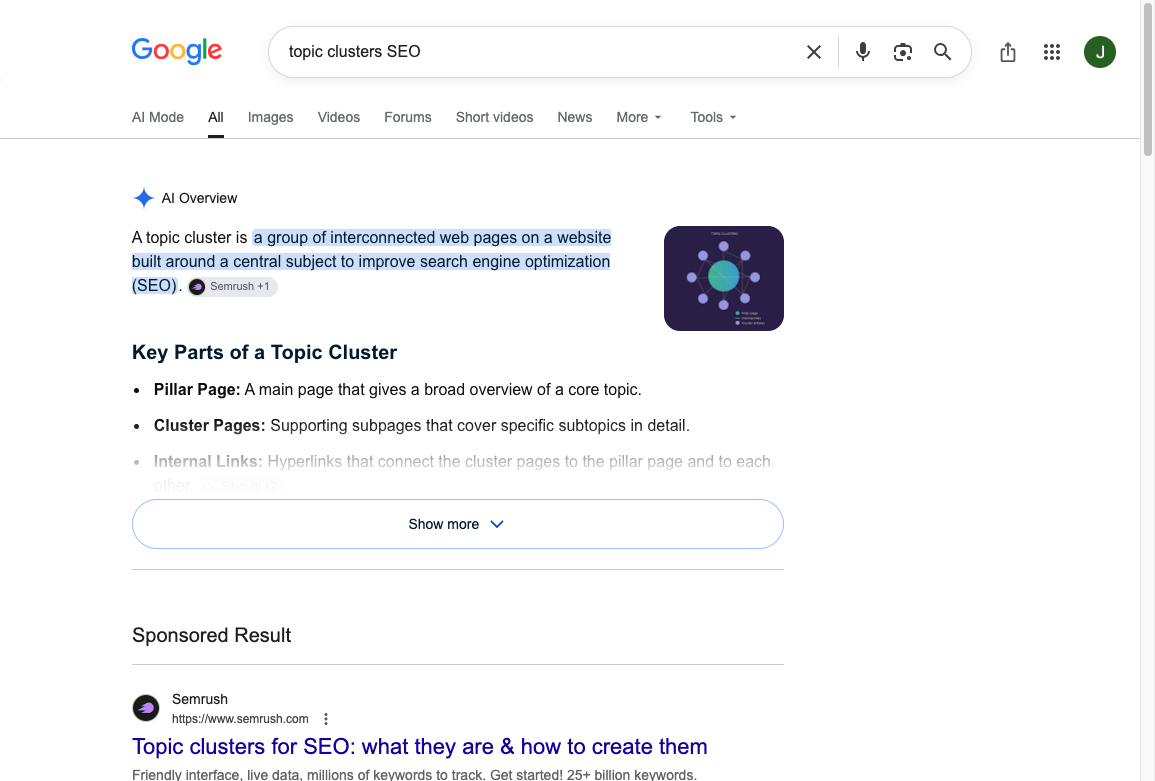
Google already treats related pages as a package in AI Overviews. Search "topic clusters SEO" and the overview names the pillar, the supporting pages, and the internal links before you hit a blue link. That is the job. Isolated posts do not get that treatment.
What Is an SEO Topic Cluster?
An SEO topic cluster is a group of related pages organized around one central topic.

The structure is simple:
- Pillar page: the broad hub page that explains the main topic and points readers to deeper pages.
- Cluster pages: narrower pages that answer specific questions, use cases, comparisons, or workflows.
- Internal links: the connections between the pillar and cluster pages.
For example, a broad "AI SEO" pillar could connect to pages about AI keyword research, SEO content briefs, internal linking, content refreshes, and programmatic SEO. Each page has a different job. If two pages answer the same intent, the cluster is not stronger. It is just creating keyword cannibalization.
| Page role | Example | Reader intent |
|---|---|---|
| Pillar page | AI SEO guide | Understand the full topic and choose a strategy |
| Tutorial | AI keyword research workflow | Learn how to do one task |
| Tool-led page | SEO content brief generator | Turn keyword groups into writer instructions |
| Implementation page | AI internal linking guide | Connect pages after publishing |
| Advanced guide | Programmatic SEO with AI | Scale structured content safely |
This is why I prefer thinking in page roles, not just keywords. A cluster works when every page has a reason to exist.
If you want the original model, not a vendor workflow, HubSpot's topic-cluster video is the useful companion before you build the map:
Topic Clusters: The Next Evolution of Content Strategy
| Page type | Owns | Does not own | Links to |
|---|---|---|---|
| Pillar | The overview, the map, the "start here" | Full tutorials, tool bake-offs, templates | Every supporting page that a reader might need next |
| Supporting page | One intent: how-to, comparison, template, or use case | Re-defining the whole topic | The pillar, plus one related sibling if the next step is real |
| Dead weight | Overlapping keywords with no new job | Anything | Nowhere useful; merge or redirect it |
A cluster is not a publishing quota. The biggest mistake I see is eight articles that all answer "what is AI SEO" with a different H1. That is cannibalization with extra steps. If two URLs would satisfy the same SERP, keep one.
Why AI Content Clustering Matters for SEO and AI Search
Topic clusters have always helped with site structure. They make it easier for readers to move through a topic and easier for crawlers to find related pages. Google's link best practices are clear that links help Google discover pages, while anchor text helps users and Google understand what the destination page is about. That is the practical reason I still care about clusters even when the SEO conversation gets distracted by tools.
AI search raises the stakes. When an AI answer system needs to summarize a complex topic, it benefits from pages that are clear, specific, and connected. A single broad article can answer the basics, but a cluster can cover definitions, workflows, comparisons, edge cases, and examples without forcing all of that into one bloated page. The win is not just more coverage. It is cleaner coverage.
The SEO benefit usually comes from four things:
| Benefit | What it looks like in practice |
|---|---|
| Stronger topical coverage | The site covers the main topic and its meaningful subtopics instead of publishing one isolated article. |
| Cleaner search intent | Each page targets a distinct reader need, which reduces overlap and cannibalization. |
| Better internal linking | Pillar and cluster pages pass context to each other through descriptive links. |
| More useful AI-search passages | Specific sections, tables, definitions, and examples are easier for AI systems to summarize or cite. |
This does not mean AI-generated volume automatically helps. Google's people-first content guidance still points back to useful, reliable content made for readers. A thin cluster of generic pages can make a site look busy without making it more trustworthy.
Where AI Actually Helps in Content Clustering
AI is good at pattern work. It can sort a lot of messy inputs faster than a human editor can. In my experience, this is where it earns its keep: not by deciding the strategy, but by making the messy middle easier to review.
For clustering, that usually means:
- grouping keywords by intent and topic
- summarizing existing URLs around a subject
- finding overlapping pages that may need consolidation
- identifying missing subtopics from competitor and SERP patterns
- drafting an SEO content brief for each page
- suggesting natural internal-link opportunities
- turning a cluster map into a staged publishing plan
The mistake is letting AI make the strategy decision. AI can say that "AI SEO tools" and "how to use AI for SEO" are related. A human still needs to decide whether those belong on one page or two. Usually, they should be separate because one reader wants a tool comparison and the other wants a workflow. I have seen clusters get weaker, not stronger, when every related keyword is treated as proof that another page should exist.
Use AI as the sorting assistant. Keep the judgment with the editor, SEO lead, or person who understands the business.
The AI Content Clustering Workflow
Here is the workflow I would use for a new cluster or a content library cleanup.
1. Choose a Pillar Topic With Business Value
Start with a topic that is broad enough to support several pages but specific enough to stay useful. I like to pressure-test the pillar before doing any keyword expansion, because a weak pillar only produces a bigger weak cluster.
A good pillar topic usually has three traits:
- people search for it
- your product, service, or expertise connects to it naturally
- you can create supporting pages without repeating the same article in different words
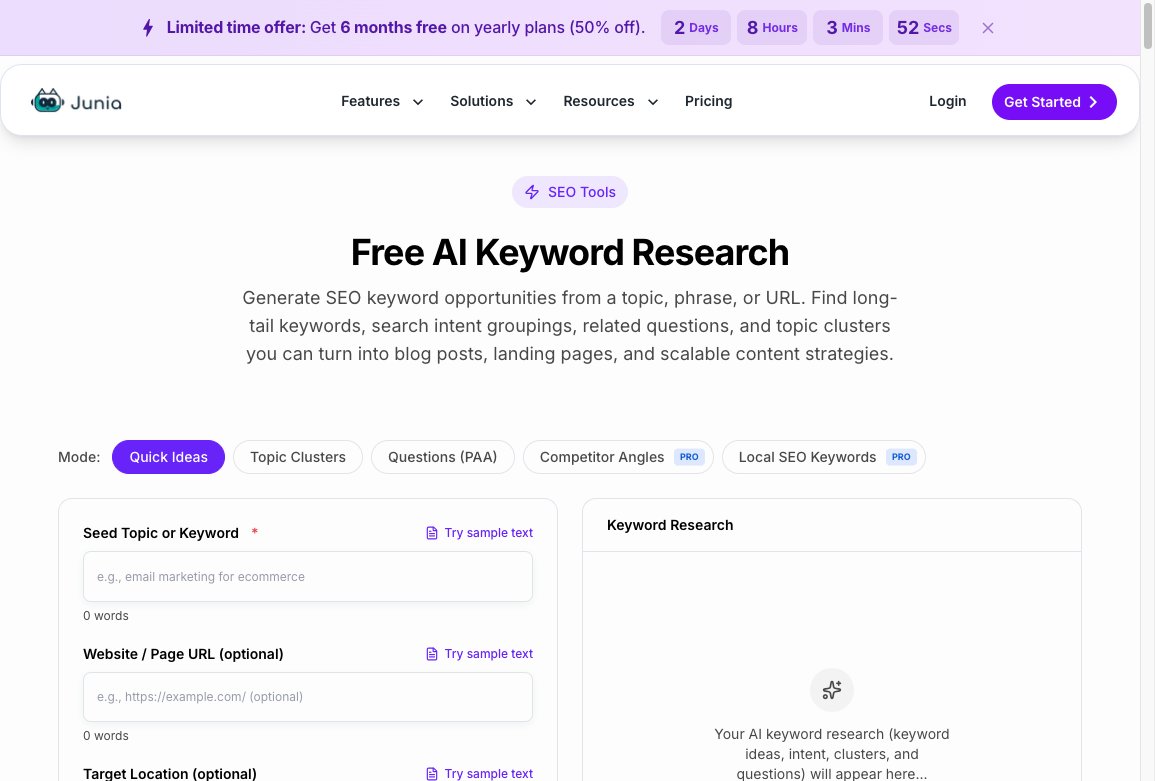
For Junia, "AI SEO" is a useful pillar because it connects naturally to keyword research, briefs, internal links, content generation, content refreshes, and structured scaling. A tool like AI keyword research fits the workflow because the real problem is not collecting more terms. It is turning them into page roles. The Topic Clusters mode is the one I actually use for this: seed the pillar, then force the output into page jobs instead of a longer keyword dump.
A weak pillar is either too broad or too small. "Marketing" is too vague for most sites. "Best title tag length" may be useful, but it is probably a supporting page, not a pillar.
2. Audit the Content You Already Have
Before creating new pages, list the URLs you already have around the topic.
This is the step many teams skip, and it is often where the fastest gains are hiding. You may already have most of the cluster, but the pages are unlinked, outdated, or aimed at overlapping intents.
Build a simple audit table:
| Field | Why it matters |
|---|---|
| URL | Shows which assets already exist |
| Current title | Helps identify duplicate angles |
| Primary intent | Clarifies the page's job |
| Clicks and impressions | Shows what already has traction |
| Ranking queries | Reveals hidden coverage |
| Existing internal links | Shows whether the page is isolated |
| Recommended action | Keep, update, merge, redirect, or create |
Ask AI to group the URLs by topic and intent, then review the output manually. I would never let the model decide redirects or merges on its own. Those calls need performance data, backlink context, product relevance, and editorial judgment. A model can flag possible overlap; it cannot know which URL the business actually depends on.
3. Group Keywords by Intent, Not Similar Words
Keyword clustering goes wrong when it only groups similar phrases. This is one of the places where AI output can look impressively organized and still be strategically wrong.
These terms look related:
- "AI SEO tools"
- "how to use AI for SEO"
- "AI SEO content brief"
- "AI internal linking"
But they represent different reader needs. One person is comparing tools. Another wants a process. Another is creating briefs. Another is fixing site architecture.
Use a table like this before assigning pages:
| Intent group | Example keywords | Best page type |
|---|---|---|
| Learn the concept | AI SEO, what is AI SEO | Pillar or beginner guide |
| Do the task | how to use AI for keyword research | Step-by-step tutorial |
| Choose a tool | best AI SEO tools | Comparison or roundup |
| Create instructions | SEO content brief, content brief template | Template or workflow guide |
| Scale the process | programmatic SEO tool, bulk content creation | Product-led advanced guide |
| Improve old content | SEO improver, update blog posts | Refresh workflow |
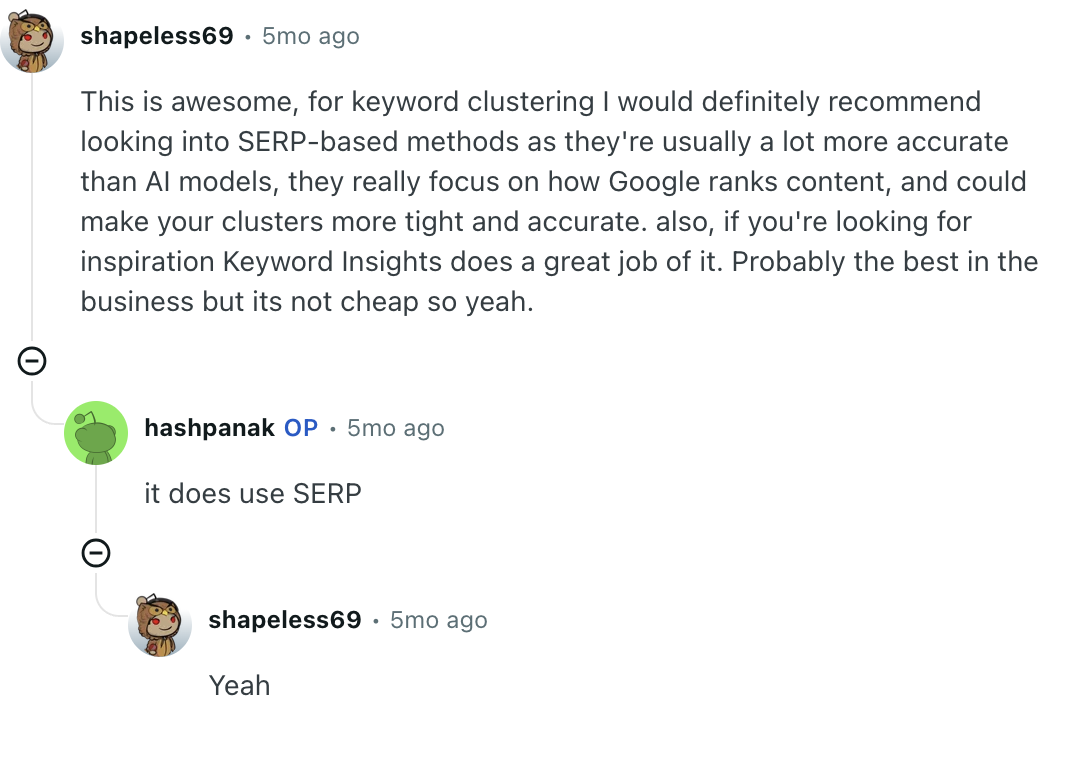
This step protects the cluster from cannibalization. If two proposed pages have the same audience, same intent, and same expected answer, they probably should not both exist. Personally, I would rather publish one decisive page than three thin variations that fight each other.
4. Build the Cluster Map Before Writing
Once the intent groups are clear, decide what each page is responsible for. This is where the cluster starts to become an editorial system instead of a keyword export.
Here is a simple AI SEO cluster map:
| Page | Role | Links to |
|---|---|---|
| AI SEO guide | Pillar and strategic overview | All major cluster pages |
| AI keyword research workflow | Shows how to find and group opportunities | Pillar, brief guide, internal linking guide |
| SEO content brief guide | Turns keyword groups into article instructions | Pillar, writing workflow, brief template |
| AI internal linking guide | Connects related pages after publishing | Pillar, programmatic SEO guide |
| Programmatic SEO guide | Explains structured page scaling | Pillar, bulk content, multilingual SEO |
| SEO content refresh guide | Improves existing cluster pages | Pillar, content audit, optimization workflow |
This map becomes the operating plan. Writers know what to create. Editors know what each article should and should not cover. SEOs know where internal links belong. I find this especially useful when multiple people are touching the same topic, because it reduces the quiet drift that happens when every draft redefines the basics.
If you use an AI article writer, the map matters even more. It gives the tool boundaries so it does not create isolated drafts that all repeat the same definitions.
5. Create Briefs That Separate the Pages
Every cluster page should get its own content brief before writing starts. It sounds procedural, but this is where a lot of quality control happens.
A useful brief should include:
- primary intent
- target reader
- main question answered in the first section
- sections to include
- sections to avoid because another page owns them
- internal links to add
- examples, data, screenshots, or product details needed
- source notes for claims that need verification
6. Write the Pillar Page Like a Hub
A pillar page should cover the broad topic, but it should not become a dumping ground. The best pillar pages feel like confident navigation, not encyclopedias.
The job of the pillar is to:
- define the topic clearly
- explain why it matters
- organize the subtopics
- link to deeper pages
- help readers choose the next step
If a pillar page tries to fully answer every subtopic, it gets long, repetitive, and hard to navigate. A concise section on the topic of interest can point readers to a dedicated supporting page instead of trying to cover every implementation detail on the pillar. That restraint is editorially useful and commercially useful: readers get the next step without being buried in every possible detail.
7. Publish Supporting Pages With Clear Jobs
Each supporting page should go deeper than the pillar on one specific intent.
A good cluster page usually has:
- a direct answer early
- examples, steps, or decision rules
- natural links back to the pillar
- links to related cluster pages only when they help the reader continue
- enough specificity to stand alone
This is where I would be strict. If the draft starts with the same generic introduction as the pillar, cut it. The reader clicked a narrower page because they want a narrower answer.
Internal Links Are the Cluster's Wiring

Internal links turn a set of related posts into a cluster. Without them, even good pages can sit beside each other without helping each other.
Use them with a clear purpose:
| Link type | What to do |
|---|---|
| Pillar to cluster | Link from the pillar to the most important supporting pages. |
| Cluster to pillar | Link back when the broader topic helps the reader orient themselves. |
| Cluster to cluster | Link between related pages when the next step is genuinely useful. |
| Old page to new page | After publishing a new page, add links from older relevant posts. |
| Anchor text | Use descriptive, natural anchors instead of repeating exact-match phrases. |
Bad internal links sound like a resource list. Good internal links sound like useful advice. I usually read the sentence aloud: if the link feels bolted on, the anchor is probably serving SEO before it serves the reader.
The wiring looks like this when it is working:
- Pillar page
- Tutorial
- Comparison
- Template
View diagram source
flowchart TD
  P[Pillar page] --> A[Tutorial]
  P --> B[Comparison]
  P --> C[Template]
  A --> P
  B --> P
  C --> P
  A --> C
  B --> A
Cluster-to-cluster links only earn their place when the reader actually needs the next step. A tutorial can point to a template. A comparison should not dump every sibling URL into a "related reading" box.
For example, "click here" tells the reader nothing. "Create the brief before drafting" is more useful, and a link on "brief" only belongs if the sentence explains why the brief matters.
For teams publishing at scale, the cluster map becomes the control layer for bulk content creation. It tells the system which pages to create, which URLs already exist, and where each new draft should fit.
The same rule applies to an AI SEO agent or a programmatic SEO workflow. Automation only helps when every new page has a role, a destination, and a reason to exist. If the agent cannot say which URL already owns that intent, do not let it publish. A well-designed agent workflow checks the existing URL map before it drafts anything new.
Example: Building a Cluster Around "AI SEO"
Let's say your site wants to build authority around AI SEO. I would resist the urge to start with a long list of article titles.
A weak plan would be:
- write "What is AI SEO?"
- write "AI SEO tools"
- write "Best AI SEO tools"
- write "Top AI SEO tools"
- hope one of them ranks
A stronger plan starts with intent:
| Reader question | Page idea | Notes |
|---|---|---|
| What is AI SEO and why does it matter? | AI SEO guide | Pillar page |
| How do I find keywords with AI? | AI keyword research workflow | Tutorial |
| How do I turn keywords into briefs? | SEO content brief generator guide | Workflow and tool tie-in |
| How do I connect pages after publishing? | AI internal linking guide | Implementation page |
| How do I scale this across hundreds of pages? | Programmatic SEO with AI | Advanced use case |
| How do I improve existing articles? | SEO improver workflow | Refresh and optimization guide |
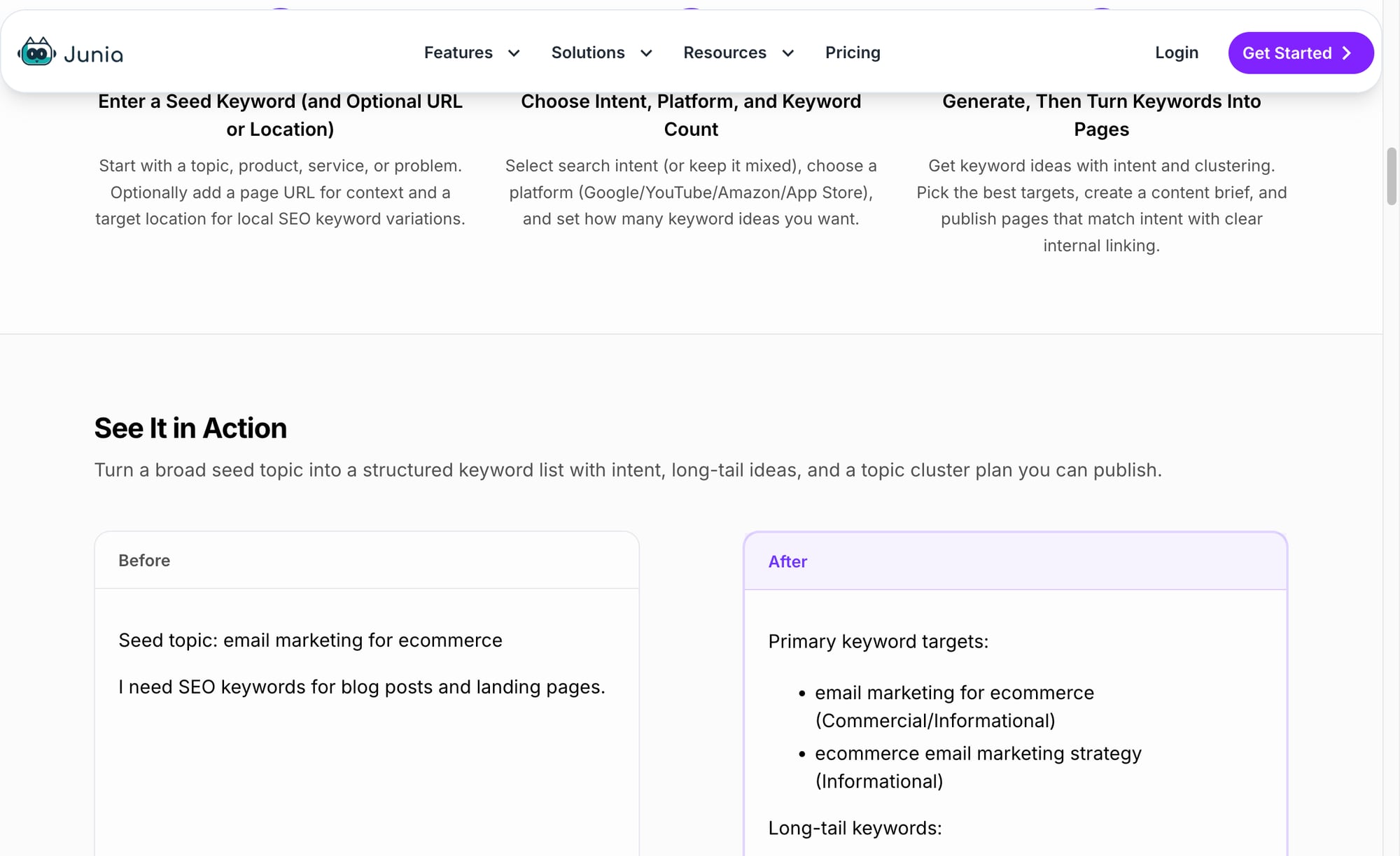
If you use Junia, the workflow can look like this:
- Use keyword research to find and group the opportunity.
- Create briefs from the cluster map.
- Draft or refresh pages.
- Add internal links after the URLs exist.
- Improve older pages with an SEO improver when the audit shows they are slipping, thin, or disconnected.
The tool stack helps, but the strategy is the map. Without the map, AI can create more pages without creating more authority. That is the uncomfortable part of AI-assisted SEO: speed exposes weak planning faster.
How to Measure Topic Cluster Performance
Do not judge a cluster only by the pillar page. I have seen supporting pages prove the value of a cluster long before the hub page becomes the obvious winner.
A cluster can work even when the pillar is not the first page to rank. Sometimes supporting pages win long-tail queries first, build relevance, and help the pillar improve later.
Track the cluster as a group:
| Metric | What it tells you |
|---|---|
| Total organic clicks across the cluster | Whether the topic is growing overall |
| Ranking keyword growth | Whether coverage is expanding |
| Pages with impressions but low clicks | Which titles or metas need work |
| Internal links per page | Whether important pages are isolated |
| Conversions by page or intent | Which parts of the cluster drive business value |
| AI search citations or mentions | Whether pages are being referenced in AI answers |
| Cannibalized queries | Whether pages need clearer roles, merges, or redirects |
For mature clusters, schedule refreshes. Search behavior changes, products change, and AI search surfaces new related questions. A strong cluster is maintained, not published once and forgotten. In practice, the refresh cadence matters less than having someone own the cluster and notice when the pages start drifting apart.
Common AI Content Clustering Mistakes
The biggest mistake is treating clustering as a content-volume tactic. I do not think clustering works when the hidden goal is simply "publish more."
More pages only help when those pages answer different needs.
Watch for these problems:
- Publishing too many similar articles: If five pages target the same intent, merge or differentiate them.
- Choosing a pillar that is too broad: "Digital marketing" is rarely a useful pillar for a focused SaaS site.
- Skipping the content audit: Existing pages may need updating and linking, not replacement.
- Letting AI write generic sections: AI can organize ideas, but weak prompts often create the same definitions competitors already have.
- Forgetting internal links: A cluster without links is just a collection of posts.
- Ignoring product fit: Traffic matters less when the topic has no connection to the audience or offer.
- Over-optimizing anchors: Natural, descriptive anchors are better than repeating the same keyword everywhere.
This is also why an AI autoblogging setup needs cluster planning. Automated publishing works best when the site knows what each page should do before the draft is generated.
Final Takeaway
AI-driven content clustering is not about letting AI invent a huge list of blog posts.
It is about using AI to make better SEO decisions faster: audit what exists, group keywords by intent, find missing pages, build briefs, connect the pages with internal links, and refresh the cluster over time. The human job is to keep asking whether each decision makes the cluster more useful or just larger.
If you are starting from scratch, build one strong cluster before scaling. If you already have a lot of content, start with the audit. Either way, the rule is the same: every page needs a clear job, and every link should help the reader take the next useful step. I would protect that more aggressively than I would protect publishing speed.