
12 Types of Stories With Examples: Short Story Examples by Genre

Thu
AI SEO Specialist, Full Stack Developer

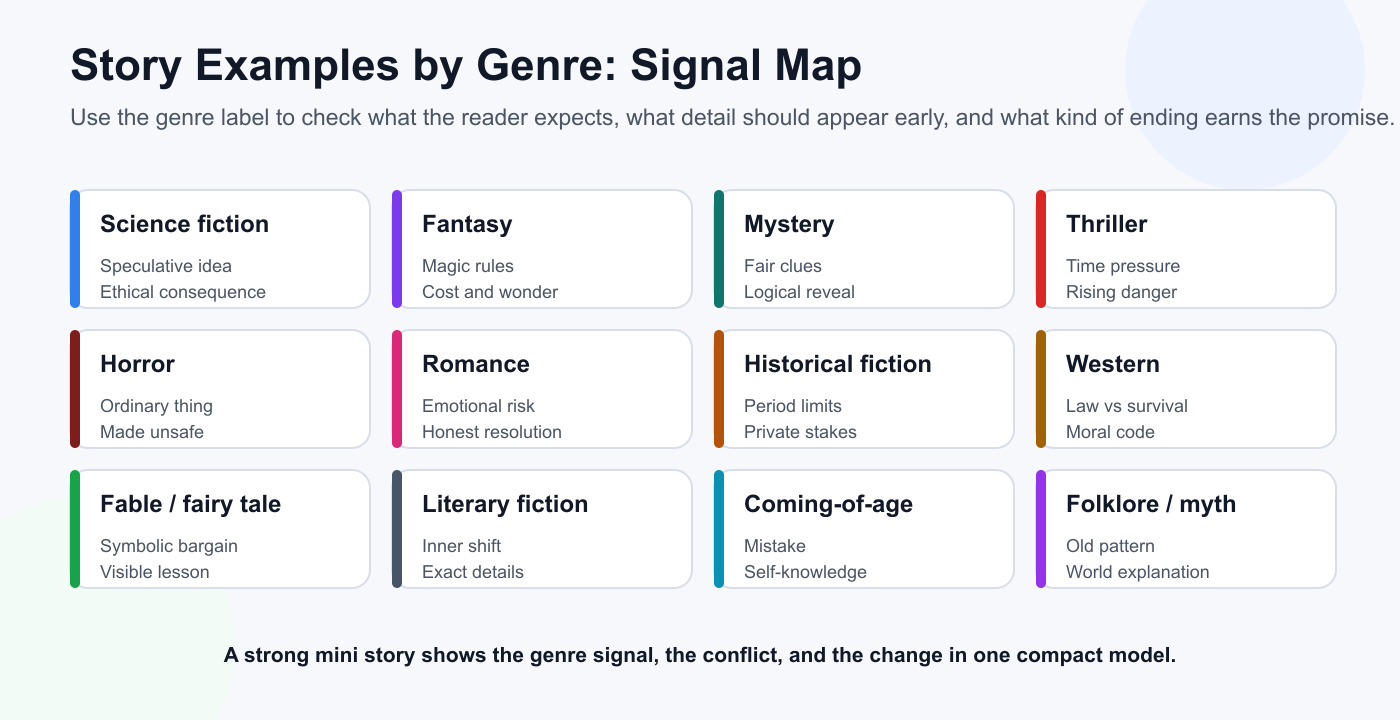
Story examples are easiest to learn from when they are short, specific, and tied to a genre. A mystery model should show a clue. A romance model should show emotional tension. A horror model should make an ordinary detail feel unsafe.
That is the point of this guide. Instead of giving you a long lecture about fiction categories, it gives you 12 student-friendly story examples by genre, then explains what each one teaches. You can use them for a creative writing assignment, a classroom discussion, or a first draft when you know the genre but not the shape of the story yet.
Genre is not just a label on a bookshelf. Oregon State's writing guide explains genre as a pattern readers recognize because certain features repeat over time. For writers, that means genre gives you a promise: the reader expects a certain kind of conflict, setting, mood, and payoff.
TL;DR: Story Examples by Genre
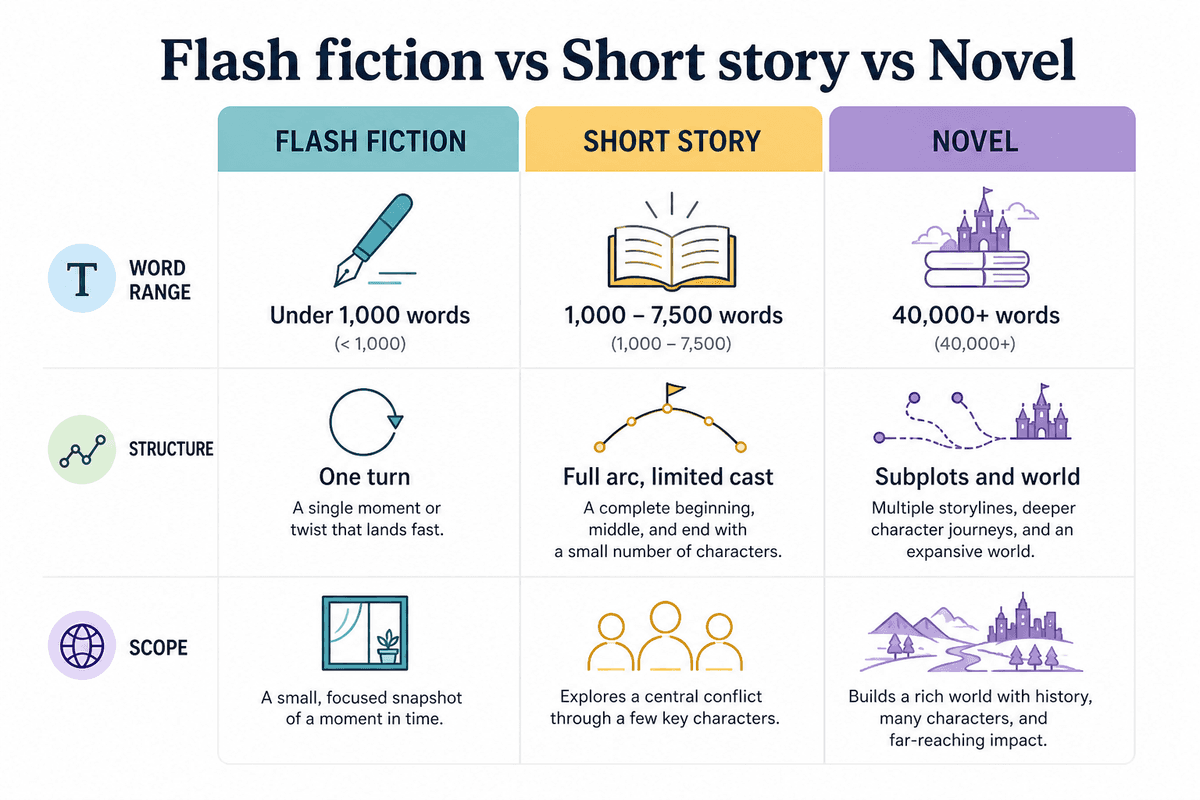
| Genre | Short example idea | What the genre teaches you |
|---|---|---|
| Science fiction | A student discovers the school chatbot has been answering questions from tomorrow. | Use a speculative "what if" to test human choices. |
| Fantasy | A quiet librarian finds that overdue books are portals to unfinished kingdoms. | Make magic feel governed by rules, costs, and wonder. |
| Mystery | A trophy disappears from a locked classroom during assembly. | Plant clues fairly, then reveal the pattern. |
| Thriller / suspense | A runner keeps receiving live route updates from someone following her. | Keep pressure rising and make time feel limited. |
| Horror | A family photo changes every night, and one person slowly fades from it. | Turn a familiar object into a source of dread. |
| Romance | Two debate rivals keep editing each other's speeches until honesty slips through. | Let vulnerability create the real plot. |
| Historical fiction | A young printer hides a banned pamphlet during a city crackdown. | Let the time period shape the danger and choices. |
| Western | A new sheriff must decide whether to arrest the only doctor in town. | Use frontier pressure to test a moral code. |
| Fable / fairy tale | A fox trades its shadow for beauty and learns why shadows matter. | Build a simple symbolic story around a lesson. |
| Literary fiction | A son sorts his mother's recipe cards and finds the apology she never said aloud. | Focus on character, memory, language, and meaning. |
| Coming-of-age | A teen lies to join an older group, then has to choose who to disappoint. | Show identity changing through mistakes and consequences. |
| Folklore / mythology | A village asks the moon why the river stopped singing. | Use mythic patterns to explain fear, nature, or culture. |
If you are writing your own draft, pick the row that matches the effect you want. Then build the story around three things: a character who wants something, a problem that blocks them, and a change that happens by the end. A basic story-writing structure check helps before you start adding genre details.
How to Read These Story Examples
| Genre | What to study in the example | Common student miss |
|---|---|---|
| Sci-fi | World rule introduced through action | Info-dump prologue |
| Fantasy | Magic cost / constraint | Power without price |
| Mystery | Clue placement | Hiding the detective’s logic |
| Thriller | Clock / escalation | Flat middle |
| Horror | Dread before gore | Jump scare only |
| Romance | Desire + obstacle | Instant perfect couple |
How to read these: do not copy the plot. Mark where the genre promise appears in the first page, then where the pressure changes.
Do not copy the plot exactly. Copy the function.
When you study a story by genre, ask four questions:
- What promise does the genre make? A mystery promises a puzzle. A romance promises emotional resolution. Horror promises fear or unease.
- What detail signals the genre early? A spaceship, a locked room, a prophecy, a missing person, a haunted object, or a forbidden letter can tell readers what kind of story they are in.
- What changes by the end? The case is solved, the character grows up, the lovers become honest, or the myth explains why the world is the way it is.
- What should I practice from this example? Pacing, clues, atmosphere, dialogue, world-building, conflict, or theme.
Purdue OWL's fiction writing guidance makes a useful point for beginners: reading short stories gives writers models for plot, character development, scope, and showing instead of telling. That is why short genre examples work well in class. You can see the whole machine at once.
1. Science Fiction Story Example
Mini example: Maya volunteers to test her school's new homework chatbot. At first, it only corrects grammar. Then it starts warning her about questions the teacher has not assigned yet. When Maya realizes the bot is pulling answers from tomorrow, she has to decide whether to use it to win a scholarship or expose the system before it changes other students' futures.
Genre signals: advanced technology, cause and effect, ethical choice, future consequences.
Science fiction works best when the science or technology changes the human problem. The chatbot is not interesting only because it is futuristic. It matters because it tempts Maya, gives her power, and forces her to choose what kind of person she wants to become.
A real short story to study is Beth Goder's "How To Say I Love You With Wikipedia," which uses a speculative digital premise to explore connection and feeling. That is a useful lesson: science fiction does not have to be cold or technical. The best sci-fi often uses the impossible to make a very human question sharper.
Try this: Start with a "what if" question, then make it personal. What if memories could be edited? What if your phone predicted one lie per day? What if a robot inherited a family secret?
2. Fantasy Story Example
Mini example: In a town where every child receives one small spell at age twelve, Nira gets the useless ability to hear doors whisper. Everyone laughs until the old library door warns her that a prince has been locked inside a book for 300 years. To free him, she must decide which door in town deserves to stay closed forever.
Genre signals: magic, hidden rules, enchanted objects, a quest, a cost.
Fantasy depends on wonder, but wonder needs structure. If anything can happen, nothing feels meaningful. In this example, the magic has limits: Nira hears doors, not every secret in the world. The choice also has a price, which makes the magic part of the conflict instead of decoration.
For published models, Alix E. Harrow's "Do Not Look Back, My Lion" shows second-world fantasy with its own social rules, while "A Witch's Guide to Escape" is a strong portal fantasy example because ordinary life and magical possibility overlap. Those two examples are useful because they show how broad fantasy can be.
Writers who want help shaping a premise can use a story generator to brainstorm a world, conflict, and character goal, but the final draft still needs your own rules and emotional stakes.
3. Mystery Story Example
Mini example: During a school assembly, the championship trophy disappears from a locked classroom. The only people with keys are the principal, the coach, and the janitor. But the detective notices one odd thing: the dust around the trophy case has been wiped in a perfect circle, as if the trophy had been spun before it vanished.
Genre signals: central puzzle, suspects, clues, misdirection, final explanation.
A mystery is a promise that the truth can be found. The writer's job is to hide the answer without cheating. Give readers real clues, but make the wrong explanation look tempting.
Andy Weir's "The Adventure of the Sealed Room" is a useful locked-room model because the mystery appears impossible at first, then becomes logical once the hidden mechanism is explained. That is the pleasure of the genre: the ending should surprise the reader and still feel fair.
Try this: Before drafting, list the solution first. Then add three clues, two red herrings, and one reason the guilty character behaves suspiciously for an innocent-looking reason.
4. Thriller and Suspense Story Example
Mini example: Lena is training for a city marathon when her running app starts giving instructions she did not program: Turn left now. Slow down. Do not look behind you. At first she thinks it is a prank. Then the app shows a second blinking dot moving faster on the same route.
Genre signals: immediate danger, time pressure, limited information, short scenes, rising stakes.
Thriller and suspense stories are built on pressure. The reader should feel that waiting will make things worse. In the example above, the app creates a ticking clock because every turn matters and every delay brings the pursuer closer.
Renee Roberson's "The Polaroid" is a strong suspense model because it uses information arriving in fragments. The reader learns enough to feel danger, but not enough to relax. That is a useful pacing lesson: suspense often comes from controlled uncertainty, not constant action.
If your suspense draft feels flat, shorten the time frame. A story that takes place over one hour, one night, or one train ride can feel more urgent than a story spread across weeks.
5. Horror Story Example
Mini example: Every night, a framed family photo changes. At first, the changes are tiny: a hand on the wrong shoulder, a face turned toward the window. Then the youngest child begins to fade from the picture. In the morning, no one remembers her except her older brother.
Genre signals: dread, isolation, the uncanny, helplessness, a threat that may not be fully explained.
Horror does not need to begin with a monster. Often, it works better when something ordinary becomes wrong. A photo, mirror, hallway, lullaby, or bedroom can become frightening because the reader already understands what it should be.
Samantha Mabry's "Hover" is worth studying for atmosphere. It uses a haunting premise and a domestic setting, which is often more unsettling than a remote castle because the danger enters a place that should feel safe.
Try this: Pick one everyday object and change one rule about it. The object remembers you. It moves only when ignored. It shows a future you cannot prevent. Then follow the emotional damage that rule creates.
6. Romance Story Example
Mini example: Two students are rivals on the debate team. They spend every tournament trying to beat each other, but they also keep improving each other's arguments in the shared practice document. One night, one of them leaves a private note in the margin: You are braver on paper than you are in person.
Genre signals: emotional tension, attraction, vulnerability, conflict, a hopeful resolution.
Romance is not just "two people like each other." The relationship has to drive the story. The obstacle should force the characters to become more honest, not simply delay the ending.
Courtney Milan's "The Goddess of Small Things" is a useful romance example because the central pleasure comes from identity, curiosity, and emotional recognition. A strong romance scene usually has two conversations happening at once: what the characters say aloud and what they are afraid to admit.
Dialogue matters a lot in this genre. If you are stuck, draft the scene plainly first, then use a dialogue generator to explore alternate rhythms or subtext. Keep the lines that reveal character rather than the ones that only sound dramatic.
7. Historical Fiction Story Example
Mini example: In 1790s Paris, a young printer's apprentice hides a banned pamphlet under the floorboards. When soldiers search the shop, she realizes the pamphlet was written by her own mother. Saving it could put the whole family at risk, but destroying it would erase the only public proof of what her mother believed.
Genre signals: real period pressure, researched setting, social rules, historical conflict, private stakes.
Historical fiction should not treat history as wallpaper. The time period should create problems the character could not face in the same way today. Laws, class, gender roles, technology, transportation, food, work, and speech can all shape the plot.
Kate Heartfield's "A Cut-Purse Rethinks His Ways" is a useful model because it ties character choice to a historical world of money, survival, and social pressure. The lesson is simple: research matters most when it changes what the character can do.
Try this: After choosing a period, write down three limits your character faces because of that time. Then make one of those limits central to the conflict.
8. Western Story Example
Mini example: A new sheriff arrives in a frontier town where the only doctor is also a wanted thief. When a fever spreads through the settlement, the sheriff must decide whether justice means making the arrest now or keeping the doctor free long enough to save the town.
Genre signals: frontier setting, law versus survival, moral code, isolation, harsh landscape.
Western fiction often tests character under thin social rules. There may be a law, but the town is far from help. There may be justice, but applying it too simply can hurt innocent people. That tension is what keeps the genre from becoming only hats, horses, and dusty streets.
Annika Barranti Klein's "Prairie Fever" is useful to compare because it leans into the psychological pressure of frontier life. The setting is not just scenery. It changes what the character can endure and what choices seem possible.
If you write a Western, decide what kind of frontier pressure matters most: distance, weather, violence, loneliness, hunger, land, reputation, or law.
9. Fable or Fairy Tale Story Example
Mini example: A fox becomes jealous of the peacock's beauty and trades its shadow for brighter fur. For one day, every animal admires the fox. At sunset, the fox realizes it can no longer find shelter because no tree recognizes it without its shadow.
Genre signals: symbolic characters, simple plot, magic or talking animals, moral lesson.
Fables and fairy tales are useful for students because they make theme visible. The fox does not need a long backstory. The missing shadow carries the meaning: vanity can cost you protection, identity, or belonging.
Fairy tales usually use transformation, tests, impossible tasks, and moral contrast. Fables are often tighter and more direct, ending with a clear lesson. Both forms are good practice for writing a complete story in a small space.
Try this: Choose one abstract idea, such as greed, courage, jealousy, kindness, or pride. Then turn it into an object, animal, spell, bargain, or rule.
10. Literary Fiction Story Example
Mini example: After his mother dies, Daniel sorts her recipe cards into a plastic box. Between instructions for soup and holiday bread, he finds notes she wrote but never sent: apologies, jokes, and one memory that changes how he understands the last year of her life.
Genre signals: character focus, interior conflict, careful language, memory, ambiguity.
Literary fiction often cares less about a large external event and more about how a character understands that event. The plot may be quiet, but the emotional movement should still be clear.
Allison Light's "Breathing for Two" is a helpful example of literary fiction because the meaning comes through a small observed situation rather than a high-concept premise. That does not mean nothing happens. It means the most important action may be internal: a realization, refusal, grief, or shift in perspective.
Writers sometimes confuse literary fiction with vague writing. Do the opposite. Use exact details. A recipe card, a stain, a crossed-out word, or a missing photograph can carry more weight than a page of abstract reflection.
11. Coming-of-Age Story Example
Mini example: Tessa lies about her age to join an older theater group. At first, she loves being treated like she belongs. Then the group asks her to make fun of a younger student who reminds her of who she was six months ago.
Genre signals: identity, growing responsibility, peer pressure, mistake, self-knowledge.
Coming-of-age stories show a character crossing an emotional threshold. The change does not have to be huge. A believable moment of maturity can be as small as telling the truth, refusing a dare, apologizing, or realizing that approval has a cost.
Lyndsie Manusos's "Love is Done at the Seat of Your Pants" is a useful model because it focuses on grief, pressure, and emotional maturity rather than a neat "lesson learned" ending. That is important. Growing up rarely feels tidy while it is happening.
If you are writing for school, this genre is often a good choice because it gives you a clear arc: the character begins with one idea about themselves and ends with a more complicated one.
12. Folklore, Mythology, or Legend Story Example
Mini example: A village wakes to find the river silent. No one can fish, sleep, or remember the songs used at weddings. A child climbs the hill to ask the moon what happened, and the moon says the river stopped singing because the villagers forgot to thank the stones that shaped its path.
Genre signals: oral storytelling rhythm, symbolic nature, gods or spirits, cultural explanation, repeated phrases.
Folklore, mythology, and legends often explain why something is the way it is: why a season changes, why a mountain has a name, why people follow a custom, or why a warning should be remembered.
These stories usually feel older than the page. They use pattern, repetition, symbolic characters, and memorable images. A trickster, moon, river, tree, ancestor, or god may carry the meaning of the story.
Try this: Start with a question a child might ask: Why do crows sound like that? Why does winter return? Why do people leave flowers by the road? Then answer it with a story that feels larger than one person.
Quick Genre Comparison for Student Writers
| If your story needs... | Choose this genre | Focus your draft on... |
|---|---|---|
| A puzzle with a fair answer | Mystery | Clues, suspects, reveal |
| Fear or unease | Horror | Atmosphere, vulnerability, the unknown |
| Speed and danger | Thriller / suspense | Time pressure, pursuit, stakes |
| A relationship arc | Romance | Emotional honesty, conflict, resolution |
| A speculative idea | Science fiction | Technology, consequences, ethics |
| Magic or impossible worlds | Fantasy | Rules, wonder, cost |
| A lesson in symbolic form | Fable / fairy tale | Moral pattern, image, transformation |
| A realistic inner shift | Literary fiction | Character, memory, meaning |
| A young person changing | Coming-of-age | Identity, mistake, maturity |
This is also where genre overlap becomes useful. A story can be a science fiction mystery, a historical romance, a fantasy coming-of-age story, or a horror Western. If your idea crosses categories, that is not a problem. Just decide which promise is primary so the reader knows what kind of payoff to expect.
How to Use Story Examples in Your Own Writing
Start by choosing the genre that matches the reader experience you want. Do you want the reader to solve, fear, wonder, hope, grieve, laugh, or understand? That answer matters more than the label.
Then build a small plan:
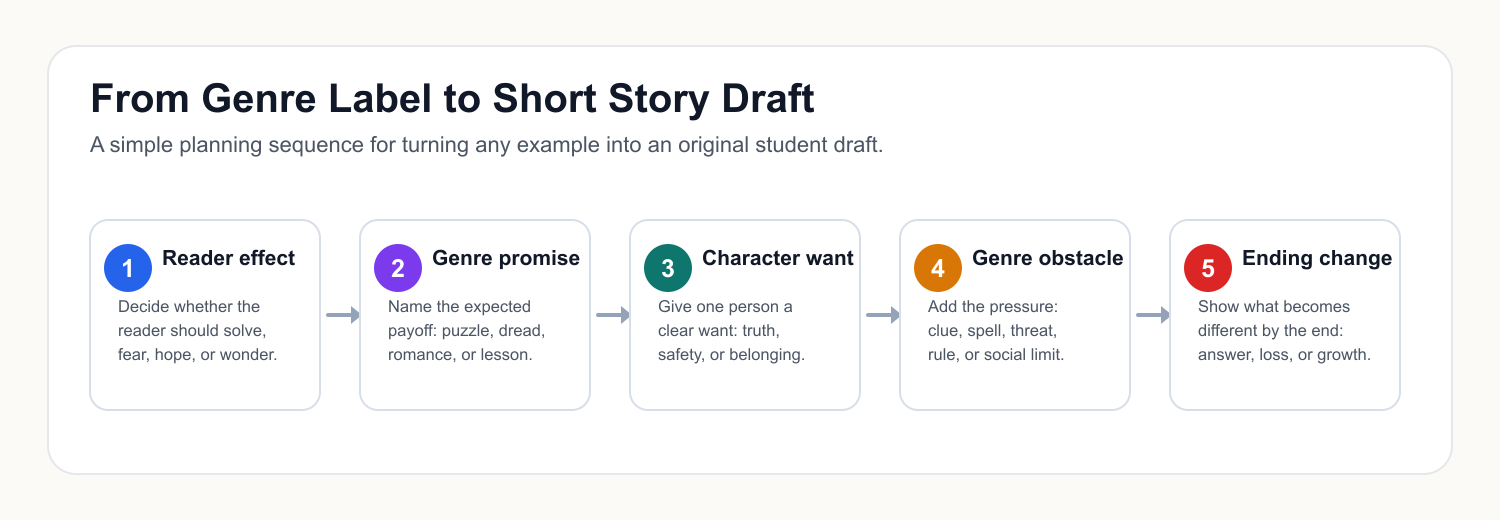
- Write the genre promise in one sentence. Example: "This is a mystery about a missing trophy where the clue is hidden in the dust."
- Name the character's want. The character wants safety, love, proof, freedom, respect, revenge, belonging, or the truth.
- Add one genre-specific obstacle. A spell has a cost. A suspect lies. A storm traps the town. A ghost changes the photo.
- Choose the ending effect. Surprise, relief, dread, wonder, sadness, hope, or moral clarity.
- Revise for the genre signals. Add the details readers expect, but avoid stuffing the story with every trope at once.
If you are planning a full assignment, the model still needs to become a complete draft with a beginning, middle, and ending. A practical story-writing process helps you move from premise to scene instead of stopping at an idea. If you already have a draft, check for common story writing mistakes, especially weak conflict, unclear stakes, and endings that do not change anything.
For classroom use, teachers can turn the examples above into prompts, reading checks, or short writing exercises. Level-appropriate practice passages make genre easier to compare side by side, and a reading passage generator can help create those samples quickly. A worksheet generator can then turn genre signals into quick identification activities.
Final Takeaway
A genre is a set of expectations, not a cage. Once you know what readers expect, you can meet those expectations, bend them, or combine them with another genre on purpose.
For students, the fastest way to improve is to study short examples. Look at how the story opens, what details signal the genre, how the conflict grows, and what changes by the end. Then write a small version of your own. One focused scene with a clear genre promise will teach you more than a huge idea that never becomes a finished story.