
Free Webinar Script Generator
Build complete webinar presentations with audience hooks, teaching sections, engagement prompts, transitions, offer pitches, and closing CTAs. Useful for coaches, SaaS demos, workshops, lead generation webinars, and educational presentations.
Webinar Script
Your webinar script will appear here (with timing, speaker notes, transitions, interaction prompts, and CTA)...
How the AI Webinar Script Generator Works
Get results in seconds with a simple workflow.
Enter Your Topic and Goal
Add your webinar topic and choose a goal (educate, lead generation, sell, demo). Optionally include your audience, offer/CTA, and key points to ensure the script matches your messaging.
Choose Duration and Style
Pick a webinar length (30–90 minutes) and a style mode (lead gen, sales webinar, training, product demo). The generator builds a structure with logical pacing and transitions.
Generate, Personalize, and Present
Get a complete webinar script with speaker notes, interaction prompts, and a CTA. Do a quick pass to add your examples, proof points, and product specifics before presenting live or recording.
See It in Action
Example of turning a vague webinar idea into a structured, conversion-ready webinar script flow.
Webinar topic: SEO for small businesses. I’ll talk about keywords, content, and backlinks, then mention my services at the end.
Webinar script flow: Strong hook + outcome promise → agenda + expectations → 3-step SEO framework (keyword intent, on-page structure, internal links) with examples → interactive poll + quick checklist → recap + common mistakes → transition to offer (free audit + next steps) → objection handling → Q&A prompts → closing CTA and follow-up.
Why Use Our AI Webinar Script Generator?
Powered by the latest AI to deliver fast, accurate results.
Complete Webinar Script (Hook → Agenda → Teaching → Pitch → Q&A → Close)
Generates a full webinar script with opening hook, agenda, segment transitions, teaching points, CTA/pitch section, Q&A prompts, and a confident closing—so you can present without starting from scratch.
Built-In Webinar Structure + Timing Cues
Creates a clear webinar outline with estimated timestamps (30/45/60/90 minutes) to keep pacing tight and avoid running long during live sessions.
Audience Engagement Prompts (Polls, Chat, Micro-Commitments)
Adds interactive moments like polls, chat questions, and quick exercises to increase attention, reduce drop-off, and improve webinar conversion rates.
Conversion-Focused CTA and Offer Positioning
Includes a persuasive, non-pushy offer segment with benefits, proof cues, risk reversal, and next steps—ideal for lead generation webinars, product demos, and sales webinars.
SEO & Content Marketing-Friendly Webinar Repurposing
Outputs a script that’s easy to repurpose into blog posts, landing pages, email sequences, and YouTube descriptions—helpful for content creation and organic traffic growth.
Pro Tips for Better Results
Get the most out of the AI Webinar Script Generator with these expert tips.
Open with a strong promise + who it’s for
In the first 60–90 seconds, clearly state the outcome, who it’s for, and what they’ll be able to do after the webinar. This reduces drop-off and increases engagement.
Use “micro-yes” questions to keep attention
Add quick chat prompts like “Type 1 if you’ve tried this” or “Drop your niche in the chat.” Small interactions increase retention and help you tailor examples in real time.
Teach a framework, not just tips
Frameworks are easier to remember and repurpose into slides and blog posts. They also position you as an expert and make the pitch feel more natural.
Save the pitch for after real value
Conversion rates improve when attendees feel they received genuine, actionable teaching before the offer. Use a clear transition: recap → gap → solution → next steps.
Add proof points you can defend
If you mention results, include accurate numbers, timelines, and context. Strong proof increases webinar conversions, but only if it’s credible and specific.
Who Is This For?
Trusted by millions of students, writers, and professionals worldwide.
Create a webinar script that actually keeps people watching
Most webinars fail for boring reasons. The intro drags. The agenda is fuzzy. The “teaching” becomes a ramble. Then the pitch shows up out of nowhere and everyone mentally checks out.
A good webinar script fixes that. Not by sounding scripted, but by giving you a clean flow you can follow live.
This AI Webinar Script Generator helps you produce a full webinar structure with:
- A strong hook and clear promise
- A simple agenda that feels like a path, not a list
- Teaching segments with transitions that do not feel abrupt
- Polls, chat prompts, quick exercises, and micro commitments
- A CTA that fits your goal, from lead gen to demo to sales
- Q&A prompts so you are not stuck at the end going “any questions?”
If you want a broader set of writing and marketing tools in one place, you can also use the AI writing tools on Junia AI and keep everything consistent across your scripts, landing pages, and follow ups.
What makes a webinar script convert better (without feeling salesy)
A webinar that converts is usually doing a few simple things well.
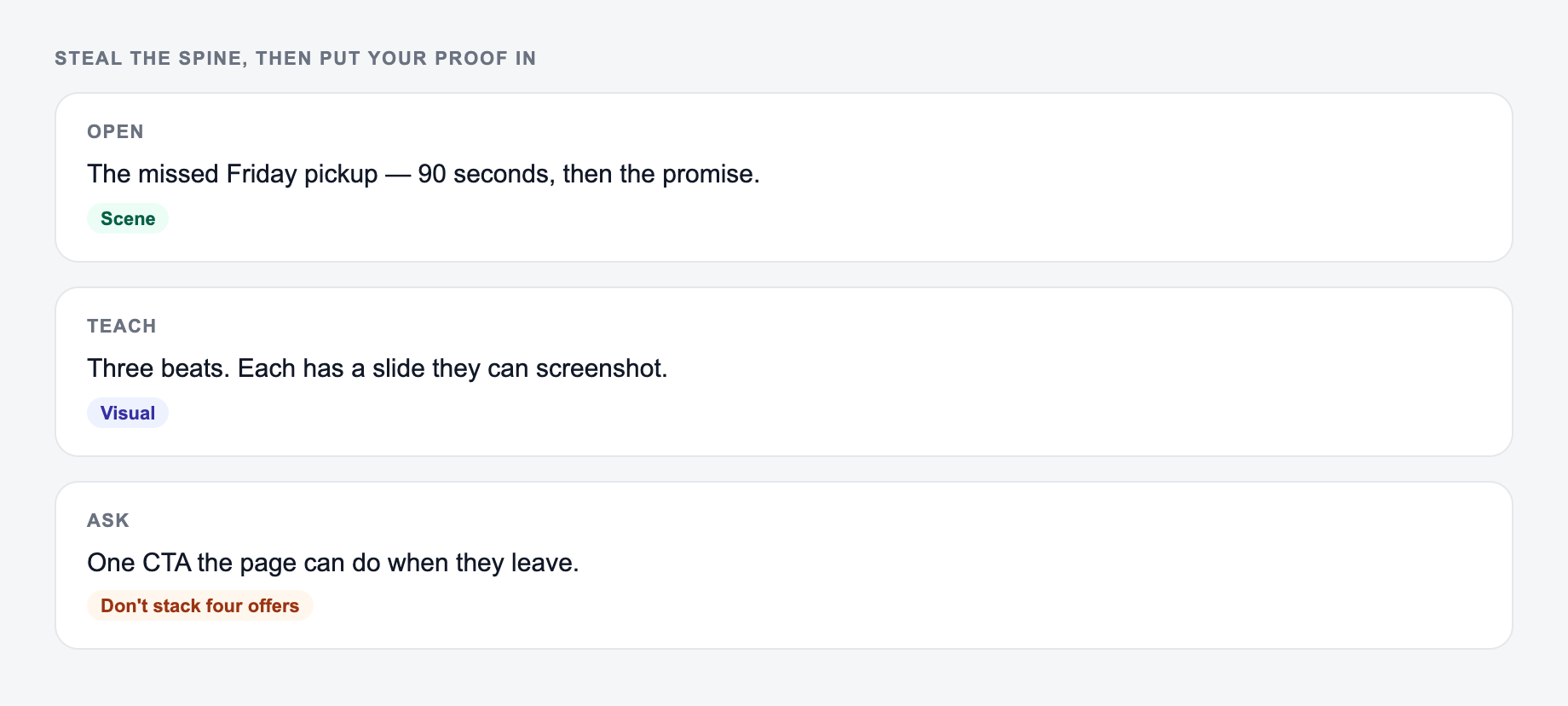
1) It promises one clear outcome
Not ten outcomes. One. People show up for a result, not a topic.
Instead of: “SEO for SaaS” Try: “Build a 90 day SEO content plan you can execute with a small team”
2) It teaches in chunks, not a stream of tips
Think in segments. Each segment should have:
- a point
- an example
- a quick check in question
- a transition line that tees up the next part
That is how you keep pacing tight, especially on 45 or 60 minutes.
3) It earns the pitch
The pitch lands better when it feels like the next logical step.
A clean transition formula that works almost every time:
- recap what they learned
- call out the gap (what is hard to do alone)
- introduce your offer as the shortcut or support
- make the next step obvious and low friction
4) It anticipates objections before Q&A
If you know the common objections, you can address them calmly in the script:
- “I do not have time”
- “We tried this before”
- “I need results faster”
- “This seems too technical”
When you handle them early, Q&A becomes easier, and your CTA feels safer.
A simple webinar script outline you can steal (and then personalize)
Here is a practical structure that works for lead gen, training, and sales webinars. Adjust the timing based on your duration.
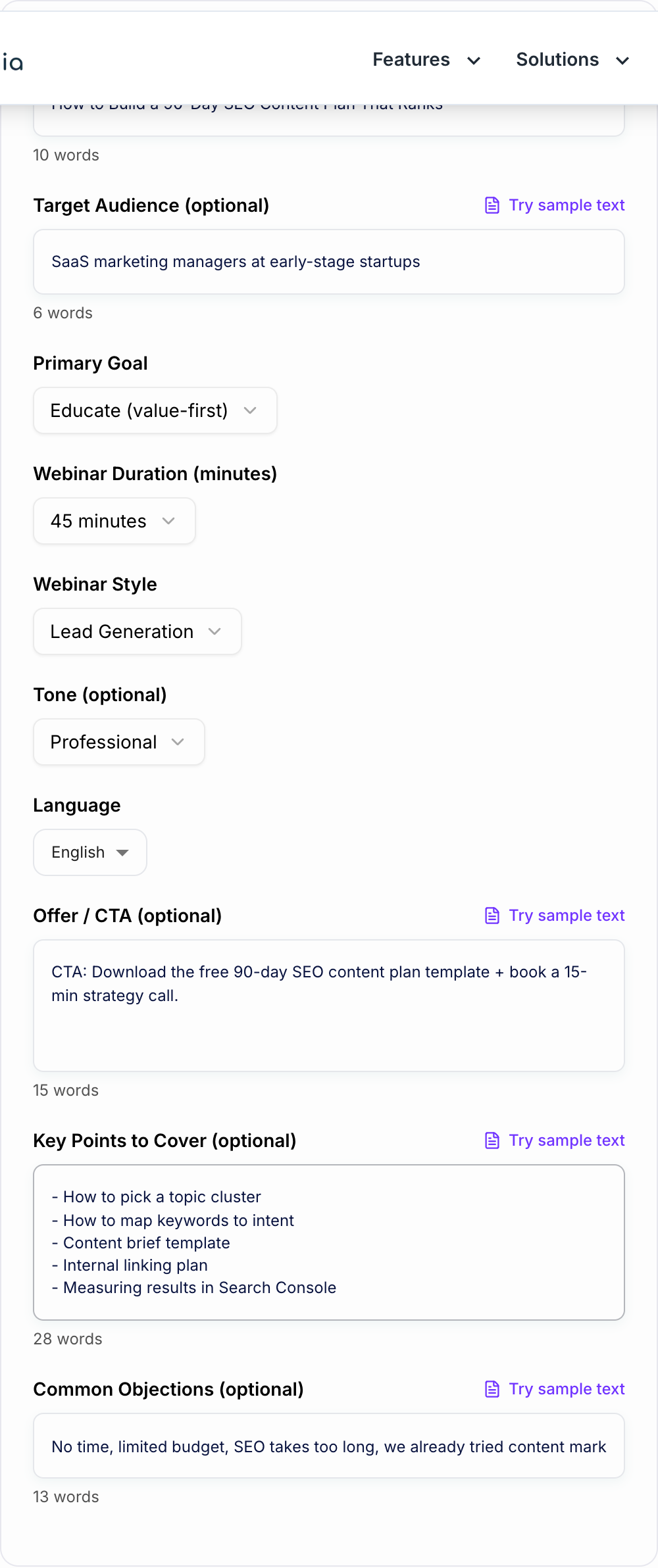
Setting the topic, the offer, and the running time keeps the script teachable instead of a pure pitch.
-
Cold open hook (1 to 3 min)
Outcome promise, who it is for, quick credibility, set expectations. -
Agenda + rules (2 min)
What you will cover, when Q&A happens, what to do in chat. -
Big idea / framework (5 min)
The mental model that organizes everything else. -
Teaching segment 1 (10 to 15 min)
Example, mini story, quick interaction prompt. -
Teaching segment 2 (10 to 15 min)
Common mistakes, checklist, “type yes if…” moment. -
Teaching segment 3 (10 to 15 min)
Case study or walkthrough, recap bullets, transition. -
Offer / CTA (5 to 12 min)
Who it is for, what is included, benefits, proof you can defend, risk reversal, next steps. -
Objection handling (3 to 6 min)
Short, confident answers. No arguing. -
Q&A prompts + close (5 to 10 min)
Seed questions, final CTA, what happens after the webinar.
Repurpose your webinar into SEO content (so it keeps working after you present)
A webinar script is basically a content asset in disguise. After you generate your script, you can turn it into:
- A blog post outline (each teaching segment becomes an H2)
- A landing page section flow (hook, benefits, agenda, proof, CTA)
- Email follow ups (recap, replay, objection handling, CTA)
- YouTube description and pinned comment CTA
- Short clips with captions from the teaching segments
If you want the webinar to drive organic traffic long term, keep the topic aligned to one search intent. Then reuse the same phrasing across the title, the opening hook, and your repurposed blog post headings. It sounds small, but it helps.
Frequently Asked Questions
What is a webinar script generator?+
A webinar script generator creates a structured, ready-to-present webinar script, including the opening hook, agenda, main teaching segments, transitions, engagement prompts, CTA/offer, and closing. It helps you present clearly and improve retention and conversions.
Will the script include timing and section breakdowns?+
Yes. The generator can structure the webinar into timed segments based on your selected duration (e.g., 30, 45, 60, or 90 minutes) so pacing stays realistic for live delivery.
Can I use this for lead generation webinars and sales webinars?+
Yes. Choose a mode like Lead Generation, Sales Webinar, Product Demo, or Training. Each mode adjusts the structure and CTA style so the script fits your goal—capturing leads, booking demos, or selling.
Can I customize the tone and language?+
Yes. You can select language and optionally specify tone (professional, friendly, persuasive, educational, etc.) to match your brand voice and audience expectations.
Does it add facts or make up case studies?+
No. The script is designed to avoid inventing facts. If you want proof points (numbers, case studies, testimonials), include them in your input so they can be used accurately.
How do I repurpose the script for content marketing and SEO?+
A well-structured webinar script can be turned into a blog post outline, landing page copy, email follow-ups, social snippets, and video descriptions. After the webinar, you can refine the transcript and publish a long-form article targeting the same keywords and search intent.