
Best AI SEO Agent Use Cases for Content Teams

Thu
AI SEO Specialist, Full Stack Developer

The best AI SEO agent use cases are not vague promises like "automate SEO."
They are specific workflows where AI can reduce manual work without removing strategy: keyword research, content briefs, internal links, refreshes, competitor analysis, and publishing QA.
For content teams, the real value is consistency. An AI SEO Agent can help the team follow the same SEO process across many pages instead of reinventing the workflow every time.
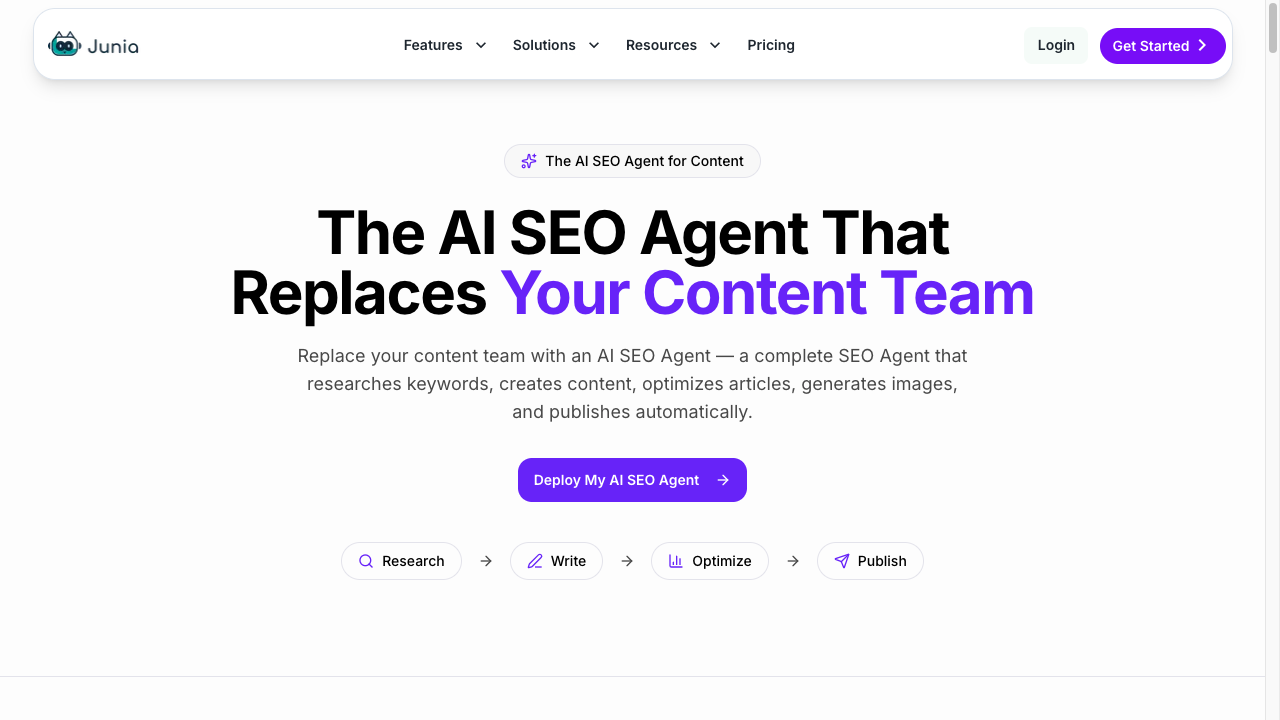
That screenshot is the job. Research to publish. If you only use AI to draft, you are still doing the SEO thinking by hand, and the agent is just an expensive writer.
Use an agent for the repeatable pass. Keep a human for the decision. I have seen teams automate clustering, briefs, and internal links and get faster. I have also seen them automate the angle, the claim, and the CTA and ship 20 pages that all sound like the same product.
| Use the agent for | Still do this yourself |
|---|---|
| Grouping keywords and spotting cannibalization | Deciding which page deserves to exist |
| First-pass briefs from SERP patterns | The page angle, examples, and what not to cover |
| Refresh checklists on old URLs | Which issues are worth a rewrite this quarter |
| Internal link candidates in both directions | Which links actually help the reader |
| Competitor section patterns | The sharper point your page will make |
| Template QA on programmatic or agency work | Positioning, pricing claims, and publish/no-publish |
- Is the work repeatable across pages?
- Do it manually or with a single tool
- Is the quality bar clear?
- Write the standard first
- Let the agent run the first pass
- Human reviews angle, claims, and CTA
- Publish or send back
- No
- Yes
View diagram source
flowchart TD
    A[Is the work repeatable across pages?] -->|No| B[Do it manually or with a single tool]
    A -->|Yes| C[Is the quality bar clear?]
    C -->|No| D[Write the standard first]
    C -->|Yes| E[Let the agent run the first pass]
    E --> F[Human reviews angle, claims, and CTA]
    F --> G[Publish or send back]
This matters most when the team already knows what good looks like. If the brief is vague, the agent will scale the vagueness.
1. Building Topic Clusters
Topic clusters are one of the clearest use cases for AI SEO agents. Not because clustering is clever. Because the failure mode is boring and expensive: five pages competing for the same intent.
A cluster has a pillar page, supporting articles, and internal links that connect the topic. The hard part is not understanding the concept. The hard part is mapping the cluster without overlap. HubSpot's original pillar-and-cluster walkthrough is still the cleanest explanation of the page roles. Use it for the model, then let the agent do the mapping.
How to Create an Effective Topic Cluster and Pillar Page
An agent can help:
- group keywords by intent
- identify missing supporting pages
- spot pages that are competing with each other
- suggest which pages should link together
- create briefs for each missing page
- flag orphan pages after publishing
This is especially useful for teams building topical authority around a product category, such as AI SEO, programmatic SEO, or content automation. If two pages would rank for the same query, merge them. Do not let the agent invent a third.
2. Creating Content Briefs at Scale
If every writer gets a different quality of brief, the content library becomes inconsistent fast. That is the actual problem. Speed is secondary.
An AI SEO agent can standardize the brief process. It can pull in keyword intent, competitor patterns, product notes, internal link targets, FAQs, and structure recommendations.
The goal is not to create longer briefs. It is to create clearer briefs. I would rather send a writer 400 words that name the angle than 1,200 words of SERP recap.
A good brief tells the writer:
- what the page should accomplish
- what the searcher already knows
- what sections are required
- what examples would make the page stronger
- what internal links should be included
- what not to cover because another page owns that intent
That makes the drafting and editing process much smoother. Skip this step and you will spend the saved time on rewrites. Drafting without a brief is the usual failure point, and it shows up later as cannibalization, not as a bad sentence.
3. Refreshing Existing Content
Most teams do not need to publish endlessly. They need to improve what already exists. A new URL is a political win. A refresh is usually the better SEO move.
An AI SEO agent can review older pages and suggest updates based on:
- outdated examples
- missing subtopics
- weak introductions
- poor internal links
- title and meta mismatch
- thin FAQs
- pages that rank but do not convert
This is useful because content refresh work is repetitive, but still needs judgment. The agent can surface likely issues. The editor decides what is worth changing. If a page ranks and converts, leave the intro alone. Fix the missing comparison, not the adjectives.
For teams with large libraries, that can save a lot of time.
4. Internal Linking After Publishing
Internal links are easy to forget because they are not as visible as a new article. They are also the cheapest win after publish. I would rather fix five orphan pages than write a sixth supporting post.
But they matter. They help readers move through a topic, and they help search engines understand which pages are related.
An AI SEO agent can check a new page against your existing library and recommend internal links in both directions:
- links from the new page to relevant tools, guides, and product pages
- links from older pages back to the new page
That second part is where many teams fall behind. They publish a new page, link out from it, and never update the older pages that should support it. An agent is useful here because the library is large and the job is mechanical. The human still has to reject links that exist only to pass PageRank.
5. Competitor Gap Analysis
AI is useful for competitor analysis because it can summarize patterns quickly.
An agent can compare competing pages and identify:
- sections most competitors cover
- questions they answer well
- gaps they ignore
- examples they do not include
- search intents they blend together
- opportunities for a sharper angle
The human job is to choose the angle. The agent can show you the pattern, but you still need to decide what would make your page genuinely more useful. Copying the competitor outline is how you get a page that ranks for a week and never gets cited.
6. SEO Agency Automation
Agencies often repeat the same SEO workflow across many clients: audits, briefs, content updates, internal links, and reporting.
That makes SEO agency automation a strong fit for AI SEO agents.
An agent can help standardize the first pass while leaving room for account-specific judgment. For example, it can prepare a content refresh plan for each client, but the strategist still decides which changes match the client's goals and market.
The best agency use case is not replacing specialists. It is removing repetitive preparation work so specialists can spend more time on decisions. If the first-pass looks the same for every client, that is a feature. If the published page looks the same, that is a problem.
7. SaaS SEO Workflows
For SaaS SEO, AI SEO agents can help connect product positioning with content execution.
That matters because SaaS content often fails when it is too generic. A page might rank, but if it does not connect the search problem to the product, it will not help pipeline.
An agent can help SaaS teams:
- map product use cases to keywords
- build comparison and alternative pages
- create feature-led articles
- refresh old educational posts with stronger product context
- link informational content to solution pages
- identify pages that get traffic but no conversions
The review step is important here. Product positioning should stay human-led. I would rather have a slightly slower comparison page that names a real tradeoff than a feature dump the agent copied from the homepage.
8. Ecommerce SEO Automation
For ecommerce teams, AI SEO agents can support category, product, and buying-guide workflows.
That can include:
- improving category page copy
- identifying missing buying guides
- clustering product-related keywords
- creating FAQ sections for category pages
- suggesting internal links between guides and product categories
- refreshing seasonal pages before demand spikes
The key is using real product data, customer questions, and merchandising priorities as inputs. Without those, ecommerce SEO automation just multiplies thin category copy.
9. Programmatic SEO QA
Programmatic SEO can work well when pages are built from useful, distinct data.
It can also go wrong quickly when hundreds of pages are thin, duplicated, or barely different.
An AI SEO agent can support a programmatic SEO tool by checking templates, identifying duplicate sections, recommending internal links, and flagging pages that need more unique value before publishing.
This is one of the best places to use AI as a reviewer, not just a generator. If the template is weak, an agent will publish the weakness at scale. That is not a content problem. It is a data problem.
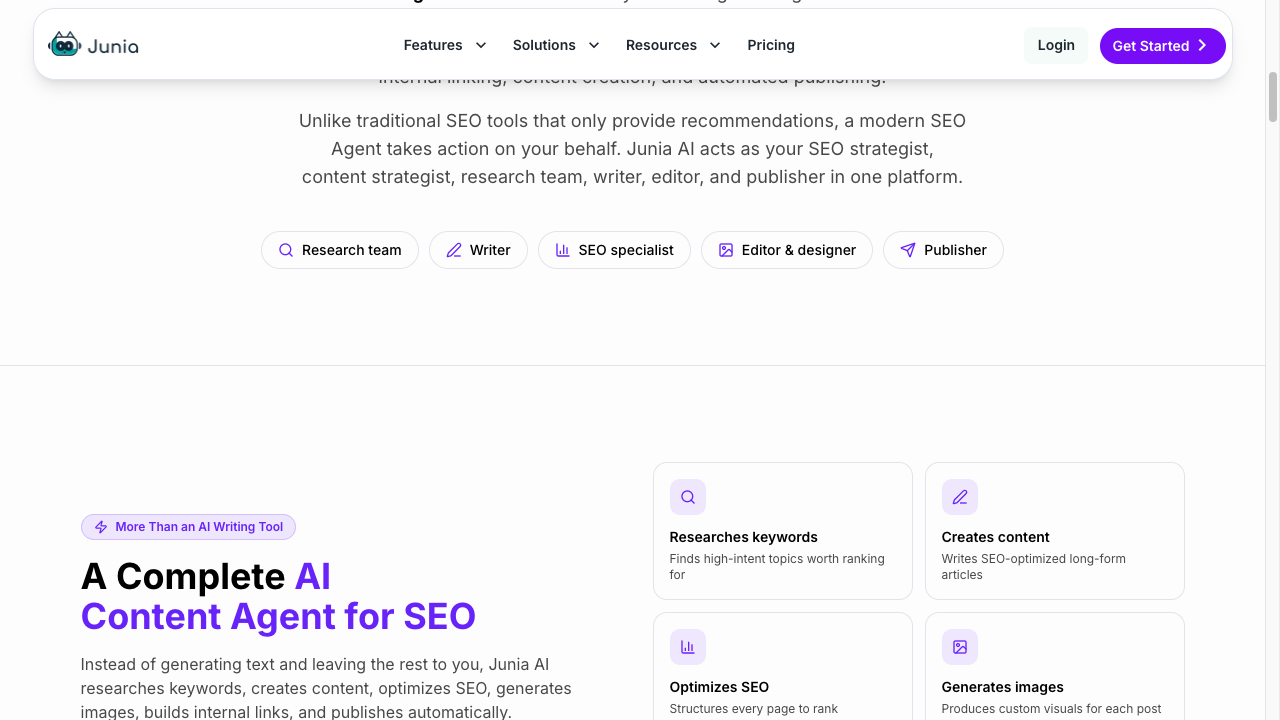
The product framing is aggressive. Treat it as a content system, not a replacement for the people who know when a page should not exist.
Final Takeaway
AI SEO agents are most useful when the workflow is repeatable and the quality bar is clear.
If you still need the definition, start with what an AI SEO agent is.
If you only need a single job done, a focused option from the AI SEO tools list is enough.
Use agents to standardize research, briefs, refreshes, internal links, competitor analysis, and publishing QA. Keep humans in charge of strategy, claims, examples, and final approval.
That balance is where content teams get the real benefit: faster execution without turning the site into generic SEO output.