
How to Create an SEO Content Brief That Human Writers Can Actually Use

Thu
AI SEO Specialist, Full Stack Developer

An SEO content brief is supposed to make writing easier.
But a lot of briefs do the opposite. They give writers a keyword, a word count, a list of headings copied from competitors, and maybe a few related terms. Then everyone acts surprised when the finished article feels generic.
A useful SEO brief gives the writer enough direction to match search intent, cover the topic properly, and still write something a human would want to read.
Here is how to create one without turning it into a bloated document nobody wants to use.
Start with the real search intent
Before you add keywords or headings, figure out what the reader actually wants.
Search intent is not just “informational” or “commercial.” That label helps, but it is too broad on its own. You need to know what job the page is expected to do.
For example, someone searching seo content brief template probably wants a structure they can copy. Someone searching how to create an SEO content brief wants the process behind the structure. Someone searching for an SEO content brief generator may want to skip the manual work and generate the brief directly.
So your brief should answer questions like:
- What is the reader trying to finish?
- What do they already understand?
- What would make them trust this article?
- What would feel like unnecessary background?
If you skip this step, the article may still include the keyword, but it will miss the reason people searched in the first place.
Analyze the SERP, but do not blindly copy it
The search results can tell you what Google already understands about the query.
Look at the top-ranking pages and note:
- the dominant content format
- common subtopics
- examples or templates readers expect
- questions answered in People Also Ask
- gaps where the current results feel thin
This is where many briefs go wrong. They treat SERP analysis like a copying exercise. If every competing article has the same five headings, that does not automatically mean your article should use the same five headings in the same order.
Use the SERP to understand the baseline. Then ask what would make your page more useful.
That might mean adding a clearer workflow, better examples, stronger on-page SEO guidance, or a section that connects the article to a larger content clustering for SEO plan.
Choose one primary keyword and a few supporting terms
Your brief should make keyword targeting clear, not overwhelming.
Start with one primary keyword. This is the phrase the page is mainly built around. Then add a small set of secondary keywords that support the same intent.
For this kind of article, that might look like:
- Primary keyword:
how to create an seo content brief - Secondary keywords:
seo content brief,seo brief,content brief for writers - Related concepts: search intent, SERP analysis, headings, internal links, writer instructions
If you need help finding keyword variations, an AI keyword research tool can speed up the research stage. Just do not paste every keyword it gives you into the brief. A writer needs priorities, not a dump of terms.
Define the angle before the outline
The angle is the promise of the article.
Without it, the writer may produce a technically correct post that sounds like every other result. With it, the article has a point of view.
For example, the angle for this topic is not just “what is an SEO content brief.” It is “how to create a brief that helps human writers produce better content without boxing them into robotic SEO instructions.”
That angle affects the whole article:
- the introduction focuses on practical frustration
- the outline explains the workflow, not just the definition
- the examples show what to include and what to leave out
- the tone respects the writer instead of treating them like a keyword machine
Add the angle near the top of the brief so the writer knows how to frame the piece.
Build a simple outline with clear jobs for each section
A good outline is more than a list of H2s.
| Brief field | Writer needs it because… |
|---|---|
| Search intent | Stops a how-to from becoming a definition |
| Angle | Prevents cloning the top 10 |
| Section jobs | Stops repeated advice under new H2s |
| Links + constraints | Keeps drafts usable on first pass |
A brief is an assignment, not a keyword list. If a junior writer couldn’t draft from it, neither can AI.
SEO Copywriting Tutorial: From Start to Finish
Each section should have a purpose. Tell the writer what the section needs to accomplish, especially if the topic is easy to make vague.
Instead of this:
## Search Intent
## Keywords
## Outline
## Internal Links
Use this:
## Identify the search intent before writing
Explain how to read the SERP, compare ranking pages, and decide what the reader is trying to accomplish.

## Choose keywords without overloading the writer
Show how to pick one primary keyword and a few supporting terms, then explain where they should appear naturally.
That small difference makes the brief much easier to use.
Add writer instructions that improve the final draft
This is the part most SEO briefs underuse.
Writer instructions should explain how the article should feel, what to avoid, and where the writer has room to make judgment calls.
Useful instructions might include:
- Keep paragraphs short and scannable.
- Explain the process before adding edge cases.
- Use examples where a concept could feel abstract.
- Avoid stuffing exact-match keywords into every heading.
- Link to supporting resources only where they genuinely help the reader.
This is also where you can include brand-specific guidance. If the page needs to follow specific SEO best practices, make those expectations clear before drafting starts.
Include internal links as part of the brief
Internal links are easier to place naturally when they are planned before writing.
Add a short internal link section with:
- the destination URL
- suggested anchor text
- why the link belongs in the article
- where it might fit naturally
For example, a brief about creating SEO briefs could link to a keyword research tool in the section about choosing target keywords, not randomly in the conclusion.
If the article will be written with AI, this step matters even more. A separate guide on content briefs for AI writers can help you adapt the brief so the AI has clearer context, constraints, and output expectations.
Give the writer a quality checklist
End the brief with a short checklist the writer can use before submitting the draft.
Keep it practical:
- Does the introduction match the search intent?
- Does each major section answer a real reader question?
- Are examples included where the topic gets abstract?
- Are internal links placed naturally?
- Is the primary keyword used in obvious places without sounding forced?
- Does the article add anything better than the current SERP?
This checklist helps the writer self-edit before the article reaches an editor.
What a usable SEO content brief includes
Here is the simple version:
| Brief section | What it should include |
|---|---|
| Topic and title | Working title, target page type, and article angle |
| Search intent | What the reader wants and what the page must satisfy |
| Keywords | One primary keyword plus a small set of supporting terms |
| SERP notes | Common patterns, expected subtopics, and visible gaps |
| Outline | H2/H3 structure with notes for each section |
| Internal links | Relevant links, anchors, and placement notes |
| Writer guidance | Tone, examples, formatting, and things to avoid |
| Quality checklist | Final checks before editing or publishing |
Final thoughts
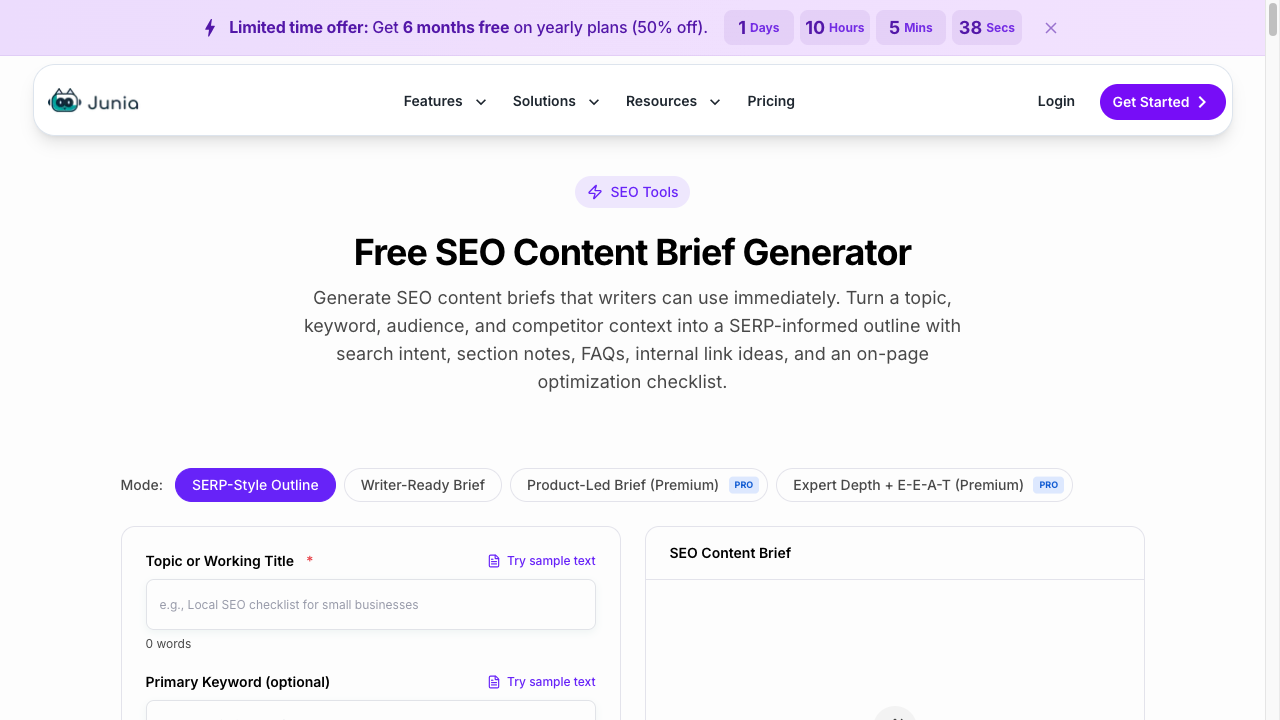
The best SEO content briefs are specific enough to guide the writer and flexible enough to let them write well.
That is the balance to aim for.
Do the research, define the intent, choose the right keywords, map the structure, and explain what good looks like. If you want to move faster, use a brief generator for the first draft of the plan, then edit it with human judgment before handing it to a writer.