
How to Write Content Briefs for AI Writers

Thu
AI SEO Specialist, Full Stack Developer

AI writers can move fast, but they are only as useful as the brief you give them.
If the brief is vague, the output usually sounds vague. If the brief only says “write an SEO article about this keyword,” you will probably get a generic post with predictable headings and thin examples.
A good AI writing brief gives the tool context, structure, constraints, and quality standards. It tells the AI what to write, what to avoid, and how the finished article should feel.
Here is how to write one that actually helps.
Start with the article’s job
Before you give the AI a keyword, explain what the article needs to accomplish.
For example:
- Is it teaching a beginner?
- Is it comparing options?
- Is it helping someone complete a workflow?
- Is it supporting a product page?
- Is it part of a larger SEO cluster?
This matters because AI tools often default to broad explanations. If you define the job clearly, the draft has a better chance of staying focused.
Editor’s note: The brief is not a prompt dump. It is the editorial assignment. If a junior writer could not produce a useful draft from it, neither will the model.
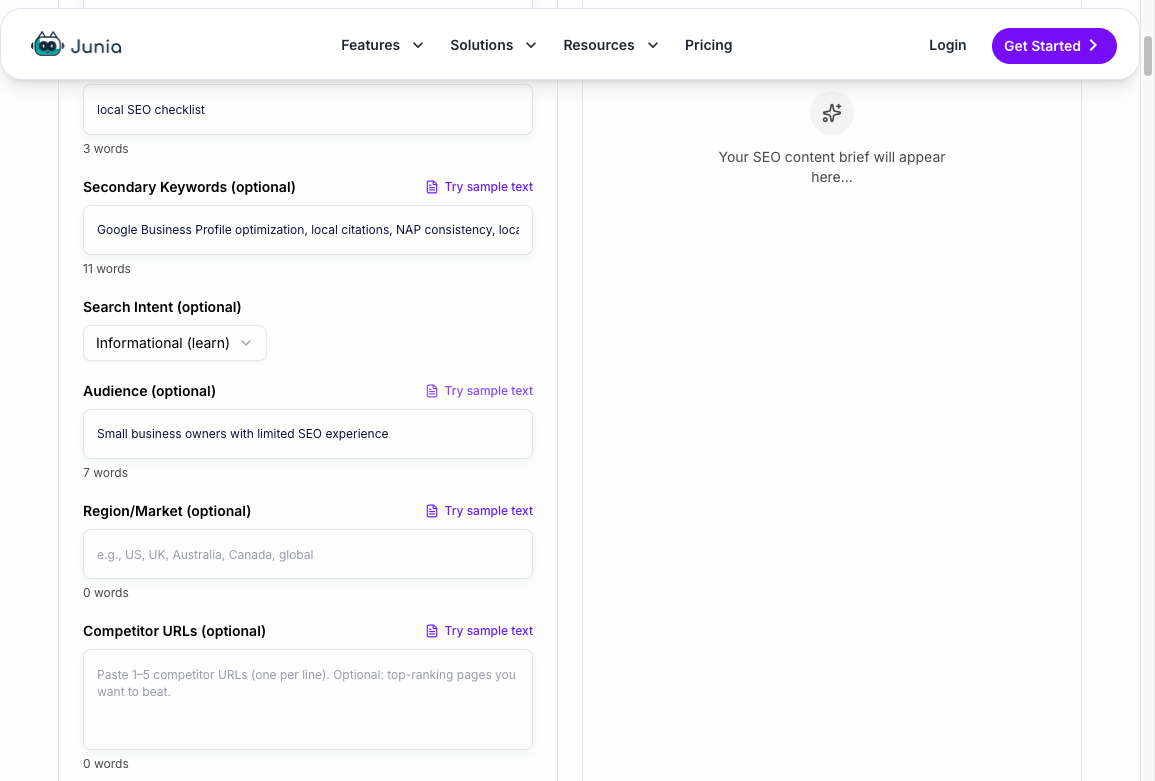
If you are building the brief from scratch, an AI SEO content brief generator can help you turn the topic, keywords, and search intent into a usable starting point.
Give the AI search intent, not just keywords
Keywords matter, but they are not enough.
Tell the AI what the searcher is trying to do. A keyword like content brief template could mean the reader wants a downloadable template, a list of fields, or an explanation of how to brief a writer.
A better instruction looks like this:
Primary keyword: content brief for AI writers
Search intent: The reader wants to know how to brief AI writing tools so the output is more specific, structured, and useful.
Reader level: Beginner to intermediate marketer or content editor.
Goal: Give them a repeatable briefing process and examples they can copy.
That gives the AI much more direction than a keyword list.
| Intent signal | What to write in the brief | What the AI usually does without it |
|---|---|---|
| Job to be done | “Help an editor brief AI writers for publishable drafts” | Writes a generic “what is a content brief” explainer |
| Reader level | “Content editors who already use AI drafts” | Over-explains basics and under-delivers on process |
| Success look | “Includes a copyable brief and an editing checklist” | Ends with vague “best practices” |
Weak brief vs usable brief
I have tested this the hard way: the same model, same topic, two briefs. The weak one produces fluent filler. The usable one produces something you can edit.
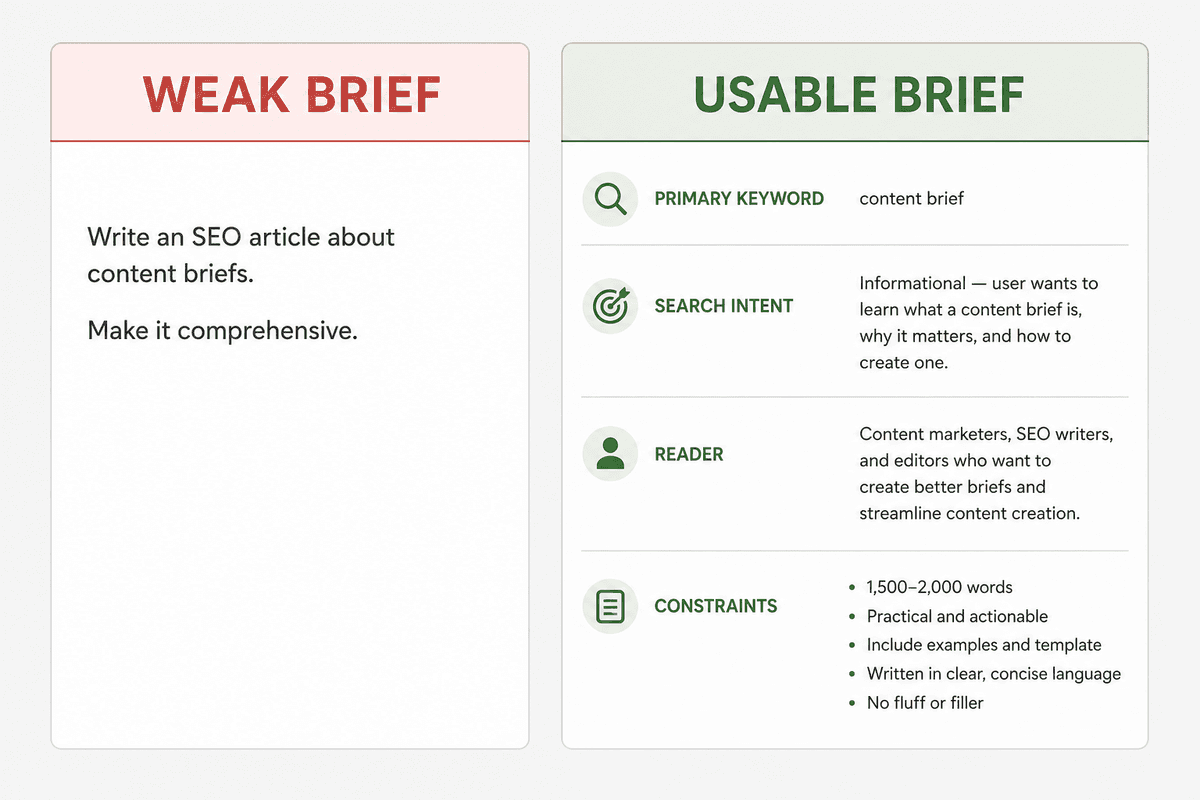
The difference is rarely “better prose settings.” It is whether you removed the guesses the model would otherwise invent.
Add context the AI would otherwise guess
AI tools fill gaps. Sometimes that helps. Sometimes it creates bland or inaccurate content.
Your brief should remove the most important gaps:
- Who is the reader?
- What do they already know?
- What should the tone be?
- What should the article avoid?
- What examples should appear?
- What product or internal resource should be mentioned?
- What claims need careful wording?
If brand voice matters, include that too. You can also connect the brief to a brand voice guide so the output does not sound disconnected from the rest of your site.
Use a structured outline with section notes
Do not just ask the AI to “write a complete article.”
Give it a structure.
## Why AI writers need better briefs
Explain the problem with vague prompts and generic AI output.

## What to include in an AI writing brief
Cover topic, intent, reader, outline, examples, links, tone, and constraints.

## AI writing brief example
Show a copyable example for a blog article.

## Editing checklist
Explain what a human editor should check after generation.
Section notes are important because they tell the AI what each part should do. Without them, the model may repeat the same idea under different headings.
If you want a walkthrough of building a brief from scratch before you adapt it for AI, this Rank Math tutorial is a solid section-level reference:
How to Create a Content Brief from Scratch (Step-by-Step)
Include examples of the output you want
AI responds well to examples.
If you want short paragraphs, show a short paragraph. If you want practical explanations, include one. If you want the article to avoid hype, say that directly.
For example:
Style guidance:
- Use short paragraphs.
- Explain concepts in plain language.
- Avoid phrases like “in today’s digital landscape.”
- Use examples where the advice could feel abstract.
- Sound like an experienced editor, not a sales page.
This is also where you can ask the AI to avoid common weak spots, like fake statistics, unsupported claims, or overconfident statements.
Plan internal links before generation
Internal links should be part of the brief, not an afterthought.
Give the AI the exact destination, preferred anchor, and placement idea.
Example:
Internal links:
- AI article writer page
  Anchor: AI article writer
  Placement: Mention when explaining how the brief turns into a first draft.

- How to create an SEO content brief guide
  Anchor: how to create an SEO content brief
  Placement: Mention when explaining the broader SEO briefing process.
This helps the AI place links where they fit naturally. For example, after building the brief, the next step may be drafting with an AI article writer.
If the article needs keyword research, leave a placeholder until the research is complete instead of letting the model invent targets.
Add constraints so the draft does not drift
Constraints are not about making the AI less creative. They are about keeping the article useful.
Good constraints include:
- Do not invent statistics.
- Do not mention competitors unless provided.
- Do not add external links unless included in the brief.
- Do not repeat the same advice in multiple sections.
- Keep the introduction under 120 words.
- Use the exact H2 structure unless a section clearly needs a subheading.
The more important the article is, the more useful these constraints become.
Use a human editing checklist
Even with a strong brief, AI output still needs review.
| Check | Pass if… | Fail if… |
|---|---|---|
| Search intent | The first two sections answer the reader’s job | The draft stays definitional and never gets practical |
| Specificity | Examples name inputs, fields, or outcomes | Advice stays abstract (“be clear,” “add value”) |
| Accuracy | Claims match the brief or a real source | Stats, tools, or quotes appear from nowhere |
| Structure | Headings do distinct jobs | Two sections restate the same point |
| Links | Destinations feel like a natural next step | Links are stacked or forced into the intro/close |
| Voice | It sounds publishable for your brand | It reads like a template with synonyms swapped |
Common mistake: Treating a detector score or “humanizer” pass as the edit. Those can clean cadence. They cannot add judgment, examples, or intent coverage.
For a broader SEO briefing workflow, read how to create an SEO content brief. The same fundamentals apply, but AI briefs need tighter instructions because the tool cannot infer your editorial judgment.
Copyable AI writing brief
Use this as a starting point:
Topic:
Primary keyword:
Secondary keywords:
Search intent:
Target reader:
Reader problem:
Article goal:
Tone:

Required outline:
## Section 1
Notes:

## Section 2
Notes:

## Section 3
Notes:

Internal links:
- URL:
  Anchor:
  Placement:
  Reason:

Style rules:
- Use short paragraphs.
- Avoid unsupported claims.
- Give concrete examples.
- Do not use filler introductions.

Final output:
- Write in markdown.
- Keep the structure clean.
- Include a short conclusion with a useful next step.
Choose this briefing approach if…
| Situation | Briefing approach | Why |
|---|---|---|
| One high-stakes page | Fully manual brief with examples and constraints | You need judgment the model cannot invent |
| Repeatable blog cadence | Brief generator + human edits on intent and links | Speed without blank-page work |
| Thin drafts keep coming back | Add constraints and a pass/fail editing checklist | The problem is usually missing boundaries, not “better prompts” |
Final thoughts
AI writers are not magic. They are systems that respond to context.
A strong brief gives that context clearly: intent, reader, angle, structure, examples, links, tone, and constraints. Once you do that, AI becomes much more useful as a drafting partner and much less likely to produce generic content you have to rewrite from scratch.