
Link Building With AI: Outreach Emails and Guest Post Pitches That Earn Backlinks

Thu
AI SEO Specialist, Full Stack Developer

AI can make link building faster. It cannot make weak outreach good.
That distinction matters. If you ask an AI tool to "write a backlink email," you usually get a polite template that sounds like every other pitch in an editor's inbox. The real advantage comes earlier in the process: finding pages where your resource actually belongs, turning page research into a specific reason to reach out, and writing a message that proves you did not just scrape a list.
I would absolutely use AI for link building, but only as a research and drafting assistant. The link still has to be earned by relevance, editorial fit, and a useful asset. When those pieces are missing, faster outreach just means you annoy more people in less time.
TL;DR: The Best Way to Use AI for Link Building
Use AI to personalize at scale, not to mass-send generic outreach at scale. That is the line I would not cross.
| Step | What AI should do | What you must still decide |
|---|---|---|
| Pick the asset | Summarize the page, extract linkable claims, find missing proof | Whether the page is actually worth linking to |
| Find prospects | Expand topics, cluster pages, summarize competitor backlink patterns | Whether each site is relevant, active, and editorially real |
| Qualify pages | Identify the likely section where your link could fit | Whether the link would help that page's reader |
| Draft outreach | Create short emails from real page notes | Whether the first two lines sound specific and true |
| Pitch guest posts | Compare ideas against the site's existing content | Whether the idea is new enough for that audience |
| Follow up | Write useful reminders, snippets, or second angles | Whether the follow-up adds value or just nags |
| Measure results | Classify replies and summarize campaign performance | Whether earned links are relevant, editorial, and safe |
The simple workflow is:
- Build or improve one linkable asset.
- Find pages that already cite similar or adjacent resources.
- Use AI to summarize each target page and identify the exact fit.
- Draft a short email from those notes.
- Send fewer, better pitches.
- Track links earned, not just emails sent.
That is the version of AI link building that can help SEO. The risky version is using AI to generate thousands of thin pitches, fake personalization, paid-link requests, or automated guest post spam. I have very little patience for that version because it burns the channel for everyone else.
Start With a Page That Deserves Links
Before writing a single outreach email, ask the question an editor will ask silently:
| AI is great for… | Keep human for… |
|---|---|
| Prospect lists and research notes | Deciding if the page deserves a link |
| First-draft outreach variants | Personalization that proves you read their page |
| Subject line options | Sending / relationship judgment |
AI can draft outreach. It cannot invent a reason you deserve the link.
Does Google see automatically generated content as a bad thing?
Why should I link to this?
AI cannot fix a weak reason. Editors, bloggers, and content managers link when your page makes their page more useful. That usually means your resource gives their readers something specific they do not already have. In my experience, this is where most link-building campaigns are won or lost before the first email is drafted.
The strongest linkable assets are usually:
- Original data, surveys, benchmarks, or trend analysis.
- Free tools, templates, calculators, or checklists.
- A clear comparison that saves the reader research time.
- A diagram, workflow, or visual explanation that simplifies a messy process.
- A practical guide with examples, not just more words.
- A case study that shows what changed, what worked, and what failed.
For example, if you are promoting a page about email outreach, your pitch is stronger when the page includes fresh benchmarks, tested templates, or a workflow a writer can use immediately. If you are promoting a free SEO template, your pitch is stronger when the target page already lists useful resources for the same audience.
This is where AI writing tools can help before outreach starts. Use them to turn the asset into a sharper summary, a tighter pitch angle, and a short list of claims that need evidence. But do not confuse a cleaner description with a better asset. I would rather improve one weak section on the page than generate 50 more pitches for a page that still does not deserve the link.
If the page is thin, improve it first. A good SEO content brief can expose missing sections, weak examples, and unanswered questions before you ask anyone else to cite the page.
Find Prospects by Relevance, Not Just Volume
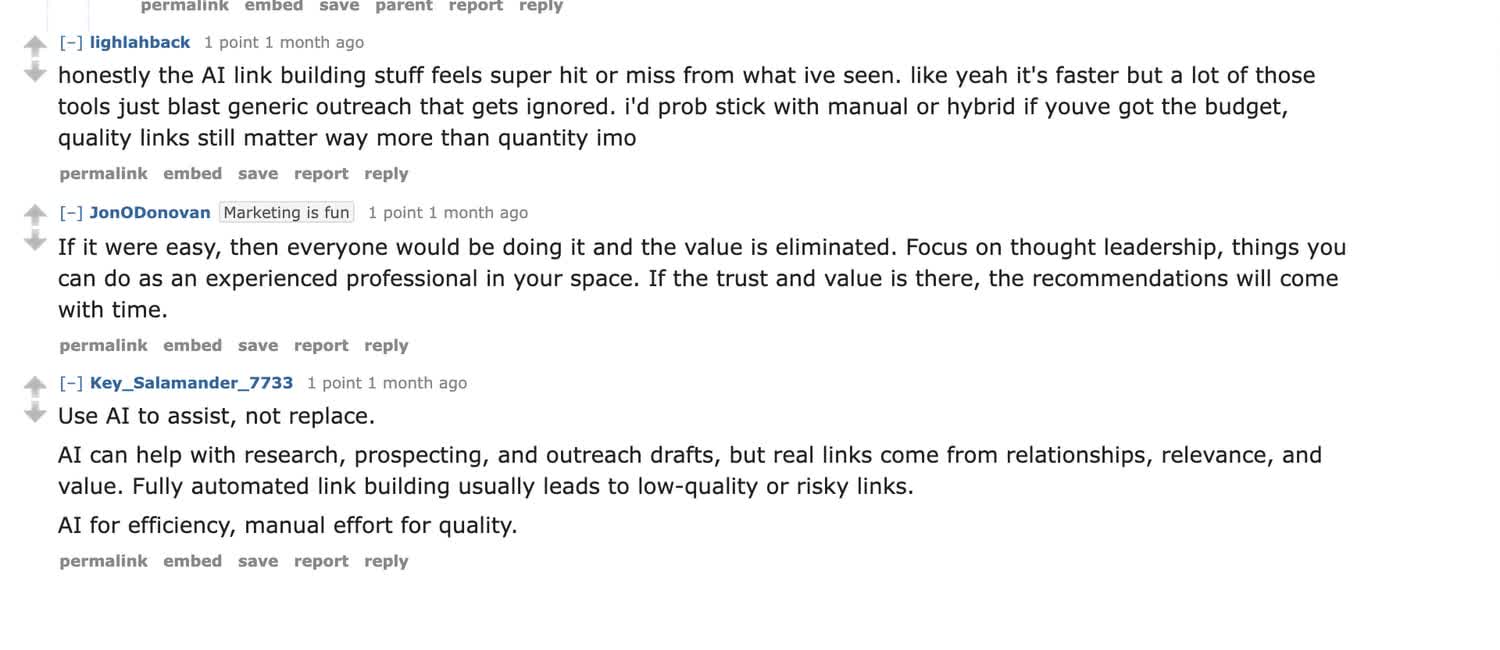
A huge prospect list feels productive. In practice, it often makes outreach worse.
A good prospect is not simply "a site in your niche." A good prospect is a specific page where your resource, quote, tool, statistic, or guest post idea would make sense to the reader.
Use AI to expand the search, then filter with human judgment. The filtering is not a formality; it is the work.
1. Start With Competitor Backlinks
Pages that already link to a competing guide, tool, statistic, or template have shown that they cite outside resources. That makes them useful starting points, not automatic opportunities.
But do not pitch the same angle the existing source already covers. If your page is just a near-duplicate, the editor has no reason to update the article.
Use AI to compare the two resources:
Compare this target page summary with our page summary.

Tell me:
1. What does their current source cover?
2. What does our page add that is genuinely different?
3. What sentence could an editor add naturally if they included our page?
4. Is the link opportunity strong, weak, or not worth pursuing?
Then verify the opportunity with a proper backlink analysis tool. AI can summarize patterns, but it should not be your only quality filter. Check referring domains, anchor text, topical fit, organic traffic, and whether the page looks like something a real reader would trust. I also look for simple editorial signals: named authors, recent updates, real outbound links, and pages that are clearly written for readers rather than link sellers.
2. Look One Topic Away
Exact-match prospecting runs out quickly. The better opportunities are often one step away from your topic, where the audience still has the problem but fewer people are sending the same pitch.
If your page explains how to create an online store, do not only target articles about building online stores. You can also target pages about side hustles, dropshipping, selling on Etsy, small business websites, product photography, or ecommerce SEO if your resource gives the reader a natural next step.
I like this prompt for adjacent prospecting:
My page is about [topic].

Give me 20 adjacent topics where this page could add value as a supporting resource.
For each topic, explain:
- why the audience would care
- what type of article might link to it
- what pitch angle would make the link feel useful
The goal is to avoid the lazy pitch: "I noticed you wrote about X." A stronger pitch explains why your resource improves a specific page for a specific reader.
3. Separate Resource Outreach From Guest Post Outreach
Resource link outreach and guest post outreach are different campaigns. I would not mix them in the same sequence.
For a resource link, you are asking someone to update an existing page. The offer must be easy: a newer statistic, a better tool, a clearer checklist, a missing explanation, or a useful template.
For a guest post, you are asking for editorial space. The offer has to be bigger: a specific topic, a credible author, a clear outline, and a reason the publication has not already covered the idea.
If guest posting is part of the plan, a dedicated guest posting tool stack can help with prospecting, contact discovery, campaign tracking, and follow-up. AI helps most when it can compare your pitch against the publication's existing posts and remove ideas that are too similar. That last part matters more than people think; editors are rarely short on broad ideas, but they are short on angles that feel fresh for their audience.
Qualify Every Prospect Before Sending Anything
This is the step that keeps AI-assisted link building from turning into spam. It is also the step I would spend the most time on.
Before a contact enters your outreach sequence, check the page manually or with AI-assisted review:
| Qualification question | Why it matters |
|---|---|
| Is the page topically relevant? | A link from an unrelated article is harder to justify and weaker for readers. |
| Does the page already cite external sources? | Some pages rarely link out, especially sales pages and category pages. |
| Was the page updated recently? | Maintained pages are more likely to be edited. |
| Is the site real and active? | Avoid thin guest post farms, scraped sites, and obvious link sellers. |
| Does your page add something new? | "Similar but better" is rarely enough. |
| Can you identify the right person? | Author or editor outreach usually beats generic inboxes. |
| Would the link fit in one sentence? | If you cannot write the placement sentence, the pitch is not ready. |
Personally, I would rather send 40 strong emails than 400 loose ones. A smaller list makes it easier to personalize properly, protect your sender reputation, and learn from the replies.
Turn Page Research Into Outreach Notes
The best outreach emails are short, specific, and easy to answer.
They do not over-explain your company. They do not flatter the recipient with vague praise. And they do not ask for a backlink before giving a reason. My test is simple: if the first two lines could be sent to 200 different sites, the email is not personalized yet.
The input matters more than the tool. Give AI the notes you gathered from the page, not just the domain name. Bad inputs produce smooth, useless emails.
Use a prompt like this:
Write a link-building outreach email using the notes below.

Rules:
- Keep it under 120 words.
- Sound like one person emailing another person.
- Do not use hype, fake compliments, or "I hope this email finds you well."
- Mention the specific article naturally.
- Lead with the reason this helps their reader.
- Do not ask for a backlink directly in the first sentence.
- Give me 3 subject line options.

Recipient article: [title + URL]
What their article covers: [short notes]
What is missing or outdated: [specific gap]
Our resource: [URL + one-sentence value]
Why it helps their reader: [specific reason]
Possible placement: [section or sentence where it fits]
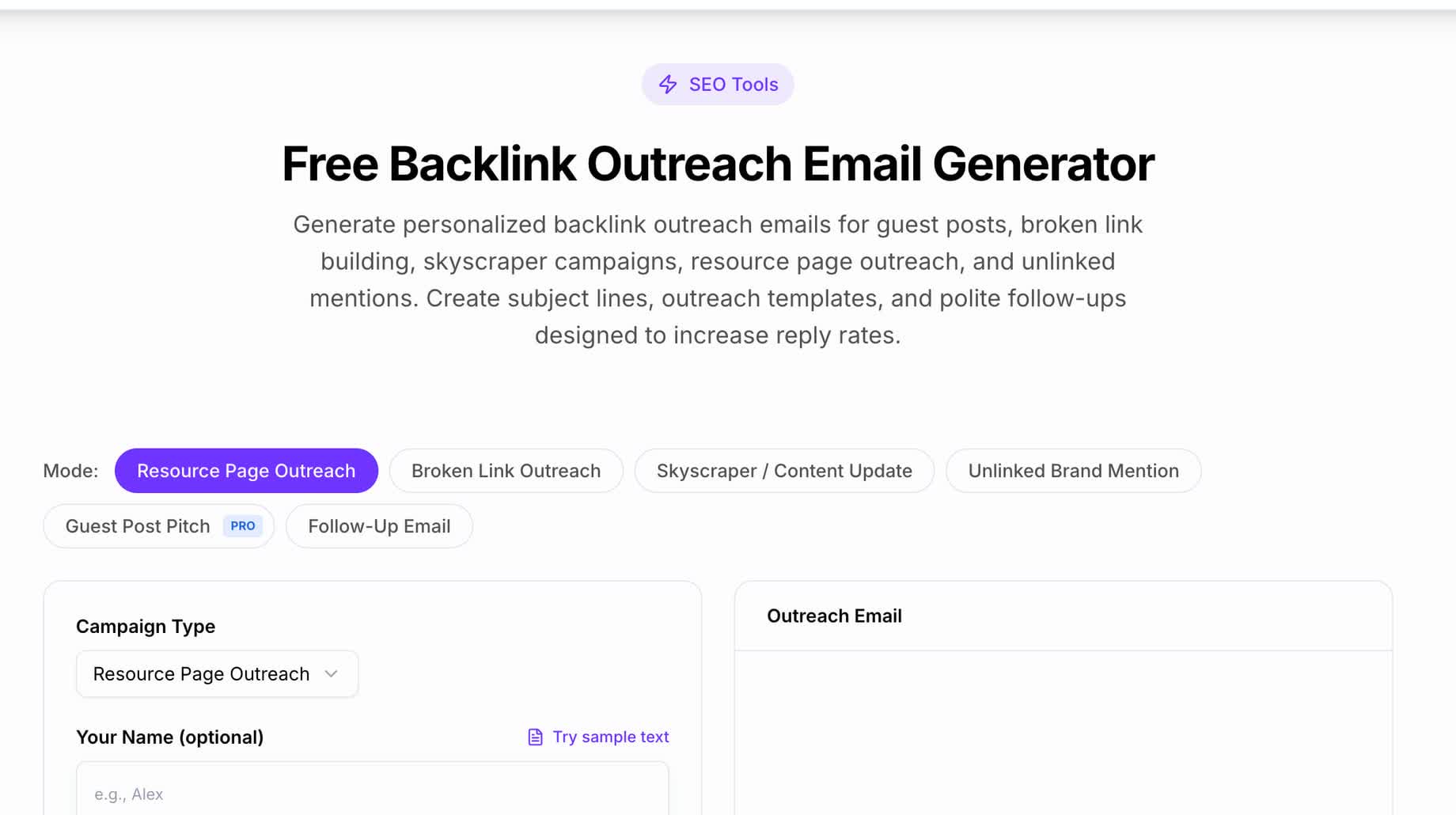
If you want a faster first draft, a backlink outreach email generator can turn those notes into a usable starting point. I would still edit the final version by hand, especially the opening line and the exact reason for the pitch. That is where automated copy most often sounds just a little too convenient.
Resource Update Email Template
Subject: quick note on your [topic] article

Hi [First name],

I was reading your article on [specific topic] and noticed the section about [specific detail].

One thing that might make that section more useful is [your resource], which includes [specific value: newer data, a free template, a comparison, a checklist, etc.].

It could fit where you discuss [section/page detail], especially for readers who want to [reader outcome].

Happy to send the exact snippet if useful.

[Your name]
The key is the sentence about fit. If you cannot explain where the resource belongs, the pitch probably is not ready.
Write Subject Lines That Sound Like Real Email
Subject lines for link-building outreach should feel specific, not clever. I usually pick the subject line that feels almost boring, as long as it is accurate.
Good patterns:
quick note on your [article topic] piecefresh data for your [article title] articlepossible addition to your [resource/list]question about your [topic] guideidea for [site name]'s [topic] section
Weak patterns:
Link building opportunityHigh quality guest postCollaboration requestBoost your SEOAmazing resource for your readers
AI can generate 20 subject lines quickly, but most will be too polished. Pick the plain one. An email subject line generator is useful for options, but the winning line usually sounds like something you would actually send to one person. If it reads like a campaign name, rewrite it.
Personalize the Part That Proves You Read the Page
Personalization is not the same as using someone's first name. It is proof of attention.
Real personalization proves you understand the page. That can mean:
- Mentioning a specific section, claim, outdated statistic, broken source, or missing example.
- Matching your pitch to the publication's audience.
- Suggesting a guest post topic that extends what the site already covers.
- Referencing a recent article without pretending it changed your life.
- Explaining why your resource belongs on that exact page.
Bad personalization:
I loved your article. It was very insightful.
Better:
Your section on follow-up timing is useful, but it stops before showing what the second email should actually say. We have a short follow-up template that would give readers a practical next step.
That second version works because it gives the editor a reason to care. It also shows restraint: no fake excitement, no over-selling, just a clear improvement to the page.
If you use AI for this step, ask it to summarize the target page first and pull out specific moments worth referencing. Then verify those details yourself before sending. One wrong reference is enough to make the entire email feel automated.
Use AI for Guest Post Pitches, Not Generic Topic Lists
Guest post pitches fail when they ask the editor to do the work.
"I can write about SEO, content marketing, or AI" is not a pitch. It is homework for the editor.
Send a specific idea with a clear angle. I would also send fewer ideas, not more. Three strong, distinct pitches beat a menu of ten vague topics.
Guest Post Pitch Template
Subject: article idea for [site name]: [specific headline]

Hi [First name],

I read your recent piece on [their topic] and noticed you cover [related theme] for [audience].

I had an idea that could fit that audience:

"[Proposed headline]"

It would cover:
- [specific point 1]
- [specific point 2]
- [specific point 3]

The angle is [why this is different from what they already published].

Here is one relevant example of my work: [link]

Would this be worth a draft?

[Your name]
AI is useful before this email because it can compare your proposed headline against the publication's archive. That comparison is where the pitch gets sharper.
Prompt:
Here are 10 guest post ideas and a list of articles already published by this site.

Remove ideas that are too similar.
Improve the strongest 3 ideas so they feel specific to this site's audience.
For each idea, add a 3-bullet outline and explain why it is not a repeat.
This is especially useful in competitive niches where every obvious guest post topic has already been published many times. When I see a pitch that could have been written without reading the site, I assume the editor will see the same thing.
Let AI Draft Follow-Ups, But Make Each One Useful
Most link-building campaigns need follow-ups. People miss emails, postpone decisions, or wait until they are updating an article.
The mistake is sending the same "just checking in" message twice. I think that is the fastest way to make a decent first email feel lazy in hindsight.
Each follow-up should add something:
- A specific snippet they could use.
- A shorter version of your pitch.
- A second topic idea.
- A screenshot or example, if it genuinely helps.
- A polite final note that makes it easy to say no.
Follow-Up Template
Subject: Re: quick note on your [topic] article

Hi [First name],

Just bringing this back once.

The simplest fit would be one sentence in your [section name] section, where you explain [topic]. Something like:

"[Suggested sentence with your resource included naturally.]"

If it is not a fit, no worries.

[Your name]
That kind of follow-up is better than a nudge because it reduces the editor's work. A follow-up email generator can create variations, but keep the final message short and specific. The second email should earn its place in the thread.
Keep AI Outreach Inside Search and Email Rules
AI makes it easy to scale outreach. That also makes it easy to create risk.
First, do not use AI to create manipulative link schemes. Google's spam policies cover link spam, including links intended to manipulate rankings. Paid placements, excessive exchanges, automated link drops, and pressure-based outreach are not the kind of links you should be building. If a campaign does include paid placements, treat them as advertising: mark them and vet each site before you buy a backlink, checking for real traffic and topical fit.
Second, follow email rules. In the United States, the FTC's CAN-SPAM compliance guide explains requirements such as accurate header information, non-deceptive subject lines, clear identification, and opt-out handling. If you contact people in Europe, the European Commission's guidance on legitimate interest makes the balancing test clear: your business interest has to be weighed against the person's rights and expectations.
This is not legal advice. The practical rule is simple: contact relevant business recipients, be honest about who you are, make the message useful, and stop emailing anyone who asks you to stop. I would treat compliance as part of campaign quality, not an administrative detail you clean up later.
Use AI to Improve the Page You Are Pitching
Sometimes the outreach is fine, but the page is not link-worthy enough. That is frustrating, but it is also fixable.
Before launching a campaign, run the page through a hard review:
Review this page as if you are an editor deciding whether to link to it.

Tell me:
1. What parts are worth citing?
2. What claims need evidence?
3. What sections feel generic?
4. What would make this page more useful than competing pages?
5. What linkable asset could we add: table, template, statistic, visual, checklist, or example?
For link building, the most useful additions are usually practical:
- A comparison table.
- A downloadable checklist.
- A short template.
- A data point with a credible source.
- A before-and-after example.
- A visual workflow.
- A mini case study.
This is also where AI-generated copy needs a human pass. If the page sounds generic, editors will not want to cite it. A good human touch pass should add examples, remove empty claims, check facts, and make the writing sound like it came from someone who has actually done the work. I would be especially hard on introductions, claims without proof, and any paragraph that sounds like it could appear on a dozen competing pages.
Track Metrics That Prove Links Were Earned
Do not judge an AI link-building campaign by how many emails you sent. That is activity, not progress.
Track the full path from prospect to link:
| Metric | What it tells you |
|---|---|
| Qualified prospects | Whether your research process is finding enough relevant pages. |
| Emails sent | Campaign volume, not campaign quality. |
| Bounce rate | Whether your contact data is clean. |
| Open rate | Whether subject lines and sender reputation are healthy. |
| Reply rate | Whether the pitch is interesting enough to answer. |
| Positive reply rate | Whether the offer is strong enough. |
| Links earned | The actual campaign outcome. |
| Link quality | Relevance, traffic, authority, placement, and editorial context. |
| Referral traffic | Whether the link sends useful visitors. |
| Ranking movement | Whether links help the page over time. |
AI can summarize replies and classify them into positive, negative, maybe, and follow-up needed. That saves time, especially when campaigns get large.
But do not let the dashboard hide link quality. Ten weak links from unrelated sites are not better than two relevant editorial links from pages people actually read. I would rather explain a smaller campaign with stronger links than celebrate a bigger report full of placements nobody should trust.
Common AI Link-Building Mistakes
The most common mistakes are easy to avoid, but they still show up when teams let the tool set the pace:
- Sending AI-written emails without checking whether the page reference is true.
- Pitching a generic article instead of a specific asset or angle.
- Asking for a backlink before explaining the value.
- Using the same template across every niche.
- Including too many links in the first email.
- Pitching sites that obviously sell guest posts at scale.
- Letting AI invent statistics, names, article details, or publication guidelines.
- Measuring replies instead of earned links.
- Forgetting to follow up with people who showed interest.
- Treating guest posts, resource updates, broken-link outreach, and digital PR like one campaign.
AI should make the process more thoughtful, not just faster. If it only increases volume, the process probably needs a reset.
A Simple AI Link-Building Workflow
Here is the workflow I would use:
- Pick one linkable asset: a guide, tool, template, study, checklist, or comparison.
- Use competitor backlink research to find pages that already cite similar resources.
- Use AI to expand into adjacent topics where your asset would still help.
- Filter prospects by relevance, quality, freshness, and likelihood to link.
- Summarize each target page and identify the exact reason your resource fits.
- Draft personalized outreach emails from those notes.
- Write two follow-ups that add value instead of repeating the same ask.
- Track replies, live links, link quality, and ranking movement.
- Feed campaign results back into the next round of prospecting and pitches.
The practical stack can stay simple. Use AI SEO writing tools to strengthen the page you are pitching, then use outreach-specific tools for email drafts, subject lines, and follow-ups. Keep the human review step in place. I would not automate the final yes-or-no decision on a prospect or a pitch.
Final Takeaway
AI is useful for link building because it helps with the slow parts: research, prospect grouping, outreach drafts, guest post angles, follow-ups, and campaign analysis.
But backlinks are still earned through relevance and trust.
The best AI-assisted outreach does not feel automated. It feels like someone found the right page, understood what the editor was trying to do, and offered something that would make the page better.
That is the standard worth aiming for. Not more emails. Better reasons to send them.