
8 AI Article Writers That Actually Produce Publishable SEO Content (2026)

Yi
SEO Expert & AI Consultant

Most AI article writers can produce a long draft. That is no longer impressive, and in my experience it is often the least useful thing to measure.
The harder question is whether the tool can help you create an article that is structured around search intent, easy to edit, fact-checkable, and useful enough to publish. For SEO teams, the best AI article writer is not the one with the longest feature list. It is the one that reduces cleanup.
That is the lens I use in this comparison. Broader AI content generators can cover landing pages, ads, emails, and product copy. Here the focus is narrower: tools that help plan, draft, optimize, and revise articles without creating extra editorial debt. If you only need quick first drafts rather than a full planning and optimization workflow, a simpler AI blog generator may be enough.
Quick Picks: Best AI Article Writers in 2026
| Rank | Tool | Best for | Main reason to use it |
|---|---|---|---|
| 1 | Junia ai | SEO article production | End-to-end article workflow with SEO, research, optimization, and publishing support |
| 2 | Writesonic | Multi-format content teams | Good option when articles sit alongside chatbots, audio, images, and other formats |
| 3 | Jasper | Brand-led marketing teams | Strong brand voice and campaign copy workflows |
| 4 | Frase | Research and content briefs | Useful for turning SERP research into outlines and briefs |
| 5 | Rytr | Lightweight drafting | Fast, affordable draft generation for simpler content needs |
| 6 | Surfer SEO | Optimization-heavy workflows | SERP-driven editor guidance and content scoring |
| 7 | WordAI | Rewriting existing content | Good for sentence-level rewriting, variation, and reframing |
| 8 | Writerly | Team collaboration | Helpful for collaborative content production and multilingual teams |
If you only remember one thing, make it this: choose the tool that gives you the best edited article, not the fastest raw draft. I have seen fast tools become slow workflows once an editor has to rebuild the outline, verify every claim, and remove vague filler from every other paragraph.
How I Evaluated These AI Article Writers
The comparison is based on how each tool fits into a real SEO writing workflow, not on how many templates it advertises. Template count is easy to sell; editing time is harder to hide.
I looked at six practical criteria:
| Criterion | What it means in practice |
|---|---|
| Search intent fit | Can the tool help shape the article around what the reader actually wants? |
| Structure quality | Does it create a logical outline, or does it bury the answer under filler? |
| Editing time | How much work is needed before the draft is publishable? |
| SEO support | Does it help with keywords, headings, internal links, metadata, or content gaps? |
| Factual control | Can you review claims, add sources, and avoid unsupported statements? |
| Workflow fit | Does it fit how writers, editors, and SEO teams already work? |
This matters because Google does not reward content simply because it was written quickly. Google Search Central's guidance on helpful, reliable, people-first content still comes back to usefulness, originality, trust, and whether the page was created for people first. Its guidance on using generative AI content also makes the practical point clear: automation is not the issue by itself; low-value content created mainly to manipulate search is.
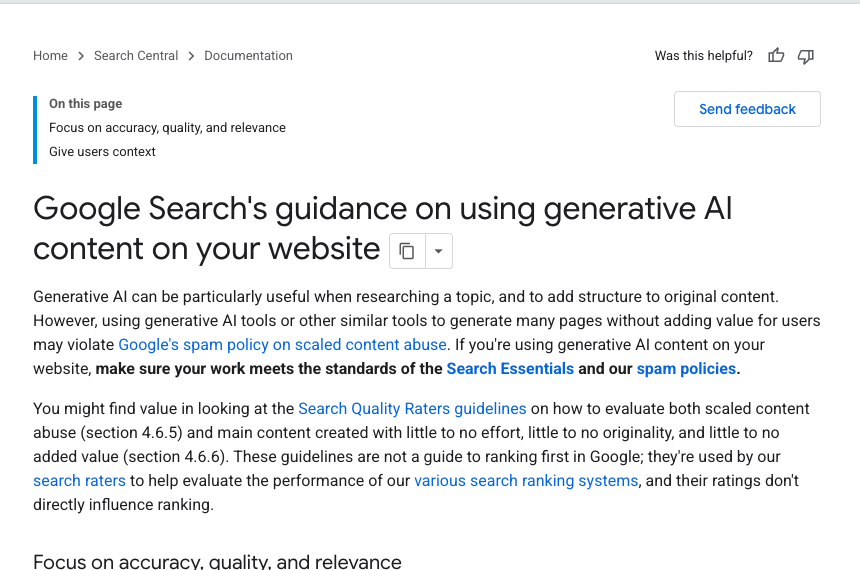
That is why the best AI article writers in 2026 are really workflow tools. They help you plan, draft, optimize, edit, and publish with fewer weak spots. Personally, I trust a slower tool with a stronger workflow more than a fast generator that leaves the editor to fix intent, structure, and sources afterward.
- Keyword or topic
- Search intent and brief
- AI-assisted draft
- Human edit and fact check
- SEO optimization
- Publish and refresh
View diagram source
flowchart LR
    A[Keyword or topic] --> B[Search intent and brief]
    B --> C[AI-assisted draft]
    C --> D[Human edit and fact check]
    D --> E[SEO optimization]
    E --> F[Publish and refresh]
If you want a current walkthrough of ranking SEO content in 2026, not just generating it, this is a useful companion:
How to create SEO content that actually ranks in 2026
What Makes an AI Article Writer Worth Using?
A useful AI article writer should improve the article production process without removing editorial judgment. The tool should make the editor sharper, not invisible.
At minimum, it should help you:
- Build a search-intent-aware outline before drafting
- Generate a first draft that has a clear argument and clean section order
- Add examples, definitions, comparisons, and practical steps where readers need them
- Review claims and sources before publishing
- Optimize headings, keywords, metadata, and internal links without keyword stuffing
- Keep tone and brand voice consistent across many articles
AI adoption is now mainstream enough that "we use AI" is not a differentiator. Stanford HAI's 2026 AI Index reports that organizational AI adoption reached 88%. The advantage is not access to AI. It is having a stronger content workflow than competitors using the same underlying models, then applying better human judgment at the end.
1. Junia ai
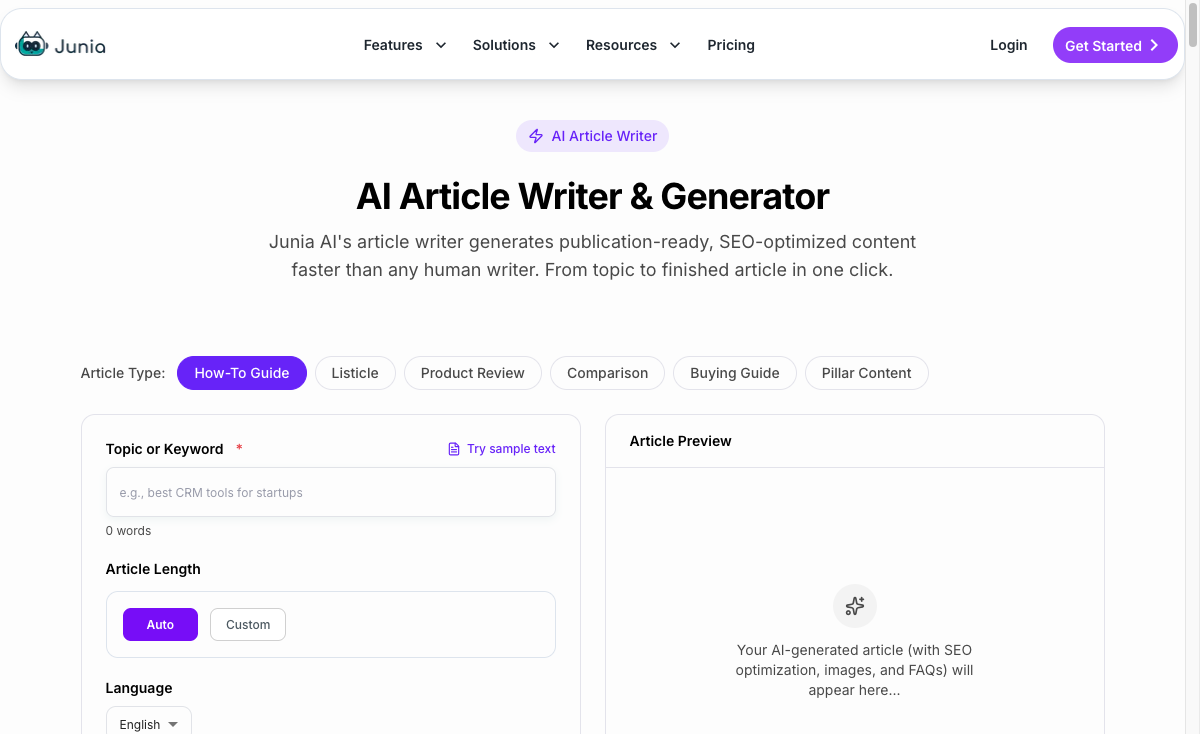
Junia ai is the strongest pick here if your main goal is publishing SEO articles rather than just generating copy. I am biased toward tools that respect the whole publishing process, and Junia is the clearest example in this list.
The difference is workflow. Junia is built around long-form content production: keyword research, article generation, SEO optimization, internal linking, metadata, and publishing. That makes it a better fit for teams that want a repeatable article process instead of a blank AI chat box.
It also fits the way SEO content is actually produced. A strong article usually starts with a keyword or topic, moves into a brief, becomes a draft, gets edited, and then needs optimization before publishing. Junia keeps more of that work in one place.
That workflow usually starts with search demand. Build the topic around real queries first, then turn that research into a brief with a clear angle, section order, and evidence plan. When that step is skipped, even a polished AI draft tends to feel like a stitched-together summary instead of an article with a point of view.
Once the draft exists, title and snippet work becomes more useful. Create several headline options for the article angle, then translate the same promise into search-result copy without overstating what the page delivers. I would rather see a slightly plainer title that matches the article than a clever one that the page cannot support.
Save readability cleanup for the final pass, when the structure is already settled.
Best for: SEO teams, content sites, agencies, and founders who want an article workflow with fewer handoffs.
Where it stands out:
| Strength | Why it matters |
|---|---|
| SEO-first article workflow | Helps with more than raw drafting |
| Long-form support | Better fit for guides, comparisons, and blog content |
| Internal tool ecosystem | Useful for keywords, briefs, metadata, readability, and optimization |
| Multilingual support | Helps teams create content for more than one market |
| Publishing workflow | Reduces the copy-paste work between tools |
Watch out for: Junia AI is best when you actually use the SEO workflow around the writer. If you only want a quick paragraph or a social caption, a lighter tool may be enough.
Verdict: Best overall AI article writer for SEO content production.
2. Writesonic
Writesonic is a good choice for teams that need more than article drafts. It covers blog writing, marketing copy, chatbot-style content, images, and other formats, which makes it useful when a content team is producing across several channels.
For article writing, the main appeal is convenience. You can move from ideation to draft generation quickly, then reuse the same platform for other marketing assets. That is helpful for small teams that do not want separate tools for every content format, especially when speed matters more than deep SEO control.
The tradeoff is focus. Writesonic can do a lot, but SEO article production is only one part of the platform. If your main goal is ranking long-form content, you will still want a clear brief, human editing, and a separate quality check before publishing. I would not treat its breadth as a substitute for editorial discipline.
Best for: content teams that publish articles but also need ads, landing page copy, chatbot content, and other formats.
Pros
- Flexible content formats
- Useful for fast first drafts
- Good fit for teams that want one broad content platform
- Supports multilingual content needs
Cons
- Can feel busy if you only need article writing
- SEO work still needs editorial review
- Broad feature sets can make the workflow less focused
Verdict: Best for multi-format content production, especially when articles are only one part of the workload.
3. Jasper
Jasper is strongest when brand voice matters. It is built for marketing teams that need a consistent tone across campaigns, blog posts, emails, landing pages, and other assets.
For article writers, Jasper is useful when the main risk is inconsistency. If several people are writing under one brand, voice controls can help keep drafts from sounding like they came from five different companies. That can save real editing time. I have found this matters most in teams where the article is only one part of a campaign and every asset needs to sound related.
The weakness is SEO depth. Jasper can help produce polished marketing copy, but it is not the most complete option if you need search intent research, entity coverage, internal linking, and optimization built directly into the article workflow. For SEO-heavy publishing, it works best alongside a stronger brief and optimization process.
Best for: brand-led marketing teams that care about consistent messaging.
Pros
- Strong brand voice controls
- Good campaign and marketing workflows
- Useful for teams producing many types of copy
- Cleaner tone control than many lightweight AI writers
Cons
- Not the strongest standalone SEO article workflow
- Can require extra tools for research and optimization
- Pricing may be too high for small sites with simple needs
Verdict: Best for brand consistency, especially when article writing is part of a broader marketing operation.
4. Frase
Frase is useful before the first draft is written. Its strength is topic research, content briefs, questions, competitor coverage, and outline planning.
That makes it valuable for SEO writers who do not want to start from a blank page. Instead of guessing what to cover, you can use Frase to understand common subtopics, questions, and headings from ranking pages. This is especially helpful for informational content where missing a key section can make the article feel incomplete.
As a pure article writer, Frase is not always the most natural or polished. I would treat it as a research and brief tool first, then use human editing or another writer to improve the final voice. Used that way, it can prevent a lot of structural mistakes before they ever reach the draft.
Best for: SEO briefs, topic research, and content planning.
Pros
- Strong research workflow
- Helpful for SERP-informed outlines
- Good at surfacing questions and subtopics
- Useful for writers who need structure before drafting
Cons
- AI drafts can still feel generic
- Less useful for brand voice than Jasper
- Works best when paired with a strong editor
Verdict: Best for turning search research into a usable article plan.
5. Rytr
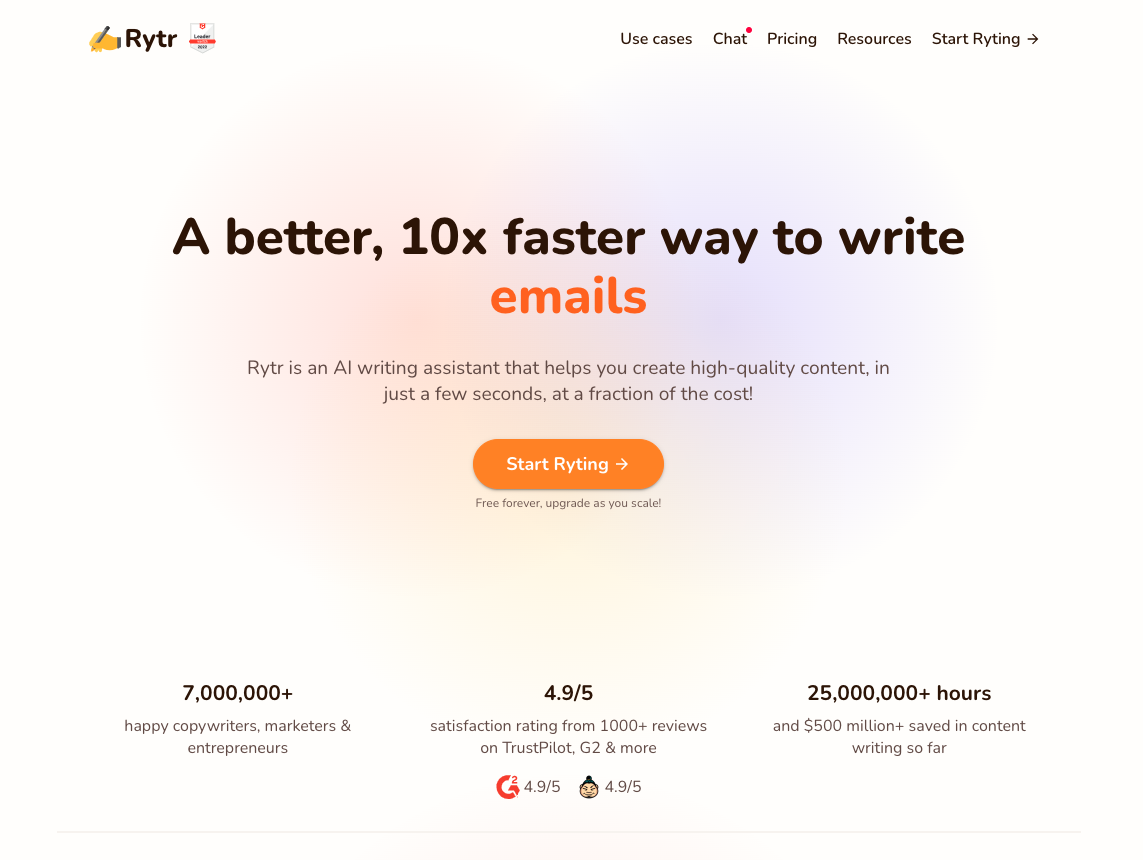
Rytr is a lightweight AI writing tool for people who want quick drafts without a heavy platform.
It works best for shorter sections, simple blog drafts, rewrites, outlines, and quick ideation. If you are a solo creator or small business owner, that can be enough. You can get unstuck, produce a rough draft, and then polish it manually.
The limitation is depth. Rytr is not the tool I would choose for complex SEO articles where you need serious research, search intent analysis, internal links, and careful optimization. It is better as a drafting assistant than a complete article production system. That is not a criticism so much as a boundary: lightweight tools are useful when you do not expect them to carry the whole workflow.
Best for: fast, affordable drafting and idea generation.
Pros
- Easy to start using
- Good for short drafts and rewrites
- Useful tone options
- Lower-friction than larger platforms
Cons
- Not ideal for advanced SEO workflows
- Needs careful editing for depth and originality
- Can produce thin sections if the prompt is vague
Verdict: Best budget-friendly option for simple article drafts.
6. Surfer SEO
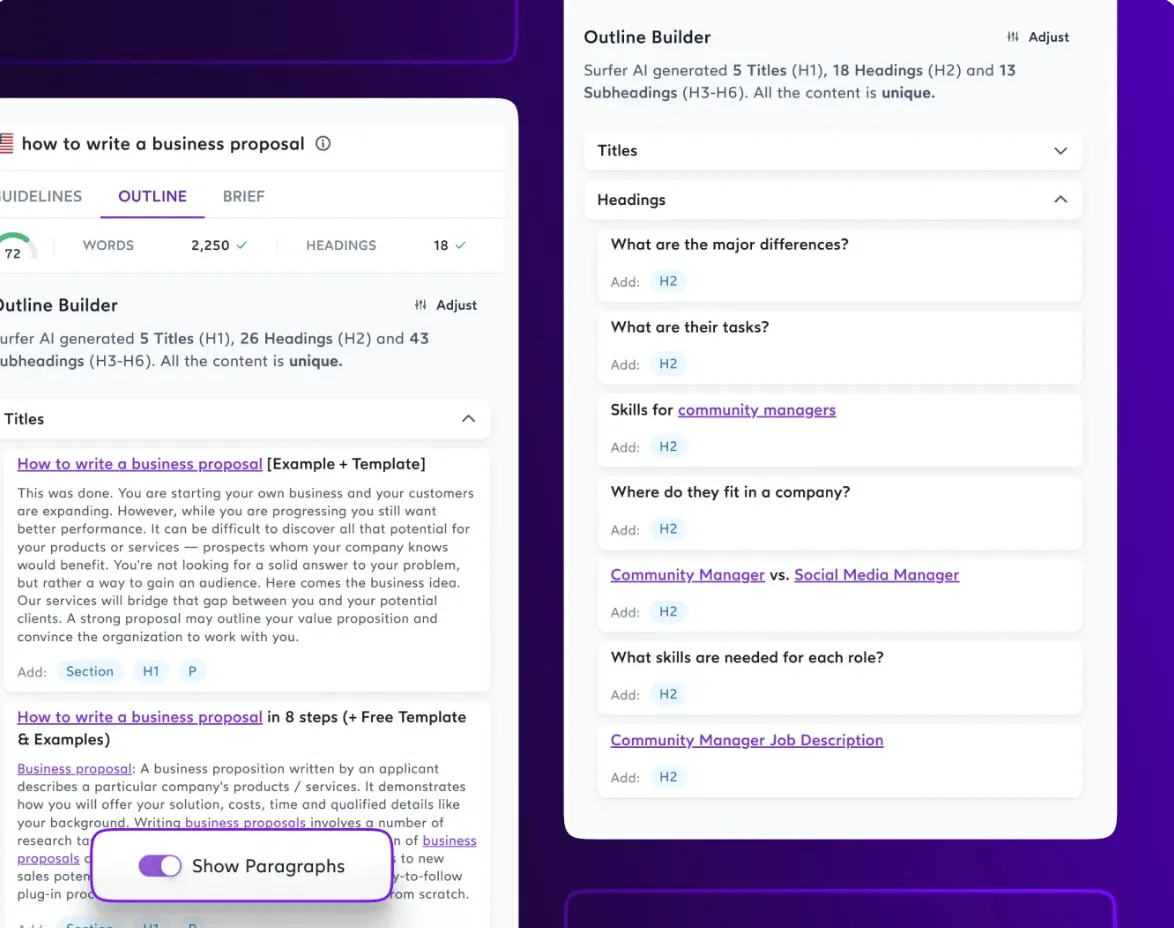
Surfer SEO is best understood as an optimization tool that also supports AI-assisted writing.
Its main value is the content editor. You get guidance based on what currently ranks: terms to include, content length, headings, and coverage signals. That can be useful when you already have a draft and want to make it more competitive.
The risk is over-following the score. A content score can help you notice gaps, but it should not replace editorial judgment. If you add terms just because a tool suggests them, the article can become bloated and unnatural. I have seen otherwise useful drafts get worse because someone chased a score instead of asking whether the added section helped the reader. Surfer is most useful when an experienced editor uses it as a diagnostic tool, not as a final authority.
Best for: SEO teams that want SERP-based optimization guidance.
Pros
- Helpful content editor
- Useful for updating existing articles
- Good for comparing a draft against ranking pages
- Clear optimization feedback
Cons
- Can encourage over-optimization if used mechanically
- Less focused on brand voice
- Advanced workflows can get expensive
Verdict: Best for optimization-heavy workflows after the article direction is already clear.
7. WordAI
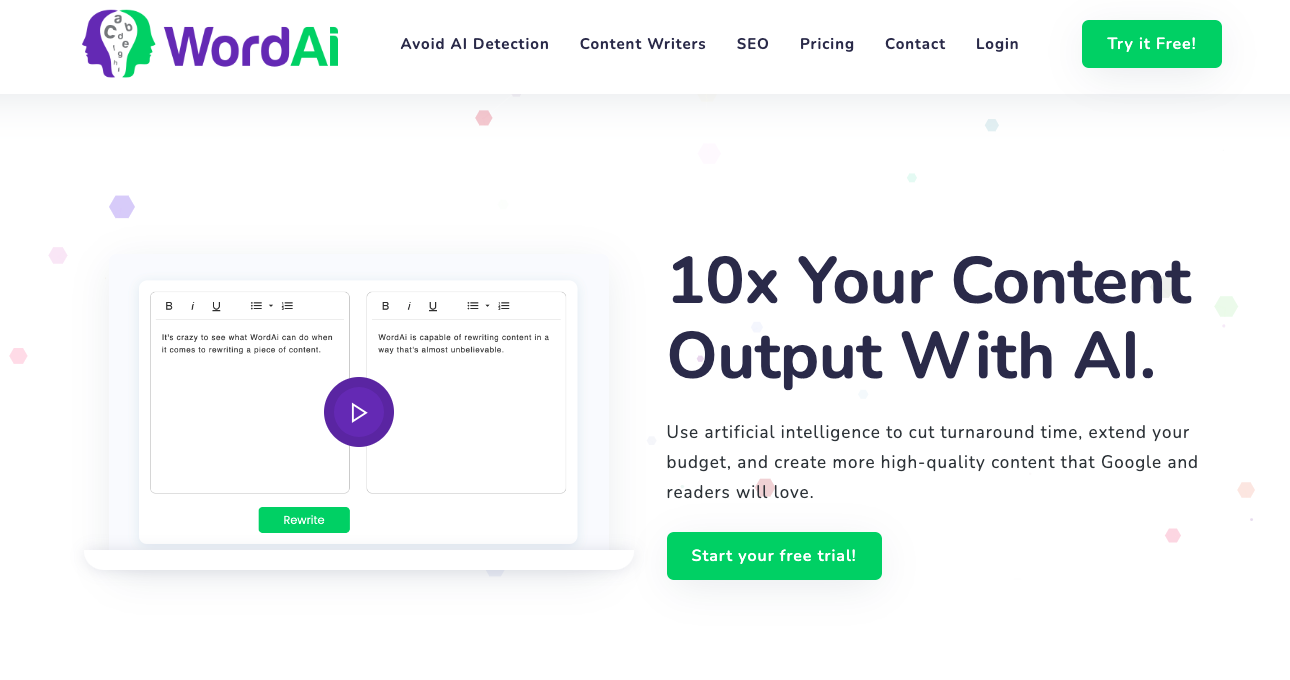
WordAI is not the tool I would pick to plan an article from scratch. It is more useful when you already have content and need to rewrite, reframe, or create variations.
That can be helpful for refreshing stale content, improving awkward sentences, or rewriting sections that are too close to another source. Used carefully, it can speed up editing. Used carelessly, it can make content less specific by smoothing out the very details that made the draft useful.
For SEO content, the right use case is narrow: improve existing copy, then have a human editor check whether the meaning, examples, links, and claims still hold. I would never let a rewriting tool be the last step before publishing.
Best for: rewriting existing content and creating text variations.
Pros
- Strong sentence-level rewriting
- Useful for content refreshes
- Can help reduce repetition
- Good fit for teams that already have source material
Cons
- Not a complete SEO article workflow
- Needs human review to preserve meaning
- Can weaken specificity if overused
Verdict: Best as a rewriting assistant, not as your main article strategist.
8. Writerly
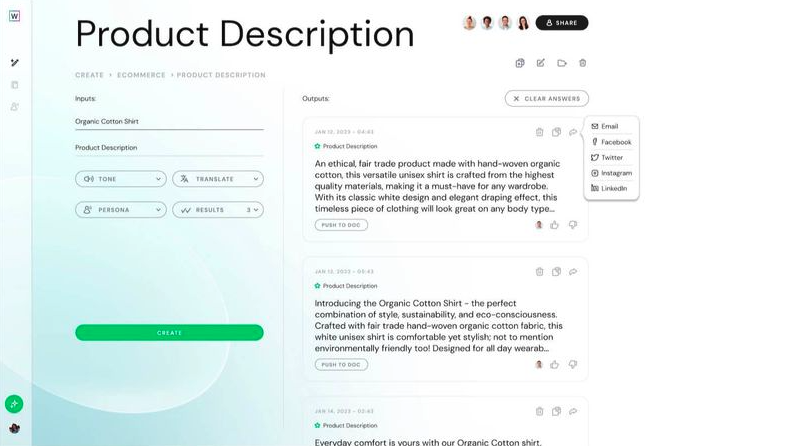
Writerly is a better fit for teams than for solo writers looking for the sharpest SEO article workflow.
Its strength is collaborative content production: multiple users, shared workflows, multilingual support, and a platform-style setup for teams that need to produce content together. That can be useful if your bottleneck is coordination rather than ideation.
For SEO article writing, it still needs the same editorial guardrails as any other AI writer: a clear brief, fact checks, examples, internal links, and a human editor who knows when a section is too vague. Collaboration features help a team move work around; they do not decide whether the article is worth reading.
Best for: collaborative teams producing content across several markets or departments.
Pros
- Team-friendly workflow
- Multilingual support
- Useful for shared content production
- Better fit for organizations than one-off writing
Cons
- Not the strongest SEO-specific workflow
- Can feel too broad for solo writers
- Still needs strong editorial review
Verdict: Best for collaborative content teams that need shared AI writing workflows.
Side-by-Side Comparison
| Tool | SEO article fit | Brand voice | Research/briefing | Optimization | Best use case |
|---|---|---|---|---|---|
| Junia ai | High | High | High | High | End-to-end SEO articles |
| Writesonic | Medium | Medium | Medium | Medium | Multi-format content |
| Jasper | Medium | High | Low-Medium | Medium | Brand-led marketing copy |
| Frase | Medium | Low-Medium | High | Medium | Briefs and SERP research |
| Rytr | Low-Medium | Medium | Low | Low | Simple drafts |
| Surfer SEO | Medium | Low-Medium | Medium | High | Draft optimization |
| WordAI | Low | Low-Medium | Low | Low-Medium | Rewriting existing copy |
| Writerly | Medium | Medium | Medium | Medium | Team collaboration |
How to Choose the Right AI Article Writer
Start with your bottleneck. This is the part I would not overcomplicate.
If your team struggles with SEO planning, choose a tool with keyword, brief, and optimization support. If the problem is brand consistency, prioritize voice controls.
If the problem is slow first drafts, a lighter writing assistant may be enough. For deeper drafts, compare options built specifically for long-form AI writing.
Here is the simplest decision path:
| If you need... | Choose... |
|---|---|
| A full SEO article workflow | Junia ai |
| SERP research and briefs | Frase |
| Optimization feedback on drafts | Surfer SEO |
| Brand voice and campaign content | Jasper |
| Fast drafts on a budget | Rytr |
| Rewriting existing content | WordAI |
| Multi-format content production | Writesonic |
| Team collaboration | Writerly |
Do not buy a writer to skip editing. Buy one that leaves fewer boring decisions: outline order, intent match, metadata, internal links. The judgment still has to be yours.
Also think about what happens after the draft. A tool that generates 2,000 words quickly is not useful if your editor spends three hours fixing structure, tone, unsupported claims, and internal links. The real cost of a weak AI article writer usually appears after the export button.
That concern shows up outside formal tool reviews too. Practitioners pushed back on tools that simply automate more content instead of helping with intent, structure, internal links, technical gaps, and human review.
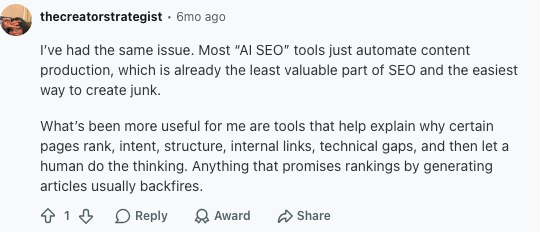
For SEO articles, I would always check the draft against this short publishing checklist. It is simple, but it catches most of the problems I see in AI-assisted drafts:
- Does the introduction answer the search intent quickly?
- Are the headings useful, or are they generic filler?
- Are claims fact-checked and sourced where needed?
- Are examples specific enough to be useful?
- Are internal links natural and relevant?
- Does the article add anything beyond what ranking pages already say?
- Would a human reader trust this if they found it from Google?
If the answer is no, the tool did not finish the job. It only gave you raw material.
How AI Article Writers Have Changed

The biggest change is that AI article writers are no longer judged only by output quality.
Early tools competed on speed: type a topic, get an article. That created a lot of thin, similar content. Modern SEO workflows need more than that. They need research support, search intent alignment, factual control, brand voice, internal linking, refresh workflows, and a way to make content useful enough for both readers and search systems. In practice, the best tools now feel less like writing shortcuts and more like production systems.
That is also why using a general chatbot is different from using an article writer. ChatGPT or Claude can help with brainstorming, outlining, rewriting, and editing. But unless you build the workflow yourself, you still need separate tools for keyword research, content briefs, SEO scoring, metadata, internal linking, and publishing.
Dedicated article writers are valuable when they remove that operational friction.
Final Verdict
For most SEO article workflows, Junia ai is the best overall AI article writer in this list because it is built around the full publishing process, not just text generation. That is the distinction I care about most.
The rest depends on your use case:
- Use Junia ai if you want an end-to-end SEO article workflow.
- Use Writesonic if you need articles plus other content formats.
- Use Jasper if brand voice is your main concern.
- Use Frase if you need stronger briefs and SERP research.
- Use Rytr if you want simple, fast drafting.
- Use Surfer SEO if optimization guidance is the bottleneck.
- Use WordAI if you mostly rewrite existing copy.
- Use Writerly if collaboration matters more than solo drafting speed.
AI article writers can save time, but they should not replace editorial standards. The winning workflow is still simple: use AI to draft and organize faster, then add the human judgment that makes the article worth publishing. That means adding examples, checking claims, improving structure, and making sure the voice sounds like your brand. My opinion: the best AI article writer is the one that leaves you with fewer boring editorial decisions, not fewer editorial decisions altogether.
Before scaling article production, answer the ranking question honestly: AI content can rank in Google, but only when the final page is useful, accurate, and edited for readers. Softening a few sentences is not that edit.