
Free Industry-Specific Jargon Generator
Create realistic industry jargon, role-specific terminology, and professional buzzwords for business writing, onboarding, training, and content marketing. Generate terms with definitions and example usage across SaaS, finance, healthcare, HR, and other industries.
Industry Jargon
Your industry-specific jargon list will appear here...
How the AI Industry Jargon Generator Works
Get results in seconds with a simple workflow.
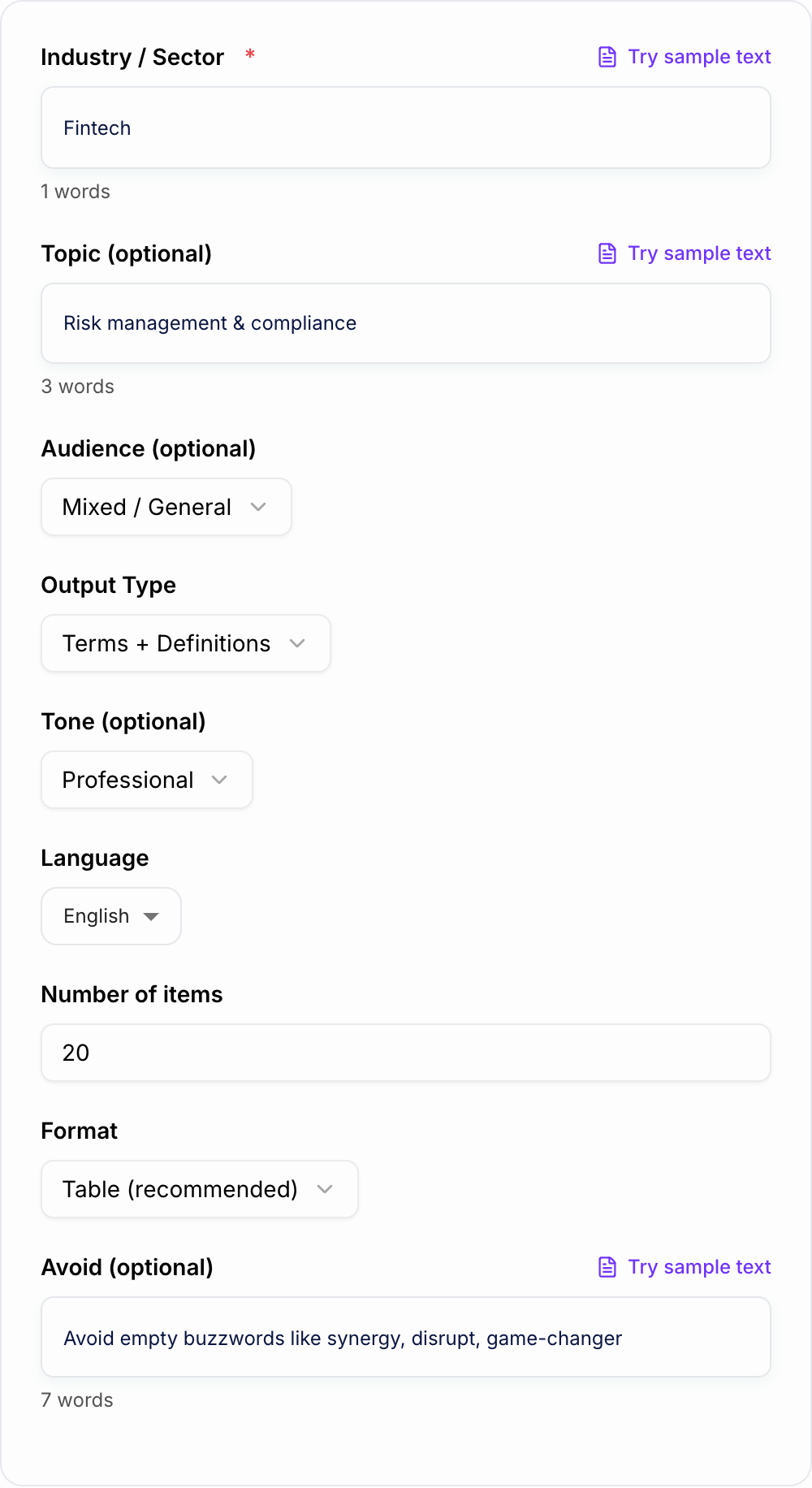
Enter Your Industry (and Optional Topic)
Choose your sector and, if needed, add a topic like compliance, onboarding, GTM, or supply chain to focus the terminology on what you’re writing about.
Choose Output Type and Audience
Pick whether you want terms, phrases, or acronyms—and set the audience (executive, internal, client-facing) to control jargon density and tone.
Generate, Then Use Naturally
Copy the list into your content brief, email, or draft. Use the definitions and examples to keep wording accurate, credible, and easy to understand.
See It in Action
Example of upgrading generic business writing with credible, industry-aware terminology—without overdoing buzzwords.
We need to improve our risk process and make sure we follow the rules, while keeping customers happy and reducing issues.
We need to strengthen our risk management framework and compliance controls while maintaining customer experience and reducing operational incidents.
Why Use Our AI Industry Jargon Generator?
Powered by the latest AI to deliver fast, accurate results.
Industry-Specific Jargon (Not Generic Buzzwords)
Generate realistic industry terminology, acronyms, and phrases tailored to your sector and topic—useful for professional emails, reports, and content that needs authentic domain language.
Clear Definitions + “Use It in a Sentence” Examples
Every term includes a concise meaning and an example sentence so you can use jargon correctly without sounding forced or misusing technical language.
Audience-Aware Output (Internal, Executive, Client-Facing)
Adjust jargon density and wording based on who you’re writing for—leadership updates, customer communications, investor materials, or technical documentation.
SEO-Friendly Terminology for Content Briefs
Discover related terms and common phrases you can incorporate into outlines, headings, and FAQs to improve topical coverage for SEO—without keyword stuffing.
Multiple Output Formats (Table, Bullets, JSON)
Get jargon in a clean table for easy editing, a scannable bulleted list, or JSON for workflows, docs, and prompt chaining.
Pro Tips for Better Results
Get the most out of the AI Industry Jargon Generator with these expert tips.
Use jargon to improve topical coverage, not to pad keywords
Add relevant terms where they belong (definitions, FAQs, examples, captions). Avoid repeating the same phrases unnaturally—write for clarity first, SEO second.
Keep client-facing content bilingual: jargon + plain English
For external audiences, pair the term with a simple explanation the first time you use it. You’ll sound credible without sacrificing readability.
Create a lightweight glossary for consistency
Pick the preferred term for each concept (especially acronyms) and use it consistently across pages, sales decks, and docs to strengthen brand clarity.
Avoid regulated or medical/legal claims unless you can verify
In healthcare, finance, and legal contexts, double-check definitions and avoid implying guarantees, outcomes, or compliance claims you can’t support.
Use the 'Avoid' field to filter out empty buzzwords
If you want practitioner language, tell the tool to avoid clichés (e.g., “synergy”, “disrupt”) and prioritize operationally meaningful terms.
Who Is This For?
Trusted by millions of students, writers, and professionals worldwide.
How to Use Industry Jargon Without Sounding Like You Are Trying Too Hard
Industry jargon is useful for one reason. It compresses meaning.
In a meeting, in an email thread, in a report, people do not want a paragraph when a phrase will do. A term like “risk appetite” or “patient throughput” carries context, assumptions, and a shared mental model. When you use it correctly, you sound like you belong in the room.
When you use it wrong, it is instantly obvious.
That is basically what this AI Industry Jargon Generator is for. Not to stuff buzzwords into your writing, but to help you pull the real terms, the common acronyms, and the natural phrases professionals actually use, then pair them with definitions and example usage so you can apply them safely.
What You Actually Get From an Industry Jargon Generator
Depending on the mode you choose, you will get slightly different kinds of output.
Terms plus definitions (best for glossaries and briefs)
Use this when you are writing:
- Content briefs and outlines for SEO writers
- Internal documentation and onboarding docs
- Job descriptions and role scorecards
- Client education pages where you still want to sound credible
A quick definition matters here because jargon without clarity just becomes noise.
Phrases you can use (best for emails and decks)
This mode is for writing that has to feel like it came from someone inside the industry. Things like:
- Executive updates
- Sales collateral
- Project status reports
- Meeting notes that need to be short but specific
Phrases are where people tend to overdo it. So the goal is not to use twenty phrases in one email. It is to use one or two in the right place.
Acronyms plus expansions (best for regulated and technical spaces)
Acronyms are everywhere in healthcare, finance, government, security, and enterprise SaaS. This mode helps you avoid the awkward moment where you expand the wrong thing or use an acronym that no one in that niche actually uses.
Also, acronyms can differ by region or company. So treat this as a starting point, then sanity check it against your context.
Where This Helps Most (Realistic Examples)
Tick these before the output leaves your machine. A fluent miss is still a miss.
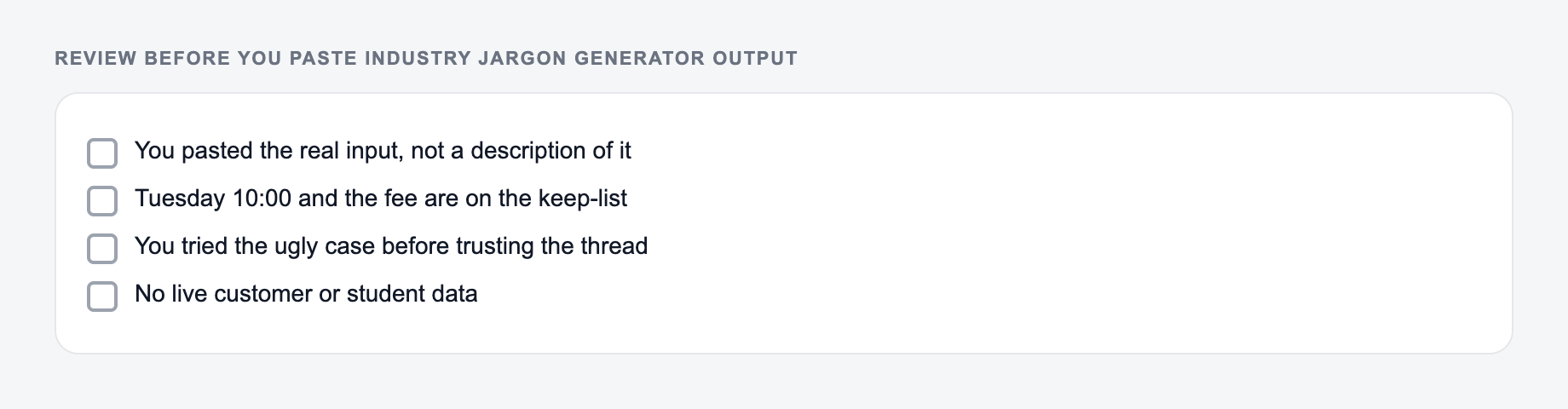
Here are a few situations where industry specific language is the difference between “generic AI copy” and “oh, this is legit”.
1) SaaS and product marketing
Instead of repeating “growth” and “improve conversion” everywhere, you can pull adjacent concepts that expand topical depth: activation, retention cohorts, expansion revenue, product led motion, time to value.
That helps writing and SEO. The page covers more of what the reader expects without you doing obvious keyword repetition.
2) Finance and fintech
Finance writing often fails because it is too vague. Jargon gives you precision, when used carefully: KYC, AML, underwriting, chargebacks, risk controls, loss provisioning, audit trail.
Even better if you pair the term with a one line plain English explanation the first time you use it.
3) Healthcare and health tech
Healthcare is full of terms that sound similar but mean different things. This is where definitions and examples matter most. And where you should be extra cautious about compliance or medical claims.
4) HR and internal comms
HR jargon is real, but it is also where people get cynical fast. Use this generator with an “avoid clichés” list and aim for practical language: role leveling, compensation bands, performance calibration, headcount planning.
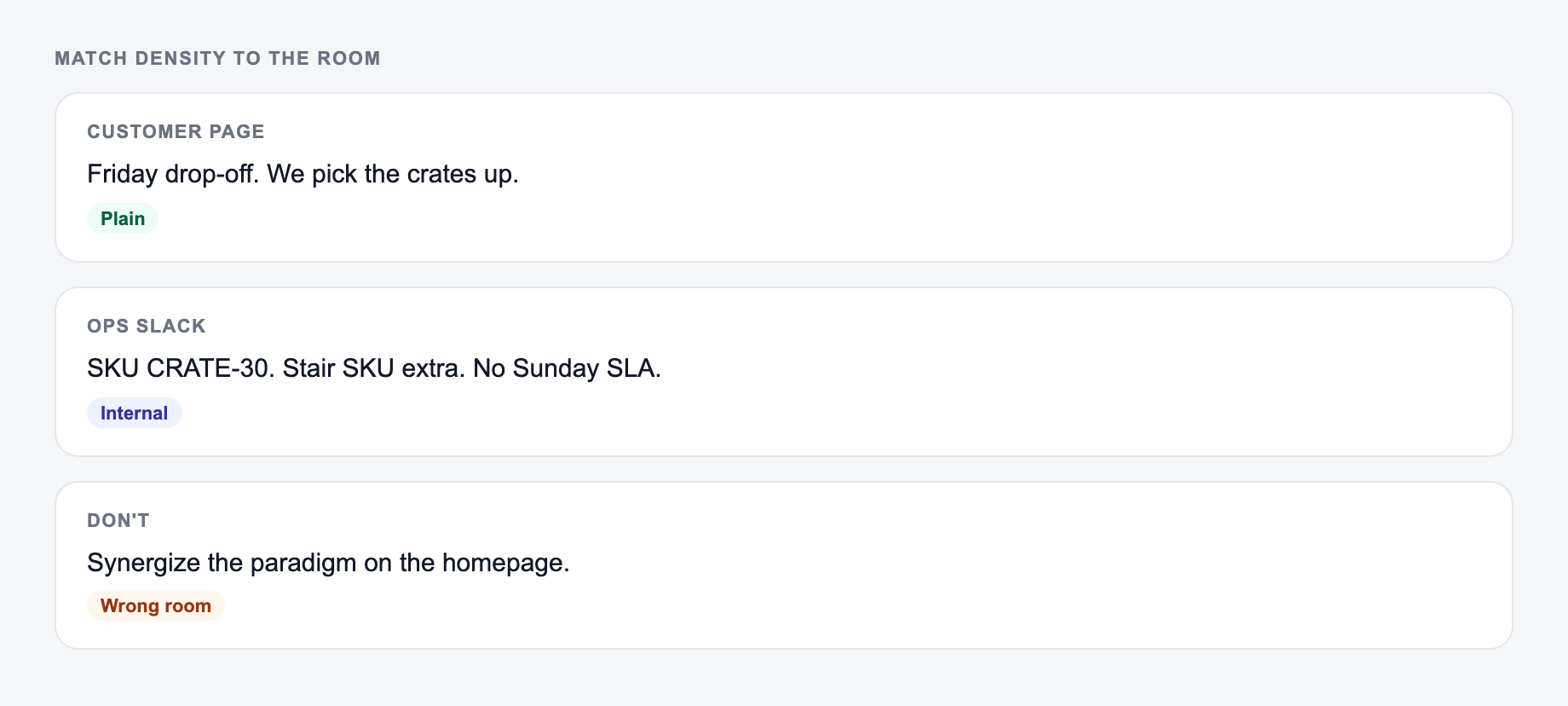
A Simple Rule: Match Jargon Density to the Audience
If you are writing for executives, you usually want fewer terms, but more decisive ones. They want signal.
Industry and who will read it belong on the form. Jargon is a filter, not decoration.
Common mistakes:
- Assuming the tool will invent missing context.
- Running one setting across mixed formats.
- Pasting live customer, student, or employee data to “see what happens.”
Do the reverse: add the noun, split the batch, and strip sensitive details first.
If you are writing for internal teams, you can use more jargon because the shared context is stronger.
If you are writing for clients or the public, go bilingual:
- jargon term
- plain English meaning
- then proceed normally
That one small pattern makes your writing feel expert and readable at the same time.
SEO Tip: Use Jargon as Entities, Not Just Keywords
Edge cases worth one run:
- Empty or two-word input — it should ask for a noun, not invent a project.
- Mixed lists — one delimiter per run.
- Protected terms — lock them before you generate.
If you are using this tool for SEO content, the best use is to enrich sections like:
- H2 and H3 headings (only when natural)
- FAQs
- Definitions
- Examples and scenarios
- “Related concepts” paragraphs inside the body
Search engines tend to reward pages that cover a topic comprehensively. Industry terminology helps you cover the surrounding concepts readers expect, especially in B2B niches.
Not by stuffing, more like… widening the frame.
If you want to build more workflows like this, from content generation to rewriting to SEO support, you can do it inside the broader set of tools at Junia AI.
Quick Checklist Before You Paste Jargon Into Anything
- Does the term match the industry and the topic, not just the vibe?
- Would a practitioner in that role actually say this?
- Are you mixing internal jargon into client facing writing?
- Can you add a short definition the first time it appears?
- Are you accidentally implying compliance, certification, or outcomes you cannot verify?
If you keep those in check, jargon stops being “buzzwords” and starts being what it is supposed to be. Useful shorthand that makes your writing tighter, clearer, and more credible.
Frequently Asked Questions
What is an industry jargon generator?+
An industry jargon generator produces sector-specific terms, acronyms, and common phrases used by professionals in a given field. It helps you write with more credible, domain-appropriate language while keeping definitions and usage clear.
Can this help with SEO and content optimization?+
Yes. Industry terminology can help improve topical coverage by surfacing related entities, acronyms, and phrases readers expect to see. Use the output to enrich headings, FAQs, and supporting sections—while keeping language natural and avoiding keyword stuffing.
Will the jargon be accurate for my niche?+
The generator is designed to produce realistic terms and definitions for your chosen industry and topic. Always review for context, regional differences, and compliance requirements—especially in regulated industries like healthcare, finance, and legal.
How do I avoid sounding like I’m forcing jargon?+
Choose an appropriate audience (client-facing vs internal), use the example sentences as patterns, and keep jargon density moderate. When in doubt, pair each term with a plain-English explanation in the next sentence.
Can I generate jargon for a specific role or seniority level?+
Yes. Use the Role-Specific mode (if available) and specify the role (e.g., product manager, compliance analyst, data engineer) and seniority. The output will prioritize practitioner language appropriate to that level.
Does this work in languages other than English?+
Yes. Select your output language. For best results, include the industry and topic as they’re commonly named in that language (or provide both English + local terms in the topic field).