
Free Travel Itinerary Generator
Plan personalized travel itineraries based on destination, budget, interests, and trip length. Generate realistic day-by-day schedules with attractions, local food suggestions, transit guidance, neighborhoods, and optimized routing.
Your Travel Itinerary
Your day-by-day travel itinerary will appear here...
How the AI Travel Itinerary Planner Works
Get results in seconds with a simple workflow.
Add Destination + Trip Length
Enter where you’re going and how many days you have. Optionally add dates to account for seasonality and typical daily timing.
Customize Interests, Budget, and Pace
Choose an itinerary style and add interests, must-see places, and constraints (kids, accessibility, no early mornings, hotel area) for a more realistic travel schedule.
Generate, Then Do a Quick Reality Check
Review the plan, confirm opening hours and transit, and swap in your specific hotel and booked reservations. You’ll end up with a publish-ready itinerary you can follow.
See It in Action
Example showing how the generator turns basic trip info into a structured day-by-day itinerary.
Destination: Lisbon Days: 3 Interests: viewpoints, local food, history Must-see: Belém, Alfama, Sintra Notes: Staying near Baixa; prefer not to start before 9am
Day 1 (Baixa + Alfama) Morning: Start ~9:30 in Baixa for an easy first walk; explore central squares and viewpoints nearby. Afternoon: Head into Alfama for historic lanes, photo spots, and a relaxed lunch with classic local dishes. Evening: Sunset viewpoint, then a casual dinner in a nearby neighborhood (keep it close to reduce uphill walking).
Day 2 (Belém) Morning: Belém waterfront area; prioritize the main monuments earlier to avoid peak crowds. Afternoon: Museum/indoor option + riverside stroll; bakery stop for a signature pastry. Evening: Return to the center; low-key night walk and a neighborhood dinner.
Day 3 (Sintra day trip) Morning: Depart after 9:00; choose 1–2 major sites to keep pacing realistic. Afternoon: Scenic viewpoints + historic center; plan a flexible return time. Evening: Easy final dinner near Baixa and optional sunset spot if energy allows.
Why Use Our AI Travel Itinerary Planner?
Powered by the latest AI to deliver fast, accurate results.
Day-by-Day Travel Itinerary (Morning/Afternoon/Evening)
Get a clear itinerary plan for each day with time-blocked suggestions, realistic pacing, and a logical flow—ideal for city trips, weekend getaways, and longer vacations.
Attractions + Neighborhood Planning (Efficient Routing)
Build a travel route that groups sights by neighborhood to reduce backtracking and transit time, making your trip itinerary more efficient and less stressful.
Budget-Aware Suggestions (Free to Luxury)
Choose a budget level and get activity and dining ideas that match your spending style, including money-saving tips for transport passes and free viewpoints or museums (when applicable).
Personalized by Interests (Food, Culture, Nature, Nightlife)
Tailor your itinerary to what you actually like—museums, architecture, beaches, hikes, markets, cafés, shopping, or nightlife—so the travel plan feels custom, not generic.
Practical Travel Tips Included
Includes daily logistics like best times to visit popular attractions, transit guidance, walking-friendly areas, and backup options—helpful for first-time visitors and international travel.
Pro Tips for Better Results
Get the most out of the AI Travel Itinerary Planner with these expert tips.
Anchor each day around one “must-do”
Pick one high-priority attraction per day, then fill the rest with nearby neighborhoods, viewpoints, cafés, or markets. This keeps your itinerary flexible and resilient to delays.
Group by neighborhood to save hours
The biggest itinerary mistake is zig-zagging across the city. Keep each day focused on one or two adjacent areas to reduce transit time and decision fatigue.
Leave buffer time for queues and weather
Popular sights often need extra time for lines and security. Add a buffer block or a backup option (museum/café/market) to keep the day enjoyable.
Add your hotel area for better routing
If you know where you’re staying, include it in constraints. You’ll get better start/end points and a more efficient daily travel loop.
Confirm opening hours and reservation rules
Before you finalize the plan, verify official opening times, closures, and ticket requirements—especially for museums, palaces, national parks, and seasonal attractions.
Who Is This For?
Trusted by millions of students, writers, and professionals worldwide.
How to Build a Travel Itinerary That Actually Works (Not Just a List of Places)
Most travel plans fail for one simple reason: they’re a collection of attractions, not a realistic schedule.
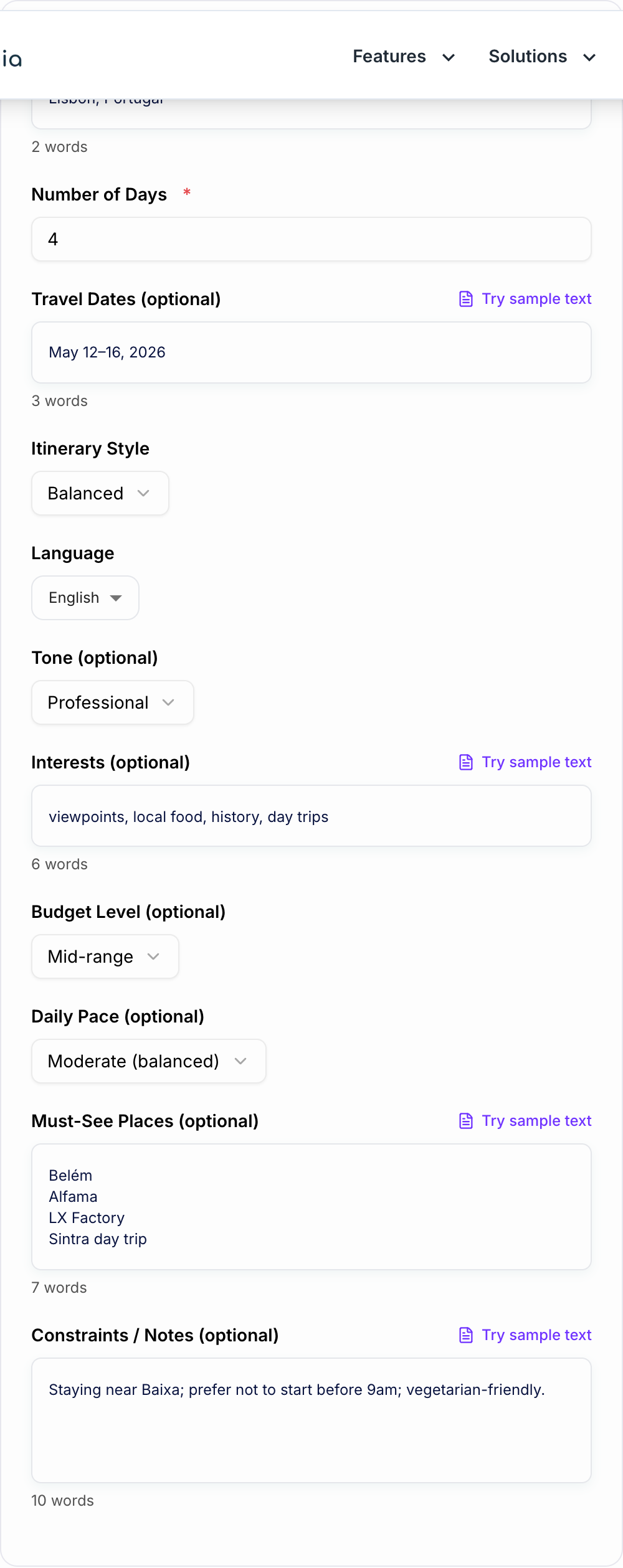
Days, pace, and constraints (budget, mobility, kids) belong on the form. Hours and bookings still need a human check.
Use the AI Travel Itinerary Planner as a mechanical pass. If the output needs a judgment call (legal, medical, grading, production code), a person still owns the last look.
A good travel itinerary is a balance of must-see sights, neighborhood flow, and energy management. It should help you experience more while feeling less rushed.
What makes an itinerary “good”?
- Logical routing: activities grouped by nearby areas so you’re not crossing town repeatedly
- Realistic pacing: time for queues, meals, transit, and breaks
- A clear day structure: morning/afternoon/evening blocks you can follow
- Flexibility: a backup option for weather, closures, or low-energy moments
- Personalization: aligned with your interests (food, museums, nature, nightlife) and budget
A simple planning framework
- Pick one anchor per day (your #1 priority)
- Add nearby supporting activities (1–3 items max depending on pace)
- Choose a neighborhood dinner zone (so evenings stay easy)
- Leave a buffer block (for surprises and serendipity)

Tick these before the output leaves your machine. A fluent miss is still a miss.

Common misses with the Travel Itinerary Planner:
- Describing the file instead of pasting it.
- Running one setting across mixed formats.
- Pasting live customer or student data “to see what happens.”
Translation vs “local feel”
If you’re traveling internationally, the best itinerary isn’t only accurate—it’s practical. That means choosing walkable clusters, planning around typical crowd patterns, and keeping options open.
Pro tip for better results
If you know your hotel area, arrival time, or any non-negotiables (kids, accessibility, dietary needs), add them in the notes. Those details dramatically improve the realism of the day-by-day plan.
Use this travel itinerary generator to create a structured first draft, then do a quick verification pass for opening hours, reservations, and seasonal changes before you finalize your trip.
Frequently Asked Questions
How does the travel itinerary generator work?+
You enter your destination and number of days, then optionally add your dates, interests, budget level, pace, and must-see places. The tool generates a day-by-day itinerary with a logical sightseeing order, time blocks, and practical tips.
Will the itinerary include real addresses and exact opening hours?+
It provides practical planning guidance, but you should confirm opening hours, ticket rules, and temporary closures on official websites. This helps keep your itinerary accurate and avoids last-minute surprises.
Can it create a travel itinerary for any country or city?+
Yes. It can generate itineraries for major cities, small towns, and multi-stop regions worldwide. For remote destinations, add extra constraints (transport, season, driving) to improve accuracy and pacing.
Can I customize the itinerary pace and interests?+
Yes. You can set a relaxed, moderate, or packed pace and add interests like museums, beaches, hiking, shopping, nightlife, or food. You can also list must-see places to ensure they’re included.
Is this itinerary good for international travel planning?+
Yes. It’s designed to produce a clear travel plan with neighborhood grouping, transit awareness, and travel tips. For international trips, you should still verify visa requirements, holidays, and local transportation schedules.
Can I generate the itinerary in another language?+
Yes. Choose your output language to get the full itinerary in that language, which is useful for travel companions, multilingual planning, and local communication.