
Free AIDA Framework Generator
Use the AIDA framework to generate persuasive copy that captures attention, builds interest, creates desire, and drives action. Add your product, audience, benefit, offer, and CTA to create copy for ads, email campaigns, sales pages, product descriptions, and landing pages.
AIDA Copy
Your AIDA framework copy will appear here...
How the AI AIDA Framework Generator Works
Get results in seconds with a simple workflow.
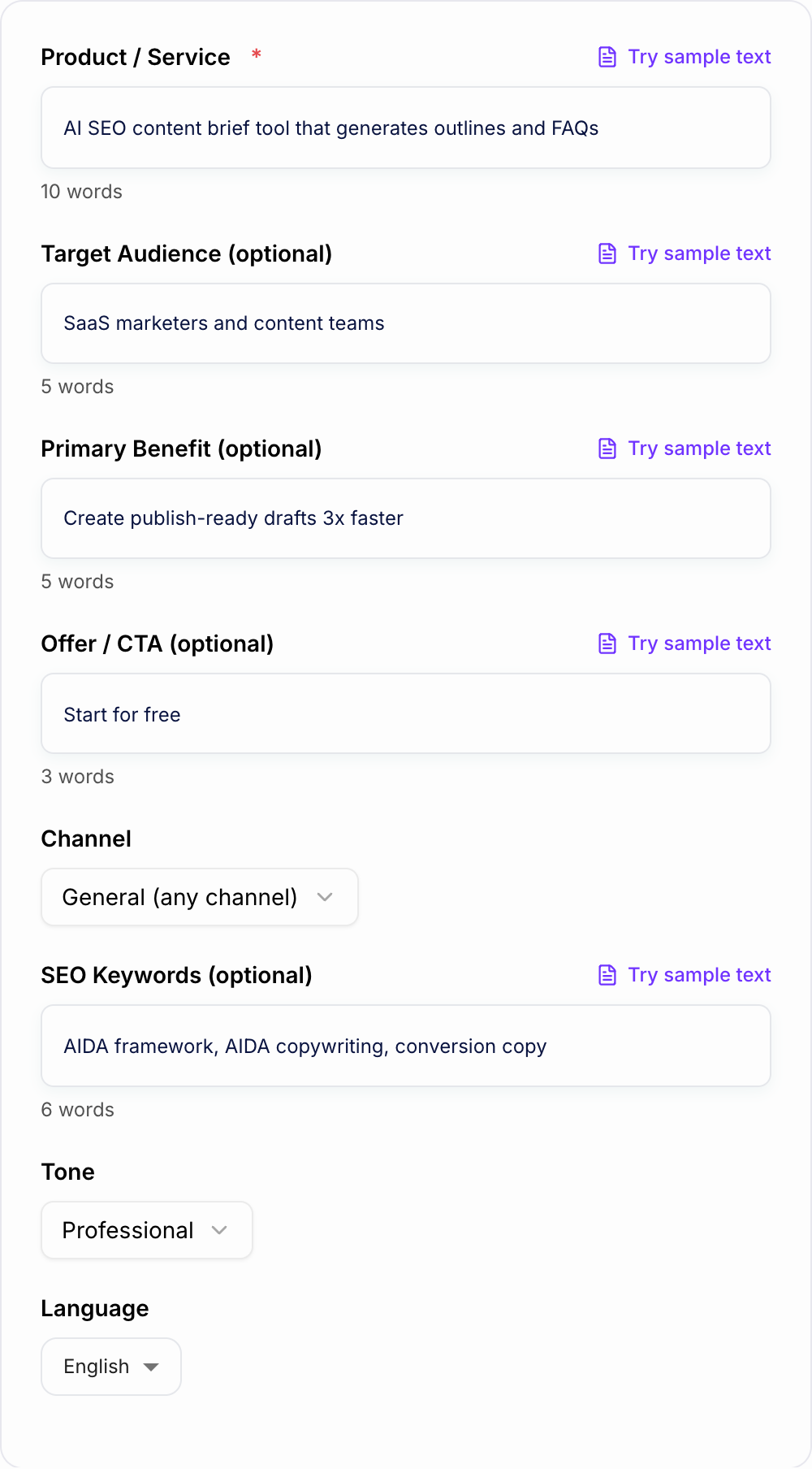
Enter Your Product and (Optionally) Audience + Offer
Add what you’re selling, who it’s for, and what you want readers to do (start free trial, book a demo, buy now). Optional inputs help the copy match your positioning and funnel stage.
Choose Channel, Tone, and Language
Select where the copy will be used (landing page, ads, email, product page). Then pick a tone and output language so the AIDA framework matches your brand voice.
Generate, Then Edit for Specific Proof Points
Copy the AIDA output and enhance it with details like testimonials, metrics, guarantees, and feature-proof pairs. Small edits often create big conversion lifts.
See It in Action
Example of turning a basic product description into persuasive AIDA marketing copy with clear benefits and a strong call to action.
We offer an AI tool that helps you write marketing copy for your website. It’s fast and easy to use.
Attention: Still staring at a blank page when you need high-converting copy?
Interest: Our AI AIDA copy generator helps you turn a product idea into structured marketing messaging—hook, benefits, and CTA—in minutes.
Desire: Get clearer positioning, stronger benefit-led language, and copy that’s tailored for landing pages, ads, or emails—so you can launch faster and improve conversion rates with less guesswork.
Action: Enter your product and offer, choose a tone, and generate your AIDA copy now.
Why Use Our AI AIDA Framework Generator?
Powered by the latest AI to deliver fast, accurate results.
Instant AIDA Copy (Attention → Action)
Generate structured AIDA marketing copy with clear hooks, benefit-led messaging, and strong calls to action—ideal for conversion-focused copywriting.
Channel-Aware Copy for Ads, Email, and Landing Pages
Tailors AIDA output to your channel (landing page, email, paid social, search ads, product pages) so the length, CTA style, and formatting fit the use case.
Benefit-First Messaging That Stays On-Brand
Turns product details into reader-centered benefits and outcomes, helping you write persuasive copy without sounding salesy or generic.
Optional SEO Keyword Integration
If you add keywords, the generator weaves them in naturally to support on-page SEO while keeping the copy readable and conversion-driven.
Multiple CTA Angles and Value Props
Provides strong CTA ideas and positioning angles so you can test variations for higher click-through rates and conversions.
Pro Tips for Better Results
Get the most out of the AI AIDA Framework Generator with these expert tips.
Lead with a specific pain or outcome in Attention
The best hooks are specific. Call out the problem your audience is already trying to solve (or the result they want) to increase scroll depth and clicks.
Turn features into outcomes in Desire
List the result first (save time, reduce risk, increase revenue), then support it with a feature or mechanism. This keeps the copy benefit-led and persuasive.
Add objections right before the CTA
If users hesitate, address common objections in one line (price, time, complexity, switching costs) and then restate the CTA to reduce friction.
Create 3 variants and A/B test your hook + CTA
Often, the biggest lift comes from testing the first line and the CTA. Generate multiple angles and run quick tests on ads, hero sections, or email subject lines.
Use keywords naturally (only where they fit)
If you’re optimizing for SEO, include the primary keyword where it reads naturally—especially in the headline or first lines—without sacrificing clarity or persuasion.
Who Is This For?
Trusted by millions of students, writers, and professionals worldwide.
Generate AIDA Copy with an AI AIDA Framework Generator
AIDA is old. Like, really old. And it still works because it maps to how people buy. The AI AIDA Framework Generator gives you that structure without making you manually rebuild the copy from scratch for every ad, email, product page, or landing page.
People rarely land on your page ready to purchase. They arrive distracted, skeptical, and scanning. AIDA gives you a simple path to move them from “wait, what is this?” to “okay, I want that” without rambling.
Here is the structure the generator uses:
- Attention: stop the scroll. Make the first line earn the next one.
- Interest: confirm you understand the problem, and hint there’s a better way.
- Desire: turn features into outcomes. Add proof, specifics, and differentiation.
- Action: make the next step obvious, easy, and low friction.
And yes, you can compress it for ads or expand it for landing pages. Same structure, different length.
Choose the Right AIDA Format for the Channel
Different channels need different pacing. If you write “landing page AIDA” like an ad, it feels thin. If you write “ad AIDA” like a landing page, it gets ignored.
AIDA for landing pages
- Longer Interest and Desire
- More clarity, more objections handled
- Stronger CTAs, often multiple
What to include:
- A clear promise in the hero
- Proof points or placeholders for proof
- Objection handling near the CTA (pricing, time, switching, complexity)
AIDA for paid ads
- AIDA is compressed into 1 to 4 lines
- The hook is everything
- CTA needs to be direct
What to include:
- A sharp hook (problem, outcome, contrarian angle, curiosity)
- One main benefit, not seven
- One clear action
AIDA for email
- Subject lines do a lot of the Attention work
- Interest and Desire happen fast
- Action is usually a single link or button
What to include:
- 3 to 5 subject line variations
- A preview line that continues the hook
- A tight body with one main point and one CTA
AIDA for product descriptions
- Scannable Desire section with benefit bullets
- Differentiators and “why this one”
- Clear CTA, even if it’s just “Add to cart”
What to include:
- Benefit bullets (outcome first)
- One or two micro proof details (materials, method, results, compatibility)
- Simple CTA line to close
What to Enter for More Specific AIDA Copy
Most generic AIDA copy is missing two things: numbers and mechanism. Add those details before you generate, and the output usually becomes sharper immediately.
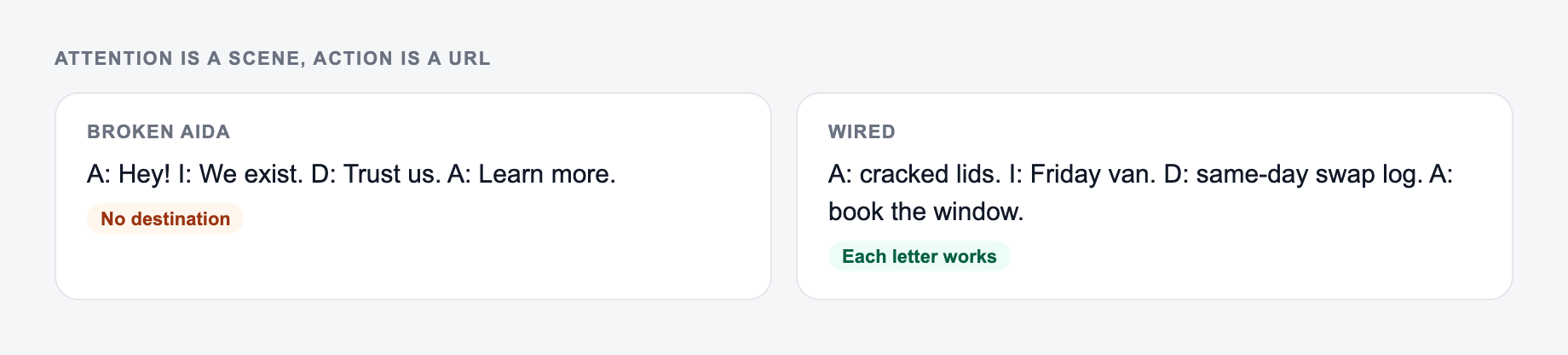
Try adding any of these to your inputs:
- A measurable outcome: “publish 3x faster”, “save 5 hours a week”, “cut CAC by 12%”
- The mechanism: “uses SERP clustering”, “prebuilt templates”, “done for you briefs”
- The alternative you replace: “instead of starting from scratch”, “instead of hiring 3 freelancers”
- A constraint: “in 10 minutes”, “without redesigning your site”, “without long onboarding”
Even one detail changes the whole feel.
Review the Generated AIDA Copy Before Publishing
Run your draft through this. Takes 30 seconds.
Attention
- Does the first line call out a pain, outcome, or strong curiosity gap?
- Is it specific enough that the right audience thinks “that’s me”?
Interest
- Did you clearly name the problem and the stakes?
- Do you hint at the solution without over explaining?
Desire
- Are benefits written as outcomes (not features)?
- Did you include at least one differentiator?
- Did you reduce risk (easy setup, guarantee, cancel anytime, no credit card)?
Action
- Is the CTA one clear step?
- Does the CTA match the offer (demo vs trial vs buy)?
- Did you remove friction with one reassurance line?
AIDA and SEO: yes, they work together (if you don’t force it)
If you’re using AIDA for a landing page that targets search traffic, the trick is simple.
Use the keyword where it naturally belongs:
- In the headline or first lines (Attention or Interest)
- In a subheading that matches the intent
- Lightly in the body, only when it reads normally
Then support it with intent matching sections:
- quick benefits
- objections
- FAQs that match the queries people actually search
Generate a few AIDA versions here, then compare the hooks, benefit language, proof points, and CTA. A broader AI writing platform like Junia AI is useful when that copy needs to become a full landing page, ad set, email sequence, or SEO page instead of a single standalone draft.
Common AIDA mistakes (that quietly kill conversions)
A synonym is not a test. If you change “unlock” to “discover,” you did not run a variant — you changed the mood of the same fog.
-
Attention is vague “Introducing the future of…” is not a hook. Say the pain or the outcome.
-
Interest becomes a feature dump Interest is empathy plus context, not a list of capabilities.
-
Desire has no proof Even a placeholder helps: “Trusted by [industry] teams”, “Used for [use case]”, “Results vary, but…”
-
Action is timid or confusing One CTA. One path. If you want “Book a demo”, don’t also push “Start free trial” in the same breath unless you’re intentionally offering two angles.
When to use AIDA vs other frameworks
AIDA is strongest when you need to move fast from hook to CTA.
Use it when:
- you’re writing ads, landing pages, email promos
- you have a clear offer (trial, demo, discount, guide)
- you want structure that’s easy to edit and test
If you’re writing a long educational blog post, AIDA can still work, but you’ll usually want additional structure like problem agitation, examples, and deeper sections. AIDA is the spine, not the entire body.
A Simple Input Recipe for Better AIDA Outputs
If the output felt generic, it is usually one of these three misses.
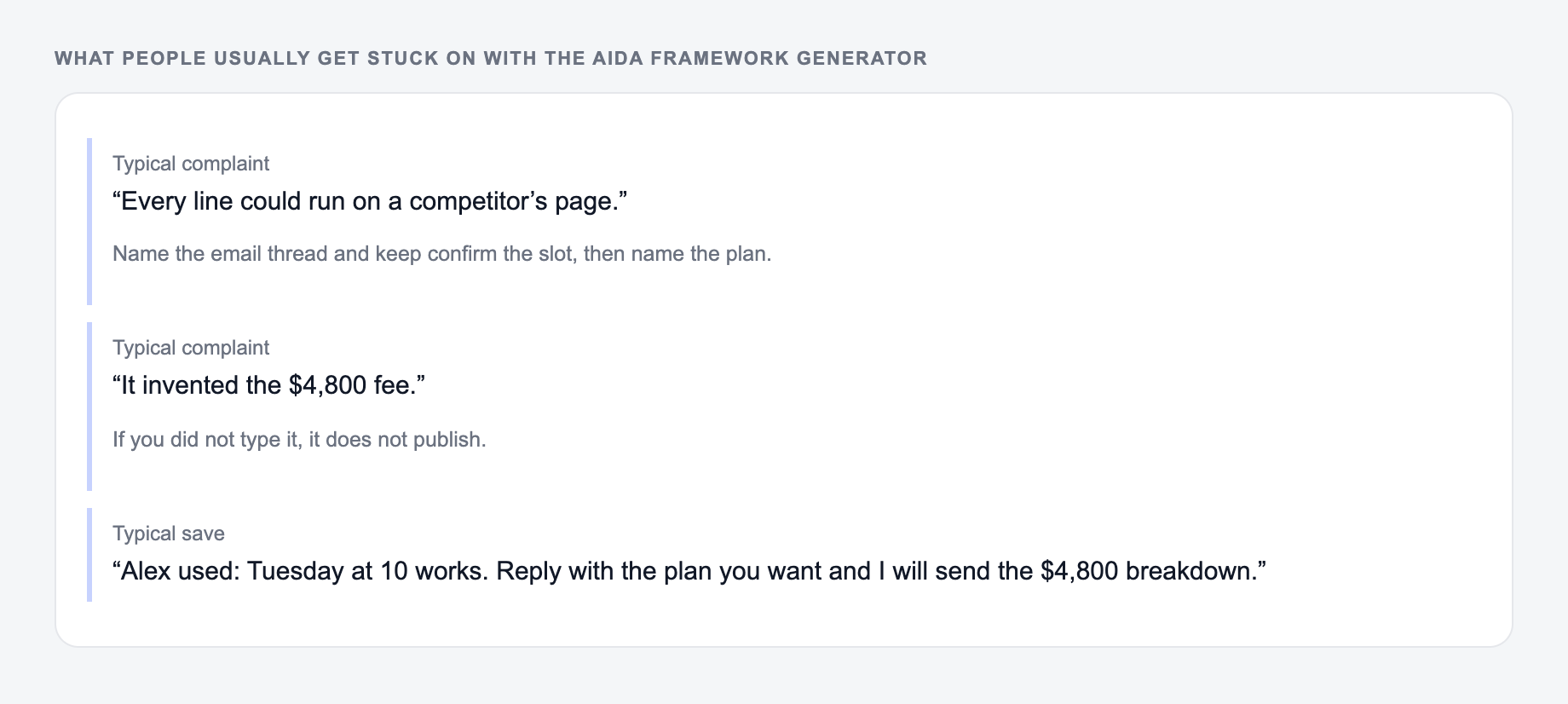
If you want the generator to produce sharper copy, feed it inputs like this before you click generate:
Offer, audience, and where the copy will run belong on the form before Attention-Interest-Desire-Action.
Campaign stub you can actually brief:
- One promise.
- Three assets (ad, email, on-site) that share the promise and change the ask.
- A kill list — offers you will not make this week.
If the AI AIDA Framework Generator output ignores the kill list, the brief never made it onto the form.
- Product: what it is, in plain English
- Audience: who it’s for, plus their context
- Primary benefit: one outcome, ideally measurable
- Offer: the exact CTA
- Channel: where it will be used
- Keywords: only if SEO matters
Small inputs. Big difference.
Frequently Asked Questions
What is the AIDA framework?+
AIDA is a classic copywriting framework that stands for Attention, Interest, Desire, and Action. It helps you structure marketing copy to grab attention, build interest, create desire with benefits, and drive action with a clear CTA.
What can I generate with this AIDA Framework Generator?+
You can generate AIDA copy for landing pages, ads, emails, product descriptions, and general marketing copy. The output is structured to be easy to edit and publish quickly.
How do I make the AIDA copy more specific and less generic?+
Add specifics like your audience, primary benefit, unique differentiator, and offer (free trial, demo, discount, guarantee). The more concrete the inputs, the more tailored and high-converting the AIDA copy will be.
Can I use this for SEO landing pages?+
Yes. Add your target keywords and use the SEO-focused mode (if available) to incorporate keywords naturally. For best on-page SEO results, also align the copy with search intent and add supporting sections like FAQs and proof points on the page.
Does AIDA work for short-form ad copy?+
Yes. In short-form copy, AIDA becomes more compressed: a strong hook (Attention), one key benefit (Interest/Desire), and a direct CTA (Action). This tool can generate multiple concise variations for testing.
Will the generator include guarantees or claims?+
It avoids making unverifiable or risky claims. If you want guarantees, social proof, or compliance-sensitive statements, add them explicitly (or edit the output) to match your brand and legal requirements.