
Free Facebook Ads Primary Text Generator
Generate Facebook ad primary text tailored to your product, audience, campaign goal, offer, and tone. Create hook-led Meta ad copy variations for sales, leads, traffic, awareness, UGC-style creatives, and retargeting tests.
Facebook Ads Primary Text
Your Facebook ad primary text variations will appear here...
How the Facebook Ads Primary Text Generator Works
Get results in seconds with a simple workflow.
Describe Your Product and Offer
Enter what you’re selling and (optionally) your offer, audience, and constraints. Even a short input is enough to generate usable Facebook ad primary text.
Choose Goal, Angle, Tone, and Language
Select your campaign goal and a primary angle (benefits, pain point, social proof, education, urgency). Pick a tone and output language to match your brand voice.
Generate Variations and Test
Get multiple primary text options. Paste the best candidates into Meta Ads Manager, pair them with strong creatives, and A/B test to find the top-performing message.
See It in Action
Example of transforming a generic Facebook ad into clear, benefit-led primary text with a strong hook and CTA.
Try our resume builder today. It’s easy to use and helps you make a great resume fast. Sign up now.
Still tweaking your resume for hours—and hearing nothing back?
Build an ATS-friendly resume in minutes with templates that highlight your skills the right way. Start with a proven layout, customize it to your role, and export a polished version you can send today.
Start your free trial and apply with confidence.
Why Use Our Facebook Ads Primary Text Generator?
Powered by the latest AI to deliver fast, accurate results.
Conversion-Focused Facebook Ad Primary Text Variations
Generate multiple Meta ad primary text options built for performance—hooks, benefits, proof points, and clear CTAs—so you can test creatives faster and improve ROAS.
Goal + Angle-Based Copy (Sales, Leads, Traffic, Awareness)
Adapts messaging to your campaign objective and chosen angle (benefits, pain point, social proof, education, urgency) to match user intent and reduce wasted spend.
Audience-Aware Messaging That Feels Native in the Feed
Produces audience-specific language and value props that sound natural on Facebook and Instagram—helping ads blend into the feed while still driving action.
Keyword-Smart Copy for Relevance (Without Stuffing)
Optionally incorporates a primary keyword and related phrases to boost ad relevance signals and clarity, while keeping the copy human, readable, and policy-friendly.
Built-In Testing-Friendly Output
Creates diverse copy angles (short, medium, story-led, proof-led) so you can A/B test primary text alongside headlines and creatives to find winning combinations.
Pro Tips for Better Results
Get the most out of the Facebook Ads Primary Text Generator with these expert tips.
Write for the first 2 lines
Most people skim the opening. Make the first sentence a hook (pain point, outcome, or curiosity) so users tap “See more” and keep reading.
Match the copy to the creative
Primary text should set up what the image/video proves. If your creative shows a demo, your copy should promise the result and explain how it works—briefly.
Use one clear CTA (and reduce friction)
Tell people exactly what to do next: shop now, get the guide, book a call, start a free trial. Add a friction reducer like “cancel anytime” or “takes 60 seconds” if true.
Test different hook families
Rotate hooks: question hooks, contrarian statements, quick-win promises, “before/after” framing, and social proof. Keep the offer constant to isolate the hook impact.
Avoid policy-risk phrasing
Avoid implying personal attributes (e.g., “Are you depressed?”). Use general phrasing (e.g., “If you’ve been feeling stressed…”) and keep claims realistic and supportable.
Who Is This For?
Trusted by millions of students, writers, and professionals worldwide.
Generate Facebook Ad Primary Text Variations That Are Ready to Test
Facebook ad primary text has to do more than describe the product. It needs to stop the scroll, connect the creative to the offer, make the next step feel clear, and avoid claims that create policy or trust problems.
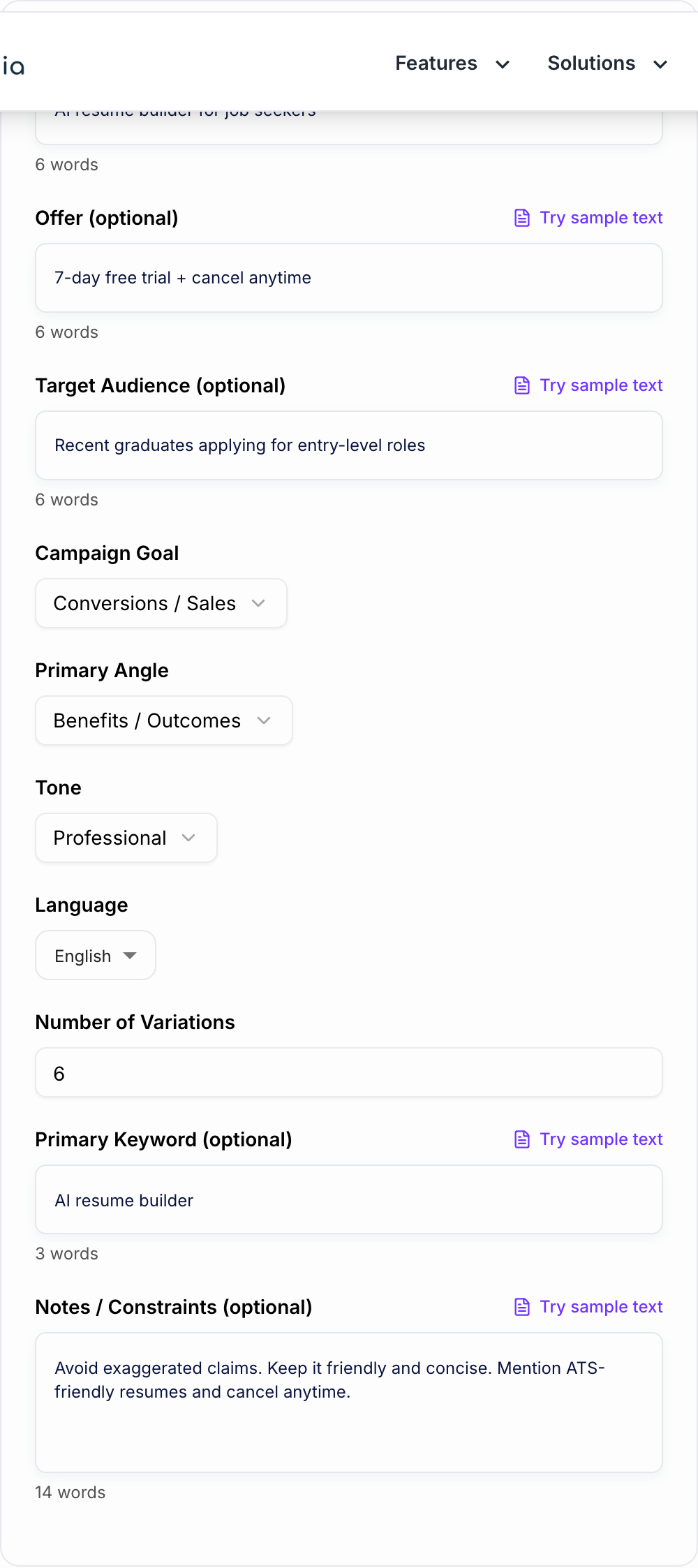
This Facebook Ads Primary Text Generator helps you create those variations faster. Instead of rewriting the same ad five ways, you can generate different hooks, angles, tones, and CTAs from one campaign brief.
What to enter before you generate ad copy
Treat the input form like a short creative brief. The generator can work from a simple product description, but the strongest output usually includes:
- Product or service: what you are selling
- Audience: who should care about it
- Campaign goal: conversions, leads, traffic, awareness, engagement, or app installs
- Offer: discount, demo, free trial, guide, quote, booking, bundle, or limited-time deal
- Primary benefit: what changes for the customer
- Proof: rating, review count, customer count, speed, warranty, credential, or differentiator if true
- Constraints: claims to avoid, phrases to include, emoji preference, tone, or length
Weak input:
Project management app for teams
Stronger input:
Project management app for 10-50 person agencies. Goal: demo bookings. Benefit: see every deadline, owner, and client update in one workspace. Proof: used by 1,200 agencies. CTA: Book a demo. Tone: clear, confident, no emojis.
That extra context gives the generator enough material to produce copy that sounds campaign-specific rather than generic.
Pick the mode based on the campaign goal
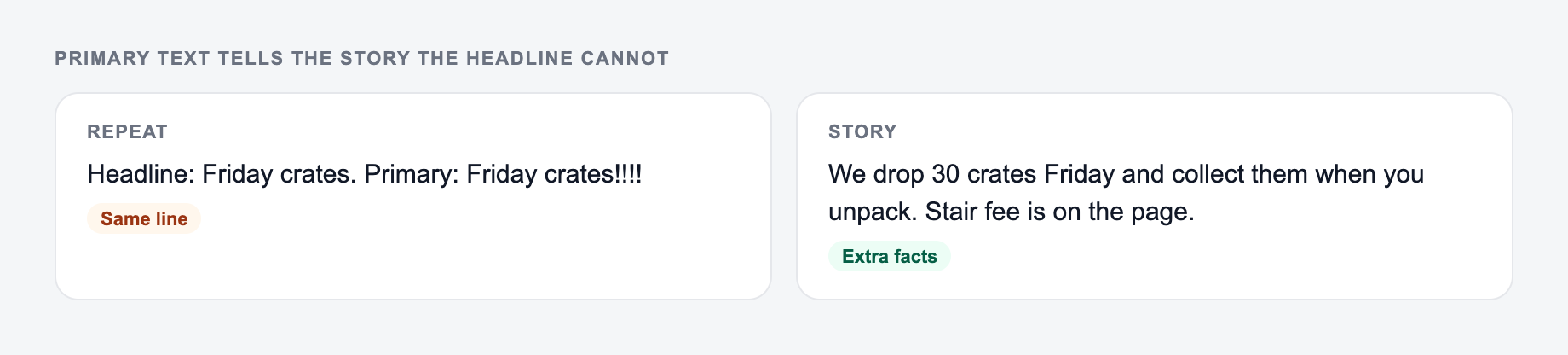
The same product can need different primary text depending on the objective.
Performance / Direct Response
Use this for conversions, trials, bookings, quotes, and purchases. The copy should move quickly from hook to benefit to CTA.
Brand Voice
Use this when trust, positioning, or values matter more than immediate conversion. This works for awareness campaigns, founder-led brands, and categories where the buyer needs context.
UGC-Style
Use this when the creative feels like a creator video, testimonial, or personal recommendation. Keep the copy conversational and avoid sounding like a polished corporate ad.
Problem -> Solution
Use this when the audience already feels the pain. The trick is to describe the problem without overdoing negativity or implying sensitive personal attributes.
Offer / Promotion
Use this when the deal is the reason to act. Add real terms, deadlines, and exclusions so the generated copy stays accurate.
Lead Gen
Use this when the CTA asks for a form fill, booking, quote, or demo. Good lead-gen copy explains what happens after the click and reduces friction.
Example input and generated direction
Input:
Paste the offer and the one proof you have. The form should not invent social proof.
A/B is one changed idea. Swapping “unlock” for “discover” is not a variant. Test object-vs-urgency, or proof-vs-promise — not two moods of the same fog.
- Product: AI resume builder
- Audience: recent graduates applying for entry-level roles
- Goal: conversions
- Offer: 7-day free trial, cancel anytime
- Benefit: create an ATS-friendly resume in minutes
- Constraint: no exaggerated job-guarantee claims
Generated primary text direction:
Still rewriting your resume every time you apply?
Build an ATS-friendly version in minutes with guided templates that help your strongest skills stand out. Start with a proven layout, tailor it to the role, and export a polished resume you can send today.
Start your free trial and apply with more confidence.
The structure is simple: hook, benefit, reason to believe, friction reducer, CTA. You can ask the generator for shorter, more direct, UGC-style, or proof-led variations from the same input.
How to review generated Facebook ad primary text
Do not paste every generated option into Meta Ads Manager. Shortlist first.
Check each variation for:
- First-line strength: Would the opening line earn attention before "See more"?
- Message match: Does the copy support the image, video, headline, and landing page?
- One main CTA: Is the next step obvious, or are you asking for too many things?
- Proof quality: Are numbers, testimonials, ratings, or claims accurate and visible after the click?
- Policy risk: Does the copy imply personal health, finances, identity, or hardship in a way Meta may reject?
- Length fit: Does the copy fit the creative format and buying stage?
If a version is promising but vague, regenerate with a stronger benefit. If it sounds too aggressive, add constraints such as "avoid hype," "keep claims conservative," or "make this more professional."
How to test generated primary text without muddy data
Primary text testing gets messy when every ad changes at once. Keep the creative and offer stable, then compare copy angles.
A clean test might include:
- 2 pain-point hooks
- 2 benefit-led hooks
- 2 proof-led hooks
- 1 educational hook
- 1 direct offer hook
Watch CTR and CPC for attention quality, but do not stop there. CPA, lead quality, conversion rate, and comments can reveal whether the copy is attracting the right clicks.
When one hook family wins, generate a second batch in that family. That is usually more useful than jumping straight to a totally different message.
Keep the ad copy connected to the whole funnel
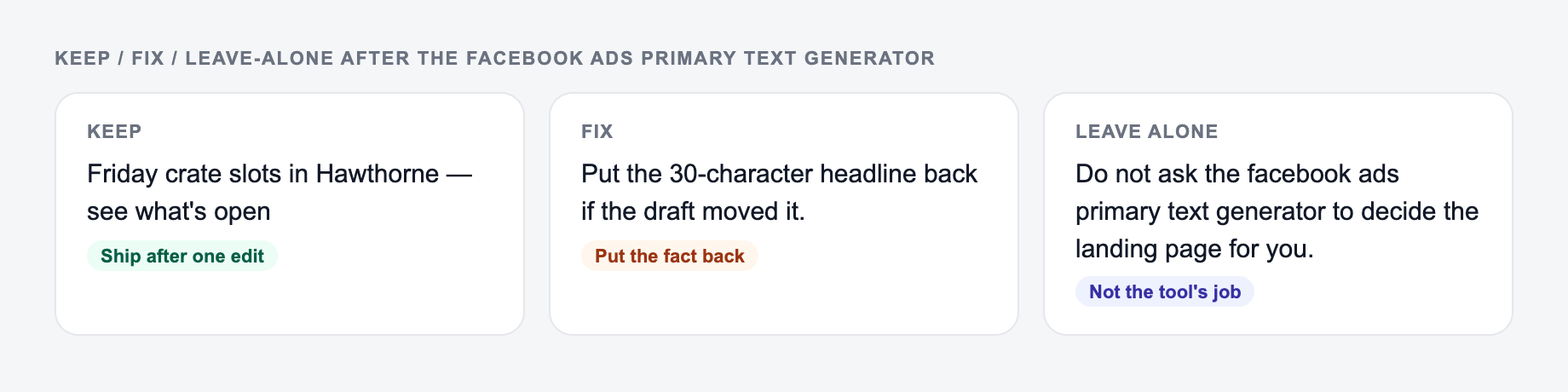
After you generate, sort the draft into keep / fix / leave-alone. Do not “improve” a sentence that was blunt on purpose.
Primary text should not carry the campaign alone. The creative should prove or dramatize the promise. The headline should compress the reason to click. The landing page should repeat the same offer and remove doubt.
If you are turning one campaign idea into ads, landing pages, emails, and follow-up messages, a broader writing workspace like Junia AI can help keep the core promise consistent across each asset.
Final checklist before publishing
Before a generated primary text variation goes live, confirm:
- The first line is specific enough to stop a relevant viewer
- The product and offer are understandable in a few seconds
- The CTA matches the campaign objective
- The copy does not make unsupported claims
- The tone matches the brand and creative format
- The landing page delivers what the ad promises
Frequently Asked Questions
What is Facebook ads primary text?+
Primary text is the main body copy of a Facebook (Meta) ad that appears above or alongside the creative. It’s where you hook attention, explain the offer, highlight benefits, and tell people what to do next (CTA).
How do I write high-converting primary text for Meta ads?+
Start with a strong hook, quickly state the outcome or benefit, add a proof point or differentiator, reduce friction (what happens next), and end with a clear CTA. Testing multiple angles is key because performance varies by audience and creative.
How many primary text variations should I test?+
A practical starting point is 5–10 variations per ad set. Test different hooks (question, bold claim, pain point), different benefit stacks, and different CTAs while keeping the creative consistent so you can isolate what drives results.
Will this tool help with Facebook ad compliance and policies?+
It generates copy intended to be clarity-first and non-deceptive, but you should still review for Meta policies (especially around personal attributes, health/finance claims, and restricted content). Remove anything that could be interpreted as targeting sensitive traits.
Should I include emojis in Facebook ad primary text?+
It depends on your brand and audience. Emojis can increase scannability, but they can also reduce perceived professionalism in some niches. Use them sparingly and test performance across placements.
Do keywords matter in Facebook ad copy?+
Unlike SEO, Meta ads don’t rank by keywords, but including clear, relevant terms can improve message match and user understanding—often leading to better CTR and conversion rates. Avoid keyword stuffing; prioritize clarity and benefits.