
Free Literature Review Generator
Generate a structured literature review from a topic, research question, source list, notes, and citation style. The tool helps organize themes, compare findings, surface research gaps, and turn scattered academic notes into a draft you can verify and refine.
Literature Review
Your literature review will appear here...
How the AI Literature Review Generator Works
Get results in seconds with a simple workflow.
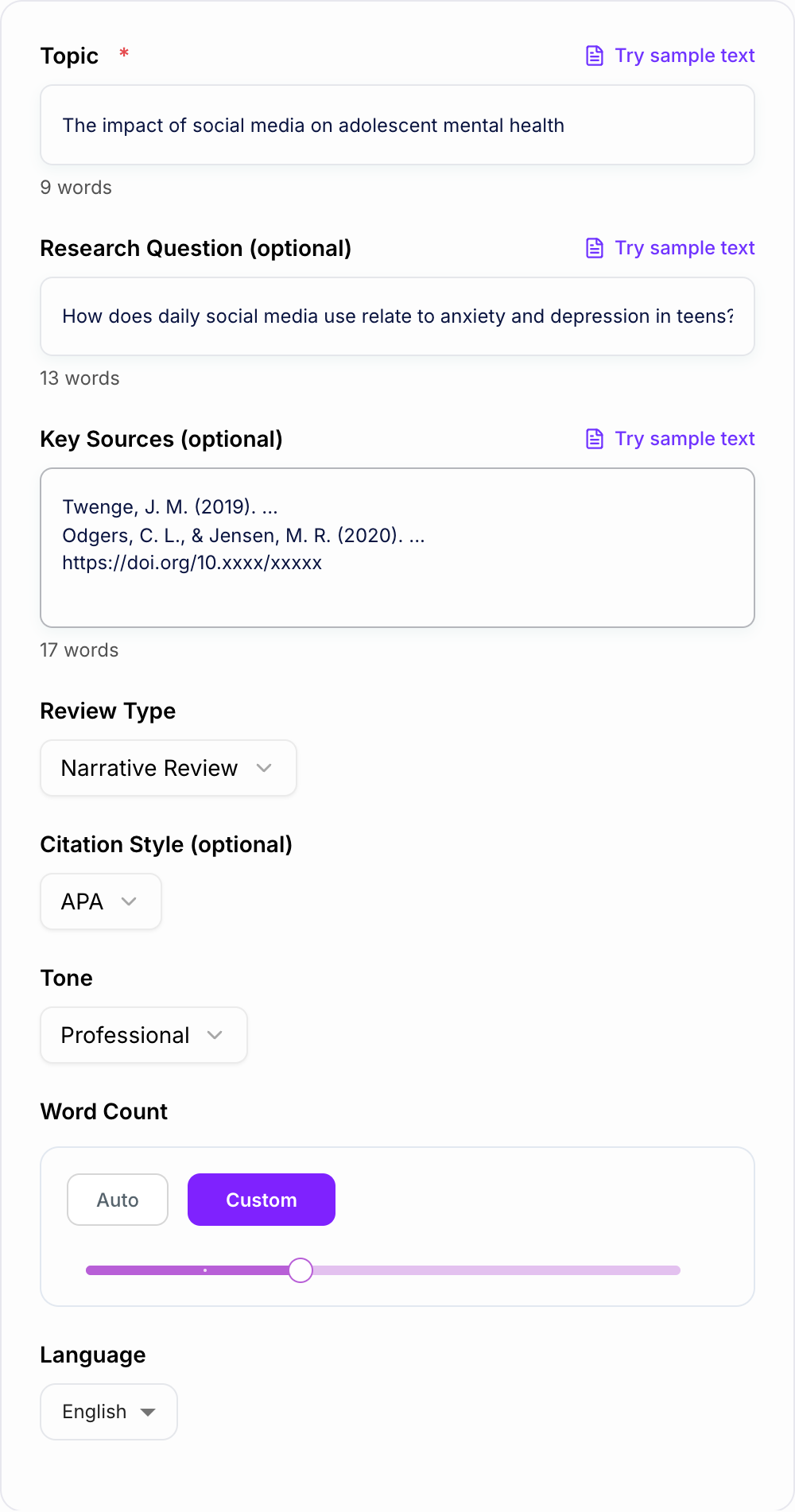
Add Your Topic (and Research Question)
Enter your literature review topic and optionally a research question to anchor the scope, themes, and synthesis around a clear purpose.
Paste Key Sources (Optional but Recommended)
Add citations, DOIs, URLs, or brief notes—one per line. The generator will synthesize these sources and avoid inventing references if none are provided.
Choose Review Type, Style, and Length
Pick narrative, thematic, chronological, critical, or systematic-style, set word count, tone, and language to match your academic requirements.
Generate, Then Validate and Refine
Use the output as a draft. Verify claims against your sources, refine the conceptual framework, and add missing seminal works before submission.
See It in Action
Turn a broad topic into a structured, academic literature review with themes, synthesis, gaps, and future research directions.
Topic: social media and teen mental health
I need a literature review for my dissertation proposal.
Title: Social Media Use and Adolescent Mental Health: A Thematic Literature Review
Introduction and scope: Defines key constructs (social media use intensity, problematic use, well-being), clarifies population and outcomes, and states the research question.
H2: Theme 1 — Patterns of Use and Exposure
- Active vs passive use, time spent, content type
- Measurement approaches and common limitations
H2: Theme 2 — Anxiety, Depression, and Well-Being Outcomes
- Evidence patterns across cross-sectional and longitudinal studies
- Confounders and effect heterogeneity
H2: Theme 3 — Mechanisms and Mediators
- Social comparison, sleep disruption, cyberbullying, fear of missing out
- Protective factors (social support, digital literacy)
H2: Theme 4 — Moderators and Equity Considerations
- Age, gender, socioeconomic context, baseline mental health
- Platform differences and cultural context
Research gaps:
- Need for stronger causal inference designs and standardized measures
- Understudied groups and context-specific outcomes
Future research directions:
- Longitudinal designs with objective usage data
- Mechanism-focused interventions and subgroup analyses
Conclusion: Summarizes consensus and debate while linking themes back to the research question.
Why Use Our AI Literature Review Generator?
Powered by the latest AI to deliver fast, accurate results.
Theme-Based Synthesis (Not Just Summaries)
Generates a coherent literature review organized by themes, comparing findings across studies and building an argument aligned with your topic and research question.
Research Gaps + Future Research Directions
Identifies common limitations, underexplored populations, methodological gaps, and unanswered questions—then proposes specific future research directions.
Academic Structure With Clear Signposting
Produces a standard literature review structure: introduction and scope, themed sections, critical discussion, limitations, research gaps, and conclusion—optimized for theses, dissertations, and journal manuscripts.
Citation-Aware Writing (With Safety Guardrails)
Uses your pasted sources as anchors. If no sources are provided, it produces a generalized literature review framework and clearly avoids fabricating exact citations or unverifiable statistics.
Adjustable Review Types + Style
Choose narrative, thematic, chronological, critical, or systematic-style formats and output language to match your discipline, supervisor requirements, and target publication venue.
Pro Tips for Better Results
Get the most out of the AI Literature Review Generator with these expert tips.
Paste sources with one-line notes for better synthesis
Add brief notes like “method, sample, key finding, limitation.” This enables more accurate comparisons, stronger thematic grouping, and a more critical literature review.
Define your scope early (population, context, timeframe)
A tight scope reduces generic writing and improves relevance. Include population, setting, timeframe, and key constructs to sharpen theme selection and gap analysis.
Prioritize synthesis language
Look for comparative phrasing (e.g., “in contrast,” “similarly,” “however,” “collectively”) and ensure each paragraph connects multiple studies to an argument—not a list of summaries.
Make gaps actionable
Turn vague gaps into testable questions: specify variables, populations, methods, and outcomes. Strong gaps improve your proposal’s rationale and study design.
Add a conceptual framework to stand out
If relevant, include a model or set of constructs that organizes the review. This improves clarity, coherence, and perceived rigor for thesis committees and peer reviewers.
Who Is This For?
Trusted by millions of students, writers, and professionals worldwide.
Generate a Literature Review Draft From Sources, Notes, and Themes
A literature review is not just a summary of articles. It is a structured explanation of what the research says, where studies agree, where they conflict, and what gap still matters. The Literature Review Generator on this page helps turn a research topic, source list, and notes into a draft you can verify and refine.
Use it when you have scattered papers, rough notes, or a broad research question and need a cleaner structure before writing the final version.
What to Enter Into the Literature Review Generator
The generator works best when you provide more than a topic. Add:
- Your research question, even if it is rough
- The discipline or course context
- Population, setting, timeframe, or key constructs
- Source titles, authors, or citation notes
- One or two lines per source about method, sample, finding, limitation, or theory
- Required citation style
- Any sources or claims you want excluded
A weak input is: "social media and teen mental health." A stronger input includes the age range, outcomes, source notes, and whether the review should focus on anxiety, depression, sleep, social comparison, cyberbullying, or digital literacy.
Pick the Review Type Carefully
Use Narrative Review for a standard related-work section that needs smooth explanation and source synthesis.
Use Thematic Synthesis when the literature is messy, multidisciplinary, or easier to organize by patterns and debates.
Use Chronological Review only when the field changed in clear phases, such as before and after a major policy, technology, method, or theory shift.
Use Critical Review when the assignment expects you to evaluate evidence quality, methods, assumptions, or limitations.
Use Systematic Style when you need transparent search logic, inclusion criteria, and a more formal methods section. It is not a replacement for a full systematic review, but it can help structure the draft.
How to Review the Generated Draft
Treat the output as a structured starting point, not a finished academic submission.
Check:
- Does each section synthesize several sources instead of summarizing one paper at a time?
- Are claims tied to sources you actually provided?
- Are gaps specific enough to guide future research?
- Does the conclusion connect back to the research question?
- Are citations real, complete, and formatted correctly?
Any claim that sounds highly specific needs source verification. Do not keep generated findings, sample sizes, dates, or citations unless you can confirm them.
Example Input and Output Direction
Input:
Paste sources you read. The form should not invent citations or years.
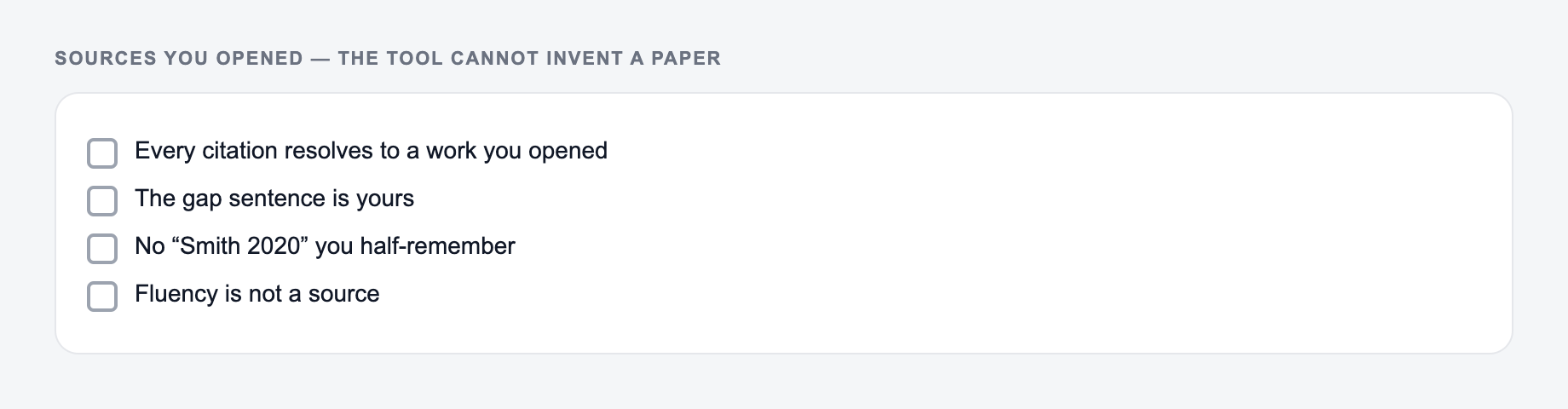
How to verify output from the AI Literature Review Generator:
- Every citation resolves to a real work you opened
- Numbers match the source, not a rounded “about”
- Instructions are safe for the actual room, grade, or patient context
- Nothing was added that you did not type
If the task is graded, cited, or used with students, the named writer still owns the claims.
Research question: How does passive social media use relate to anxiety and depressive symptoms among adolescents? Sources: 12 articles with notes on method, sample, findings, and limitations. Review type: thematic synthesis. Citation style: APA.
Generated direction:
The draft can group the literature into patterns of use, mental health outcomes, mechanisms such as social comparison and sleep disruption, moderators such as gender or baseline mental health, and research gaps around causal inference and measurement.
That structure is more useful than a paper-by-paper summary because it helps the reader understand the field, not just the reading list.
Common Mistakes to Avoid
The Literature Review Generator drafts structure. You still own the claim. If you cannot explain a sentence without looking it up, do not leave it in.
Do not paste only article titles and expect deep synthesis. Add source notes.
Do not let the generator invent authority. If a sentence sounds like it came from a study, match it to a real source.
Do not choose chronological structure unless time order matters to the argument.
Do not treat citation formatting as final. Use your citation manager, style guide, or institution requirements for the final pass.
Do not submit the draft without checking whether each theme supports your research question.
Use the Draft in a Larger Research Workflow
A generated literature review is most useful when it gives you a workable map: themes, gaps, transitions, and a conclusion direction. From there, you can revise the argument, add stronger citations, and align the structure with your assignment, thesis, dissertation, or article.
If you are building related research sections, the broader writing tools on Junia AI can help keep abstracts, outlines, summaries, and proposal drafts consistent while you do the source verification yourself.
Final Literature Review Checklist
Use this as a preflight, not a caption. If a box fails, change the input or cut the line.
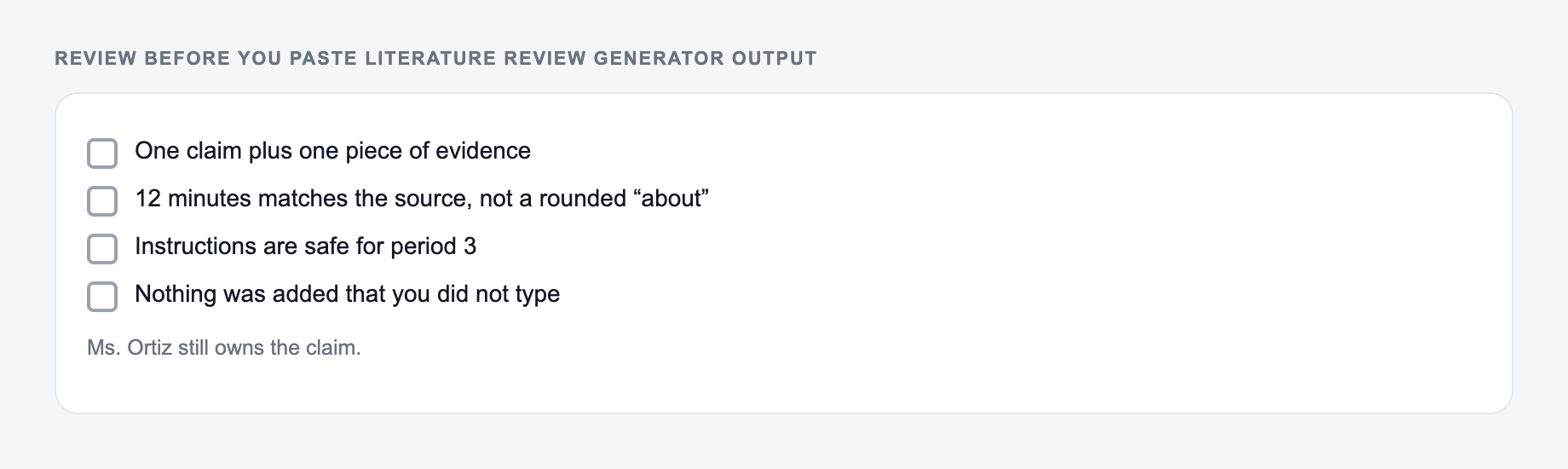
Before using the generated draft, confirm that the scope is clear, the themes are logical, multiple sources appear in each main section, disagreements are handled honestly, research gaps are specific, and every citation or factual claim has been checked against the original source.
Frequently Asked Questions
Is this literature review generator free to use?+
Yes. You can generate a literature review draft for free. Some advanced modes (like critical and systematic-style) may be marked as premium.
Will the tool include real citations and references?+
If you paste your sources (citations, DOIs, links, or notes), the review will write in a citation-aware way using those as anchors. If you don’t provide sources, it will generate a generalized literature review framework and will not invent precise references.
Can it write a systematic literature review?+
It can generate a systematic-style draft with a transparent methods overview and structured synthesis, but it cannot perform a true systematic review (e.g., exhaustive database search, screening, PRISMA flow) unless you supply the required methodology details.
How do I get a higher-quality literature review output?+
Add a clear research question and paste 5–15 key sources (citations/DOIs/URLs) with brief notes on each study’s findings or method. More source-specific input produces more accurate synthesis and stronger thematic structure.
Does it work for any field (psychology, education, business, medicine, computer science)?+
Yes. It can adapt structure and terminology across disciplines. For specialized fields, provide domain terms, the research question, and key sources to improve accuracy and relevance.
Can I generate the literature review in another language or with a different academic tone?+
Yes. Select your output language and tone. For best results, keep your topic and sources consistent with the chosen language and academic conventions.