
Free Research Paper Generator
Generate a structured research paper draft from your topic, thesis, sources, citation style, and academic level. Build an outline, full paper, literature review, or IMRaD-style draft with clear sections and citation placeholders you can replace with verified sources.
Research Paper Draft
Your research paper draft will appear here...
How the AI Research Paper Generator Works
Get results in seconds with a simple workflow.
Enter Your Topic (and Optional Thesis)
Start with a specific research topic. Add a thesis statement if you have one to keep the argument focused and reduce revisions later.
Choose Paper Type, Citation Style, and Length
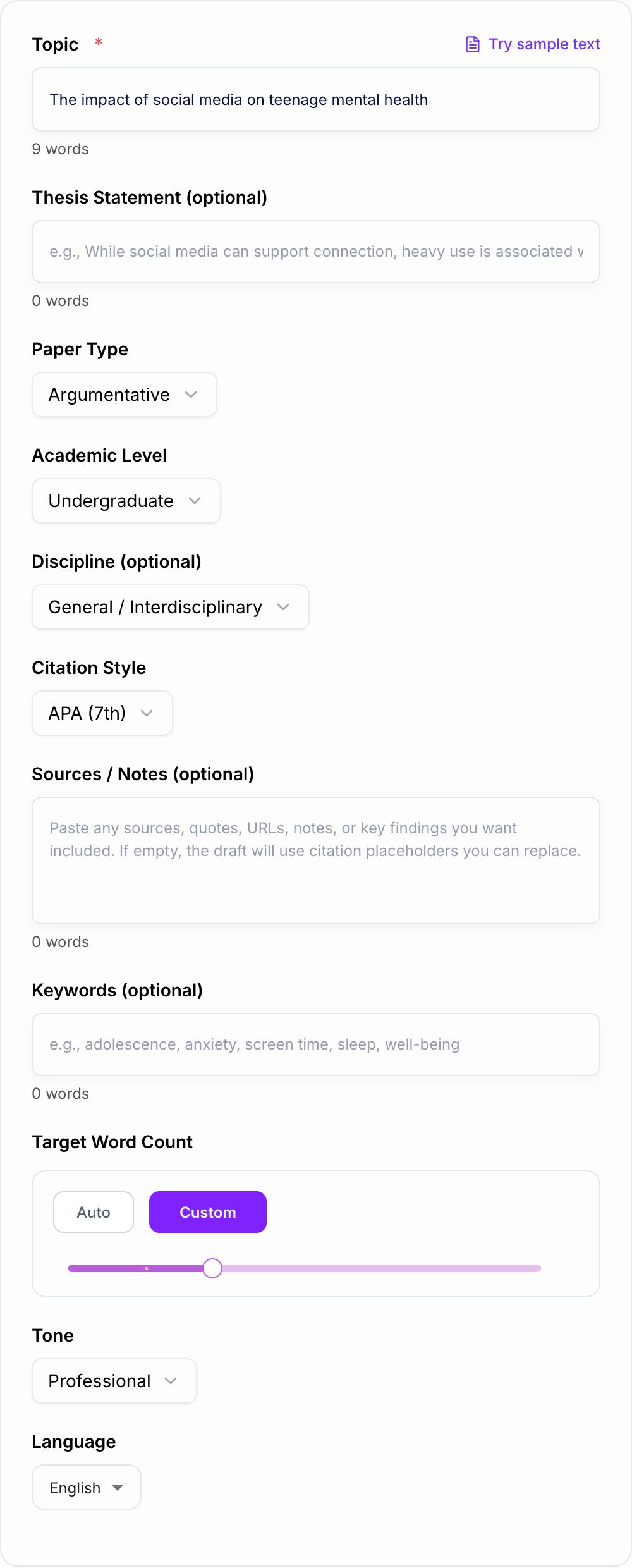
Select your paper type (argumentative, analytical, literature review, IMRaD), then pick APA/MLA/Chicago/Harvard and set a target word count for a draft that fits your assignment.
Generate, Then Replace Citation Placeholders
Get a complete draft with citation placeholders and a references template. Replace placeholders with verified sources, refine claims, and ensure originality before submission.
See It in Action
Example of turning a vague topic into a structured, citation-ready research paper draft with clear sections and a thesis-driven argument.
Topic: social media and teens
I need a research paper about how social media affects teenagers.
Title: Social Media Use and Adolescent Mental Health: Mechanisms, Risks, and Protective Factors
Abstract: This paper examines how social media use may influence adolescent mental health through mechanisms such as social comparison, cyberbullying exposure, and sleep disruption. It also reviews protective factors including digital literacy and supportive online communities. (Author, Year)
H2: Introduction
- Defines the problem and scope (teens, mental health outcomes)
- States research questions and thesis
H2: Background / Key Concepts
- Social comparison theory, self-esteem, and online identity
- Screen time vs. platform behaviors
H2: Literature Review (Themes) H3: Social comparison and anxiety symptoms (Author, Year) H3: Cyberbullying and depressive outcomes (Author, Year) H3: Sleep disruption and well-being (Author, Year) H3: Protective factors: parental mediation and digital resilience (Author, Year)
H2: Discussion
- Weighs evidence, highlights confounders, and explains plausible mechanisms
- Identifies research gaps and future directions
H2: Conclusion
- Summarizes main claims and practical implications
References (APA 7th):
- Author, A. A. (Year). Title of article. Journal Name, volume(issue), pages. DOI/URL
Why Use Our AI Research Paper Generator?
Powered by the latest AI to deliver fast, accurate results.
Academic Structure (Abstract, Intro, Body, Conclusion)
Generates a properly structured research paper draft with clear sections, logical flow, and strong signposting—ideal for academic writing, term papers, and research assignments.
Thesis-Driven Argumentation
Builds a focused thesis and supports it with claims, reasoning, and evidence types to look for—helping you create a coherent argument rather than a generic summary.
Citation-Style Formatting (APA/MLA/Chicago/Harvard)
Outputs in-text citation placeholders and a references section aligned to your selected citation style, making it easier to insert verified sources and finalize your bibliography.
Discipline-Aware Writing
Adapts vocabulary, methodological framing, and section emphasis based on discipline (e.g., psychology vs. business), improving relevance and academic fit.
Source Integration (When Provided)
If you paste notes or sources, the draft incorporates them into the correct sections, preserving key points and maintaining consistent academic tone and clarity.
Pro Tips for Better Results
Get the most out of the AI Research Paper Generator with these expert tips.
Use a narrow topic to improve depth
Instead of broad topics like “climate change,” use a focused angle (e.g., “heat islands and public health in urban neighborhoods”) to produce clearer arguments and more relevant sections.
Paste 3–8 key sources or notes for stronger specificity
Even short bullet points or quotes help the draft anchor claims to real material, improve terminology, and reduce generic academic writing.
Turn placeholders into a research checklist
Use each (Author, Year) placeholder as a prompt to find a real source that supports the exact claim in that sentence or paragraph.
Strengthen academic credibility with cautious language
When evidence is mixed, use academically appropriate hedging (e.g., “suggests,” “is associated with,” “may indicate”) and avoid absolute claims unless you can cite strong studies.
Revise the introduction last
After drafting body sections, rewrite the introduction to match the final argument, key findings, and paper structure for a more coherent final submission.
Who Is This For?
Trusted by millions of students, writers, and professionals worldwide.
Generate a Research Paper Draft with an AI Research Paper Generator
A research paper generator is useful when you need structure before you need polish. Instead of starting from a blank document, you can enter a topic, thesis, notes, citation style, and target length, then generate a draft with sections you can evaluate.
The important part is how you use the output. Treat it as a structured first draft: a thesis to test, claims to verify, citation placeholders to replace, and paragraphs to revise in your own academic voice.
What to Enter Before You Generate
The strongest outputs come from specific inputs. A broad topic will create broad paragraphs, so add boundaries wherever you can.
Useful inputs include:
- a narrow topic, population, place, or timeframe
- a working thesis or research question
- assignment requirements from your rubric
- discipline or course context
- required citation style, such as APA, MLA, Chicago, or Harvard
- source notes, quotations, URLs, or findings you already trust
- keywords or terms your paper must use
Weak input: "social media and teens"
Better input: "late-night Instagram and TikTok use among high school students, focusing on sleep quality, anxiety symptoms, and peer comparison. Use cautious language and APA placeholders."
How to Choose the Right Research Paper Mode
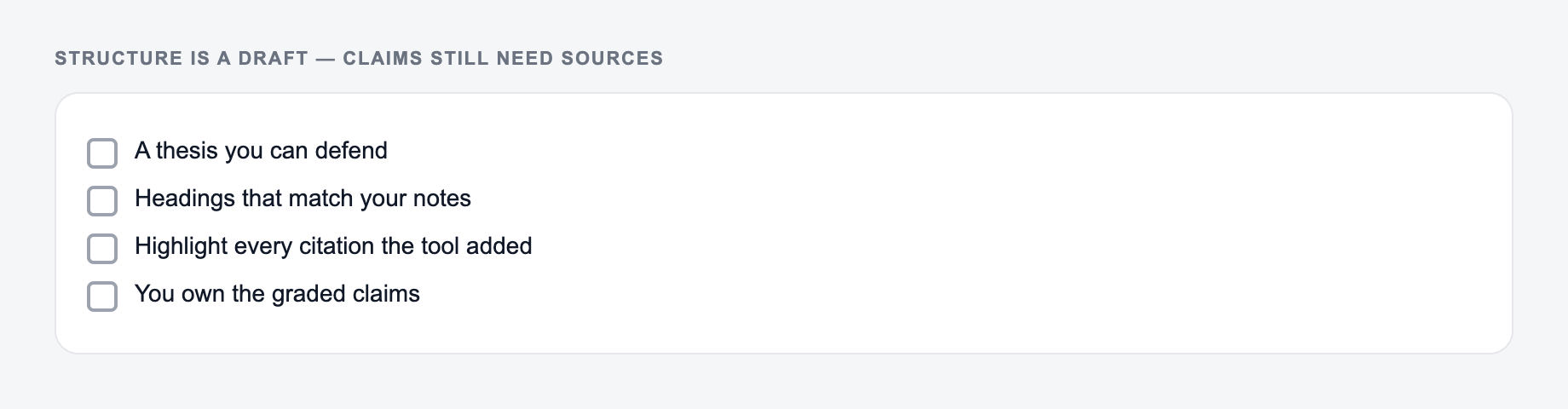
The Research Paper Generator drafts structure. You still own the claim. If you cannot explain a sentence without looking it up, do not leave it in.
Use the mode based on where you are in the writing process.
Outline Only
Choose this when you are still planning. The output should give you section headings, research questions, evidence types to look for, and a logical path through the argument.
Full Draft
Choose this when you already have direction and want paragraphs. Paste your thesis and notes so the generated paper is not forced to fill gaps with generic academic language.
Literature Review
Choose this when the assignment is about synthesis rather than argument. The generator should group themes, debates, gaps, and source needs without inventing studies.
Argumentative Paper
Choose this when you need a claim, counterarguments, rebuttals, and transitions. This mode works best when your thesis is already clear.
Empirical IMRaD
Choose this for Introduction, Methods, Results, and Discussion structure. If you do not provide actual data, keep any results clearly hypothetical or turn the output into a template.
Example Input, Generated Structure, and Revision Notes
Input:
Enter sources you can cite. Placeholder citations are a todo list, not a bibliography.
Worked example
Input: A one-line request like “run the research paper generator” with no audience, channel, or constraint.
Direction to keep: A brief the AI Research Paper Generator can use: who it is for, where the output will appear, and what must stay true.
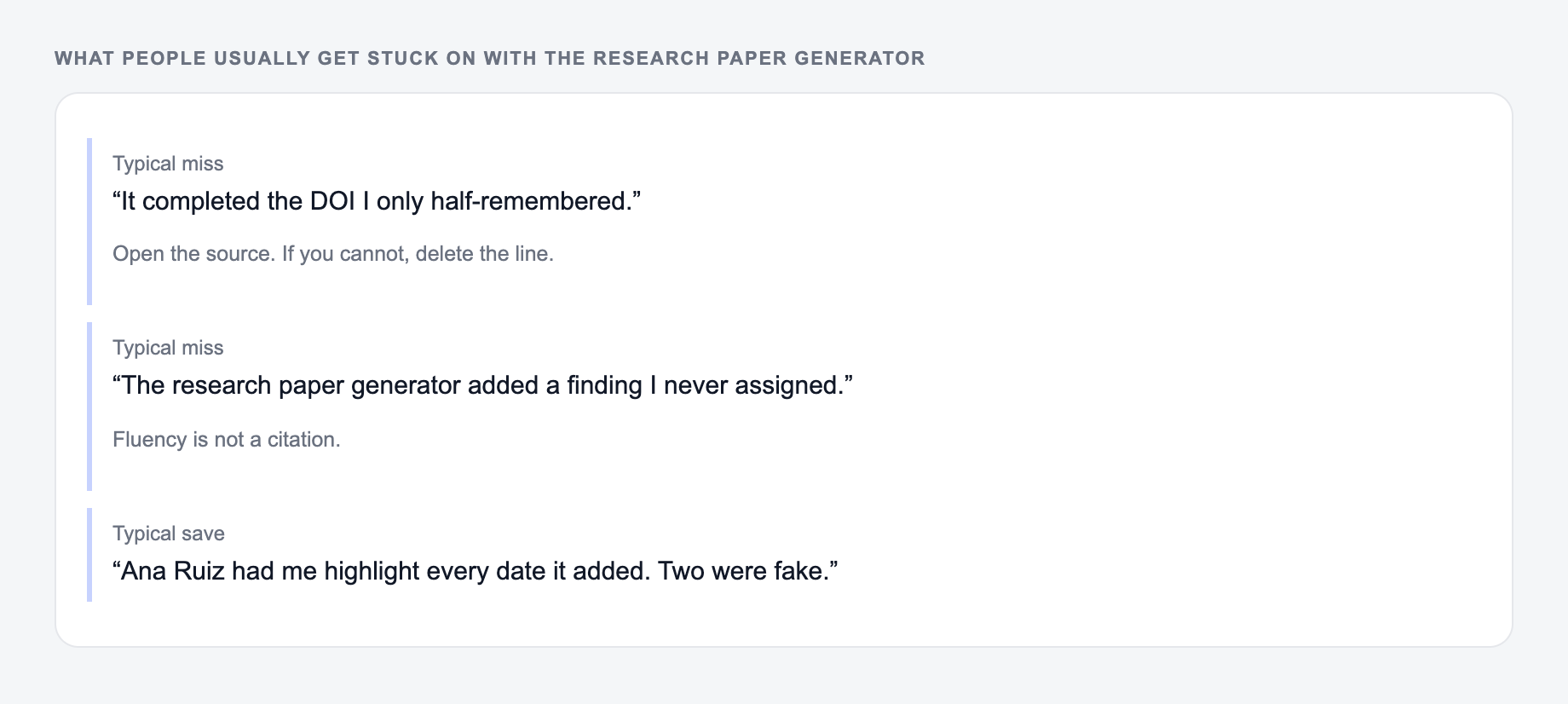
Then verify: highlight every name, date, citation, load, or measurement the AI Research Paper Generator added. If you cannot source it, it does not ship.
If the task is graded, cited, or used with students, the named writer still owns the claims.
Topic: Remote work and productivity in early-stage SaaS startups. Thesis: productivity depends less on location and more on meeting load, asynchronous norms, and manager clarity. Use undergraduate academic tone and APA placeholders.
A useful generated draft should include:
- an introduction that defines remote and hybrid work
- a thesis that names the specific policy factors being examined
- body sections on meeting load, async communication, management clarity, and measurement problems
- citation placeholders where evidence is needed
- a conclusion that stays cautious instead of claiming remote work is always better or worse
Before using it, revise for:
- unsupported claims that need real sources
- paragraphs that repeat the same idea in different words
- citation placeholders that do not match the sentence they support
- claims that sound too certain for the available evidence
- assignment rules for structure, citation style, and AI assistance
How to Replace Citation Placeholders Properly
Do not treat citation placeholders as decoration. Each one is a research task.
For every placeholder, ask:
- What exact claim is being made?
- Does it need a peer-reviewed article, official dataset, book, report, or primary source?
- Does the source support the sentence directly?
- Does the citation style match the assignment?
If you cannot find a source for a claim, weaken the claim or remove it. A cleaner, narrower paper is better than a confident paper with unsupported statements.
How to Make the Draft Sound Less Generic
Generic AI research papers usually have the same problems: broad openings, overconfident claims, thin evidence, and conclusions that repeat the introduction.
Improve the draft by:
- adding course-specific terminology
- replacing vague phrases with actual constructs or variables
- cutting paragraphs that do not move the thesis forward
- adding transitions that explain why the next section matters
- revising the introduction after the body is finished
- checking every claim against your sources
If you draft academic content often, keeping your tools in one workspace helps. The writing tools on Junia AI are useful when you need to move from outline to draft to revision without rebuilding the process each time.
Final Review Checklist Before Submission
These are the complaints that show up after the first draft — they are almost always about the brief, not the model.
Before you submit or share the paper, check:
- the thesis is specific and appears early
- each major section supports the thesis
- every citation placeholder has been replaced or removed
- the reference list matches the required style
- no facts, statistics, or study findings are unsupported
- the tone matches your academic level
- the final draft follows your institution's AI policy
Use the generator for structure and momentum. Use your judgment, sources, and revision process to make the paper defensible.
Frequently Asked Questions
Is this research paper generator free to use?+
Yes. You can generate a structured research paper draft for free. Some advanced modes (like in-depth literature review synthesis or IMRaD optimization) may be marked as premium.
Does it generate real citations and references?+
By default, it uses citation placeholders (e.g., Author, Year) so you can insert verified sources. If you provide your own sources/notes, the draft can integrate them, but you should always verify accuracy and formatting before submitting.
Can it write in APA, MLA, Chicago, or Harvard style?+
Yes. Choose your citation style to format in-text citation placeholders and the references section accordingly. Always double-check style rules required by your school or journal.
Will the tool invent statistics or studies?+
It’s designed to avoid fabricated statistics. If you haven’t provided sources, it will use cautious academic language and suggest what evidence to look for rather than presenting specific unverified numbers as facts.
Can I use this for a literature review?+
Yes. Choose the Literature Review mode to generate a theme-based synthesis framework, including suggested subtopics, debates, and a checklist of sources to find and cite.
How do I get the best output?+
Provide a clear topic, an optional thesis, and any notes/sources you already have. Set the academic level, discipline, and target word count so the draft matches your assignment expectations.