
Free PAS Framework Generator
Use the AI PAS Framework Generator to create persuasive Problem-Agitate-Solution copy tailored to your offer, audience, pain points, objections, and CTA. Generate landing page blocks, ad variations, email copy, SEO-friendly PAS sections, and high-ticket B2B messaging without sounding overhyped.
PAS Copy
Your PAS framework copy will appear here...
How the AI PAS Framework Generator Works
Get results in seconds with a simple workflow.
Enter Your Offer (and Audience, if you have it)
Add your product/service and optionally your target audience so the PAS copy matches your market, use case, and positioning.
Add Pain Points, Goals, and Objections
Provide common frustrations, the outcome people want, and any objections. This helps create sharper problem framing and more persuasive solution language.
Generate PAS Copy and Use It Anywhere
Get a ready-to-use PAS section. Paste it into a landing page, ad, email, or sales page, then lightly edit to match your brand voice and add proof (testimonials, guarantees, examples).
See It in Action
Example of turning a generic offer into conversion-focused PAS copy for a landing page or ad.
We offer local SEO services for plumbers. Contact us to learn more.
Problem: You’re a plumber, but when people search “plumber near me,” your business barely shows up—so the calls go to competitors.
Agitate: That means you’re losing high-intent jobs every week, relying on referrals, and spending money on ads that stop working the moment you pause them.
Solution: Our local SEO service helps plumbers rank higher in Google Maps and local search with a clear plan—on-page fixes, Google Business Profile optimization, and local authority building—so you get more qualified calls without guessing. CTA: Book a free local visibility audit.
Why Use Our AI PAS Framework Generator?
Powered by the latest AI to deliver fast, accurate results.
Instant Problem–Agitate–Solution Copywriting Framework
Generate a complete PAS structure (Problem, Agitate, Solution) that turns audience pain points into clear, conversion-focused messaging for landing pages, ads, and emails.
Audience-Aware Pain Points (Not Generic Templates)
Tailors the problem and agitation to your target audience, industry, and context so your copy feels specific, relevant, and persuasive—without sounding like hype.
Offer-Centric Solutions With Clear Next Steps
Transforms your product/service into a solution section that highlights outcomes, reduces friction, and includes a strong call-to-action to support lead generation and sales.
Multiple Formats for Marketing Channels
Create PAS copy for landing page blocks, short-form ads, and email marketing, so you can reuse the same core message across your funnel and campaigns.
Keyword-Aware Copy Options for SEO Landing Pages
Optionally incorporates target keywords naturally to support SEO landing pages and service pages—helping you align persuasive copy with search intent (without keyword stuffing).
Pro Tips for Better Results
Get the most out of the AI PAS Framework Generator with these expert tips.
Make the problem specific to a moment in their day
High-converting PAS copy describes a real scenario: what they’re trying to do, what keeps failing, and what it costs them (time, money, stress, missed opportunities).
Agitate with consequences, not exaggeration
Instead of hype, highlight realistic impacts: wasted ad spend, inconsistent leads, pipeline uncertainty, churn, poor close rates, or lost rankings—whatever fits your offer.
Tie the solution to a clear mechanism
Your solution should explain how it works at a high level (process, system, method). Clarity builds trust and reduces the “sounds too good to be true” reaction.
Use one primary CTA for better conversion clarity
For most pages and emails, keep the next step simple (Book a call, Start a trial, Get a quote). Multiple CTAs can dilute the action you want.
Add proof after PAS
PAS creates emotional relevance—proof closes the gap. Add testimonials, case studies, screenshots, guarantees, or a short FAQ to address objections and increase conversions.
Who Is This For?
Trusted by millions of students, writers, and professionals worldwide.
Generate Persuasive Copy with an AI PAS Framework Generator
PAS stands for Problem, Agitate, Solution. It works because it starts with the reader's situation before introducing your offer. The risk is that weak PAS copy can sound dramatic, vague, or pushy.
The AI PAS Framework Generator helps you create usable PAS copy for landing pages, ads, emails, sales pages, and SEO service pages. Use it to get the first structured draft, then refine the pain points, proof, and CTA so the message feels credible.
What to Enter Into the PAS Generator
The generator can create copy from just an offer, but the output improves when you add real audience context.
Useful inputs include:
- Offer: the product, service, page, promotion, or lead magnet
- Audience: who the copy is for and what they already understand
- Primary goal: book a call, start a trial, buy now, request a quote, download a resource, or join a list
- Pain points: what keeps failing, what feels frustrating, what the audience complains about
- Objections: too expensive, tried it before, skeptical of results, too complex, not urgent enough
- Marketing intent: lead generation, direct sales, demo, signup, or awareness
- Keywords: terms to include naturally when the copy will appear on an SEO landing page
- Tone and length: punchy for ads, calmer for B2B, more detailed for a page block
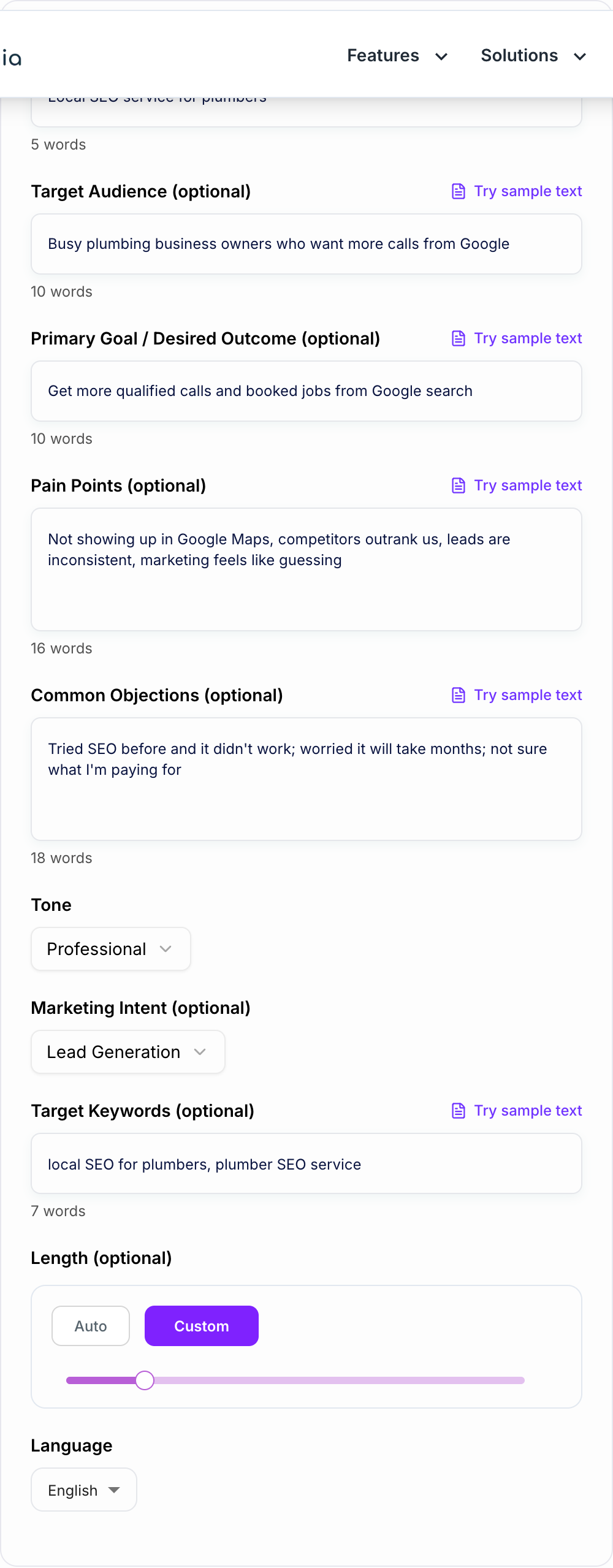
A weak input is "SEO service." A stronger input is "local SEO service for busy plumbing business owners who want more qualified calls from Google but are skeptical because they tried SEO before." That gives the generator a specific problem and believable objection.
How to Choose the Right PAS Mode
Use PAS Framework when you want a clean labeled structure you can adapt into any channel.
Use Landing Page Block when the copy needs a headline, skimmable sections, and a CTA. This is best for homepages, service pages, feature pages, and sales pages.
Use Ad Variations when you need several hooks or angles for testing. Review these for specificity because short ad copy can become generic quickly.
Use Email (PAS) when you want a short campaign message with a subject line, opening problem, body, offer, and CTA.
Use SEO-Friendly PAS when the copy must include target keywords without sounding stuffed. This is useful for service pages and commercial landing pages.
Use High-Ticket / B2B when credibility matters more than urgency. This mode should reduce hype, address objections, and explain the mechanism behind the solution.
How to Review Generated PAS Copy
PAS output should feel sharp, not manipulative. Before using the copy, review each section separately.
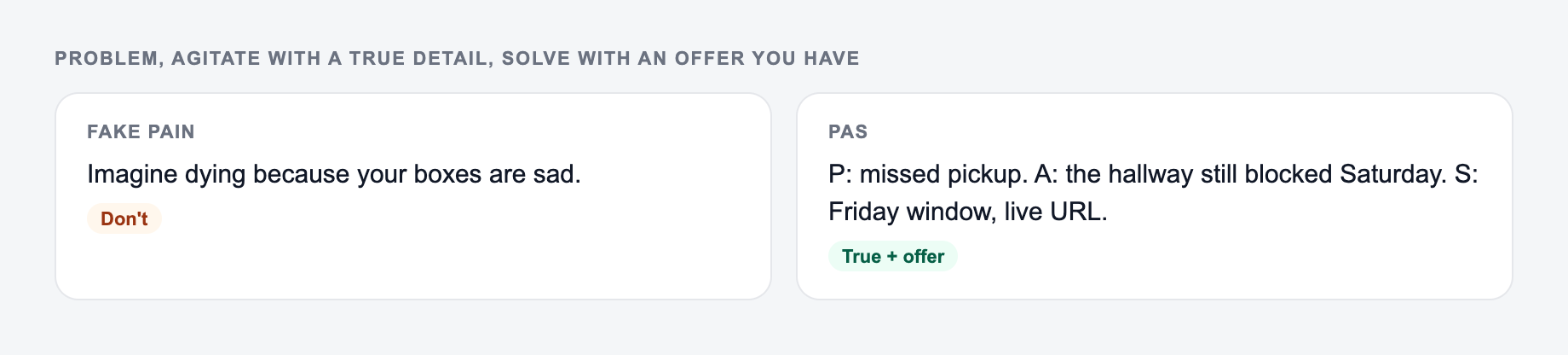
For Problem, ask whether the pain point is specific enough that the reader recognizes themselves. "Need more leads" is common. "You get calls, but too many are price shoppers outside your service area" is stronger.
For Agitate, check that the copy names realistic consequences instead of inventing fear. Use time, money, missed opportunity, confusion, or repeated friction when those costs are true.
For Solution, make sure the offer explains a mechanism. Do not stop at "we help you grow." Say what you improve, how the process works, and what the reader should do next.
For CTA, keep one primary action. Multiple calls to action can weaken the conversion path.
Example Input and Generated Output
Example input:
Problem and the offer that solves it belong on the form. Do not invent pain the customer never named.
Discard pile for AI PAS Framework Generator drafts:
-
Fake urgency with no date you will honor
-
Personalization tokens that resolve empty
-
Claims a competitor could paste without lying less than you
-
Offer: local SEO service for plumbers
-
Audience: busy plumbing business owners in the US
-
Goal: book more qualified calls from Google
-
Pain points: weak Google Maps visibility, competitors outrank them, inconsistent leads
-
Objections: tried SEO before, worried it takes too long, unsure what they are paying for
-
Intent: lead generation
Useful PAS output:
Problem: When homeowners search "plumber near me," your business is not showing where it matters, so urgent jobs go to competitors.
Agitate: That does not just mean fewer clicks. It means slower weeks, more dependence on referrals, and paid ads that stop producing the moment you pause the budget.
Solution: Our local SEO service improves the pages, Google Business Profile signals, and local authority that influence visibility, then tracks calls and rankings so you can see what is changing. CTA: Book a free local visibility audit.
This output works because it names a real search moment, explains the cost of inaction, and gives the offer a concrete mechanism.
How to Adapt PAS Copy for Different Channels
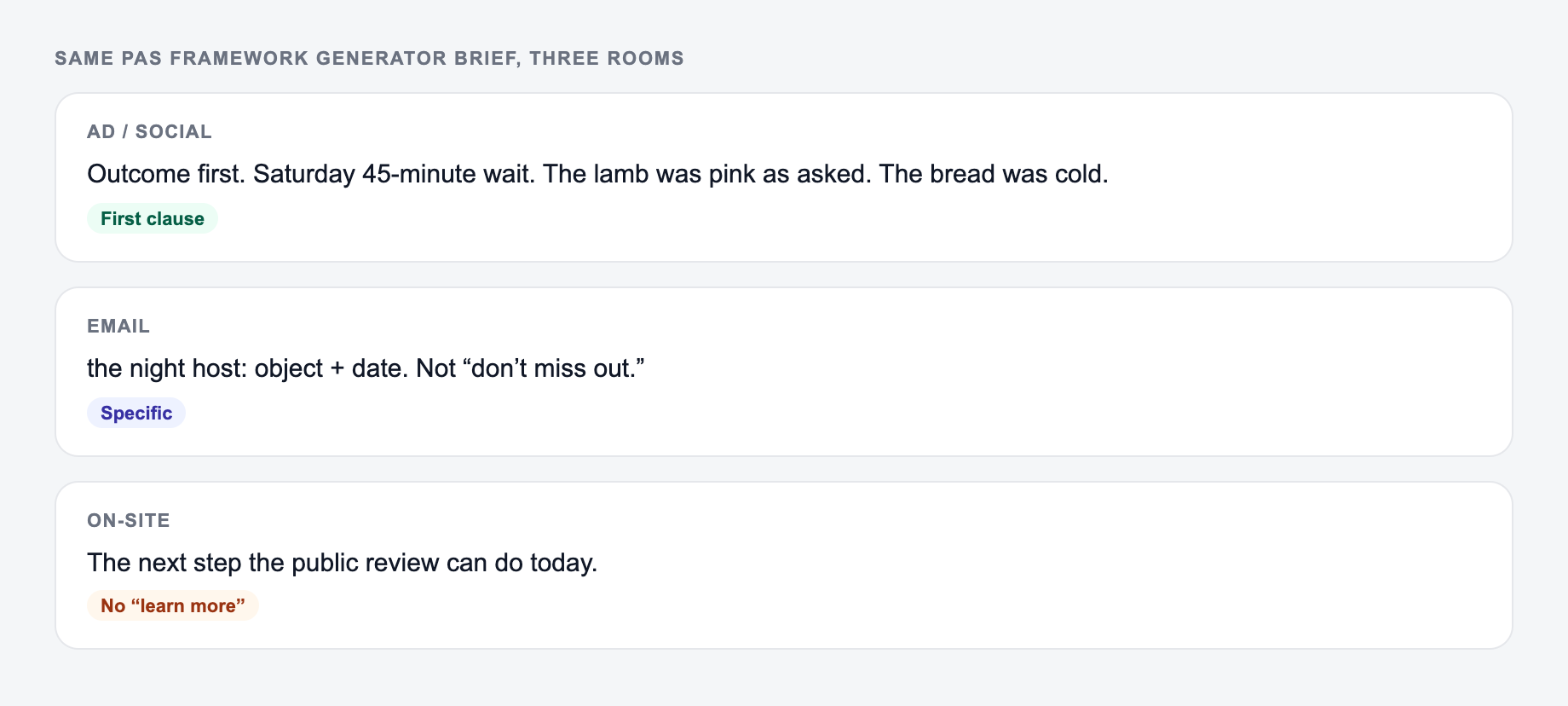
The output should change when the room changes. Synonyms across cards are a failed brief.
For a landing page, add proof after the PAS block: testimonials, case studies, screenshots, guarantees, or a short FAQ. PAS creates relevance, but proof earns trust.
For ads, cut the copy down to one problem, one consequence, and one promise. Keep each variation focused on a different angle so testing teaches you something.
For email, make the problem line feel conversational and keep the CTA simple. If the message feels too intense, lower the agitation and add a softer transition into the offer.
For SEO pages, include the target keyword where it naturally fits, usually in the headline or first line. Do not repeat the keyword in every PAS section.
If you are building multiple pages, ads, or emails from the same positioning work, Junia AI can help turn one refined angle into more campaign assets without losing the core message.
PAS vs AIDA vs BAB
Use PAS when the audience already feels the pain and you need quick conversion-focused copy.
Use AIDA when you need a broader narrative: attention, interest, desire, action.
Use BAB when transformation is the main hook: before, after, bridge.
For short ads, service page sections, and problem-aware email promos, PAS is usually the fastest starting point.
Final Checklist Before Using Generated PAS Copy
Discard pile:
- Fake urgency with no date you will honor
- Personalization tokens that resolve empty
- A line a competitor could paste without lying less than you
Before you publish the output, confirm:
- The problem is specific to the audience
- The agitation is true, not exaggerated
- The solution explains how the offer helps
- The CTA is singular and clear
- Any SEO keywords fit naturally
- The final copy sounds like your brand, not a template
The PAS Framework Generator should save drafting time. The final judgment still comes from making the message specific, believable, and useful.
Frequently Asked Questions
What is the PAS framework in copywriting?+
PAS stands for Problem–Agitate–Solution. It’s a proven copywriting framework that identifies a customer problem, intensifies the consequences or frustrations (agitate), and then presents your offer as the solution—often leading to higher conversions on landing pages, ads, and emails.
Is this PAS framework generator free to use?+
Yes. You can generate PAS copy for free. Some advanced modes (like SEO-friendly or high-ticket/B2B positioning) may be marked as premium.
Can I use PAS copy for landing pages and sales pages?+
Yes. PAS is commonly used on landing pages, sales pages, and service pages because it quickly connects to visitor intent, clarifies the stakes, and makes the solution feel urgent and relevant.
How do I make PAS copy sound less salesy?+
Use specific, realistic pain points, avoid exaggerated claims, and focus on clarity. A helpful tone, concrete examples, and a simple CTA (instead of pressure) typically makes PAS copy feel natural and credible.
Should I include keywords in PAS copy for SEO?+
If you’re using PAS on an SEO landing page, include your primary keyword naturally in the headline or first lines, then use related terms where they fit. Prioritize readability and search intent over repeating keywords.
What information should I provide for the best PAS output?+
At minimum, provide your offer (product/service). For better results, add your audience, desired outcome, pain points, and objections—this helps generate more specific problem statements and stronger, more believable solutions.