
Free Reflection Generator
Generate a structured reflection from your experience, class activity, placement, project, journal prompt, or workplace learning moment. Add context, choose a reflection framework, and get a draft with clear description, analysis, lessons learned, and practical next steps.
Reflection
Your reflection will appear here...
How the AI Reflection Generator Works
Get results in seconds with a simple workflow.
Describe the Experience (Quickly)
Enter a topic or experience. Optionally add context like your role, what happened, and what made it challenging to generate a more personal, specific reflection.
Choose a Framework, Tone, and Length
Pick a reflective writing framework (Gibbs, Rolfe, Kolb, or STAR), select a tone, and choose a word count to match your assignment, journal, or professional log requirements.
Generate and Personalize
Get a polished reflection with lessons learned and next steps. Review for accuracy, add any course-specific learning outcomes, and adjust details to match your real experience.
See It in Action
Example of turning a brief idea into a structured reflection with clear learning points and next steps.
I had to lead a group project and it was hard because people disagreed. We still finished it.
What happened: I led a four-person group project with a tight deadline. Two teammates disagreed on the approach, which slowed progress and created tension.
So what: I noticed I avoided addressing the conflict early because I didn’t want to upset anyone. This led to unclear roles and duplicated work. When I finally facilitated a short alignment meeting, we clarified responsibilities and agreed on a simple decision rule for future disputes. I learned that leadership isn’t only about planning—it’s also about creating psychological safety and making decisions when time is limited.
Now what: Next time, I will set expectations in the first meeting (roles, communication norms, and how we decide). I will address misalignment within 24 hours, ask each person to share concerns, and summarize the decision in writing. I’ll also request mid-project feedback to identify issues before they escalate.
Why Use Our AI Reflection Generator?
Powered by the latest AI to deliver fast, accurate results.
Structured Reflection Frameworks (Gibbs, Rolfe, Kolb, STAR)
Generates a well-organized reflection using proven reflective writing frameworks—ideal for academic reflections, professional development logs, internships, and workplace learning journals.
Clear Learning Outcomes + Lessons Learned
Highlights key takeaways, skills developed, and evidence-based insights—helpful for reflective essays, placement reflections, mentoring notes, and self-assessment writing.
Authentic Voice With Tone Control
Adapts to reflective writing styles such as thoughtful, professional, candid, or formal while staying natural and human-sounding—without filler or generic phrasing.
Actionable Next Steps (Now What?)
Ends with practical improvement steps and future plans you can actually use—great for goal setting, performance reviews, growth plans, and continuous learning.
Flexible Length for Journals or Essays
Creates short reflections for quick submissions or longer reflective essays with deeper analysis—optimized for clarity, coherence, and readability.
Pro Tips for Better Results
Get the most out of the AI Reflection Generator with these expert tips.
Add one concrete example for stronger reflective writing
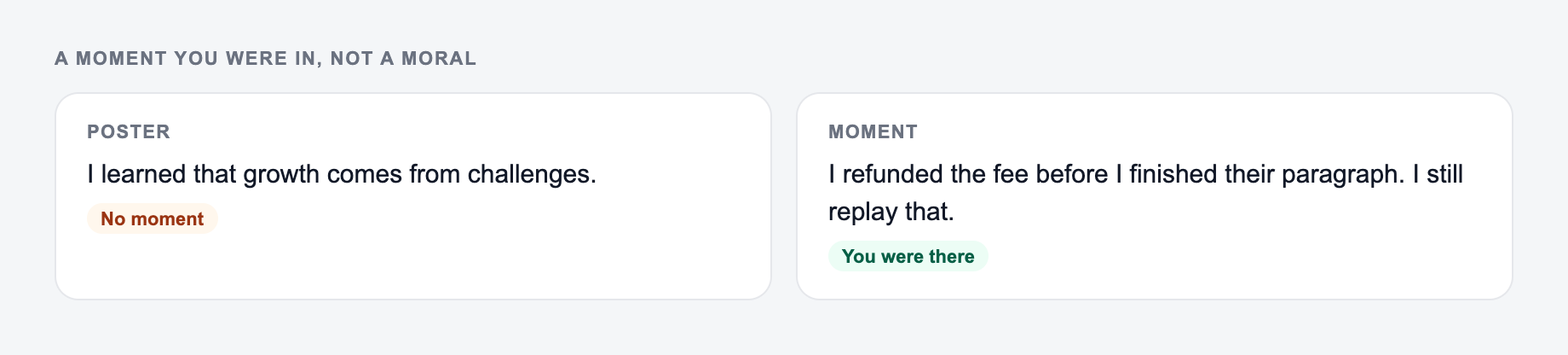
Include a specific moment (a conflict, decision, feedback, or result). Concrete evidence improves credibility and helps you meet common reflection rubrics.
Use “Now What?” to make your reflection actionable
Assessors and managers look for improvement plans. Add measurable next steps like practicing a skill, seeking feedback, or changing your approach in a similar situation.
Balance honesty with professionalism
You can acknowledge mistakes or challenges, but keep the tone constructive: what you learned, what you’d do differently, and how you’ll improve.
Match the framework to the assignment
If your course requires a framework (often Gibbs or Rolfe), choose it to ensure your reflection includes the expected sections and depth.
Keep it personal—avoid generic statements
Replace vague lines like “I learned a lot” with specific skills (communication, time management, leadership) and what changed in your thinking or behavior.
Who Is This For?
Trusted by millions of students, writers, and professionals worldwide.
Generate Structured Reflections From Real Experience
The Reflection Generator helps turn an experience into a clear reflective draft: what happened, why it mattered, what you learned, and what you will do next. It is useful for academic assignments, placement reflections, learning journals, workplace development notes, personal journaling, and professional self-review.
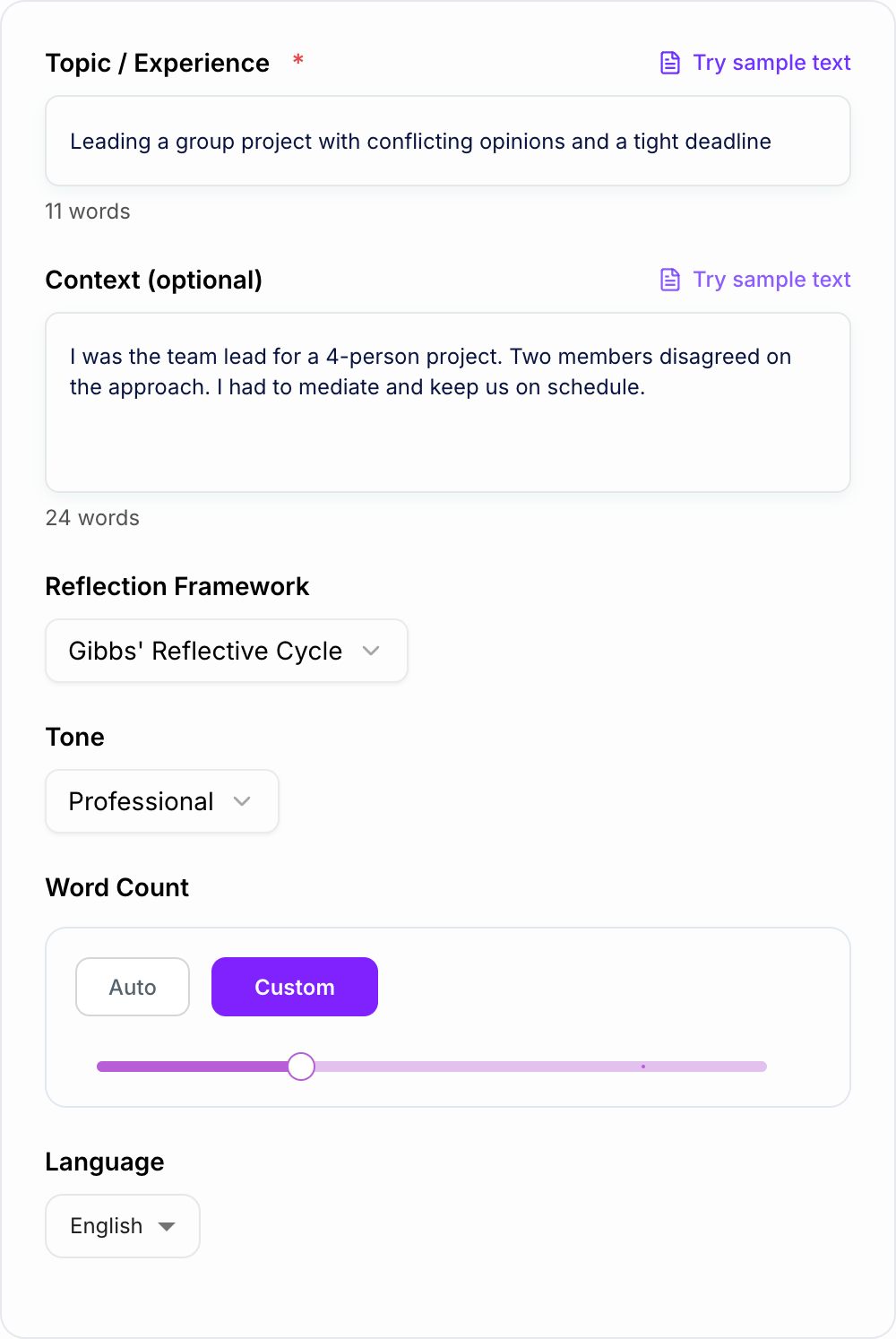
The tool is not meant to invent the experience for you. It works best when you give it a real moment, a challenge, a result, or a piece of feedback, then use the generated structure to make your thinking clearer.
What to Enter Into the Reflection Generator
Good reflection input is specific. You do not need a full essay, but you do need more than a topic.
Add:
- the experience or event you are reflecting on
- your role in the situation
- what made it challenging, surprising, uncomfortable, successful, or useful
- any feedback you received
- what you learned or suspect you learned
- the framework or assignment requirement if one is provided
- the tone: academic, professional, personal, concise, or detailed
Weak input:
Group project reflection
Better input:
I worked on a group presentation. I took over too much when the project slowed down, and two teammates stopped contributing. The final grade was good, but the process felt stressful. I need to reflect on teamwork and communication using Gibbs.
That second input gives the generator a real situation, tension, and learning direction.
How to Choose the Right Reflection Framework
Choose the framework based on the assignment or the kind of thinking you need.
Use Gibbs Reflective Cycle for detailed academic reflections. It works well for nursing, teaching practice, placements, internships, and university modules because it moves through description, feelings, evaluation, analysis, conclusion, and action plan.
Use Rolfe: What? So What? Now What? for short reflections, weekly logs, discussion posts, and quick learning notes.
Use Kolb when you need to connect experience to learning theory, practice, and future application.
Use STAR for professional reflections where outcomes matter: situation, task, action, result. This works well for workplace learning, performance reviews, leadership moments, and interview preparation.
Use Freeform when you want structure but do not need formal headings.
Example Input and Generated Direction
Give the Reflection Generator a real brief: who it is for, where it will appear, and one thing it is not allowed to invent. Here is a strong reflection prompt:
Paste what happened. The form should not invent a lesson you did not learn.
Learning workflow:
- Enter only facts you have.
- Generate a structured draft.
- Check names, dates, citations, and units.
- Rewrite the sentences you would actually say in class or in the paper.
If the task is graded, clinical, cited, or public, the named writer still owns the claims.
Experience: I led a client update meeting for the first time.
Challenge: I had the facts ready, but I rushed the explanation and did not leave enough time for questions.
Feedback: My manager said the content was accurate but the pacing made it hard for the client to follow.
Framework: Rolfe
Tone: professional
The generated reflection should identify the moment, explain why it mattered, and end with a concrete change:
What? I led a client update meeting and delivered the key information accurately, but I moved through the material too quickly.

So what? The feedback showed me that preparation is not only about knowing the facts. I also need to pace the explanation so the client can process the information and ask questions.

Now what? Before my next meeting, I will mark two pause points in the agenda, ask a check-in question after each major update, and leave five minutes at the end for clarification.
That is a usable draft because it moves from event to insight to next action.
How to Make the Generated Reflection Sound Like You
After generating the draft, personalize it with evidence.
Add:
- one exact moment from the experience
- a real feeling or reaction, if appropriate
- what someone said or what result happened
- a course concept, workplace skill, or learning outcome if required
- a next step you could realistically do
Remove any sentence that sounds too broad, such as "communication is important" or "I learned many things." Replace it with what changed in your behavior or thinking.
Academic Reflection Review Checklist
For school or university reflections, check the draft against the rubric before submitting.
- Does it answer the assigned prompt?
- Does it use the required framework?
- Does it include analysis, not just description?
- Does it connect to a learning outcome, reading, theory, or skill if required?
- Does it include first-person reflection where appropriate?
- Does the action plan say what you will do differently?
If a citation or course concept is required, add it yourself and make sure it is accurate.
Workplace and Professional Reflection Tips
Professional reflections should still be personal, but they usually need more evidence and less diary-style language.
Focus on:
- the context and constraints
- the decision you made
- the skill involved, such as communication, prioritization, leadership, or problem solving
- the result or feedback
- the behavior you will change next time
If you use several AI tools for school, work, or writing, keeping drafts in an AI writing workspace like Junia AI can help you revise the generated reflection without losing the original notes or framework.
Common Mistakes to Avoid
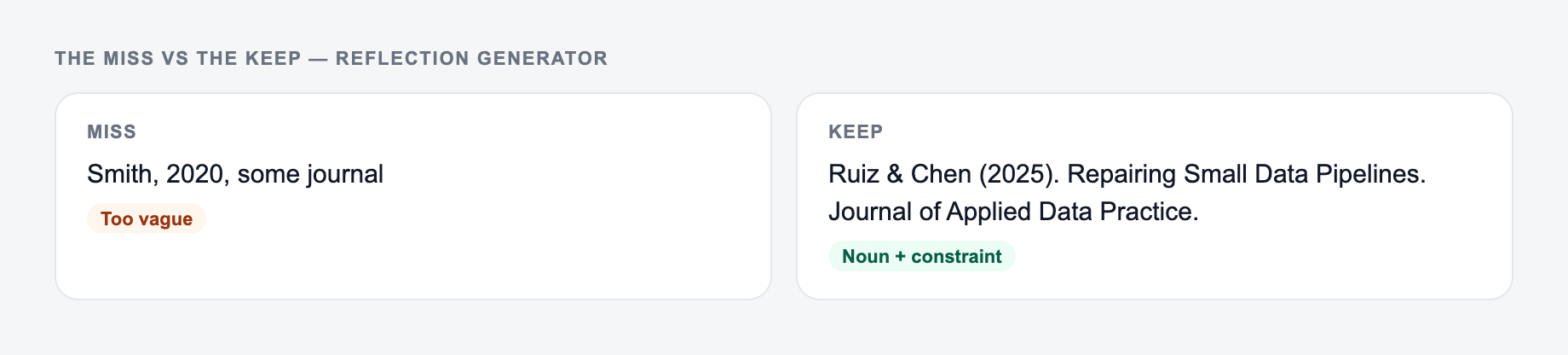
If your input looks like the miss, do not judge the tool yet — add the noun and the constraint first.
The first mistake is reflecting on a whole semester, placement, or project at once. Pick one meaningful moment and let it represent the larger learning.
The second mistake is writing only what happened. A reflection needs analysis: why it mattered, what changed, and what the experience showed you.
The third mistake is ending with a vague promise. "I will communicate better" is weak. "I will send meeting roles in writing before the next group session" is stronger.
The fourth mistake is submitting the generated draft without checking accuracy. The reflection should match your real experience and any rubric requirements.
Final Checklist Before Using the Reflection
- Experience is specific.
- Framework matches the assignment or goal.
- Draft includes insight, not just summary.
- Evidence or feedback is included.
- Next step is concrete.
- Tone fits the setting.
- Any required course concept or citation has been added and checked.
Frequently Asked Questions
What is a reflection generator?+
A reflection generator helps you write a structured reflective piece based on an experience or topic. It organizes your thoughts into clear sections (like what happened, what you learned, and what you’ll do next) so your reflection is coherent and meaningful.
Which reflection framework should I choose?+
Use Gibbs for detailed academic reflections (description, feelings, evaluation, analysis, conclusion, action plan). Choose Rolfe for a simple structure (What? So What? Now What?). Use Kolb for learning-focused reflections, and STAR for professional, results-oriented reflections.
Can this help with academic reflective writing?+
Yes. The tool can produce an academic-style reflection with clear learning outcomes, evidence from your experience, and specific improvement steps—useful for reflective essays, placement reflections, and course portfolios. Always review to match your course rubric.
Will the reflection sound authentic?+
It’s designed to sound natural and personal while staying structured. For best results, include a few specific details in the context (your role, what was challenging, and what you tried). Then lightly edit to add your real voice and any required references.
Can I generate reflections in different languages?+
Yes. Select your preferred output language to generate reflections for multilingual classes, international programs, or personal journaling.
How do I avoid generic reflections?+
Add specifics: what happened, what you felt or thought, what feedback you received, what went well/poorly, and one concrete example. Specific details make reflections stronger, more credible, and more aligned with assessment criteria.