
Best SEO.ai Alternatives in 2026: 8 Tools Ranked by Use Case

Yi
SEO Expert & AI Consultant

SEO.ai is no longer just a basic AI writing tool. Its current positioning is closer to an AI SEO agent that can create ranking content, publish it, build backlinks, monitor performance, and target visibility in Google and ChatGPT.
That matters because the best SEO.ai alternative depends on what you want to replace. In my experience, this is where many comparison lists get sloppy: they compare writing tools, optimization tools, and SEO agents as if they solve the same problem. If you only need a cheaper AI writer, your shortlist will look different from a team trying to replace an agentic SEO workflow, a content optimization editor, or an AI-search visibility tracker.
TL;DR: The best SEO.ai alternatives
| Tool | Best job | Weak spot |
|---|---|---|
| Junia AI | SEO article creation end-to-end | Not a pure rank tracker |
| SurferSEO | On-page scoring | Slower for full drafts |
| Scalenut | Keyword-led planning | Heavier UI for simple posts |
| Writesonic | Mixed gen + AI-search | Brand voice needs guardrails |
If you want the closest SEO.ai alternative for SEO content production, start with Junia ai. It is built around long-form SEO content, search intent, internal linking, structured formatting, and publishing rather than generic AI copy.
If your main problem is optimization, choose SurferSEO. If your main problem is keyword-led planning, choose Scalenut. If you need fast marketing copy across many formats, choose Copy.ai, Writesonic, or Jasper. If you mostly need creative writing support, Sudowrite is useful, but it is not a serious SEO.ai replacement.
| Rank | Tool | Best for | Strongest replacement angle | Main limitation |
|---|---|---|---|---|
| 1 | Junia ai | SEO article workflows | SERP-led article creation, internal links, long-form SEO content, publishing | Best for content-led SEO, not full backlink or ad management |
| 2 | SurferSEO | On-page optimization | Content scoring, SERP analysis, optimization guidance | Stronger as an optimizer than a full writer-agent |
| 3 | Scalenut | Keyword-led blog production | Planning, topic research, Cruise Mode-style content workflow | Can feel heavy if you only need drafting |
| 4 | Writesonic | Mixed AI writing and GEO workflows | Broad content generation plus newer AI-search visibility features | Quality still needs close editorial review |
| 5 | Copy.ai | Fast short-form and GTM content | Marketing copy, email, social, sales enablement | Lighter SEO depth than SEO-first platforms |
| 6 | Jasper AI | Brand-controlled content teams | Brand voice, campaign copy, multi-format generation | Expensive if SEO content is the only use case |
| 7 | Sincode.ai | Simple all-in-one AI writing | Basic generation across many content types | Less specialized SEO control |
| 8 | Sudowrite | Creative ideation | Story, fiction, and writer's block support | Not built for SEO workflows |
What to look for in an SEO.ai replacement
Before comparing tools, be clear about the job SEO.ai was doing for you.
Some teams use it to generate product pages or blog posts. Others want an agent that can suggest topics, publish content, improve pages, and monitor visibility over time. Those are different buying decisions.
For most SEO teams, I would judge alternatives on six things. I care less about how many buttons the platform has and more about whether it reduces the messy work between keyword, draft, edit, and publish.
- Search intent research: Does the tool analyze live SERPs, competing pages, or actual keyword demand?
- Content generation quality: Does it create structured, useful drafts or generic text that needs rebuilding?
- Optimization workflow: Does it help with headings, entities, coverage gaps, internal links, schema, metadata, and content refreshes?
- AI Search readiness: Does it help content become easier for AI systems to summarize, cite, and trust?
- Publishing workflow: Does it connect to your CMS or still leave you copying and formatting everything manually?
- Human control: Does the tool make review easier, or does it produce more content than your team can verify?
Google's official guidance for generative AI search is a useful reality check here: AI features in Search still rely on Google's core ranking and quality systems, so the work is still SEO, not a magic separate discipline. Google's guidance on generative AI content also makes the same practical point: using AI is not the issue; scaled content that adds little value is the issue.
That is why I would avoid choosing a tool only because it says "GEO" or "AEO" on the homepage. Those labels are useful shorthand, but the real test is whether the platform helps you create clear, original, well-structured, well-supported content that deserves to be cited. I have seen more value from boring editorial discipline than from most shiny AI-search terminology.
1. Junia ai: Best SEO.ai alternative for SEO article creation
.png?token=eyJhbGciOiJIUzI1NiIsInR5cCI6IkpXVCJ9.eyJ1cmwiOiJ1c2VyLWdlbmVyYXRlZC1pbWFnZXMvZjJmOThkNWUtNjNjNC00MTJiLTkyY2QtZjgyNDI5NTE3YWRkL1NjcmVlbnNob3QgMjAyMy0wOS0yNyBhdCAxLjI4LjEyICgxKS5wbmciLCJpYXQiOjE2OTY0NDgzMTYsImV4cCI6MTg1NDEyODMxNn0.Cqnxcc9levoXj8ujCyrYuoAy34HEe3anSXasxT9y8Rg)
Junia ai is the strongest SEO.ai alternative if your main goal is to create, optimize, internally link, and publish SEO content faster.
The difference is focus. A general AI writer can create text. Junia is built around SEO articles: search intent, long-form structure, internal links, metadata, formatted sections, and direct publishing. Its AI Article Writer is especially relevant if your team wants a full draft with headings, FAQs, meta fields, and a publishable structure instead of a blank editor with a chat box next to it.
Where Junia feels most useful is the research-to-draft stage. When I tested workflows like this, the real time sink was rarely typing the article from scratch. It was stitching together a keyword tool, SERP review, outline, internal links, metadata, and CMS formatting. Junia helps turn a keyword into a structured article with the supporting sections a reader actually expects, which cuts down that manual assembly work.
Junia is also a strong fit if you are thinking beyond one-off blog posts. It provides a full SEO workflow that is useful when you want the system to coordinate research, writing, optimization, internal linking, and publishing instead of handling each task in a separate tool.
When Junia ai fits
- You publish SEO articles consistently.
- You want drafts shaped around search intent, not generic copy.
- Internal linking and metadata are part of your workflow.
- You care about article structure for both Google and AI Search.
- You want fewer handoffs between research, writing, and publishing.
When to skip it
- Your only need is backlink analysis.
- You want a pure content score editor.
- You mainly write ads, emails, or short social posts.
This matters most when you publish seo articles consistently.
My take: if you are replacing SEO.ai specifically for content-led SEO, Junia should be the first tool you test. It gives you the closest match to the publishing side of the SEO.ai promise while staying focused on articles and content operations.
2. SurferSEO: Best for on-page optimization and content scoring
Surfer still wins when the brief is “score this draft against the SERP.” It is less of a full article factory than Junia or Writesonic.
SurferSEO is the better choice when your team already has writers but needs stronger optimization guidance.
Surfer's core strength is not that it writes the most original article. Its strength is helping you compare a draft against what is ranking and showing where the content is thin, overdone, or missing important topics. I like it most when there is already a competent writer or editor in the loop. Without that judgment, content scores can become a checklist game instead of an editorial tool.
Compared with SEO.ai, Surfer is less of a replacement for the entire content workflow and more of a specialist editor. It is strongest after you have a keyword, a draft, and a clear search intent. The tool can help you improve structure, topical coverage, terms, and content depth.
SurferSEO fits if your writers already produce solid drafts.; You want SERP-based scoring and content recommendations.. Skip it if you want an agent to plan, write, publish, and monitor content for you.; You need a low-touch AI writer for complete articles..
Details
- Your writers already produce solid drafts.
- You want SERP-based scoring and content recommendations.
- You refresh existing articles often.
- Optimization quality matters more than automated publishing.
Also skip when:
- You want an agent to plan, write, publish, and monitor content for you.
- You need a low-touch AI writer for complete articles.
- You find content scores distracting or easy to over-optimize.
My take: Surfer is a strong SEO.ai alternative only if your biggest gap is optimization. It is less compelling if your bottleneck is full article production.
3. Scalenut: Best for keyword-led blog planning
Scalenut is a good SEO.ai alternative for teams that want a guided SEO content workflow with planning, keyword research, and blog creation in one place.
The most useful part is the way it connects keyword planning to content execution. If you are not sure which topic cluster to build, which terms to include, or how to organize a blog post, Scalenut gives you more structure than a plain AI writer.
This is where it overlaps with SEO.ai: both tools aim to reduce the manual work between deciding on a topic and producing optimized content. Scalenut tends to feel more like a planning-and-writing platform, while SEO.ai now positions itself more like a broader agent handling content, backlinks, publishing, ads, and monitoring. Personally, I would reach for Scalenut when the team needs a steadier planning process, not when the only issue is getting words onto the page.
A good keyword research workflow still matters even when the writing is automated. If the keyword set is weak, the article will usually be weak too. Scalenut is worth testing when your team needs more discipline at the planning stage.
Good fit
- Keyword planning is your biggest content bottleneck.
- You want a guided blog creation workflow.
- You need topic clusters and SEO briefs before writing.
- You prefer an all-in-one planning interface over separate tools.
Poor fit
- You only need a lightweight AI writer.
- Your team already has strong keyword research and briefing processes.
- You want the simplest possible writing interface.
The biggest mistake I see is choosing Scalenut when you really needed a lightweight ai writer.
My take: Scalenut is a practical SEO.ai alternative for content teams that need better planning. It is less exciting if your topic strategy is already mature and you only need execution speed.
4. Writesonic: Best for mixed content generation and AI-search workflows
Writesonic is a broader AI content platform that makes sense when your team needs blog posts, landing pages, ads, social copy, and some SEO support in the same workspace.
It is not as narrowly focused on SEO articles as Junia, and it is not as optimization-heavy as Surfer. The appeal is breadth. If your content team creates many formats, Writesonic can be more useful than a tool built only around blog posts.
Competitor research for this article showed a clear trend: many 2026 AI SEO tool comparisons now judge platforms on AI visibility, AI Overviews, ChatGPT, Perplexity, and citation readiness, not just Google rankings. Writesonic appears often in that conversation because it combines content generation with newer AI-search and visibility features.
That said, I would still review every long-form output carefully. Broad AI writing platforms can help with speed, but they often need stronger human editing for specificity, examples, and factual accuracy.
Tradeoff
Choose Writesonic when these apply:
- You need many content formats, not only SEO articles.
- You want AI writing plus some SEO and AI-search tooling.
- Speed matters, but you still have an editor in the workflow. I would avoid this approach if a different job is the real bottleneck.
Look elsewhere when:
- You want the deepest on-page optimization editor.
- You only care about long-form SEO articles.
- You do not have time to review AI-generated claims.
My take: Writesonic is a reasonable SEO.ai alternative when your team wants one broad AI content system. For serious SEO article production, compare it directly against a more focused AI blog generator before deciding.
5. Copy.ai: Best for fast GTM and short-form content
Copy.ai is strongest when your content needs extend beyond SEO articles into go-to-market copy: email sequences, landing page drafts, sales enablement, ad variations, social posts, and campaign messaging.
That makes it a partial SEO.ai alternative, not a direct one. If SEO.ai was mainly helping your team write product descriptions, page blurbs, or short marketing copy, Copy.ai can be a better fit. If SEO.ai was being used as an SEO workflow engine, Copy.ai will feel lighter.
The biggest advantage is speed. Copy.ai can help a small team produce more variations quickly. The tradeoff is that SEO-specific structure, source handling, internal links, and content refresh logic usually need to be managed elsewhere. I would not want it owning a high-intent organic article from start to finish, but I would use it for campaign angles, page variants, and supporting copy around the article.
When Copy.ai fits
- You create lots of campaign copy.
- You need short-form drafts fast.
- Your SEO process already lives in another tool.
- You want a writing assistant for sales and marketing teams.
When to skip it
- You need SERP-led article generation.
- You want content scoring or deep SEO recommendations.
- You need a replacement for an AI SEO agent.
Prefer Copy.ai when the job is you create lots of campaign copy — not when serp-led article generation.
My take: Copy.ai is useful, but I would not choose it as the main SEO.ai replacement for an organic content team. It is better as a supporting tool around campaign execution.
6. Jasper AI: Best for brand-controlled marketing content
Jasper AI is a better fit for marketing teams that care about brand voice, campaign consistency, and multi-format content production.
Jasper's strength is not that it replaces a full SEO platform. It is that it helps teams create polished marketing content with more control over tone and reusable brand context. That matters if your team publishes across blog posts, landing pages, emails, ads, and social channels and wants the output to feel consistent. In practice, I see Jasper as a brand-content system first and an SEO.ai alternative second.
For SEO.ai replacement decisions, Jasper makes the most sense when content quality, brand governance, and campaign output matter more than technical SEO or AI-search monitoring.
Jasper AI fits if brand voice control is a priority.; Your marketing team produces many content formats.. Skip it if your budget is tight and you only need SEO articles.; You need deep keyword research or backlink analysis..
Details
- Brand voice control is a priority.
- Your marketing team produces many content formats.
- You want reusable workflows and templates.
- SEO is one part of a larger content operation.
Also skip when:
- Your budget is tight and you only need SEO articles.
- You need deep keyword research or backlink analysis.
- You want a specialist SEO optimization editor.
My take: Jasper is a strong AI content platform, but it is not the cleanest SEO.ai alternative unless your SEO content is part of a broader brand-content workflow.
7. Sincode.ai: Best for simple all-in-one AI writing
Sincode.ai is worth considering if you want a straightforward AI writing platform without committing to a more complex SEO suite.
It can support blog drafts, marketing copy, ideation, and general writing tasks. That makes it useful for small teams or solo creators who want an affordable, simple tool for everyday content creation.
The limitation is specialization. When I compare tools for SEO.ai replacement, I look for live search context, internal linking support, content briefs, refresh workflows, and clear optimization logic. Sincode.ai is easier to think of as a general AI writing assistant than a serious SEO operations platform. That is not a dealbreaker for every user, but it should be clear before you switch.
Good fit
- You want simple AI writing help.
- You do not need a heavy SEO toolset.
- You create a mix of basic marketing and blog content.
Poor fit
- You need a full SEO content workflow.
- You want strong AI Search optimization features.
- You rely heavily on briefs, internal links, or content refreshes.
This matters most when you want simple ai writing help.
My take: Sincode.ai can replace the writing-assistant part of SEO.ai, but not the broader SEO-agent part.
8. Sudowrite: Best for creative writing, not SEO
Sudowrite is the outlier in this list. It is excellent for creative writing, fiction, scene expansion, rewriting, brainstorming, and getting unstuck. It is not built for SEO execution.
So why include it? Because some people searching for SEO.ai alternatives are not actually looking for an SEO platform. They want an AI tool that helps them write better. If that is the real need, Sudowrite can be valuable.
But if your goal is ranking content, Sudowrite should not be your main tool. It does not replace keyword research, SERP analysis, on-page optimization, internal linking, content briefs, or publishing workflows.
Tradeoff
Choose Sudowrite when these apply:
- You write fiction, scripts, stories, or creative copy.
- You need help with ideas, tone, expansion, or rewriting.
- SEO performance is not the primary goal. The biggest mistake I see is choosing Sudowrite when you really needed a different job is the real bottleneck.
Look elsewhere when:
- You need blog posts built around search intent.
- You want AI Search visibility.
- You need SEO briefs, metadata, or internal linking.
My take: Sudowrite is a good writing tool and a weak SEO.ai replacement. Use it for creativity, not rankings.
SEO.ai alternatives by workflow
If you are still stuck, choose by workflow rather than by feature list.
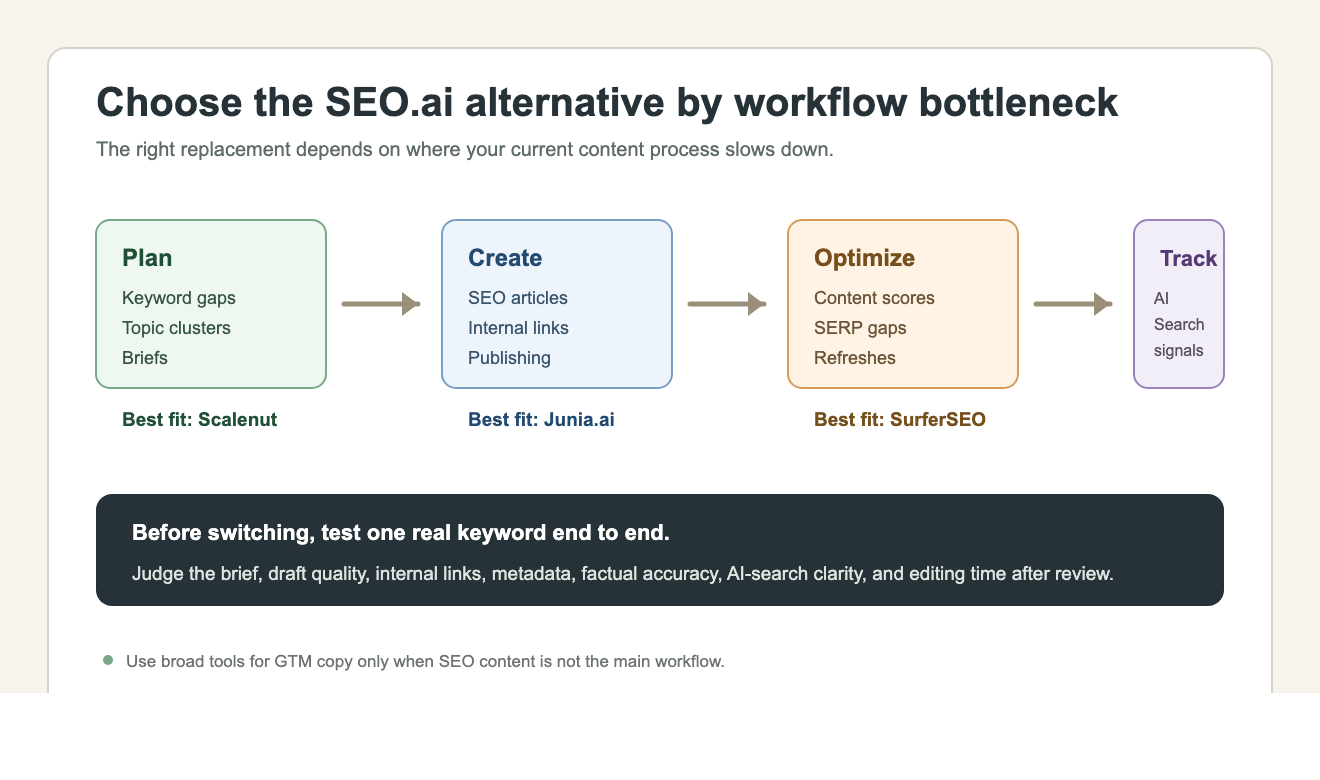
| Your main workflow | Best alternative | Why |
|---|---|---|
| Create SEO articles from keywords | Junia ai | Strongest fit for structured, search-led long-form content |
| Optimize existing drafts | SurferSEO | Best fit for content scoring and SERP-based editing |
| Plan keyword-led blog campaigns | Scalenut | Good bridge between keyword research, briefs, and drafting |
| Produce many marketing formats | Writesonic | Broadest mix of AI writing and content formats |
| Generate GTM copy quickly | Copy.ai | Strong for short-form marketing and sales copy |
| Keep brand voice consistent | Jasper AI | Better for brand-controlled content operations |
| Get basic AI writing help | Sincode.ai | Simple all-in-one writing support |
| Beat creative block | Sudowrite | Best for story and creative writing |
This is also where AI Search changes the decision. A tool that only produces a generic article is becoming less useful. Content needs to be easy to parse, easy to cite, and clearly grounded in first-hand judgment, examples, product knowledge, or reputable sources. The articles I would trust most in this environment are not the longest ones; they are the ones where the author has clearly made decisions.
For that reason, I would rather publish fewer stronger articles than use any AI tool to push out hundreds of shallow pages. Google has repeatedly framed quality and usefulness as the deciding factors, including for AI-generated content.
How to test an SEO.ai alternative before switching
Do not test these tools with a fake keyword or a topic you do not care about. Use a real article you would actually publish. I have made the mistake of testing AI writing tools on throwaway topics, and the results were almost useless because the stakes were too low to expose the workflow problems.
Here is the test I would run:
- Pick one target keyword with clear business value.
- Ask each tool to create a brief or article outline.
- Check whether it understands the search intent correctly.
- Ask it to produce a draft or optimization plan.
- Inspect the headings, examples, internal links, metadata, and factual claims.
- Count how much editing is needed before publication.
- Test whether the output can be summarized in a clear answer for AI Search.
- Check whether the workflow saves time after review, not before review.
The last point is important. A tool that produces a 2,500-word draft in two minutes is not faster if your editor spends two hours removing vague claims, duplicate sections, and fake authority. My preferred test is simple: after one real draft, ask whether I would rather edit that output or start from a clean outline. If the answer is the clean outline, the tool failed.
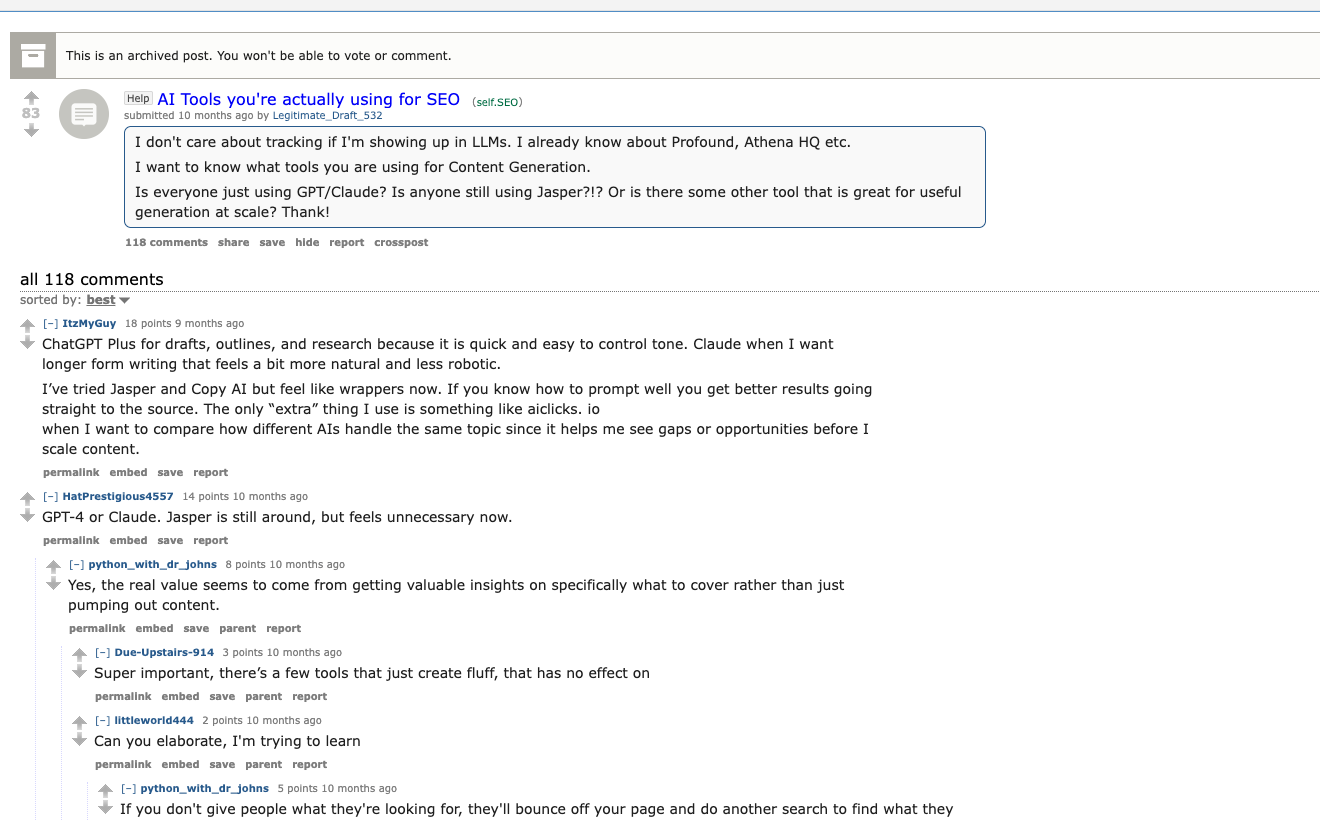
If internal links are part of your SEO workflow, test that too. A useful tool should connect related pages where the reader naturally needs more context, not force exact-match anchor text into random paragraphs. For larger content libraries, an AI internal linking tool can help, but the final link still needs to make editorial sense.
Final recommendation
The best SEO.ai alternative for most SEO content teams is Junia ai, especially if the goal is search-led article creation, internal linking, structured formatting, and publishing.
Choose SurferSEO if you already have writers and mainly need optimization. Choose Scalenut if planning and keyword research are the weak points. Choose Writesonic, Copy.ai, or Jasper if SEO content is only one part of a broader marketing content workflow.
The one mistake I would avoid is choosing the tool with the longest feature list. I have rarely regretted picking the tool that made the editorial workflow clearer; I have often regretted picking the one that promised to automate everything. For SEO and AI Search, the better question is simpler: which tool helps you publish content that is specific, useful, well-structured, and worth citing?
That is the standard any SEO.ai replacement has to meet.