
AI Search ROI Without Clicks: How CMOs Are Rethinking Measurement

Thu
AI SEO Specialist, Full Stack Developer

A few weeks ago I fell into one of those Reddit SEO threads that starts as a rant and ends up feeling like a board meeting.
Someone posted the usual pain: “Traffic is down. Rankings are fine. AI Overviews are everywhere. My boss thinks SEO is dying.”
And then the comments got more specific, which is where it got interesting. People weren’t saying SEO stopped working. They were saying the reporting stopped working.
Because the click is disappearing.
Not fully, not overnight. But enough that your nice clean dashboards are suddenly lying to you. Or at least, telling a smaller and smaller piece of the story.
AI answers, AI search interfaces, chat-based discovery, whatever you want to call it. They’re doing something simple and brutal:
They satisfy intent earlier. Before a visit. Before a session. Before your analytics even gets a chance.
So if your measurement model is still “SEO = sessions = leads”, then yeah. SEO is going to look like it’s failing… even when it’s creating demand.
This is the new CMO problem in 2026: leadership still expects content and SEO teams to prove business impact, but the environment is actively removing the old proof.
Let’s talk about what to do instead.
That is not a thought experiment. Search best CRM software today and Google often names HubSpot and Pipedrive in the AI Overview before a single blue link gets a click.
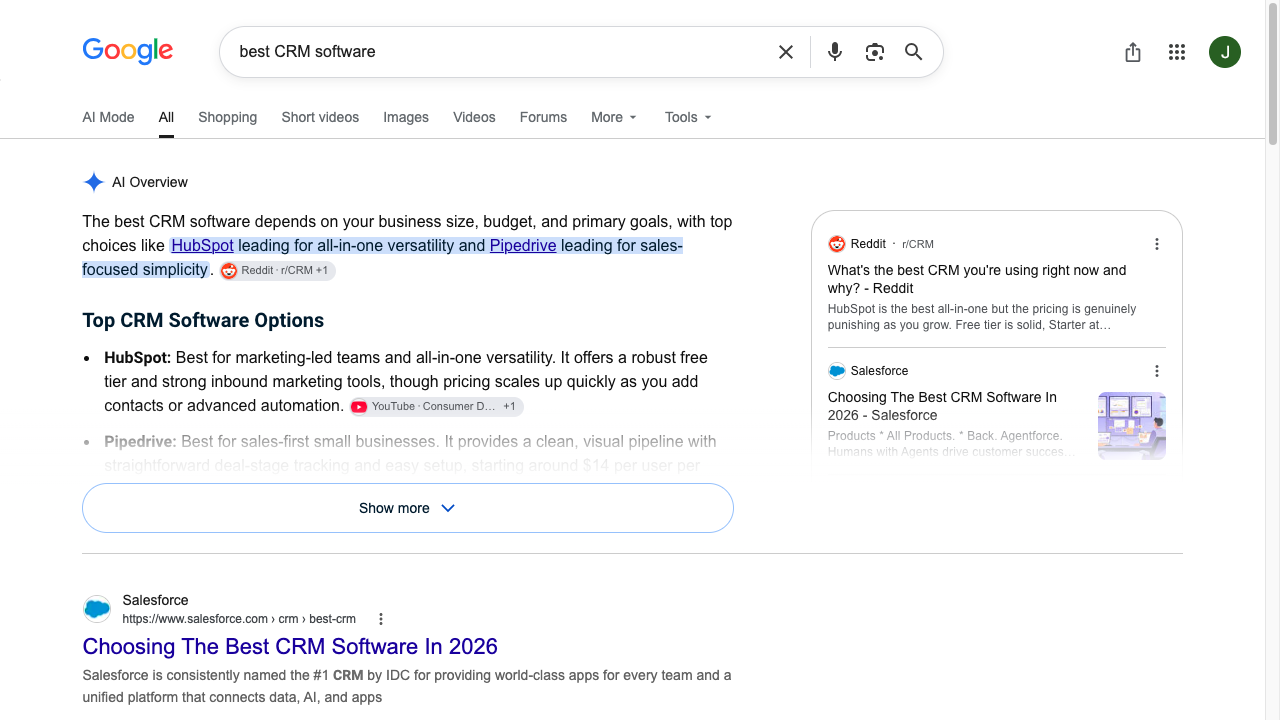
The organic result is still there. Salesforce still gets a listing. The measurement problem is that the answer happened first.
Clicks still matter. They just are not the whole story. If you drop sessions from the dashboard, you will miss site health, crawl issues, and the pages that still convert. Keep traffic. Stop making it the headline KPI.
The core shift: from clicks to influence
In classic search, measurement was straightforward:
- Rank for keyword
- Get click
- Get conversion
- Claim ROI
Now the user journey looks more like:
- Search something broad
- Read AI summary
- Ask a follow up
- Compare vendors inside the interface
- Maybe click. Maybe not.
- Later, type your brand name directly, or show up via a referral, or convert on a demo page after “dark” research
Your content can be the thing that shaped the decision, without being the thing that got the click.
- Old model
- Rank
- Click
- Session
- Last-click lead
- What actually happens
- AI mention or citation
- Brand search later
- Assisted conversion
- Influenced pipeline
View diagram source
flowchart LR
    subgraph old [Old model]
    A[Rank] --> B[Click] --> C[Session] --> D[Last-click lead]
    end
    subgraph now [What actually happens]
    E[AI mention or citation] --> F[Brand search later]
    E --> G[Assisted conversion]
    F --> H[Influenced pipeline]
    G --> H
    end
So the ROI question changes from:
“How much traffic did we get?”
to:
“Where did we show up, what did we influence, and can we connect that influence to pipeline behavior?”
I have read enough primers on AI search ROI. The useful part is not another definition of GEO. It is what you show the CFO this week, and what you stop reporting next month.
Why old SEO reporting breaks (even when work is “working”)
A few metrics are getting quietly demolished:
1. Organic sessions as the headline KPI
Sessions are now downstream of AI summaries, chat answers, and multi step discovery paths. A drop in sessions might mean:
- AI is answering the query and citing you
- Users are still learning from you, but not visiting
- Users visit later through branded/direct, not organic nonbrand
Traffic is not useless. But it’s no longer the source of truth.
2. Last click attribution as “proof”
Last click punishes content that does early education. And AI search pushes more education earlier. So the content that creates demand gets less credit.
3. Keyword rank as a proxy for outcomes
You can rank and still lose clicks. You can also not rank traditionally and still be pulled into AI answers because of entity coverage, structured data, citations, and topical alignment.
If your report is still “here are our rankings”, your CEO is going to ask the obvious question: “Cool. Where’s the revenue?”
The new model: measure visibility, engagement, and revenue influence separately
You need a measurement stack that treats AI discovery like its own distribution channel, with its own funnel.
Here are the buckets that are actually holding up for CMOs right now.
| KPI | What it proves | How you get it | Cadence |
|---|---|---|---|
| Share of voice in AI answers | Are you mentioned, cited, or recommended for the prompts buyers actually ask? | Fixed prompt set across AI Overviews, ChatGPT, Perplexity | Weekly |
| Assisted conversions | Did content shape the deal even if it did not get the last click? | Content-engaged audience tied to CRM opportunities | Monthly |
| Branded demand | Did AI exposure turn into people searching for you by name? | GSC brand and brand + category queries | Weekly |
| Influenced pipeline | Did organic content show up before pipeline moved? | CRM touches in the 30 to 90 days before stage change | Monthly / quarterly |
This matters most when traffic is down and leadership is already writing the obituary. Those four numbers give you a story that survives a missing click.
If you want a walkthrough of the visibility layer from a research team that actually measures this, Ahrefs' AEO course is the cleanest public explanation I have found:
What Is AI Visibility? The 3 Types Every Marketer Needs to Know — Ahrefs AEO Course
1) Share of voice in AI answers (not just SERPs)
If you’re not getting clicks, you still need to know if you’re present.
This becomes its own visibility layer:
- For your category queries, how often are you mentioned or cited in AI answers?
- Are competitors getting the “default” recommendation?
- What topics do you own vs what topics you’re missing?
This is basically “impression share” thinking, applied to AI outputs. Ahrefs Brand Radar is the public example I show stakeholders when they still think this is unmeasurable:
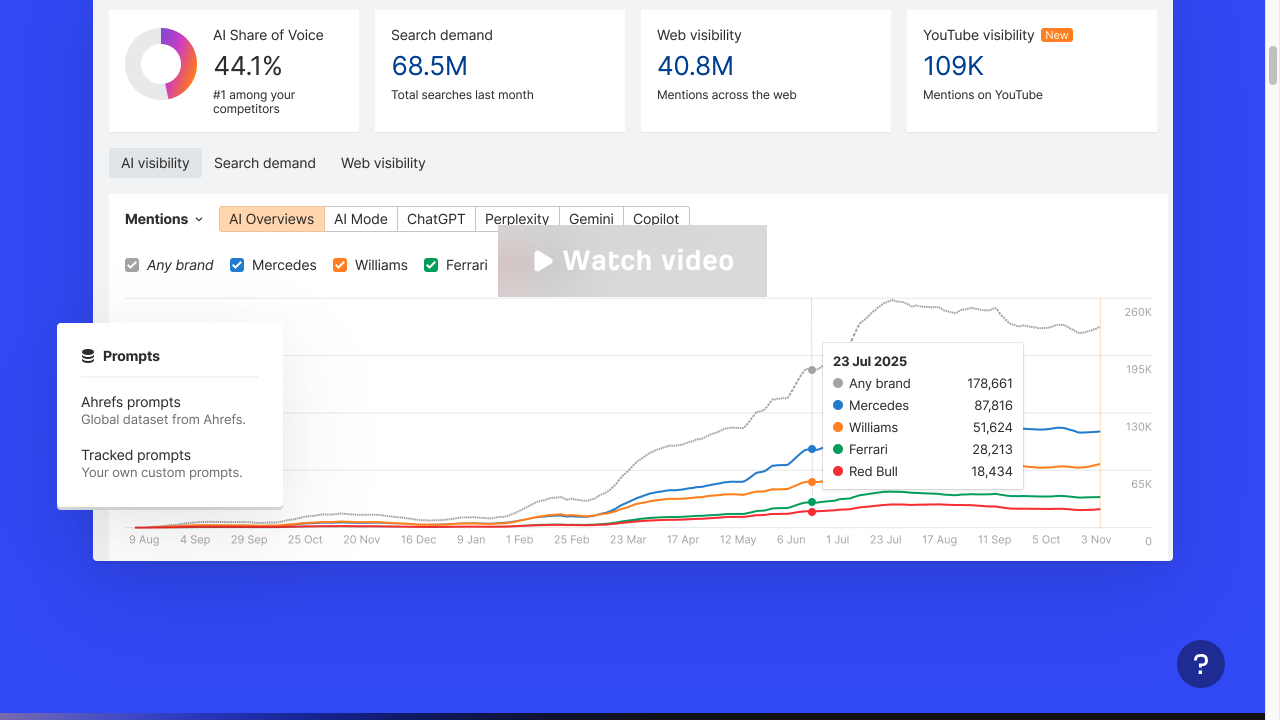
You do not need that exact tool. You do need that exact conversation: mentions, citations, and competitor share, not sessions.
How to instrument it in practice
- Pick 30 to 100 high intent prompts. Mix informational, comparison, and “best X for Y” prompts.
- Run them weekly across the AI interfaces your buyers use (Google AI Overviews, ChatGPT browsing modes, Perplexity, etc).
- Log: brand mention, citation link, position, sentiment, and which page was used as the source (if available).
- Roll it up into an AI SOV score.
If you want a free, ugly first pass before anyone buys software, Ahrefs' AI Overviews Tracker will at least tell you whether Google is citing you at all.
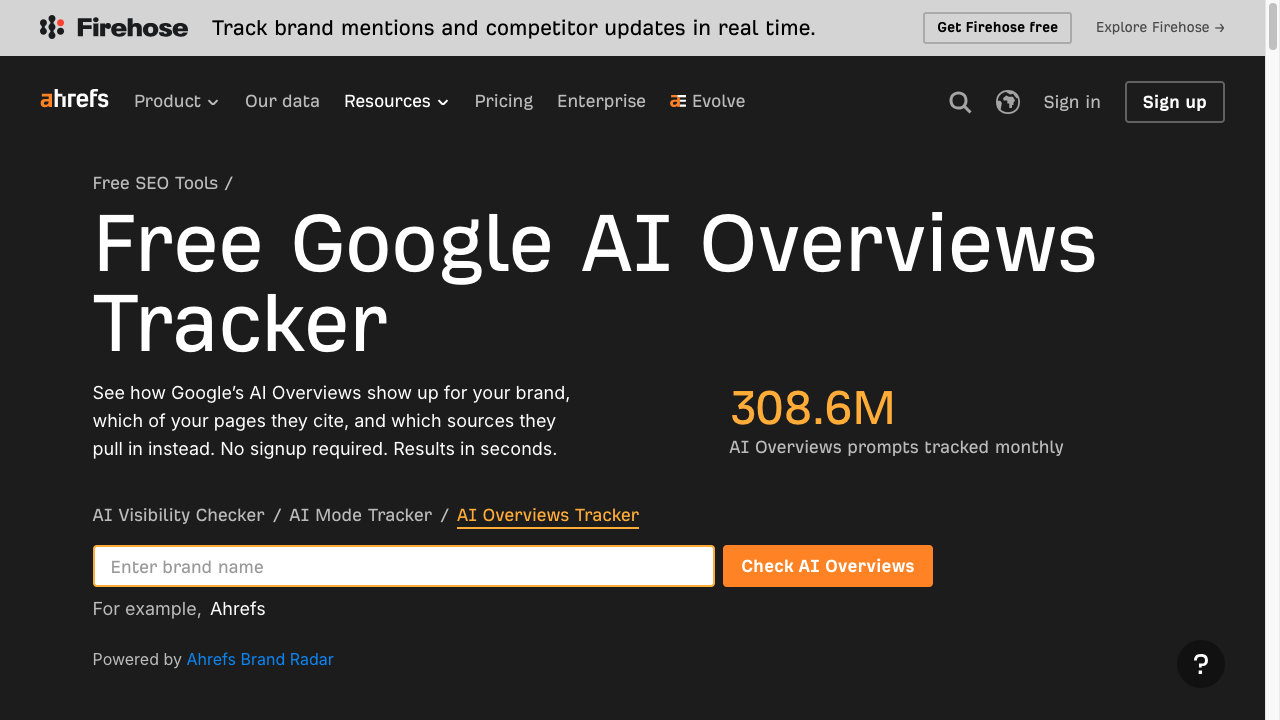
This is annoying manual work at first. But it turns the conversation from “traffic down” to “competitors are being recommended more than us for these 12 queries”.
That is something leadership understands.
2) Assisted conversions: give content credit for shaping the deal
Assisted conversions are not new. What’s new is they’re now the primary value of a lot of SEO content.
In AI search environments, content often works like:
- First touch education
- Mid funnel validation
- Objection handling
- Competitive framing
Not the final click.
So your measurement has to match that.
What to track
- Content touches in the 30 to 90 days before conversion (depending on sales cycle)
- Entry into retargeting audiences from content consumption
- Movement from nonbrand to brand behavior after content exposure
If you’re a B2B team with CRM discipline, this is where you win.
Simple setup that works
- Define “content engaged” as: viewed 2+ pages, or time on page threshold, or scroll depth, or video engagement
- Create a “Content Engaged” audience in your analytics / ad platforms
- Track how often leads that convert were previously in that audience
Now you can say: “This quarter, 38% of closed won deals had at least one content engagement touch.”
That statement survives the no click world.
3) Branded demand lift: the quiet KPI that becomes loud
When AI answers reduce generic clicks, buyers often switch to brand navigation faster.
They’ll read an AI overview, decide you sound legit, and then later search: “Junia AI internal linking” or “Junia vs X” or just “Junia AI”.
That is demand. And it’s measurable.
What to track
- Brand search volume trends (in GSC, Search Console insights, third party tools)
- Brand + category modifiers (“brand” + “pricing”, “brand” + “reviews”, “brand” + “alternative”)
- Direct traffic and returning users (with caution, because attribution here is messy)
You’re looking for correlation patterns:
- Publish / improve content on a topic cluster
- AI SOV improves for those prompts
- Brand + category searches rise 2 to 6 weeks later
- Demo assists rise among those cohorts
Not perfect science. But much closer to reality than “blog sessions”.
4) Influenced pipeline: a better executive story than “SEO leads”
At the exec level, the best metric I’ve seen for 2026 is influenced pipeline.
Not “MQLs from organic”. Not “organic revenue” in a last click model.
Influenced pipeline is: Pipeline where the account, contact, or lead engaged with organic content at any point before key stage changes.
You need two things
- Clean contact association (email capture, product signups, demo forms)
- A definition of meaningful content engagement that you trust
Then report:
- Influenced pipeline amount
- Influenced win rate vs non influenced
- Influenced sales cycle length
This is where SEO stops being “a channel” and becomes a strategic growth lever again.
A measurement framework CMOs can actually run
Here’s a pragmatic framework that doesn’t require reinventing your entire data warehouse.
Layer 1: AI visibility (weekly)
Goal: Are we being recommended?
Metrics:
- AI answer share of voice (mentions/citations)
- Topic coverage score (how many priority prompts you show up for)
- Competitor comparison presence (are you included in “best tools” answers?)
Output:
- A simple table. Prompts down the left, vendors across the top, checkmarks for mentions, plus notes for which page is cited.
Layer 2: Behavior and engagement (daily/weekly)
Goal: Are we capturing and retaining demand we influence?
Metrics:
- Content engaged users
- Return rate from content engaged cohorts
- Growth of retargetable audiences from organic content
- Email signups and product signups that include content touches
Output:
- Cohort view: engaged users this month, % that returned, % that later converted.
Layer 3: Pipeline and revenue influence (monthly/quarterly)
Goal: Are we impacting actual business outcomes?
Metrics:
- Influenced pipeline $
- Influenced win rate
- Influenced ACV (if relevant)
- Sales cycle acceleration (days)
Output:
- Executive slide: “Organic content influenced $X pipeline, with Y% win rate, and reduced cycle by Z days vs baseline.”
This layered model is how you stop arguing about clicks and start talking about outcomes.
“Okay, but how do we connect AI answers to pipeline if there’s no click?”
You don’t always connect it perfectly. That’s the point. The environment is creating blind spots.
But you can get close enough to make good decisions, and close enough to defend investment.
Here are a few field tested ways teams are doing it.
1) Build “AI discovery” landing patterns into your site
Even when AI tools do send traffic, it’s often weird traffic. Deep links. Random mid article sections. Sometimes a single paragraph.
So you want your pages to be:
- easy to understand in isolation
- internally connected so users can keep moving
This is where internal linking becomes less of an SEO checklist thing and more of a revenue thing.
If you want to automate some of this, Junia has an AI internal linking tool that helps you add contextual links at scale without turning your content into a Wikipedia mess.
2) Add “self identifying” hooks that show up in AI summaries
AI models pick up phrasing. Definitions. Lists. Clear explanations.
So you can intentionally include:
- short “what it is” definitions
- crisp “when to use it” sections
- comparison tables
- step by step frameworks with named steps
Not for keyword stuffing. For extractability. The content needs to be easy to quote.
This is also where people confuse a keyword tool with an agent. A scoring dashboard will tell you a page is “optimized.” It will not tell you whether that page is the one an AI answer should quote. If you are choosing a stack, the AI SEO agent vs AI SEO tools split is the useful frame.
3) Use CRM required fields that actually help attribution (without killing conversions)
Most forms ask “How did you hear about us?” and everyone lies or skips.
The better version:
- “What were you searching for today?” (free text)
- “Which tools did you evaluate before booking?” (multi select)
- “Where did you first hear about us?” (include “AI answer” as an option)
Then you categorize later.
It’s not perfect. But it creates directional data that’s hard to get elsewhere.
4) Create AI aware content clusters that match buyer journeys
A lot of AI answers pull from pages that look like:
- comprehensive guides
- structured explainers
- credible comparisons
- strong topical authority
If your content is scattered, thin, or overly “SEO bloggy”, you may not be included in AI answers at all. The pages that get cited usually look like a real AI SEO agent workflow: brief, draft, links, QA. Not a pile of unrelated posts.
For teams scaling content, bulk output is tempting. And risky. I would rather publish fewer extractable pages than 40 generic ones that never get named.
What metrics are becoming more useful (and what to show in reports)
If you need a quick list to bring into your next monthly review, here.
Metrics to de emphasize
- Raw organic sessions as the headline
- “Top pages by traffic” without pipeline context
- Rank reports with no mention of AI surfaces
- Last click revenue from organic as the only ROI proof
Metrics to emphasize
- AI share of voice (mentions, citations, inclusion rate)
- Assisted conversions and content touches
- Branded demand lift (brand + category search growth)
- Influenced pipeline and influenced revenue
- Engagement quality (return rate, depth, audience growth)
And one more: content that gets cited.
That sounds obvious, but it changes how you prioritize refreshes. A page that loses 20% traffic might still be a top cited source in AI answers. That page is not “declining”. It’s just being consumed differently.
A realistic example (what a CMO dashboard might look like now)
Let’s say you’re a B2B SaaS in a competitive category.
Old report:
- Organic traffic: down 18% MoM
- Leads from organic: down 12%
- Conclusion: SEO performance declining
New report:
- AI SOV for “best X for Y” prompts: up from 9% to 21%
- Brand + category searches: up 14% over 6 weeks
- Influenced pipeline: $2.4M this quarter (43% of total pipeline)
- Win rate for influenced accounts: 28% vs 19% baseline
- Sales cycle: 11 days shorter for influenced accounts
Conclusion: SEO is doing its job. The click just stopped being the proof.
This is the shift leadership needs to see, and it’s on marketing to reframe it.
Content still matters, but it has to be built for two worlds
Here’s the part content teams feel in their bones.
You now have to write for:
- Traditional search, where ranking and SERP clicks still exist
- AI discovery surfaces, where your content is summarized, extracted, and remixed
That means:
- clearer structure
- stronger entities and specifics
- fewer fluffy intros
- actually answering the question
- and yes, writing like a human so it doesn’t sound like plastic
The last one is the one teams skip. I have watched pages rank and still lose the AI Overview because the writing sounded like a template. If the draft is plastic, add a human touch before you ask it to get cited.
Because the reality is, a lot of AI scaled content is still kind of… dead on arrival. It ranks, maybe. But it doesn’t get cited. It doesn’t persuade. It doesn’t stick.
What to do next (a simple plan for the next 30 days)
If you’re a CMO or SEO lead and you need momentum, here’s a clean sequence. If the team does not yet know what an AI SEO agent is for, do not start by automating drafts. Start by measuring the prompts you already lose.
Week 1: Establish AI visibility baselines
- Choose your priority prompts. If you need the wider map first, AI SEO: everything you need to know is enough context.
- Track AI mentions and citations manually
- Identify the top 10 prompts where competitors are recommended but you are absent
Week 2: Fix the pages most likely to be cited
- Refresh the pages tied to those prompts. A catalog of AI SEO tools will not save a thin page.
- Add extractable sections, comparisons, definitions
- Improve internal linking so one cited page can pull users deeper
Week 3: Connect content engagement to CRM
- Define content engaged
- Create a segment/audience
- Build a simple influenced pipeline report (even if it’s crude at first)
Week 4: Build the exec narrative
- Present AI SOV + branded demand lift + influenced pipeline
- Make the point plainly: “Clicks are down because answers moved upstream. Influence is up and we can prove it through pipeline behavior.”
That’s the play.
Wrap up: ROI isn’t gone. The click was just a crutch.
AI search is not killing SEO. It’s killing the lazy version of SEO measurement.
The teams that win in 2026 will be the ones who stop defending traffic charts and start building influence based reporting. Assisted conversions, branded demand, AI share of voice, influenced pipeline. That’s the language leadership understands, and it maps to how buyers actually behave now.
If you want the operational side of this, the useful AI SEO agent use cases are research, briefs, refreshes, and internal links, not “write 50 posts.”
If you need a system that can run that content side without turning it into mush, look at Junia’s AI SEO Agent.
Because the goal isn’t more clicks anymore.
It’s being the source the AI pulls from. And the brand buyers remember when they’re ready to buy.