
How to Choose the Right AI Writing Tool for SEO

Yi
SEO Expert & AI Consultant

The right AI writing tool for SEO is the one that improves your whole publishing workflow, not just the one that writes the smoothest paragraph.
A ten-minute draft can still leave an afternoon of work: rebuilding the outline, checking a price, replacing invented citations, and fixing the CMS export. Those tasks belong in the buying decision. A generic chatbot can help you brainstorm and draft. A serious SEO writing tool should also help you build a brief, control the outline, improve weak sections, suggest internal links, generate metadata, preserve brand voice, and make the article easier to update after it goes live.
If a tool only gives you more text, it is not solving the SEO problem. It is creating a draft you still have to rescue.
TL;DR: Choose by Workflow, Not Word Count
| If you need to... | Choose this type of tool | Check this before paying |
|---|---|---|
| Write SEO blog posts faster | AI article writer with brief and outline controls | Does the draft match search intent before you edit it? |
| Improve old pages | SEO content improver | Does it find content gaps, thin sections, and outdated claims? |
| Plan topics and keywords | AI keyword research or SEO suite | Does it explain why a keyword is worth targeting? |
| Scale similar pages | Bulk content or programmatic SEO platform | Can you control templates, duplication, data inputs, and review queues? |
| Publish in WordPress | SEO plugin or CMS-integrated assistant | Does it work inside your real editor without formatting cleanup? |
| Support a content team | SEO writing platform | Can it handle briefs, brand voice, approvals, permissions, and exports? |
My practical recommendation: test every tool on one real keyword, one existing article, and one content format you publish often. Measure editing time, factual cleanup, and publishability. Do not judge the tool by how fast it generates a first draft.
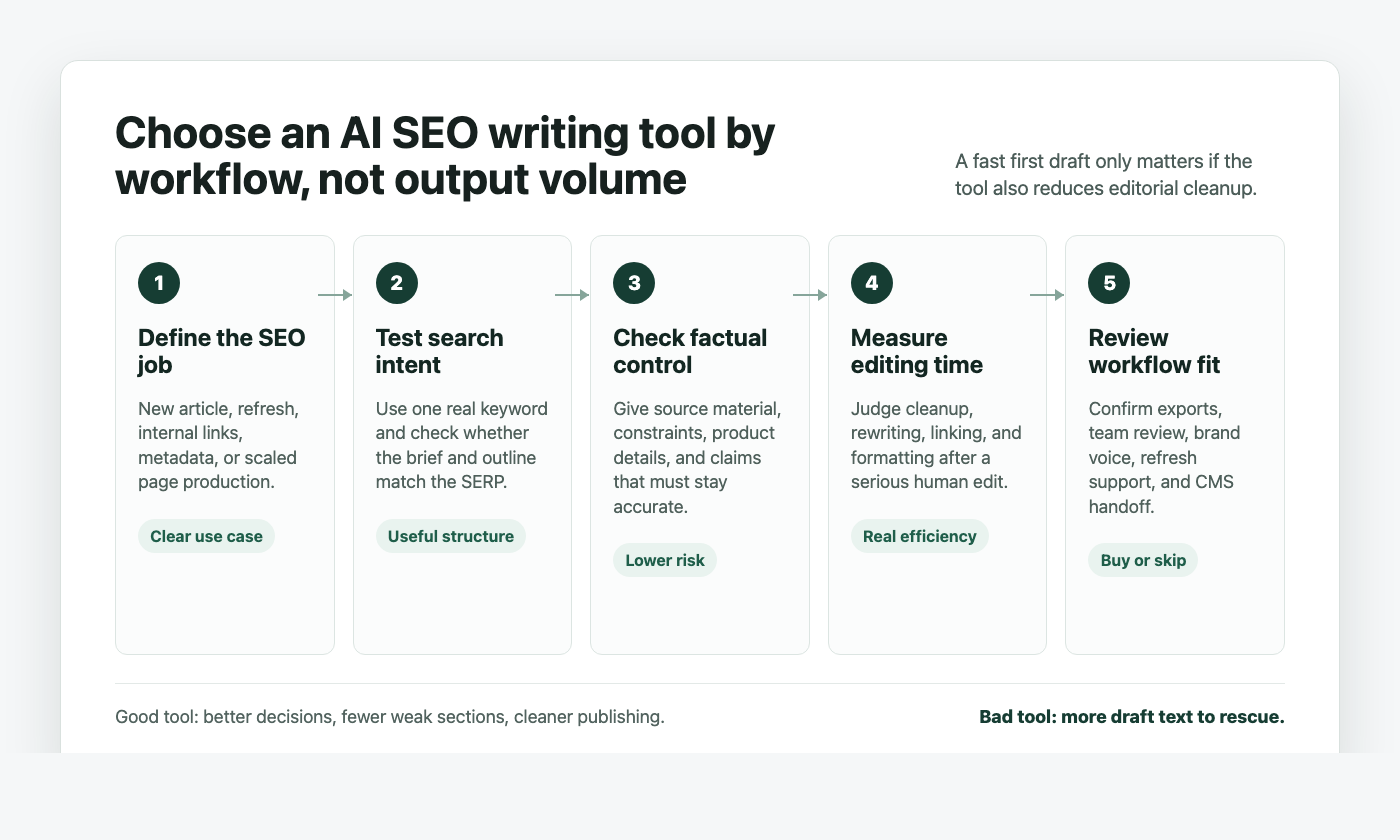
Start With the SEO Job
Before you compare tools, decide what job you are hiring the tool to do.
Most bad tool decisions start with the wrong question: "Which AI writer is best?" That is too broad. A better question is which bottleneck the tool needs to remove. A solo blogger, ecommerce team, affiliate site, SaaS content team, and agency do not need the same system.
For example, a two-location bicycle shop needs an inventory-software comparison that covers stock transfers, repair parts, and compatibility with its point-of-sale system. A fluent overview of “the benefits of inventory management” would miss the buying decision entirely.
An agency updating fifty existing comparisons has a different problem: preserving the useful copy while finding stale feature claims. Both teams may need AI writing support, but the agency should spend more of its trial on refresh controls and selective editing.
For most content teams, the right setup is a workflow: research, brief, draft, edit, optimize, internal link, publish, and refresh. A platform like Junia AI is most useful when you want those steps close together instead of scattered across several apps.
The 9 Criteria I Would Actually Use

Do not evaluate an AI SEO writing tool by asking whether it can write an article. Most can, at least well enough to look convincing for the first few paragraphs.
Ask whether it can help you publish something that deserves to rank after a real editor has checked the structure, claims, links, and usefulness.
1. Search Intent Handling
A "best tools" keyword needs comparisons. A "how to" keyword needs steps. A "template" keyword needs usable examples. A "versus" keyword needs tradeoffs.
The tool should help you see that before the draft is written. I would rather catch a bad angle at the brief stage than after reading a 2,000-word draft that confidently answered the wrong question. Look for SERP-based briefs, competitor heading analysis, related questions, intent labels, missing subtopic suggestions, and a way to adjust the outline before generation.
If you already have keyword research somewhere else, Junia's SEO content brief generator can turn a keyword into a cleaner writing plan with the audience, sections, and search angle defined before drafting starts.
2. Outline Control
This is where many tools quietly fail.
The first generated outline often looks tidy, but tidy is not the same as useful. A weak outline can leave the reader’s main question unanswered even when every sentence reads well. If the structure is wrong, polished paragraphs just make the problem harder to notice.
Before you buy, check whether you can:
- edit the outline before the full draft is generated
- remove generic sections before they become 500 words of filler
- add product knowledge, examples, and source requirements
- lock key sections that must stay in the article
- regenerate only weak sections instead of the whole draft
Good SEO writing starts before paragraph one. The tool should make structure easier to control, not harder. If I cannot reshape the outline before generation, I treat that as a serious limitation.
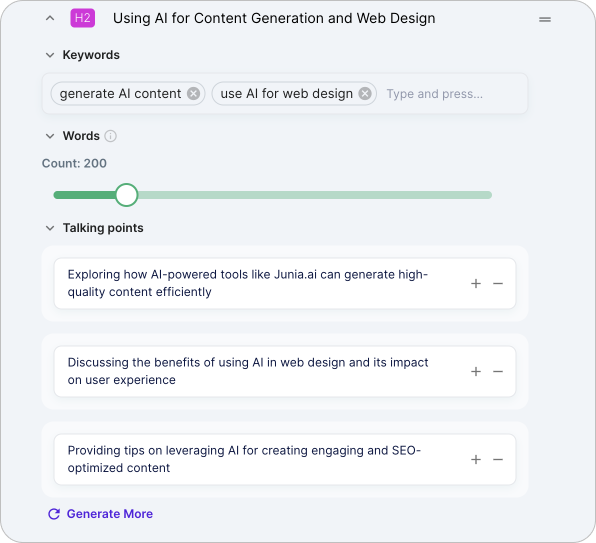
In Junia’s documented outline workflow, talking points and section order can be changed before drafting. Use those controls to specify what a section must answer.
For the bicycle-shop example, replace a heading such as “Features to consider” with “Can staff transfer stock between both shops?” Add a talking point asking how transfers affect available stock at each location. That gives the writer a question to resolve instead of permission to list features.
3. Long-Form Draft Quality
A useful long-form AI writer should produce a draft with structure, transitions, examples, and enough depth to edit. It should not just create soft claims in a polished voice. That kind of draft feels finished too early, which is exactly why it is risky.
Test it on a real keyword from your site. Give it your audience, search intent, brand notes, internal links, source material, and editorial requirements. Then judge the output like an editor:
- Does it answer the query quickly?
- Does it include concrete examples?
- Does it repeat the same point?
- Does it make claims without evidence?
- Does it understand the difference between a draft and a publishable page?
- Does it sound closer to your brand after one revision?
If your work is mostly blog publishing, compare dedicated AI article writers against general chatbots. The right choice depends on whether you need a blank assistant or a tool built around briefs, SEO structure, and revision.
4. SEO Optimization Without Keyword Stuffing
An AI SEO writing tool should help with optimization, but it should not make the page read like a checklist.
Useful optimization includes heading checks, related entity suggestions, readability notes, title and meta ideas, image alt text support, internal link suggestions, and clear warnings when a section is thin.
Google's guidance on helpful, reliable, people-first content is the right guardrail here. Optimization should make the article easier for readers and search systems to understand. It should not turn every heading into a keyword variation.
5. Factual Control and Source Handling
SEO content has to survive contact with reality.
If the tool invents statistics, misquotes sources, or confidently names features that do not exist, it creates cleanup work. A convincing sentence with a false source can take longer to repair than an awkward sentence. That risk is higher for software, pricing, legal rules, health, finance, ecommerce policies, and platform guidance.
At minimum, check whether the tool can:
- use your source material without drifting
- separate cited claims from generated explanations
- preserve factual constraints during rewrites
- flag claims that need review
- avoid fabricating links, quotes, prices, or product features
Google's guidance on AI-generated content is useful because it does not treat AI use itself as the problem. The real issue is unhelpful, unreliable, or search-engine-first content.
Check whether facts survive a rewrite. In a trial, supply a short fictional product note: “Stock transfers are included on the Plus plan. Barcode scanning is not available.” Ask the tool for a summary, then a friendlier rewrite. Both versions must preserve the plan restriction and the missing feature.
Google’s current generative-AI guidance specifically warns against producing many pages without adding value. A detector score does not answer whether the article is accurate or useful.
6. Internal Linking Support
Internal links are easy to miss when teams publish quickly.
A good tool should suggest internal links based on topical relevance, not just exact-match keywords. For example, when planning an SEO article, you might use AI keyword research first to choose the right opportunity, then create a brief, then draft, then add internal links. Those are different reader needs, so the links should appear where those needs naturally come up.
Junia's AI internal linking tool is useful when you want suggestions that fit the page context instead of manually searching your own site for every supporting article.
The standard is simple: each linked sentence should still be useful if the link were removed. If the sentence only exists to introduce a resource, rewrite it.
7. Metadata and Snippet Support
Meta titles and descriptions still matter because they shape the promise people see before they click.
The tool should generate multiple options, but it should not make the final decision for you. A good title tag is descriptive and concise; it can match the H1 when that wording works. Google may use the title element, the visible heading, and other page signals to create its title link. A good description summarizes the value of the page without exaggerating.
For this step, a meta title generator is useful for drafting options you can compare against the H1.
The description has a different job: it should summarize the page promise in one compact snippet. A meta description generator can help with that compression, but I would still edit the final version so it matches the finished page exactly.
8. Content Refresh Support
A lot of SEO growth comes from improving pages you already have.
The best AI writing tool may not be the one that creates a new draft fastest. It may be the one that helps you refresh an old article by finding outdated sections, missing subtopics, weak examples, poor internal links, and metadata that no longer matches the SERP.
For that job, an SEO improver is usually more valuable than a blank-page generator because the hard part is diagnosis, not typing.
9. Workflow Fit
This is where expensive tools either justify themselves or become shelfware.
Check the boring details. They are not glamorous, but they decide whether the tool becomes part of the publishing process or another tab people avoid opening:
- Can writers and editors collaborate?
- Can the tool export to WordPress, Markdown, HTML, Google Docs, or your CMS?
- Can you save brand voice and content rules?
- Can you reuse templates?
- Can you create review queues for scaled content?
- Can you update old articles without starting from scratch?
- Can your team actually use it without adding another messy handoff?
For sites that publish many similar but distinct pages, bulk content creation matters when the team needs repeatable drafts, review queues, and consistent formatting across many URLs.
A programmatic SEO tool becomes more relevant when pages depend on structured data, templates, and safeguards against near-duplicate content.
A Practical Test Before You Pay
Keep the inputs constant across your shortlist. Use the same source notes, audience, internal-link list, and output format. Record the plan and settings too; a premium demo and an entry-level trial are not the same comparison.
Here is a sample brief for the bicycle-shop scenario:
Topic: How to choose inventory software for a two-location bicycle shop.
Reader: A UK shop owner replacing spreadsheets.
Decision: Compare stock transfers, repair-part tracking, POS compatibility, and implementation effort.
Evidence: Use the supplied vendor documentation. Mark any missing feature or price as unknown.
Output: An outline first, then a comparison with clear reasons to choose or rule out each option. Do not invent vendor tests or customer results.
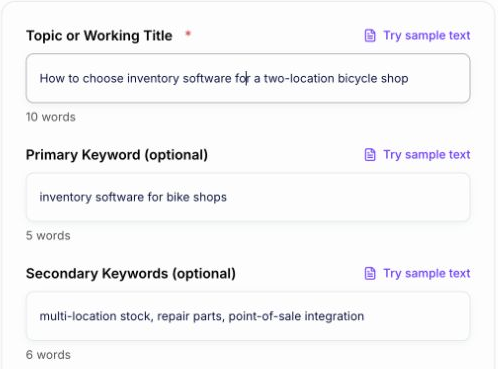
Start with the topic and keyword inputs shown here. Supply the complete brief above to every tool in your trial, including requirements that need a separate instructions field.
Before generating, set the intent to commercial investigation if the tool offers that choice. Leave competitor URLs blank until you have checked the pages; invented URLs make the comparison less useful.
Run this test before you subscribe:
| Test | What to do | Pass signal |
|---|---|---|
| Keyword test | Give the tool one real keyword from your site | It identifies intent and suggests a usable structure |
| Draft test | Ask for a full article from a strict brief | The output needs editing, not rebuilding |
| Refresh test | Give it an old underperforming page | It finds missing sections, weak claims, and outdated details |
| Internal link test | Give it 10 relevant URLs from your site | Suggestions fit the article naturally |
| Fact test | Give it source material and constraints | Claims stay tied to the source material |
| Voice test | Give it a style sample | The second draft sounds closer to your voice |
| Export test | Move the draft into your CMS | Formatting survives without cleanup |
Choose the three tasks that matter most to your team before starting the trial. A tool that fails factual preservation or the required export format should not win because it scores well on easier tasks.
Time the whole route to an accepted draft: briefing, generation, fact-checking, editing, and export cleanup. Compare that total with your usual workflow; a universal “30-minute edit” target tells you little about a specialist article.
Worked example: suppose Tool A takes 5 minutes to draft and 70 minutes to verify and repair. Tool B takes 12 minutes to draft and 25 minutes to verify and repair. That is 75 minutes versus 37 minutes, or a 38-minute saving per accepted article. At eight articles a month, the difference is 304 minutes—just over five hours. Add subscription costs only after checking that both outputs meet the same standard.
Also count rejected drafts. A fast output you discard is still time spent.
What Features Are Overrated?
Some features look impressive on a pricing page but do little for SEO.
AI detector bypassing is one of them. If a tool leads with "undetectable" content, I would be careful. A high detector score does not repair an unsupported claim, a missing example, or a broken link. The better goal is not to trick detectors. The better goal is to publish useful, specific, accurate content that a reader can trust.
Keyword density targets are another weak signal. A tool that asks you to repeat a phrase 23 times may create worse writing. I would rather see topical gaps, missing questions, and examples the article should include.
One-click article generation is useful only for low-risk drafts. For competitive SEO, the important work is still intent, structure, sources, product knowledge, links, editing, and refresh planning.
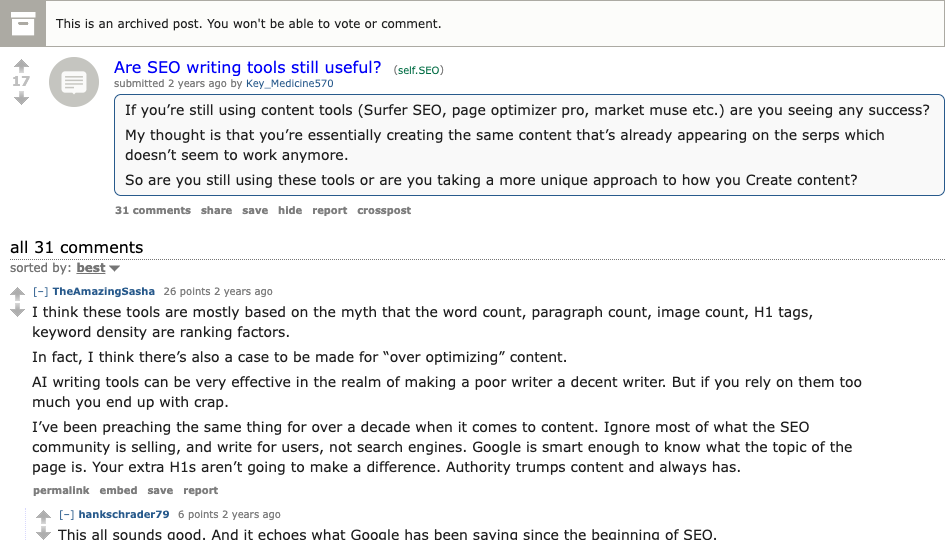
What Features Are Underrated?
The underrated features are usually the ones that reduce editing friction.
Brief quality matters because it prevents generic drafts. Outline control matters because it saves you from restructuring later. Internal link suggestions matter because they make the site easier to navigate. Metadata tools matter because they force you to define the page promise clearly. They are worth testing after the initial drafting demo, when the work moves into editing and publishing.
Image support also matters more than many teams think. Images can show workflows, compare tools, explain a framework, or support image search visibility. Google's image SEO best practices emphasize the importance of image context, alt text, and quality, so a writing tool that helps with useful visual planning can improve more than decoration.
The best tools are not always the flashiest. They are the ones that remove the tedious parts of publishing without removing editorial judgment.
How AI Search Changes the Decision
AI Search makes structure and evidence more important, not less.
I do not think AI Search changes the basic editorial standard. It raises the cost of being vague. Google's documentation on AI features in Search keeps pointing back to familiar fundamentals: helpful content, crawlability, text availability, structured data that matches visible content, good page experience, and useful images or videos.
That means your AI writing tool should help you create pages that are easy to quote, summarize, and trust:
- a direct answer near the top
- short definitions where the topic needs them
- comparison tables
- clear steps and criteria
- original examples or experience
- source-backed claims
- descriptive headings
- natural internal links
- images or videos when they clarify the topic
A short answer near the top helps readers decide whether to keep reading. It is not a guarantee of an AI citation. Google says there are no additional technical requirements for AI Overviews or AI Mode, and qualifying pages are not guaranteed to appear. Treat vendor promises of guaranteed placement as a claim to challenge.
AI Writing Tool or SEO Service?
You do not always need to choose one.
Choose an AI writing tool when:
- you already understand your audience
- you have a keyword strategy
- you need faster briefs, drafts, updates, and metadata
- you have editors who can review the work
- you publish regularly
- you want more control over production cost
Choose an SEO service when:
- you do not have a strategy yet
- your site has technical SEO problems
- you need analytics, audits, or link building
- the topic requires expert review
- rankings are tied directly to revenue
- your team cannot edit AI-assisted drafts well
The strongest setup is often both: expert strategy and quality control, supported by AI-assisted production. I think of AI as the production layer, not the strategist. It can accelerate the work, but it should not decide what the business needs to rank for or what the reader needs to trust.
Red Flags That a Tool Will Waste Your Time
Be careful if a tool leans too hard on any of these promises. These are the claims I would slow down and investigate before paying:
- "One-click SEO articles" with no research or editing workflow
- AI detector bypassing as the main selling point
- keyword density targets without intent analysis
- fake or unverified citations
- no way to control tone, structure, or sources
- no useful export path into your publishing workflow
- pricing that hides important SEO features in higher tiers
- ranking claims without showing how the tool improves the page
The goal is not to publish more words. The goal is to publish better pages with less wasted effort. If a tool makes the publishing queue bigger but the editorial queue messier, it has not solved the real problem.
My Recommendation
If you are choosing an AI writing tool for SEO in 2026, use this order:
- Define the SEO job you need the tool to handle.
- Test it on one real keyword, one old page, and one repeatable content format.
- Check structure before you judge paragraph quality.
- Measure editing time, factual cleanup, and formatting cleanup.
- Review whether the tool improves internal links, metadata, and refresh planning.
- Buy only if it saves decision time, not just typing time.
If you mostly need flexible writing help, a general AI assistant may be enough.
If you need SEO workflows, choose a tool with briefs, optimization, internal links, metadata, and refresh support.
If you need scale, choose a system with templates, data imports, human review, and publishing controls.
And if you want a practical starting workflow, I would combine Junia's AI article writer with keyword research, brief creation, internal linking, and content improvement. That gives you more than a blank text generator. It gives you the parts of the SEO writing process that usually slow teams down.
Before starting an annual plan, complete the brief-to-CMS test on one article you actually need to publish. Keep the draft, the correction notes, and the time log. Those three records give you a much stronger buying decision than another impressive demo.