
Google Translate vs AI Localization for SEO: When Free Translation Costs You Rankings

Thu
AI SEO Specialist, Full Stack Developer

Google Translate is excellent when you need to understand text quickly. It is not a full multilingual SEO workflow.
That distinction matters. A translated page can read "correct" and still miss the local keyword, use the wrong phrasing for the market, keep an English URL slug, skip hreflang, or sound slightly off to the people you want to convert. Those small misses are where free translation can become expensive.
TL;DR
Use Google Translate for rough understanding, internal research, and early market checks. Use AI localization when the translated page needs to rank, earn trust, or support revenue.
| Use case | Better choice | Why |
|---|---|---|
| Reading foreign-language pages quickly | Google Translate | Speed matters more than polish |
| Testing whether a topic might work in another market | Google Translate or basic AI translation | You are still validating the opportunity |
| Translating blog posts for organic traffic | AI localization | You need local keywords, metadata, internal links, and review |
| Translating product, pricing, legal, or signup pages | AI localization plus human QA | Mistakes affect trust and conversion |
| Scaling hundreds of articles into multiple languages | AI localization workflow | Copy-paste translation breaks down fast |
The practical rule is simple: if the page is just for comprehension, Google Translate is fine. If the page is meant to compete in search, treat translation as part of your AI multilingual SEO process.
The Real Difference: Translation vs Localization
Translation changes the language. Localization changes the page so it works in the target market.
That includes the words, but it also includes search intent, title tags, meta descriptions, internal links, examples, calls to action, currencies, units, spelling, tone, and sometimes even the offer itself.
For example, directly translating "running shoes" into Spanish may produce a technically valid phrase. But the best search term can vary by country, dialect, and buyer intent. A page targeting Mexico may need different wording from a page targeting Spain, even if both are "Spanish" pages.
That is why localization SEO is not just a language task. It is a publishing task.
Google's own international SEO documentation reinforces the technical side of this. For multilingual pages, Google recommends using separate URLs for different language versions and hreflang annotations to help Search serve the right localized URL to the right user. Google also says it uses its own algorithms to determine page language, not the lang attribute alone.
Those details are outside the scope of plain Google Translate. They belong to a real localization workflow.
Where Google Translate Works Well
Google Translate has become much more capable. In 2024, Google announced its largest language expansion for Translate, adding 110 languages and extending support to hundreds of millions more speakers.
That makes it useful for:
- understanding foreign-language articles, comments, and documentation
- checking whether competitors in another market cover a topic
- translating short internal notes
- getting a first-pass draft before deeper review
- helping non-specialists navigate unfamiliar languages
I would not dismiss it. For research, support, travel, internal communication, and quick comprehension, it is often exactly the right tool.
The problem starts when a rough translation is published as if it were a finished SEO asset.
Where Google Translate Falls Short for SEO
Google Translate does not know your SEO strategy. It does not know which keyword variant is strongest in the target country, which terms your product team never wants changed, or which phrase sounds natural to local buyers.
For SEO pages, the common failure points are predictable.
| SEO requirement | Why it matters | Where basic translation struggles |
|---|---|---|
| Local keyword research | People do not search by literal dictionary translations | Direct translations can miss the query people actually use |
| Search intent | A topic may require different examples or angles by market | The original article structure may not match local SERPs |
| Metadata | Title tags and descriptions influence search snippets | Translated metadata can become too long, vague, or awkward |
| URL structure | Search engines need crawlable language-specific URLs | Google Translate does not create an SEO site architecture |
| Hreflang | Helps Google connect language and regional page variants | Needs implementation beyond text translation |
| Brand voice | Trust depends on natural phrasing | Literal wording can feel robotic or foreign |
| Internal links | Localized pages should support the site architecture | Links and anchors often need rewriting, not direct translation |
This is why translated pages sometimes fail even when the translation is readable. The page is linguistically understandable, but it is not search-ready.
Google's spam policies also make the quality bar clear: scaled content created mainly to manipulate rankings is a risk, including content generated or transformed at scale when it adds little value. The takeaway is not "AI translation is bad." The takeaway is that translated pages still need to be useful, reviewed, and genuinely adapted for the reader.
What AI Localization Adds
AI localization platforms sit between raw machine translation and traditional human-only translation. The best workflows use AI for speed, then add controls that protect quality.
A good localization workflow usually includes:
- glossary and terminology rules, so product names and brand terms stay consistent
- translation memory, so repeated phrases do not drift across pages
- target-language keyword guidance, so the page matches how people search locally
- metadata translation and rewriting, not just body-copy translation
- URL, slug, and hreflang support
- CMS integration, so translated pages can be published and updated cleanly
- human review for high-value pages
Google Cloud's own translation products point in this direction too. Its adaptive translation feature lets teams provide example translations so the model can tailor output to a preferred style, tone, and domain. That is very different from asking a generic translator to convert a page with no context.
For Junia users, the same principle applies when using a bulk blog translation workflow: the win is not only that you can translate more articles. It is that you can keep the translated pages structured, editable, and aligned with SEO goals.
Google Translate vs AI Localization: Side-by-Side
| Factor | Google Translate | AI localization |
|---|---|---|
| Main job | Convert text quickly | Prepare publishable localized content |
| Best for | Research, comprehension, low-stakes drafts | SEO pages, product pages, content scaling |
| Keyword handling | Literal or general translation | Can use market-specific keyword guidance |
| Brand terminology | Limited control | Glossaries and terminology rules |
| Metadata | Manual | Usually part of the workflow |
| Hreflang and URLs | Not handled by the translator itself | Often supported directly or through CMS workflows |
| Human review | Separate manual step | Often built into the process |
| Risk | Awkward copy, weak intent match, missing SEO elements | Higher setup effort, but stronger publishing control |
The choice is less about "Google Translate vs AI" and more about the job you are asking the tool to do.
If the job is "help me understand this paragraph," Google Translate is usually enough. If the job is "turn this English article into a Spanish page that can rank and convert," you need localization.
A Practical SEO Workflow for Translated Pages
Here is the workflow I would use for any page that matters commercially.
| Job | Google Translate can help | AI localization is stronger when… |
|---|---|---|
| Internal understanding | Skimming foreign SERPs | You need publishable on-page copy |
| Metadata | Rough draft only | Titles/metas must match local intent |
| Commercial pages | Rarely | Offers, proof, and CTAs must feel native |
Free translation is not free if it ranks the wrong intent. Hreflang and crawlable URLs cannot save a page that reads like a dictionary dump.
Hunting a heinous hreflang headache
1. Decide Whether the Page Deserves Localization
Not every page needs a full process. Start with business value.
Localize pages that:
- already get organic traffic in the original language
- target keywords with international demand
- support demos, signups, trials, or sales
- explain important product or category concepts
- are part of a larger multilingual content strategy
For a low-priority support note or internal research document, Google Translate may be perfectly reasonable.
2. Research the Local Search Intent
Do not translate the English keyword and assume the job is done.
Look at the target-language SERP. Check the ranking page types, titles, examples, and vocabulary. In some markets, users may prefer comparison pages. In others, they may search for tutorials, pricing, alternatives, or local providers.
This is where many translated articles lose rankings before they even publish. The translation is accurate, but the page answers the wrong version of the query.
3. Localize the Page Elements, Not Just the Body
The body copy is only one part of the page.
For each language version, review:
- H1 and section headings
- title tag and meta description
- URL slug
- image alt text or captions
- internal links and anchor text
- product names and feature terms
- examples, currencies, units, and cultural references
- calls to action
This is also where a simple blog post translator is more useful when it is paired with editorial review. The first draft can save time, but the final page still needs a local SEO pass.
4. Add Hreflang and Crawlable URLs
If every language version has its own URL, search engines can crawl, index, and serve those pages more reliably.
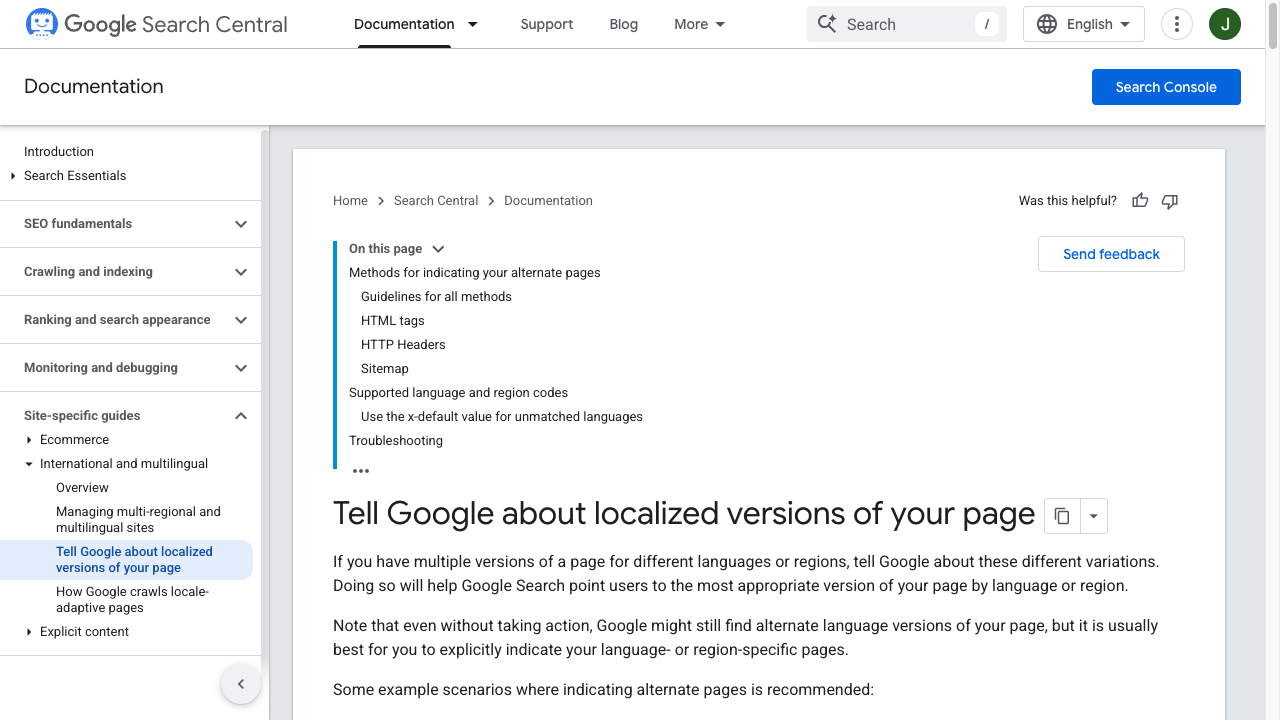
Google's guidance on localized versions is clear: hreflang helps Google understand alternate language and regional versions of a page. For larger sites, this becomes even more important because mistakes can cause the wrong language page to appear in the wrong market.
If hreflang is still fuzzy, it is worth understanding how hreflang works for multilingual websites before scaling translations across dozens of pages.
5. Review the Page Like a Local Reader
Machine output can look clean and still feel wrong.
Ask a native speaker, local marketer, or qualified reviewer to check:
- whether the wording sounds natural
- whether the keyword choices match real searches
- whether examples and claims feel local
- whether any terms sound too formal, too casual, or too literal
- whether the CTA fits the market
For high-stakes pages, this review is not optional. It is the difference between content that merely exists in another language and content that feels like it was written for that audience.
When to Use Each Option
Use Google Translate when speed matters more than search performance.
That includes quick research, customer-support triage, rough competitor checks, or early validation before you invest in a market. It is also useful when you are translating something that will not be indexed or shown to customers.
Use AI localization when the page needs to perform.
That includes SEO blog posts, SaaS landing pages, product pages, comparison pages, affiliate content, documentation pages that influence buying decisions, and any content you expect to bring in organic traffic from another country.
Use human review when mistakes would be costly.
Legal, medical, financial, technical, pricing, and brand-sensitive pages should not rely on raw machine output. The same is true for competitive commercial keywords where a slightly better phrase can change rankings and conversions.
How This Affects AI Search Visibility
AI search systems tend to summarize pages that are clear, specific, and easy to extract facts from. Localization can help here, but only if the translated page preserves meaning and structure.
A page is easier for both search engines and AI systems to understand when it has:
- a direct answer near the top
- clear comparison tables
- consistent terminology
- localized examples
- source-backed claims
- concise headings that match real questions
- no bloated sections that repeat the same idea
This is another reason not to publish raw translated text at scale. If the page is vague in the target language, AI search systems have less to confidently cite or summarize.
For multilingual growth, the strongest approach is to combine localization quality with technical SEO. That is the same foundation behind ranking blog posts in foreign countries: the page has to match the local query, be technically understandable, and feel trustworthy to the reader.
Decision Checklist
Before choosing Google Translate or AI localization, ask these questions:
- Will this page be indexed?
- Is the page supposed to rank for a target-language keyword?
- Does the page support revenue, leads, signups, or product trust?
- Does the market use different terms, spellings, currencies, or examples?
- Do we need localized metadata, slugs, and internal links?
- Will the page need updates later?
- Would an awkward translation hurt brand credibility?
If you answer "yes" to most of these, Google Translate is not enough by itself.
Final Recommendation
Google Translate is a useful translation tool. It is not a multilingual SEO strategy.
Use it when you need speed and rough comprehension. Use AI localization when translated pages are expected to rank, convert, and support your brand in another market. Then add human review to the pages where nuance, compliance, or revenue matter.
The best workflow is usually hybrid: AI handles scale, humans protect meaning, and SEO controls make sure each language version can actually compete. When you are ready to move beyond one-off translations, a repeatable process for bulk translating articles keeps quality from collapsing as volume grows.