
Best Headline Formulas for Blog Posts, Landing Pages, and Ads

Thu
AI SEO Specialist, Full Stack Developer

You do not need to reinvent headline writing every time you publish.
Most strong headlines follow a small set of patterns. The wording changes, the angle changes, and the platform changes, but the underlying formulas stay surprisingly consistent. Once you understand those formulas, writing faster gets easier and testing different angles becomes much less painful.
This guide breaks down practical headline formulas for blog posts, landing pages, ads, email, and social content, along with tips on when to use each one.
Why headline formulas work
Formulas are useful because they give structure to the decision. Instead of staring at a blank page and hoping for something catchy, you start with a known pattern and adapt it to the topic.
That does not mean your headlines should sound templated. It just means you have a solid frame to work from.
If you want to turn these frameworks into quick drafts, you can generate headlines with AI and then edit the best versions instead of starting from zero.
1. The how-to formula
How to [achieve outcome]
This is one of the cleanest formulas for informational content. It works especially well when the reader is looking for a process, a tutorial, or a direct answer.
Examples:
- How to Write Headlines That Match Search Intent
- How to Improve Landing Page Copy Without Rewriting the Whole Page
- How to Make Facebook Ads More Specific
You can make it stronger by adding a constraint:
- How to Write Better Headlines Without Sounding Generic
- How to Improve Ad CTR Without Increasing Budget
2. The list formula
[Number] ways to [goal]
List headlines are effective because they signal scannability. Readers know they can move through the piece quickly and pick out the most relevant points.
Examples:
- 11 Headline Formulas That Work for SEO Blog Posts
- 9 Landing Page Headline Ideas for SaaS Startups
- 15 Ad Headline Variations to Test This Month
This formula works well for educational content, examples, and roundups. It is also a good fit when you want to support content planning with clear structure.
3. The mistake formula
[Number] mistakes that [negative result]
Mistake headlines work because they tap into loss aversion. People want to avoid waste, confusion, and bad outcomes.
Examples:
- 7 Headline Mistakes That Kill Organic Clicks
- 5 Ad Copy Mistakes That Make Campaigns Easy to Ignore
- 8 Landing Page Headline Errors That Hurt Conversions
This formula is strong when your audience already knows the problem exists and wants a fix.
4. The question formula
How do I [solve problem]?
Question headlines can work especially well for search and AI-facing content because they map directly to user queries.
Examples:
- How Do You Write a Good Headline for SEO?
- What Makes a Landing Page Headline Convert?
- Why Do Some Ad Headlines Get Clicks and Others Get Ignored?
The key is to avoid weak, generic questions. The more specific the question, the better.
5. The comparison formula
[Option A] vs [Option B]: which is better for [goal]?
Comparison headlines work when people are evaluating options, formats, or strategies.
Examples:
- Questions vs Lists: Which Headline Style Gets More Clicks?
- Short Titles vs Long Titles: What Works Better for SEO?
- Benefit-Led vs Curiosity-Led Ad Headlines for Paid Social
This structure is a natural fit for commercial intent and mid-funnel readers.
6. The benefit-plus-audience formula
[Outcome] for [specific audience]
This formula works well for landing pages, niche blog posts, and service pages because it makes relevance obvious.
Examples:
- Better Blog Headlines for Small Business Owners
- Landing Page Copy Tips for SaaS Teams
- Ad Headline Ideas for Ecommerce Brands
If the audience is too broad, the formula loses some of its power. Keep it concrete.
7. The problem-solution formula
Struggling with [problem]? Try [solution].
This formula is good for practical content and conversion-focused pages because it connects the pain point directly to the offer or answer.
Examples:
- Struggling With Weak Titles? Try These Headline Structures.
- Low CTR on Your Ads? Start With Better Headlines.
- Landing Page Conversions Flat? Fix the Headline First.
It works best when the problem is already top of mind for the reader.
8. The proof formula
How I [achieved result]
First-person proof can work well when you have real experience, data, or a credible case study behind it.
Examples:
- How I Improved Blog CTR With Simpler Headlines
- How We Increased Ad Clicks by Testing 20 Title Variations
- How Our Team Rewrote Landing Page Headlines for Better Conversions
This formula should be used carefully. If the page does not actually provide proof, it feels flimsy fast.
9. The formula for landing pages
Landing page headlines need a slightly different emphasis. They are usually not trying to rank for broad informational keywords. They are trying to explain an offer quickly and convincingly.
A useful pattern is:
[Primary benefit] for [audience]
Examples:
- AI Writing Workflows for Content Teams
- Faster Content Production for Marketing Agencies
- SEO Brief Generation for Busy In-House Teams
You can also pair that with a support line or subheadline to add proof, context, or differentiation.
If you need help with the opening line beneath the headline, a hook generator can help shape the supporting copy.
10. The formula for ads
Ad headlines need clarity and brevity. A good ad title usually leads with the offer, the outcome, or the differentiator.
Common ad patterns:
- Get [result] faster
- [Result] without [pain]
- Try [solution] for [use case]
- The [tool/service] for [audience]
Examples:
- Get Better Headlines Faster
- Create SEO Titles Without Keyword Stuffing
- Try AI Copywriting for Product Launch Emails
- The Content Tool for Lean Marketing Teams
Some ad styles intentionally push harder on curiosity. When that is the goal, a clickbait title generator can be useful for ideation, as long as you still edit for accuracy and brand fit.
How to choose the right formula
Do not pick a formula based only on what sounds catchy. Choose based on intent and platform.
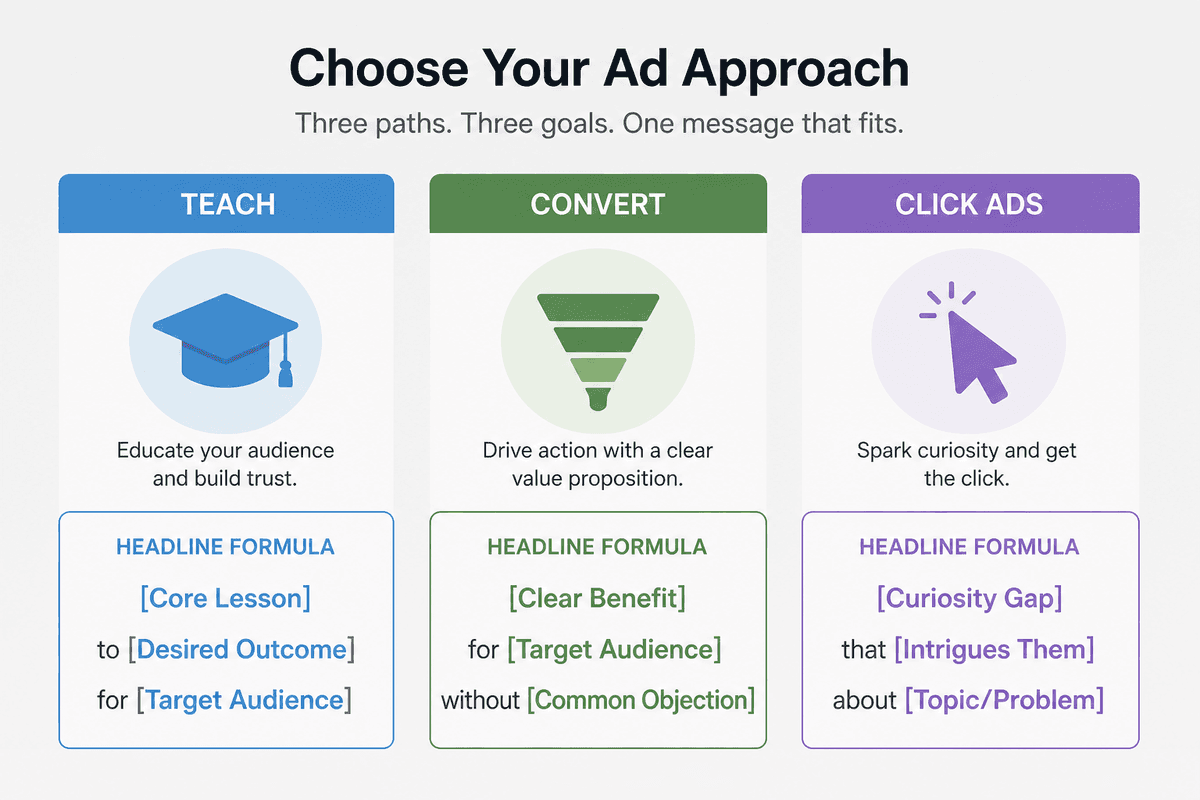
| Goal | Start with | Avoid |
|---|---|---|
| Teach | How-to / list | Cleverness that hides the promise |
| Convert | Benefit + audience / problem-solution | Feature dumps with no outcome |
| Click (ads) | Proof / tension | Clickbait you cannot deliver on the page |
Formulas are scaffolding. If the page cannot fulfill the headline, rewrite the page — or the headline.
How to Write Headlines People Can’t Help but Click [Powerful Formulas Included]
| If the page needs to... | Start with... | Why it fits |
|---|---|---|
| Answer a search query clearly | How-to or question formulas | These map cleanly to informational intent |
| Compare options or approaches | Comparison formulas | They match evaluation-stage searches |
| Offer fast scannable takeaways | List formulas | They signal structure before the click |
| Call out a problem and fix | Mistake or problem-solution formulas | They create relevance quickly |
| Sell or frame an offer | Benefit-led formulas | They put the outcome first |
- Use how-to and question formulas for educational searches.
- Use comparison and mistake formulas for evaluation content.
- Use benefit-led formulas for landing pages and product content.
- Use tighter, shorter patterns for ads and email.
If you are not sure which angle to use, draft 3 to 5 options with different formulas and compare them side by side. Then run the shortlist through a headline analyzer or cross-check it against these headline examples so you are testing real pattern differences instead of tiny wording tweaks.
Final takeaway
Headline formulas are not shortcuts for lazy writing. They are structures that help you think more clearly about the promise, audience, and format of the page.
Once you know which formula fits the intent, you can write faster, test smarter, and avoid the generic titles that get ignored.
Use the patterns here as a starting set, then adapt them to your own topics and voice. If the goal is organic search specifically, this guide on writing headlines for SEO is the best next read.