
How to Write SEO Headlines That Rank and Get Clicks

Yi
SEO Expert & AI Consultant

An SEO headline has one job before anything else: make the right reader understand the page quickly enough to click. Everything else is secondary.
That sounds simple, but most weak headlines fail in the same way. They chase keywords, emotion, or formulas before they understand the search intent. The result is a title that may look optimized, but does not clearly tell the reader what they will get.
The best SEO headlines are not the cleverest ones. In my experience, the headlines that hold up best are clear, specific, and honest. They put the main topic early, match the page format, and give Google enough consistency across the title tag, H1, and page content to understand the result.
TL;DR: the SEO headline checklist
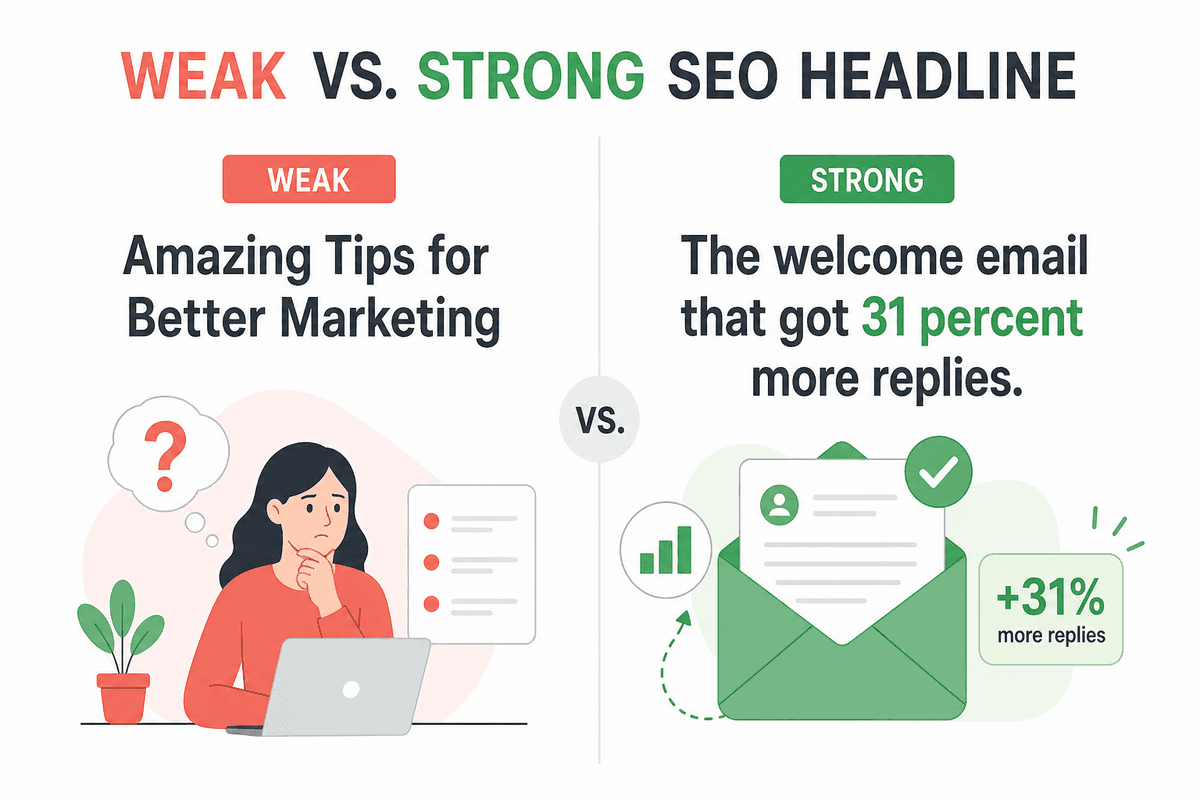
| Element | Weak | Strong |
|---|---|---|
| Noun | “tips” | Named object (email, audit, template) |
| Constraint | none | Number, audience, or outcome |
| Keyword | buried / missing | Near the front when natural |
| Promise | hype | Deliverable the page keeps |
Use this quick checklist before you publish:
| Check | What a good SEO headline does |
|---|---|
| Intent | Matches the searcher task: learn, compare, choose, buy, troubleshoot, or find a specific page |
| Keyword | Uses the primary keyword or a natural close variant near the front |
| Specificity | Names the audience, format, outcome, year, product type, or problem when useful |
| Accuracy | Promises only what the page actually delivers |
| Click appeal | Gives readers a reason to choose your result without drifting into clickbait |
| SERP fit | Stays short enough to display cleanly, usually around 50 to 60 characters for title tags |
| AI readability | Uses direct wording that AI search systems can classify, summarize, and cite |
| Trust | Hints at real testing, expertise, examples, data, or practical experience when the article supports it |
If I had to reduce this to one rule, it would be this: write the headline after you understand the page promise, not before. I have wasted too many rounds polishing a title only to realize the article itself was promising something slightly different.
SEO headline vs. H1 vs. title tag
Title tags and H1s are related but not identical jobs. Write the page promise in plain English, then fit the SERP display constraints.
People often use "SEO headline" loosely, so it helps to separate the fields.
| Field | Where it appears | Main job |
|---|---|---|
| H1 headline | On the page itself | Confirms the reader landed in the right place |
| Title tag | Browser tab and usually Google results | Helps earn the click from search |
| Open Graph title | Social shares and some discovery surfaces | Makes the page appealing in feeds |
| Structured data headline | Article schema and similar markup | Gives search systems a clean machine-readable headline |
| Internal link anchor | Links from other pages on your site | Sets context before the reader reaches the article |
These fields can be similar, but they should not be treated as one copy-paste field. The H1 can be a little more natural and complete. The title tag usually needs to be tighter. The social title can lean slightly more emotional if it still stays accurate.
Google's documentation on title links in search results also makes an important point: Google may use the title element, the main visual title, heading text, or other prominent text to generate the title link shown in search. That means your headline system needs to be consistent, not just one optimized title tag sitting on top of a vague page.
The difference between blog titles, headlines, and SEO titles matters because each field shapes a different reader moment: discovery, click-through, social sharing, and on-page confirmation.
Start with search intent, not a formula
Headline formulas are useful, but only after you know what the searcher wants.
Search intent usually falls into one of these practical buckets:
| Intent | Reader wants | Headline pattern that usually fits |
|---|---|---|
| Informational | A clear answer or explanation | "What Is...", "How to...", "Guide to..." |
| Commercial | Help choosing between options | "Best...", "Top...", "X vs. Y", "Alternatives" |
| Transactional | A product, tool, template, or service | "Free...", "Generator", "Template", "Software" |
| Troubleshooting | A fix for a problem | "Why...", "How to Fix...", "Mistakes..." |
| Navigational | A known brand or page | Brand or product name first |
If the query is "SEO headlines," the intent is not just "define SEO headline." The current ranking pages show people want a practical process, examples, templates, and technical title-tag guidance. So a headline like "What Are SEO Headlines?" is probably too basic for that SERP.
This is where I think many teams rush. They grab a formula before they have looked at the search results closely enough. The formula is not the problem; using it before you understand the reader is.
A stronger angle is:
How to Write SEO Headlines That Rank and Get Clicks
That tells the reader this is a practical guide. It also keeps the core keyword near the front without stuffing the title.
Put the main keyword near the front
The primary keyword does not need to appear in an ugly exact-match phrase. It does need to be obvious.
Weak:
Better Titles for More Organic Traffic
Stronger:
SEO Headlines: How to Write Titles That Rank
The second version is easier for readers and search systems to classify. It also survives truncation better because the key topic appears early.
This is especially important on mobile, where long title tags can get cut off. A title can often use around 600 pixels in search results, which usually works out to about 50 to 60 characters, but pixel width matters more than character count. Wide letters, dates, brackets, and brand names can all change how much fits.
Do not obsess over a perfect number. Instead, front-load the topic and remove filler words before you publish. I usually cut anything that sounds like it was added to make the title feel bigger: "ultimate," "complete," "powerful," and similar words rarely earn their space unless the article truly justifies them.
Write the page promise in plain English
Before polishing the headline, write one sentence that explains the page:
This article teaches content marketers how to write SEO headlines that match search intent, earn clicks, and avoid title rewrites.
That sentence gives you the raw material. Now you can compress it into headline options:
- How to Write SEO Headlines That Rank and Get Clicks
- SEO Headlines: A Practical Guide to Better Titles
- How to Write Search-Friendly Headlines Without Clickbait
- SEO Headline Checklist: Write Titles Readers Trust
- 9 SEO Headline Rules That Improve Clicks and Clarity
I like doing this before using any tool because it forces the page promise to become clear. A headline generator can help you create more variants later, but it should not decide the promise for you. The tool is much more useful once you can reject weak options quickly.
Use formulas as drafts, not final answers
Headline formulas are helpful because they create structure quickly. The mistake is treating them like magic.
Here are useful SEO headline formulas and when to use them:
| Formula | Best for | Example |
|---|---|---|
| How to + keyword + benefit | Tutorials | How to Write SEO Headlines That Get Clicked |
| Number + keyword + outcome | List posts | 11 SEO Headline Tips for Higher CTR |
| Keyword + checklist | Practical workflows | SEO Headline Checklist for Blog Posts |
| X vs. Y | Comparisons | H1 vs. Title Tag: What Should Be Different? |
| Best + category + qualifier | Commercial pages | Best Headline Analyzer Tools for Content Teams |
| Mistake + fix | Troubleshooting | 7 SEO Headline Mistakes That Cause Low CTR |
Use formulas to produce candidates. Then edit for accuracy, tone, and search intent. If every article on a site uses the same "Ultimate Guide" or "X Powerful Tips" structure, the pattern starts to feel templated.
Personally, I treat formulas like scaffolding. They help me get unstuck, but I do not want readers to see the scaffolding in the finished headline.
The best use of headline formulas is comparative: draft several angles, then choose the one that best matches the actual article. Real headline examples are useful for the same reason. They show patterns, but the final headline still has to fit your page.
Add specificity before emotion
Emotion helps, but specificity does most of the work. This is one of the strongest headline habits to build because it improves both SEO clarity and reader trust.
Compare these:
- Vague: "Write Amazing Headlines That Dominate Google"
- Specific: "How to Write SEO Headlines for Product Reviews"
- Specific plus useful: "How to Write SEO Headlines for Product Reviews Without Clickbait"
The third headline is better because it gives the reader a clearer situation and a clearer constraint. It does not need inflated language.
Useful specificity can come from:
- Audience: "for SaaS blogs," "for local businesses," "for journalists"
- Format: "checklist," "template," "examples," "guide"
- Outcome: "higher CTR," "fewer title rewrites," "clearer search snippets"
- Time: "2026," "this year," "after Google's latest guidance"
- Scope: "11 examples," "5-step process," "beginner guide"
- Evidence: "I tested," "data-backed," "based on 100 pages"
Only use evidence language when the article actually includes that evidence. "I tested 25 headlines" works if you tested them. It becomes clickbait if the article is just a generic advice post. I would rather publish a quieter headline than borrow authority the article has not earned.
Keep click appeal honest
Click appeal is not the same as clickbait. A good headline creates interest by being clear about the value. A clickbait headline creates interest by hiding or exaggerating the value.
Here is the difference:
| Weak or misleading | Better |
|---|---|
| This Headline Trick Will Change SEO Forever | How to Write Clearer SEO Headlines That Earn More Clicks |
| Google Hates These Headlines | 7 SEO Headline Mistakes That Can Hurt Click-Through Rate |
| Nobody Talks About This Title Tag Secret | Why Google Rewrites Title Tags and How to Reduce It |
| The Ultimate Headline Hack for Instant Rankings | SEO Headline Checklist for Search Intent and CTR |
The better versions are still clickable. They just do not rely on mystery, panic, or impossible promises.
Backlinko's CTR research found that the top organic result receives a much larger share of clicks than lower positions, with the first result averaging 27.6% CTR in its study. That does not mean a headline alone will move a page to position one. It means the snippet has to work hard once the page is visible.
Make headlines easy for AI search to understand
AI search visibility does not require a separate gimmick. Google's own generative AI search guidance says the same foundational SEO practices still matter because AI features are rooted in Google's core Search systems.
For headlines, that means clarity matters more than wordplay.
AI systems can more easily summarize and cite pages when the headline says exactly what the page answers. I have found that the boring-looking formats are often the most durable here:
- Question headlines: "What Is an SEO Headline?"
- How-to headlines: "How to Write SEO Headlines That Rank"
- Comparison headlines: "H1 vs. Title Tag: What's the Difference?"
- Checklist headlines: "SEO Headline Checklist for Blog Posts"
- Problem headlines: "Why Google Rewrites Your Title Tags"
The headline is only the first signal. The page itself should support the answer with a clear introduction, a short takeaway section, direct definitions, examples, and headings that map to real subquestions. That is why readable structure matters as much as the title. If the page is hard to scan, the headline cannot carry it alone.
Reduce the chance of Google rewriting your title
You cannot fully control the title link Google shows in search results. But you can reduce the risk of a rewrite by avoiding the common triggers.
Google's title-link guidance calls out issues like overly long title text, boilerplate titles, keyword stuffing, and unclear main titles. In practice, I check these five things:
- The title tag and H1 point to the same topic.
- The title tag is not stuffed with repeated keyword variants.
- The visible H1 is clearly the main page headline.
- The title does not rely on a vague brand template.
- The article actually delivers what the title promises.
Weak:
SEO Headlines | SEO Titles | Headline Writing | Title Tag Tips 2026
Better:
How to Write SEO Headlines That Rank and Get Clicks
The second version is simpler, more human, and less likely to look like a keyword list.
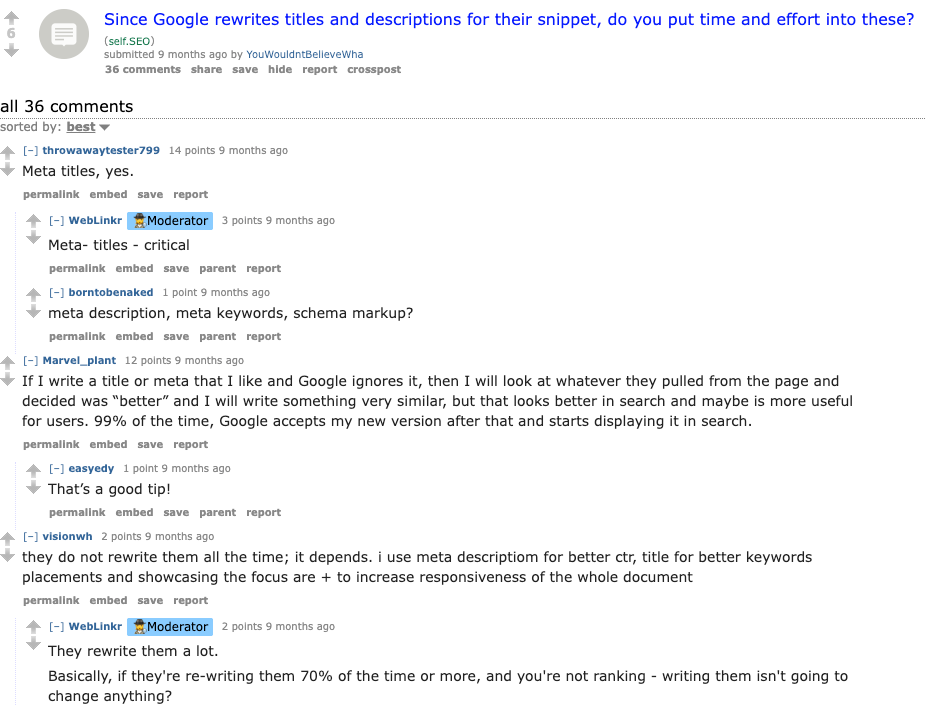
In practice, title optimization does not stop at publishing. If Google keeps choosing a different title link, review what it pulled from the page and use that as feedback for a cleaner, more useful title. I do not treat every rewrite as a failure, but repeated rewrites are a useful warning that the page signals may be muddy.
Match the headline to the content format
A headline should tell people what kind of page they are about to open.
If the article is a checklist, say checklist. If it is a comparison, say comparison. If it includes examples, say examples. This reduces friction because the reader knows what to expect before clicking.
| Page format | Strong headline signal |
|---|---|
| Step-by-step tutorial | "How to..." |
| List post | A number and a clear category |
| Comparison | "vs.", "compared," or "alternatives" |
| Template page | "template," "sample," or "framework" |
| Troubleshooting article | "why," "fix," or "mistakes" |
| Opinion or experience post | "I tested," "what I learned," or "after..." |
Catchiness should come after format clarity. A headline can be lively, but it should still tell readers whether they are getting a checklist, comparison, template, or tutorial. That is where catchy headline writing becomes useful: it improves a clear promise instead of hiding a weak one.
Build a headline workflow
Here is the simple workflow I would use for almost any article:
- Identify the primary query.
- Look at the top results and note the dominant format.
- Write the page promise in one plain sentence.
- Draft 10 to 20 headline options.
- Keep the main keyword or close variant near the front.
- Add specificity before emotional language.
- Shorten the title tag separately from the H1.
- Check that the article actually delivers the promise.
- Review how the title looks on mobile.
- Revisit the headline after the page has impression and CTR data.
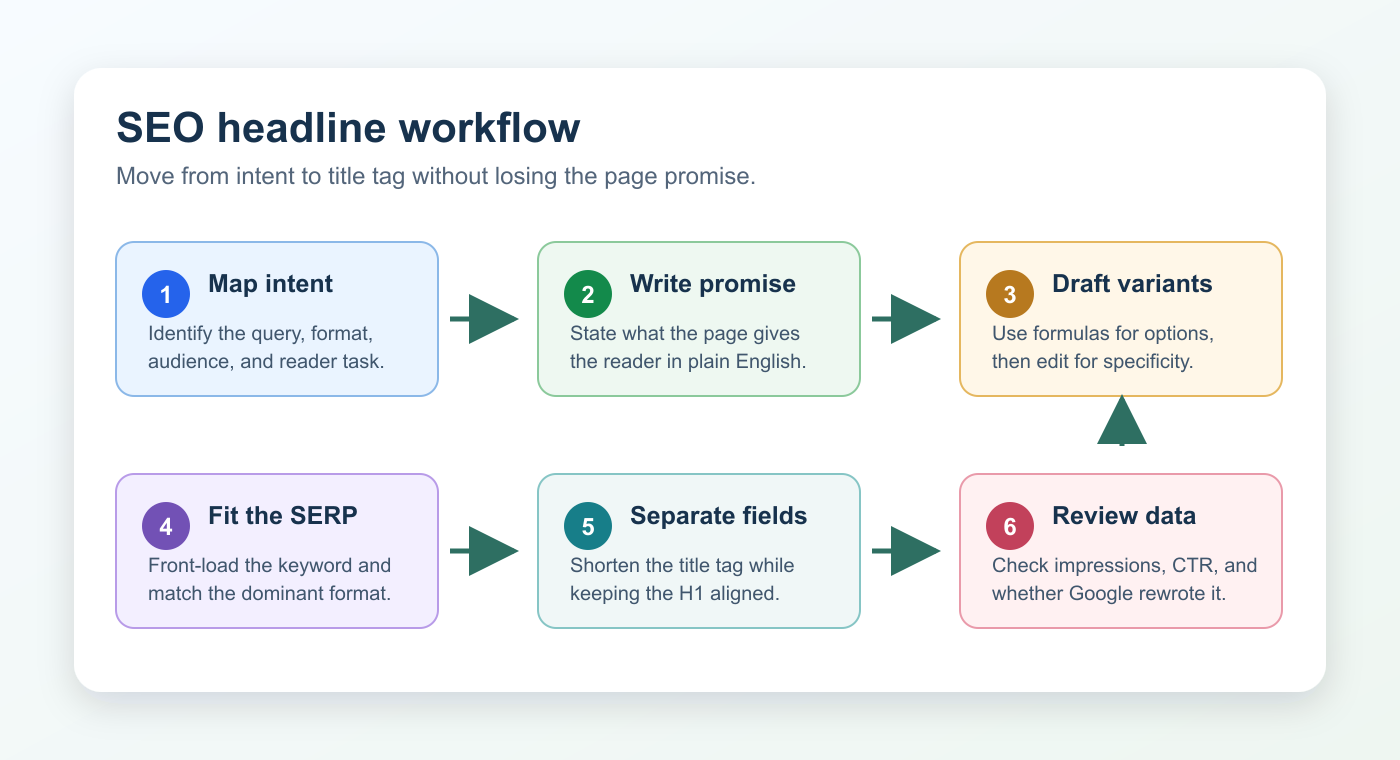
This process is boring in a good way. It keeps the headline tied to the article instead of turning it into a copywriting exercise detached from the page. When I skip this sequence, the headline usually gets flashier and less accurate.
When the main headline is working, treat the title tag as a separate final pass. SEO-optimized meta titles need the same promise in a shorter space, with the strongest words near the beginning. A meta title generator can create quick options, but the final version still needs a human check for accuracy and tone.
Use internal links as context, not clutter
Internal links help readers move through a topic, but they should not interrupt the headline advice.
For example, if you are writing a post about headline improvement, it is natural to mention the editing stage. A headline can be clear and still fail if the article underneath is thin, repetitive, or poorly structured. A practical blog post editing checklist gives that final review a place in the workflow without turning the headline article into a general editing guide.
The same applies before writing. A headline is easier to draft when the content brief already defines the target keyword, search intent, audience, outline, and required examples. A strong SEO content brief prevents headline work from becoming guesswork at the end.
Use links when they extend the reader's next step. Do not stack three related resources in one paragraph just because they are available. A link should feel like a useful doorway, not a detour.
Add structured data only when the page supports it
Article structured data can help search engines understand page details such as headline, image, date, and author information. Google's Article structured data documentation says it can help Google understand the web page and show better title text, images, and date information in search results.
That does not mean schema will rescue a weak headline. It means your markup should reflect the article accurately.
Check these fields:
headlinematches the article's real headline or title.imagepoints to a relevant image on the page.dateModifiedis current when the article is updated.- Author and publisher details are accurate.
- The visible page content supports the structured data.
This is also a trust issue. Google's guidance on helpful, reliable, people-first content keeps coming back to the same standard: make content for people, not just ranking systems. The headline, schema, and article should all tell the same truth.
Common SEO headline mistakes
The first mistake is writing the headline before the angle is clear. You end up polishing a sentence that does not yet know what the page is promising. I see this most often when teams start with a keyword list instead of a reader problem.
The second mistake is stuffing every keyword into the title. "SEO headlines, SEO titles, title tags, headline writing tips" is not a headline. It is a search query pileup.
The third mistake is copying the SERP too closely. Competitor analysis should show the intent and gaps, not give you a title to imitate.
The fourth mistake is making the H1 and title tag fight each other. If the title tag promises a checklist but the H1 says "Ultimate Guide," the page starts with a small trust problem.
The fifth mistake is using numbers without a reason. "17 tips" can work when the article genuinely needs 17 items. It feels padded when the five strongest points are buried among filler.
The sixth mistake is using AI-generated headlines without editing them. AI tools are useful for volume, but they often produce inflated adjectives, repeated formats, and vague benefits. The final headline needs to sound like it came from someone who understands the page. My usual test is simple: would I still trust this headline if I removed the exciting adjective?
Before-and-after examples
Here are a few practical rewrites:
| Weak headline | Better headline | Why it works |
|---|---|---|
| SEO Tips for Blogs | 11 SEO Blog Tips for Better Organic Traffic | Adds format, topic, and outcome |
| Improve Your Website Today | How to Improve Website SEO Without Rebuilding Your Site | Names the task and constraint |
| Best Tools | Best AI SEO Tools for Content Teams in 2026 | Adds category, audience, and freshness |
| Why Your Content Is Bad | Why Your Blog Posts Are Not Ranking and How to Fix Them | Turns insult into diagnosis |
| The Complete Guide to Marketing | Digital Marketing Guide for Small Business Owners | Narrows the audience and topic |
Notice that the better headlines are not always louder. They are more useful. That is usually the better tradeoff for SEO: a reader who understands the page is more valuable than a reader who clicks for the wrong reason.
Final publishing checklist
Before publishing, run the headline through this final review:
- Can a reader understand the page in two seconds?
- Is the main keyword or a natural variant near the front?
- Does the title match the search intent and content format?
- Would the headline still be honest if the article were quoted out of context?
- Is the title tag short enough to avoid obvious truncation?
- Does the H1 confirm the same promise as the title tag?
- Are the article headings, intro, and takeaway section aligned with the headline?
- Does the headline avoid keyword stuffing, fake urgency, and unsupported claims?
- Would the headline make sense to a human reader and an AI summarization system?
Writing SEO headlines is not about finding one clever trick. It is about making the page promise clear, then compressing that promise into a title people trust enough to click. If the headline feels plain but the right reader immediately knows why the page matters, I would call that a win.