
How to Scale SEO to 40+ Countries Without Tanking Rankings

Thu
AI SEO Specialist, Full Stack Developer

International organic traffic means earning unpaid search visits from countries outside your core market. It can be one of the most scalable growth channels you have, but only if your SEO system is built for country-level differences.
That is the part many teams underestimate. What works in one market often breaks in another because the search terms, SERPs, content expectations, and technical setup are different. Translation alone does not solve that.
This guide walks through a practical framework for scaling SEO to 40+ countries without creating duplicate-content problems or thin localized pages. You will see how to prioritize markets, research local keywords, choose the right URL structure, implement hreflang, localize content properly, and measure performance market by market.
Understanding International Organic Traffic
International organic traffic is the stream of unpaid search visits that comes from audiences in other countries or language markets. If someone in Germany, Mexico, or Japan finds your site through local search results, that traffic belongs to your international SEO program.
The opportunity is obvious: ranking in multiple countries lets you diversify acquisition, reach buyers earlier, and reduce dependence on one home market. But it only works when the page that ranks is truly relevant to that audience.
The Importance of Understanding Different Search Behaviors
The difference between domestic and international SEO is not just geography. Search behavior changes across languages, devices, competitors, and content norms. A query that looks informational in one market may be more commercial in another.
That is why international SEO vs local SEO is not a small technical distinction. Each market can require different keyword mapping, different content depth, and different trust signals.
How Unpaid Search Results Drive Global Traffic Growth
Organic search compounds well because the right page can keep generating qualified visits long after it is published. Unlike paid campaigns, you are not renting each click.
That makes international SEO attractive for brands with repeatable products, scalable content operations, or multilingual demand already showing up in analytics.
Tools for Maintaining and Improving Your Ranking
Once localized pages are live, keep improving the ones that almost rank. A workflow like AI multilingual SEO is useful here because it helps you refresh weak country pages faster without rebuilding everything from scratch.
Conducting Market and Competitor Analysis for Global Reach
Before expanding into dozens of countries, decide where expansion is most likely to pay off. Start with markets that already show signs of demand in Search Console, CRM data, or inbound inquiries. Then pressure-test them with SEO and operational filters.
Identifying Target Countries Based on Market Potential
Use a simple scoring model before adding a country to your roadmap:
- Search demand for your category or use case
- Revenue potential and buying power
- Language and localization effort required
- Competitive difficulty in local SERPs
- Operational fit, including support, payments, and legal constraints
That kind of filtering keeps you from launching everywhere at once and discovering too late that the market is small, expensive, or structurally hard to support.
Analyzing Local Audience Behavior and Search Habits
Keyword volume alone will not tell you enough. Review live SERPs in each market and pay attention to what actually ranks.
Look for:
- Whether the top results are guides, category pages, templates, or product pages
- How local competitors frame benefits and objections
- Whether users expect short answers, deep tutorials, or comparison content
- Which trust signals appear repeatedly in the top results
If you are publishing across many languages, this guide on how to rank blog posts in foreign countries is a useful companion because it forces the analysis back to real SERPs instead of generic SEO advice.
Leveraging AI for Efficient Multilingual SEO Strategies
AI is useful when it speeds up research, clustering, draft generation, and refresh work. It is less useful when teams treat it as a substitute for country-level judgment.
That is the real value of AI multilingual SEO: faster workflows, not blind automation.
Competitor Analysis in International Markets
Competitor analysis shows you what "good" looks like locally. Review the top-ranking domains in each target country, the pages they rank with, the backlink profile supporting those pages, and whether they localize deeply or rely on thin translation.
Gaps here often reveal the fastest wins. If strong competitors are ignoring a language variant, under-serving a market, or publishing generic English-first content, you have room to move in.
Performing Keyword Research for Each Target Country
International keyword research starts from the same rule as domestic SEO: match the page to how people actually search. The difference is that translated seed keywords are rarely enough.
Spanish queries in Mexico and Spain diverge. English queries in the US, UK, and India diverge. The same is true for modifiers around price, urgency, trust, and product fit.
Leveraging Native Speakers and SEO Tools
The best process combines local language judgment with SEO tooling. Native speakers help you catch phrasing, colloquialisms, and false equivalents that keyword tools flatten.
Then support that with:
- Ahrefs for country-level keyword volume and difficulty
- SEMrush for competitor rankings by market
- Google Keyword Planner with location targeting enabled
- Google Search Console filtered by country and page
- An AI keyword research tool to expand angles before manual review
Capturing Local Search Intent
Besides direct translation, check for:
- Regional spelling and vocabulary differences
- Local modifiers tied to price, speed, compliance, or trust
- Intent shifts between informational, commercial, and transactional searches
- Category labels customers actually use in that country
This is where many international SEO programs fail. They translate a term correctly, but map it to the wrong page type.
Designing an Effective URL Structure for International SEO
Your URL structure tells search engines how your international site is organized. For most teams, the real choice is between ccTLDs, subdomains, and subfolders.
| Expand to a country when… | Wait when… |
|---|---|
| Demand + offer fit are clear | You only have machine translation capacity |
| URL/hreflang plan exists | You would launch 40 thin clones together |
| You can measure by locale | Reporting is still one global GA view |
40 countries is an operations problem before it is a translation problem.
Expanding your site to more languages
| Structure | Example | Strengths | Tradeoffs |
|---|---|---|---|
| ccTLD | example.de | Strong local signal and user trust | Highest cost and fragmented authority |
| Subdomain | de.example.com | Flexible hosting and cleaner separation | Can split equity and add management overhead |
| Subfolder | example.com/de/ | Easiest to scale and consolidate authority | Slightly weaker geo signal than ccTLDs |
1. ccTLDs
ccTLDs such as example.fr or example.de send the clearest country signal. They can be a good fit when local trust and legal separation matter, but they are expensive to scale because each site behaves like a separate property.
2. Subdomains
Subdomains such as fr.example.com offer more separation while staying under one brand. They can work for large organizations, but they often introduce complexity without giving the operational simplicity most teams need.
3. Subfolders
Subfolders such as example.com/fr/ or example.com/de/ are usually the best default when you want to grow across many countries. They keep authority consolidated, simplify governance, and make analytics cleaner.
For teams targeting 40+ countries, subfolders are usually the safest starting point. If you are building repeatable localized page sets, this guide on programmatic SEO for multiple languages is a useful next read.
Implementing Hreflang Tags to Target Languages and Regions
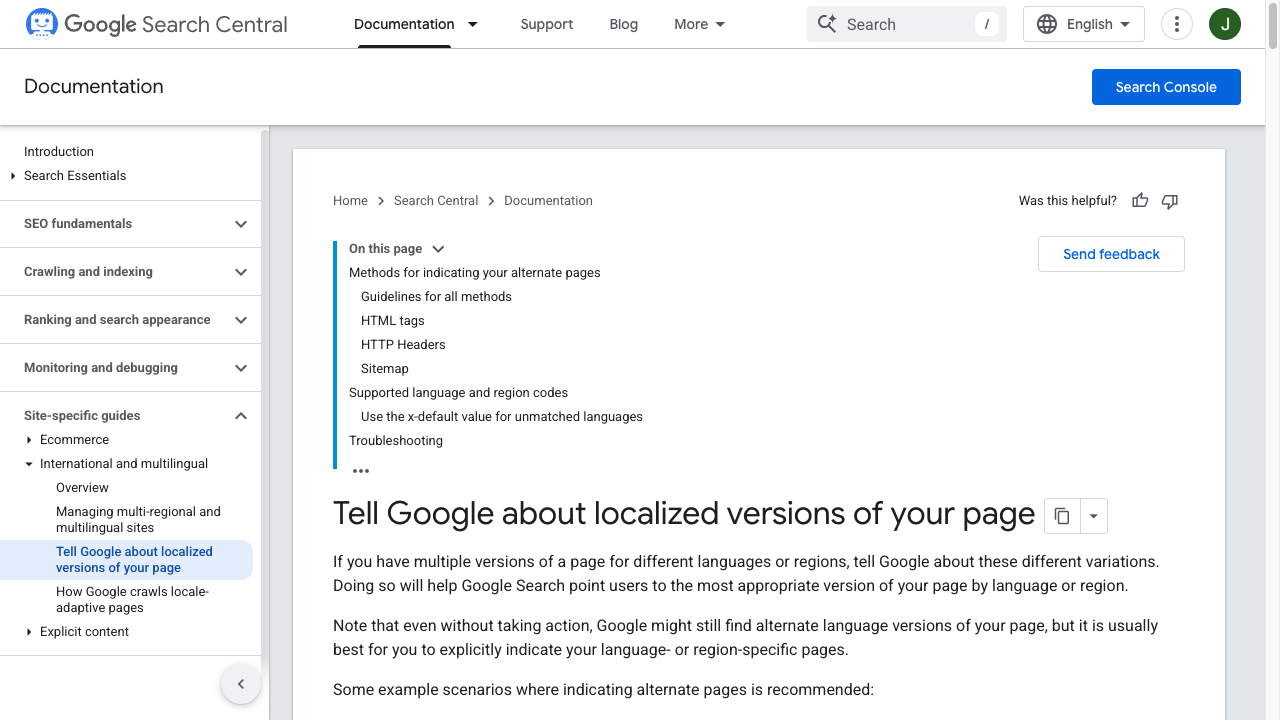
Hreflang tells search engines which language or regional version of a page should appear for which audience. It is one of the key systems that prevents international rollouts from cannibalizing themselves.
Without hreflang, your US English, UK English, and Australian English pages can look unnecessarily similar. With it, you signal that each page has a valid audience and should be matched accordingly.
Technical setup requires precision:
- Put hreflang tags in the head of each page or in your XML sitemap
- Use valid ISO language and country codes
- Include self-referencing hreflang tags
- Add an x-default fallback when appropriate
- Check reciprocal references across alternates
If you are scaling content production across many locales, a bulk blog translation workflow can speed up first drafts. Just do not confuse faster translation with finished localization.
Audit hreflang regularly. Common failures include missing return tags, wrong locale codes, pages that reference non-canonical URLs, and conflicting geo signals. This explainer on hreflang for multilingual websites is useful when your team needs a deeper implementation checklist.
Localizing Content Beyond Translation
Translation changes the language. Localization changes the experience so the page still feels native in the target market.
That includes terminology, formatting, examples, proof points, and how benefits are framed. A page that reads like a translated original often underperforms even when the grammar is technically correct.
If you are weighing speed against quality, this guide on AI website translation vs human translation for SEO is worth reading before you scale.
Here is what effective localization usually includes:
- Currency and measurements that match local expectations
- Date, time, and address formats that do not create friction
- Terminology and idioms that sound native rather than translated
- Examples and proof points that feel credible in that market
- Visual references that reflect local context when relevant
Localized pages also need localized intent. A buyer in one country may care most about speed or price, while another market may respond more to trust, compliance, or implementation detail.
If you are expanding an existing content library, this walkthrough on translating a blog into 60 languages automatically shows how to scale the workflow without losing editorial control.
Enhancing User Experience with Navigation and Language Switchers
Language switchers affect both usability and crawlability. Put them where users expect them, keep labels clear, and make sure the selected locale aligns with your URL structure.
Avoid aggressive IP-based redirection. It often sends users to the wrong version, frustrates travelers and multilingual users, and creates unnecessary crawling issues.
Navigation for international sites should follow a few simple rules:
- Show language names in their native form
- Keep the switcher visible on every localized page
- Use consistent country or language patterns in URLs
- Avoid cluttered menus when the locale list gets long
- Keep breadcrumbs and internal navigation localized too
Test the switcher with real users if possible, and remember preferences across visits. Small UX issues here create outsized conversion losses on multilingual sites.
Optimizing Website Performance Globally
International SEO is not just a content problem. Performance matters because latency rises as users get farther from your infrastructure. A page that feels fast in one region can feel slow enough to hurt rankings and conversions somewhere else.
The Role of Content Delivery Networks (CDNs)
Content delivery networks reduce latency by serving assets from locations closer to the visitor. For global SEO programs, they are often one of the highest-leverage infrastructure upgrades you can make.
In practice:
- The request is routed to a nearby edge location instead of a distant origin server.
- The shorter route reduces latency and improves perceived load time.
Providers such as Cloudflare, CloudFront, and Fastly are common choices because they offer wide coverage and mature caching controls.
Other Technical Optimizations for Global Reach
Beyond CDNs, focus on:
- Image compression and modern formats such as WebP
- Browser caching for repeat visits
- Code minification for smaller CSS and JS payloads
- Lazy loading for below-the-fold media
- Database and query tuning for dynamic content
Monitoring Performance from Different Locations
Test performance from multiple regions, not just your home market. The goal is to catch country-specific slowdowns before they show up as ranking losses or conversion drop-offs.
Building Local Backlinks to Boost Domain Authority Internationally
Local backlinks help search engines understand that your content is relevant in a market, not just translated for it. They also improve trust with local users and with the sites that may cite you later.
Identify Authoritative Local Websites
Start with local publishers, niche communities, associations, and regional industry sites. Country-specific data studies, examples, and market reports usually earn stronger links than generic translated content.
Use AI-Powered Internal Linking
Alongside backlinks, internal architecture matters. An AI internal linking workflow can help scale localized internal links so new country pages are not left orphaned.
Engage in Local Events
Events, partnerships, and local collaborations are still useful because they create market-specific mentions that competitors cannot easily copy.
Monitor Competitors' Backlink Profiles
Track competitor backlink profiles by country to find patterns worth replicating. In many markets, this is the fastest way to build a realistic outreach list.
Ensure Web Pages Are Indexed
Also confirm that newly localized pages are actually indexed. Strong content and strong links do not help if the country version never enters the index.
Leveraging Translation Management Systems (TMS) for Consistency and Efficiency
Once you are managing dozens of locales, a translation management system becomes operational infrastructure rather than a nice extra. It keeps source strings, localized drafts, approvals, and version control in one workflow.
A TMS is especially valuable when pages change often. Without one, teams end up managing updates through spreadsheets, exports, and inconsistent review loops.
Benefits of Using a TMS
- Brand consistency: translation memory reduces drift across markets
- Terminology control: glossaries keep product and SEO language consistent
- Workflow speed: integrations reduce manual exports and copy-paste publishing
The main goal is not just faster translation. It is faster iteration with less inconsistency.
Measuring Performance of International Organic Traffic Strategies
International SEO needs market-level measurement. Aggregate global traffic can hide problems because one strong country can mask five weak ones.
Key Metrics for Tracking International Organic Traffic
Track at least:
- Keyword rankings by country
- Organic sessions and landing pages by locale
- Backlink growth by market
- Indexed page counts for localized sections
Beyond Traffic: Evaluating User Engagement
Traffic is only the first layer. Review engagement metrics such as bounce rate, scroll depth, and conversion path behavior per locale. When one country underperforms, the issue is often intent mismatch or weak localization rather than pure rankings.
Conversion Rates: The True Measure of Success
Conversion rate is the clearest business signal. If a market attracts traffic but not leads, demos, or sales, the gap may be in offer framing, trust signals, local pricing, or post-click UX.
Visualizing Data for Better Insights
Build dashboards that compare countries side by side. That makes it easier to decide where to expand, where to fix, and where to stop investing.
Benefits of a Comprehensive International SEO Strategy
The upside of a strong international SEO program goes beyond traffic volume. It creates a more diversified acquisition engine and a wider set of demand sources.
1. Expanding Audience Reach Beyond Domestic Borders
- It expands discoverability beyond your home market.
- It reduces dependence on one country or one language.
- It opens new revenue paths from markets you were not serving before.
2. Increased Conversions Worldwide
- Localized pages usually convert better than generic global pages.
- Country-specific messaging reduces friction in the buying journey.
- Stronger fit improves both visibility and commercial relevance.
3. Global Brand Visibility Growth
- Ranking in multiple markets builds broader brand familiarity.
- Local visibility strengthens trust with new audiences.
- Early investment can create a durable moat in underserved regions.
Conclusion
Scaling SEO to 40+ countries works when you treat it as a systems problem, not a translation task. Market selection, keyword research, URL structure, hreflang, localization, and measurement all need to line up.
If you are starting from scratch, pick a small set of priority markets first. Build the workflow, validate the economics, and then expand once the process is stable.
That approach is slower than mass publishing on day one, but it is far more likely to produce rankings that stick.