
Free Online Course Curriculum Generator
Generate structured online course curriculums with modules, lesson plans, objectives, assignments, quizzes, and student outcomes. Designed for educators, coaches, trainers, and creators building courses for Udemy, Kajabi, Teachable, and internal training programs.
Course Curriculum
Your course curriculum will appear here...
How the AI Online Course Curriculum Generator Works
Get results in seconds with a simple workflow.
Enter Your Course Topic
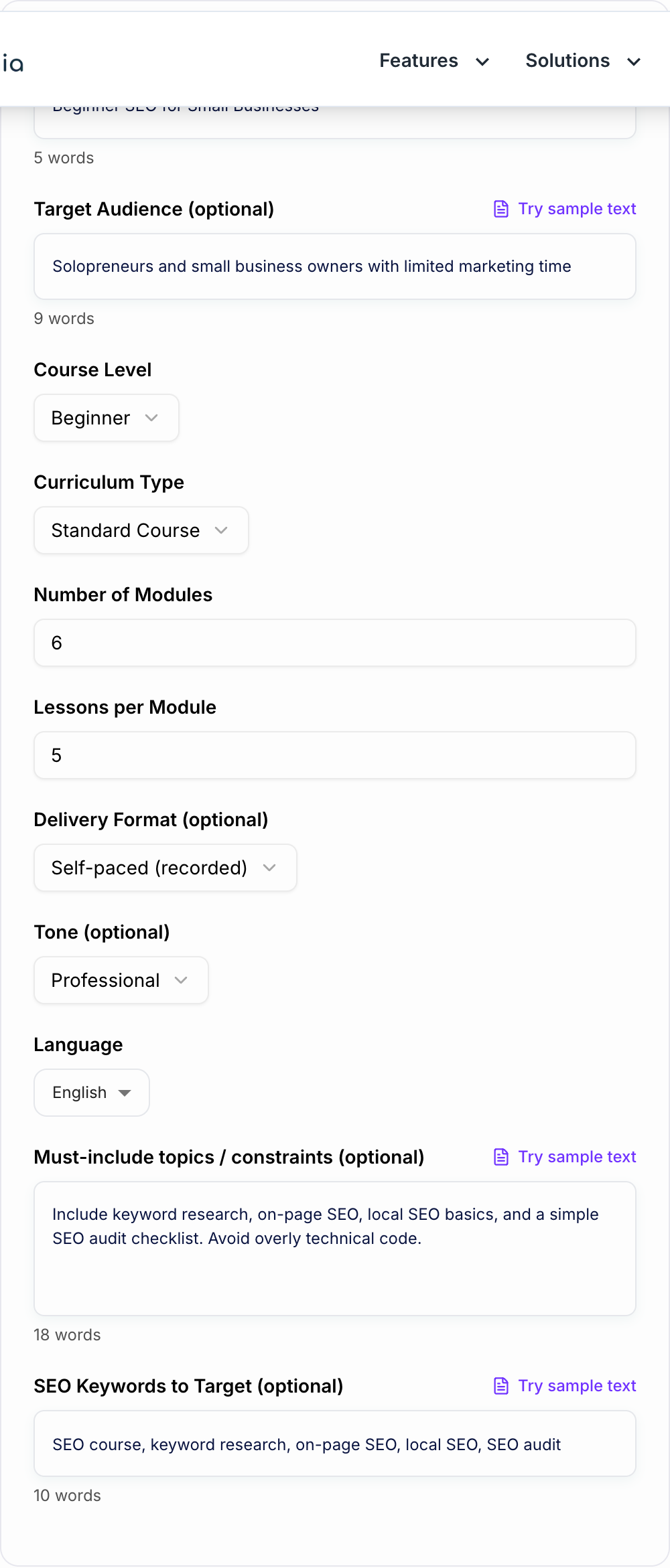
Add your course topic and optionally your target audience, level, and must-include requirements to keep the curriculum focused and relevant.
Choose Structure (Modules + Lessons)
Select the curriculum type and set approximate module and lesson counts. The generator builds a progression from fundamentals to practical mastery.
Generate, Review, and Publish
Get a ready-to-use course outline with learning objectives, lesson outcomes, and suggested assessments. Edit module names, add your examples, and publish on your course platform.
See It in Action
Example of turning a vague course idea into a structured, SEO-friendly curriculum with clear modules and lessons.
Course idea: Teach SEO. Outline: Intro, Keywords, Content, Links, Technical SEO, Wrap-up.
Course: Beginner SEO for Small Businesses Module 1: SEO Foundations + How Google Works
- Lesson 1: What SEO is (and what it isn’t)
- Lesson 2: Search intent basics
- Lesson 3: How ranking factors work (high level)
- Lesson 4: Setting up your SEO toolkit
- Lesson 5: Quick win checklist
Module 2: Keyword Research for Small Business Websites
- Lesson 1: Seed keywords and services
- Lesson 2: Finding long-tail keywords
- Lesson 3: Evaluating difficulty and intent
- Lesson 4: Mapping keywords to pages
- Lesson 5: Assignment: Build a keyword map
Module 3: On-Page SEO (Publish-Ready Pages)
- Lesson 1: Title tags and meta descriptions
- Lesson 2: Headings and content structure
- Lesson 3: Internal linking strategy
- Lesson 4: Image SEO and accessibility
- Lesson 5: Quiz: On-page SEO essentials
Module 4: Content That Ranks (Without Fluff)
- Lesson 1: Content outlines and topical coverage
- Lesson 2: E-E-A-T basics for small brands
- Lesson 3: Updating and refreshing old posts
- Lesson 4: Content calendar planning
- Lesson 5: Assignment: Draft an SEO outline
Module 5: Local SEO Essentials
- Lesson 1: Google Business Profile setup
- Lesson 2: NAP consistency and citations
- Lesson 3: Reviews and local trust signals
- Lesson 4: Local landing pages
- Lesson 5: Quiz: Local SEO checklist
Module 6: SEO Audit + 30-Day Action Plan
- Lesson 1: Technical SEO quick audit
- Lesson 2: Fixing common site issues
- Lesson 3: Tracking rankings and traffic
- Lesson 4: Prioritization framework
- Lesson 5: Capstone: 30-day SEO plan
Why Use Our AI Online Course Curriculum Generator?
Powered by the latest AI to deliver fast, accurate results.
Complete Course Outline (Modules + Lessons)
Generate a structured online course curriculum with module titles, lesson titles, and a logical learning path—from foundations to advanced application.
Learning Objectives + Outcomes (Measurable)
Includes clear learning objectives per module and lesson outcomes so your syllabus is aligned to skills, competencies, and real-world results.
Activities, Exercises, Assignments, and Quizzes
Adds practical activities and knowledge checks (quizzes, projects, prompts) to boost engagement, completion rates, and student transformation.
Audience + Level Alignment
Tailors the curriculum for your target audience and course level (beginner, intermediate, advanced) so lessons match the learner’s context and baseline knowledge.
SEO-Friendly Course Positioning (Optional Keywords)
Optionally weave in course SEO keywords naturally into the curriculum structure (module names and lesson titles) to support search visibility and marketplace discoverability.
Pro Tips for Better Results
Get the most out of the AI Online Course Curriculum Generator with these expert tips.
Define a single transformation outcome
The best online course curriculum is outcome-driven. Write one sentence: “By the end, students can ____.” Use it to keep modules aligned and prevent scope creep.
Design assessments before recording content
Create quizzes, assignments, and a capstone first. Then record lessons that directly support those assessments—this improves completion rates and course reviews.
Use a consistent lesson template
For each lesson: objective → concept → example → exercise → quick check → takeaway. Consistency makes your course feel more professional and easier to follow.
Add SEO keywords in titles—naturally
If you want marketplace or Google visibility, incorporate primary keywords into the course title and a few module headings without forcing them into every lesson.
Include implementation time
Learners need time to apply. Add “implementation” lessons (checklists, templates, audits) so students get real results, not just information.
Who Is This For?
Trusted by millions of students, writers, and professionals worldwide.
How to create a course curriculum that actually gets finished
A course curriculum is not just a list of modules. It is the learning path. The thing that helps a student go from confused to confident without getting stuck halfway.
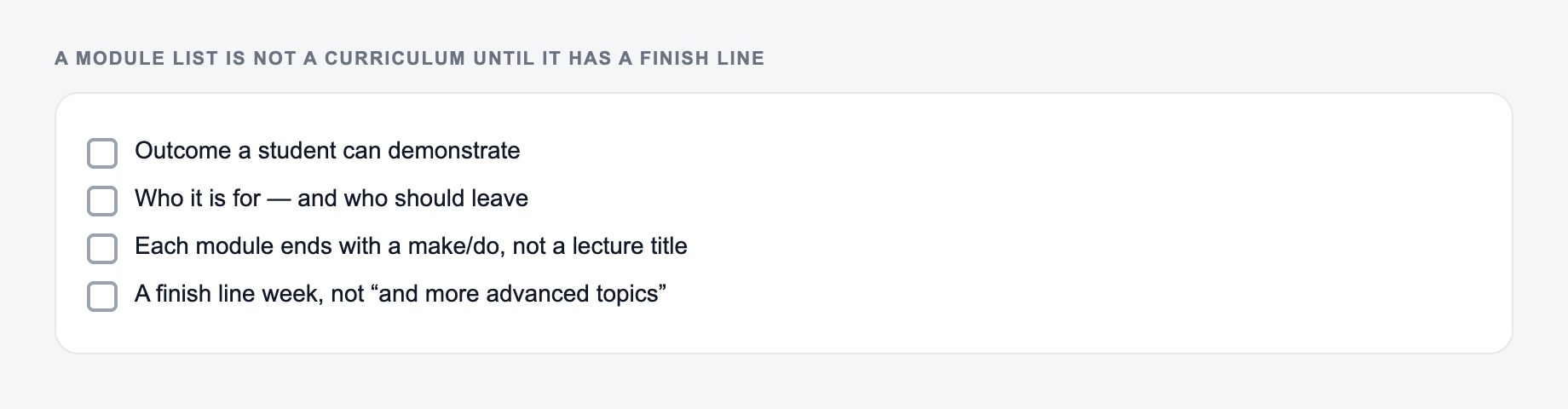
Use this as a preflight, not a caption. If a box fails, change the input or cut the line.
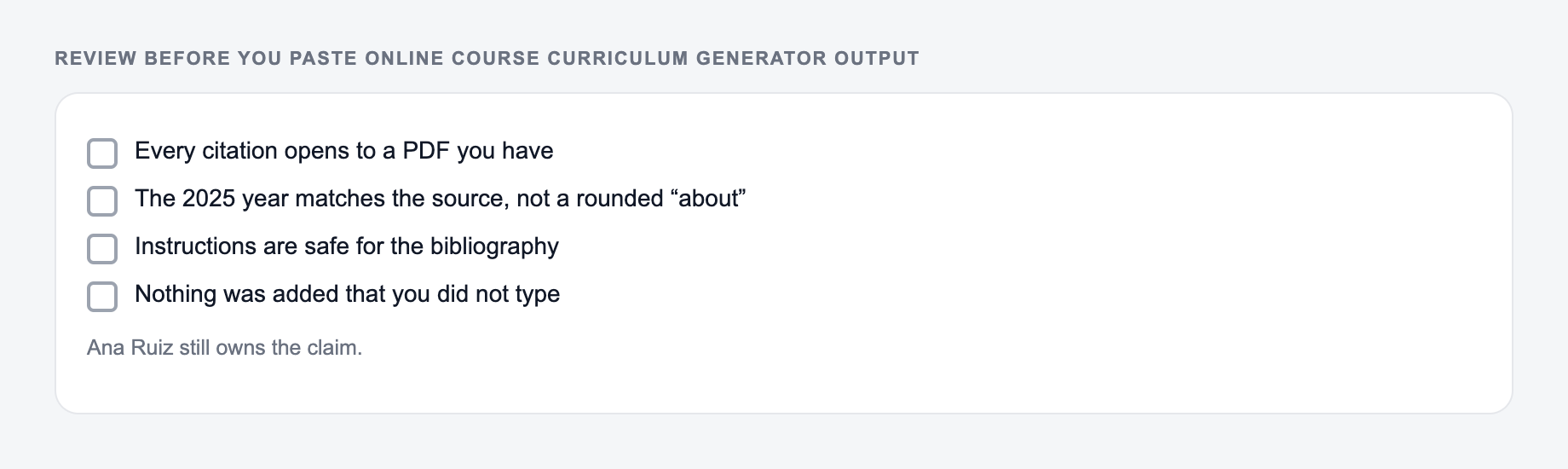
Give the Online Course Curriculum Generator a real brief: who it is for, where it will appear, and one thing it is not allowed to invent. Outcome and who the course is for belong on the form. A module list is not a curriculum until it has a finish line.
Learning workflow:
- Enter only facts you have.
- Generate a structured draft.
- Check names, dates, citations, and units.
- Rewrite the sentences you would actually say in class or in the paper.
If the task is graded, cited, or used with students, the named writer still owns the claims.
If you have ever bought a course that felt random, or overstuffed, or like it never got to the point, that is usually a curriculum problem. Not a content problem.
This Online Course Curriculum Generator is built to solve that. You paste your topic, choose the level and format, and you get a full syllabus style outline you can actually ship.
What a strong online course curriculum includes (beyond lesson titles)
Most creators stop at module names. But a publish ready curriculum typically needs a bit more structure:
- A clear transformation What changes for the learner by the end. One sentence. Keep it tight.
- Milestones (modules) Each module should represent a meaningful step forward, not just another bucket of videos.
- Lesson outcomes Not “understand SEO”. More like “build a keyword map for your homepage and service pages”.
- Practice built in Exercises, templates, checklists, mini projects. Stuff that forces implementation.
- Assessment points Quizzes for retention, assignments for skill, and ideally one capstone that ties it all together.
That is why this tool generates objectives, activities, quizzes, and assignments alongside the outline.
Picking the right course format: mini course vs bootcamp vs certification
Choosing the curriculum type matters because it changes pacing and depth.
Mini course Best when you want a fast win and a simple promise. Great for lead magnets, workshops, email courses, and low ticket offers.
Standard course The default for most creators. Balanced depth, a logical progression, enough practice to create results without overwhelming people.
Bootcamp or cohort More structure, more accountability. Week by week pacing, homework, live prompts, and tighter sequencing.
Certification style Competency based. Measurable outcomes, rubrics, grading criteria, and usually a capstone that proves mastery.
Corporate training Shorter lessons, clearer implementation, scenario based learning, and SOP style outcomes.
If you are unsure, generate two versions. One standard and one bootcamp. Compare which one matches your students reality.
A simple method to outline modules fast (without overthinking)
If you are stuck, use this quick approach:
- Start with the end state What can the learner do in the real world?
- List the 5 to 8 biggest obstacles These become your modules.
- Turn each obstacle into a repeatable process Then each process becomes lessons: explain, show, do, review.
- Add a deliverable per module A worksheet, checklist, audit, draft, plan, or template.
When you run the generator, put those obstacles in the constraints field if you already know them. It makes the output sharper.
SEO tip: make your curriculum support discoverability
If you sell on platforms like Udemy or you want your course landing page to rank in Google, your curriculum can help, quietly.
- Use a primary keyword in the course title.
- Add 2 to 4 keyword phrases in module names where they fit naturally.
- Keep lesson titles human first. Keyword stuffing looks weird and hurts conversions anyway.
This is why the tool includes an optional SEO keywords field. You can guide the structure without turning it into a robot outline.
What to do after you generate the curriculum
Do this before you record anything.
- Read it like a student Does it flow? Are there any jumps that assume prior knowledge?
- Tighten module promises Rename modules so they describe outcomes, not topics.
- Decide the capstone The capstone should prove the transformation. If the capstone is weak, the course will feel weak.
- Create lesson templates Same structure each time. Objective, concept, example, exercise, quick check, takeaway.
If you are building multiple assets around your course, you can also use the curriculum as a content strategy map. Each module can become blog posts, emails, and social scripts, all aligned.
And if you want to explore more AI tools for writing, SEO, and marketing workflows, you can start from the main AI writing platform and build a full content system around your course launch.
Frequently Asked Questions
What is an online course curriculum?+
An online course curriculum (or syllabus) is a structured plan that outlines what learners will study—modules, lessons, learning objectives, activities, assignments, and assessments—so the course delivers a clear outcome.
How do I choose the right number of modules and lessons?+
Start with the desired learner outcome and break it into major milestones (modules). For most topics, 4–8 modules with 3–7 lessons each works well. Use fewer modules for a mini course and more for a bootcamp or certification program.
Can this generate a curriculum for any niche or subject?+
Yes. You can generate course curricula for business, marketing, SEO, writing, design, health, fitness, coaching, software, language learning, or professional training. Provide constraints or must-include topics for best results.
Does the curriculum include quizzes and assignments?+
Yes. The curriculum can include lesson activities, practice exercises, quizzes, assignments, and a capstone project (especially in bootcamp or certification-style modes).
Is the curriculum SEO-friendly?+
It can be. If you add SEO keywords, the tool will incorporate them naturally into module and lesson naming where relevant—helpful for course landing pages, marketplaces, and content marketing alignment.
Can I use this for corporate training or onboarding?+
Yes. Choose a corporate training style (or add constraints) to generate a workplace-friendly curriculum with scenarios, SOP-style outcomes, and implementation-focused activities.