
Free Employee Growth Plan Generator
Generate practical employee development plans with role-based goals, measurable milestones, coaching ideas, and skill-building recommendations. Useful for onboarding, promotions, career progression discussions, and performance review planning.
Employee Growth Plan
Your employee growth plan will appear here...
How the Employee Growth Plan Generator Works
Get results in seconds with a simple workflow.
Enter a Goal (Role Optional)
Add the employee’s primary growth goal. Optionally include role/title and level to tailor competencies, milestones, and expectations.
Add Strengths, Skills, and Constraints
Include strengths to leverage, skills to improve, and any constraints (time, budget, remote setup). This helps create a realistic, actionable development plan.
Generate and Use in 1:1s
Get a structured growth plan with milestones, resources, and manager support. Use it in weekly 1:1s, performance reviews, and quarterly planning to keep progress on track.
See It in Action
Turn a vague development idea into a structured employee growth plan with goals, milestones, and manager support.
Goal: Get better at communication. Timeframe: 3 months.
Not sure what to do next or how to measure progress.
Employee Growth Plan (90 Days)
Primary goal (SMART): Lead 3 executive-ready stakeholder updates by Day 90, with an average feedback score of 8/10+ for clarity and actionability.
Key skills to build:
- Executive communication (pyramid principle, concise storytelling)
- Stakeholder management (alignment, expectations, follow-ups)
- Data-driven narrative (metrics → insights → actions)
30 days:
- Shadow 2 stakeholder updates; document structure and best practices
- Draft an update template (agenda, KPIs, risks, asks)
- Deliver 1 update to manager for feedback
60 days:
- Lead 1 live stakeholder update; capture feedback from 2 attendees
- Improve deck and narrative based on feedback; add a metrics appendix
90 days:
- Lead 2 additional stakeholder updates
- Produce a “communications portfolio” (templates, decks, outcomes, feedback)
Manager support:
- Weekly 15-min coaching + dry run before each update
- Provide examples of high-quality decks and success criteria rubric
Why Use Our Employee Growth Plan Generator?
Powered by the latest AI to deliver fast, accurate results.
SMART Goals + Measurable Milestones
Generates a career development plan with SMART goals, clear success criteria, and measurable milestones—ideal for performance management and ongoing employee coaching.
Skills Matrix (Technical + Soft Skills)
Builds a targeted skill development roadmap including core competencies, soft skills, and role-specific capabilities—useful for leveling frameworks and promotion paths.
30/60/90-Day Roadmap Options
Creates a structured 30/60/90-day plan with deliverables, learning objectives, and outcomes—perfect for onboarding growth, role transitions, and new manager expectations.
Manager Support + Feedback Cadence
Includes manager actions (coaching, shadowing, stretch work) and a feedback schedule to improve accountability, engagement, and employee retention.
Training, Projects, and Evidence of Growth
Suggests practical learning resources, stretch projects, and a proof-of-progress portfolio (metrics, artifacts, outcomes) to support promotion readiness and career progression.
Pro Tips for Better Results
Get the most out of the Employee Growth Plan Generator with these expert tips.
Tie goals to outcomes, not just activities
Instead of only listing courses, include deliverables and success metrics (e.g., reduce cycle time, improve CSAT, ship a feature, run a project). This makes the development plan measurable and review-friendly.
Add a feedback cadence for accountability
Set weekly check-ins plus a midpoint review. A consistent feedback loop is often the difference between a plan that’s written and a plan that’s executed.
Use stretch projects to accelerate growth
Pair learning with a real project that requires new skills. The plan can include scope, stakeholders, timeline, and a definition of done—great for promotion evidence.
Keep the plan realistic with constraints
If time and budget are limited, prioritize high-leverage practice (shadowing, templates, rubrics, guided reps) over long training lists.
Capture proof of progress
Maintain a simple portfolio: links to docs, project outcomes, metrics snapshots, and stakeholder feedback. This supports promotions and performance reviews with concrete evidence.
Who Is This For?
Trusted by millions of students, writers, and professionals worldwide.
Generate Employee Growth Plans with an AI Growth Plan Generator
An employee growth plan generator is most useful when it turns vague development goals into specific work, milestones, and coaching actions. The output should help a manager and employee agree on what progress looks like, not just list training ideas.
Use the Employee Growth Plan Generator for 30/60/90-day plans, performance development, career growth conversations, and promotion readiness. The better your input, the more realistic the plan will be.
What to Enter Into the Growth Plan Generator
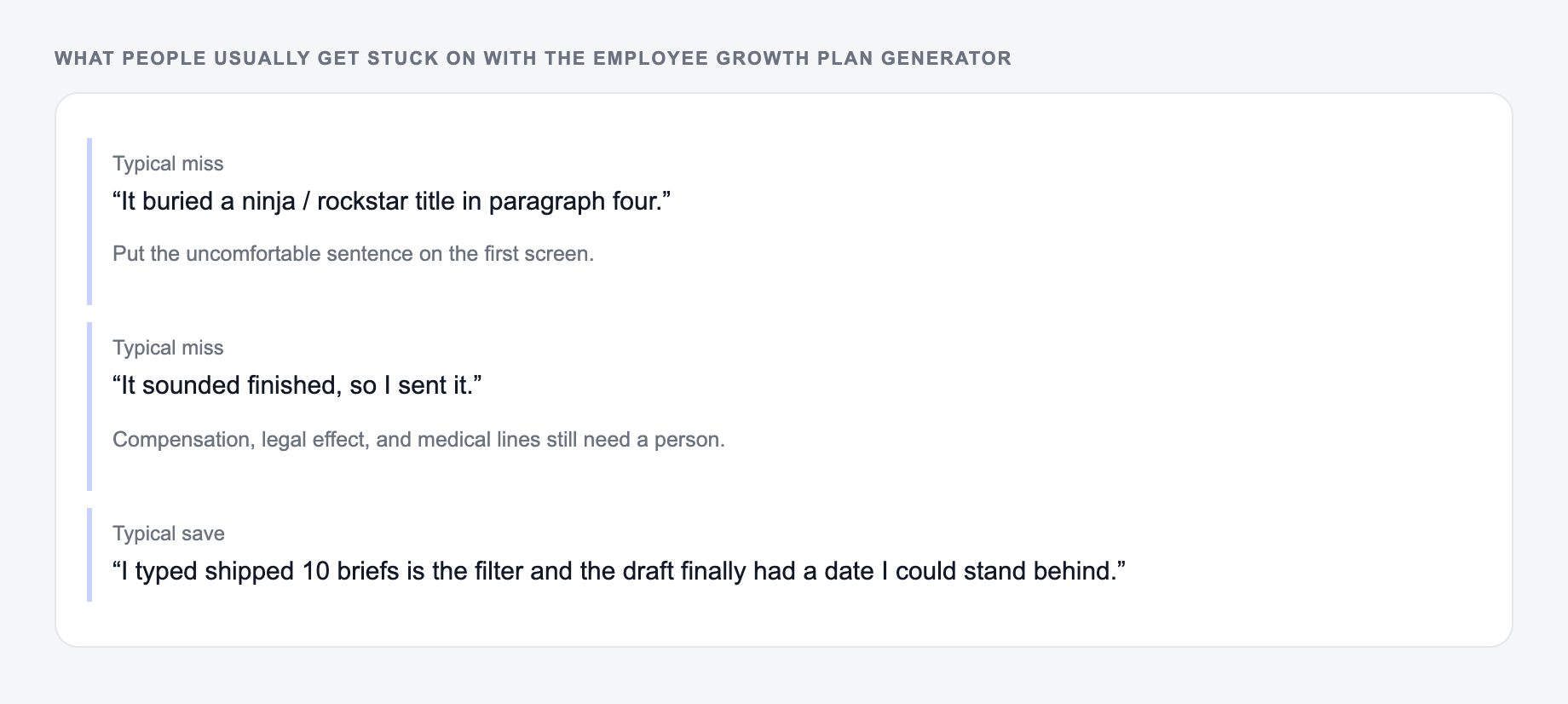
Before anything leaves the outbox:
- You can point to the number in a spreadsheet or a contract
- You would sign it if your name were the only one on it
- Compensation, legal effect, and medical content had a human pass
If the output felt generic, it is usually one of these three misses.
Start with the employee's role and current context. Include responsibilities, level, strengths, recent feedback, and the growth need you want the plan to address.
Good inputs sound like this:
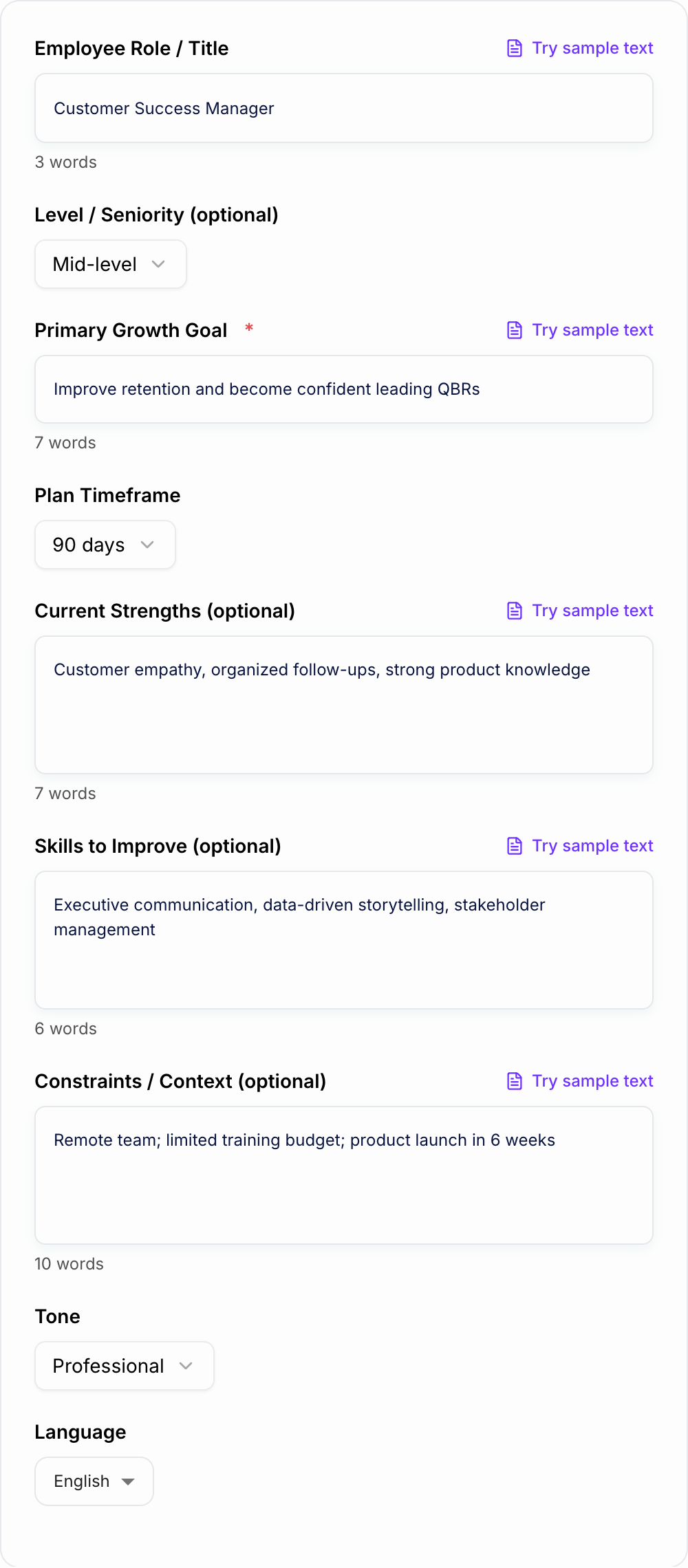
- "Customer Success Manager, strong relationships, needs stronger renewal forecasting and executive communication."
- "New engineering lead moving from individual contributor to team ownership."
- "Marketing specialist preparing for senior role, needs stronger campaign measurement and stakeholder updates."
Then add the plan goal. Avoid broad goals like "improve leadership." Use a clearer outcome: "lead two cross-functional updates by Day 90" or "prepare for senior CSM responsibilities this quarter."
Choosing the Right Plan Type
Use 30/60/90 Plan when someone is new to a role, taking on more scope, or needs short-term momentum. This format works well because each phase has visible progress.
Use Performance Improvement when the plan needs to focus on a specific gap. Keep it practical and observable: what behavior should change, what support will be provided, and how progress will be measured.
Use Promotion Readiness when the employee needs proof of next-level work. Add role expectations, scope gaps, stakeholder needs, and examples of projects that can show readiness.
Use Career Development when the conversation is broader and longer-term. This is better for skill building, future direction, and ongoing growth rather than a single performance issue.
How to Review the Generated Plan
A strong generated growth plan should include:
- one primary goal, not ten competing priorities
- three to five skills or behaviors that support that goal
- milestones tied to real work
- evidence that can be reviewed later
- manager actions such as coaching, feedback, shadowing, or project access
- review checkpoints with dates or phases
If the output is too generic, add more role context and regenerate. If the plan feels too ambitious, shorten the timeframe or reduce the number of goals.
Avoid Plans That Are Just Training Lists
Courses, books, and workshops can help, but they should not be the whole plan. A useful employee development plan connects learning to performance.
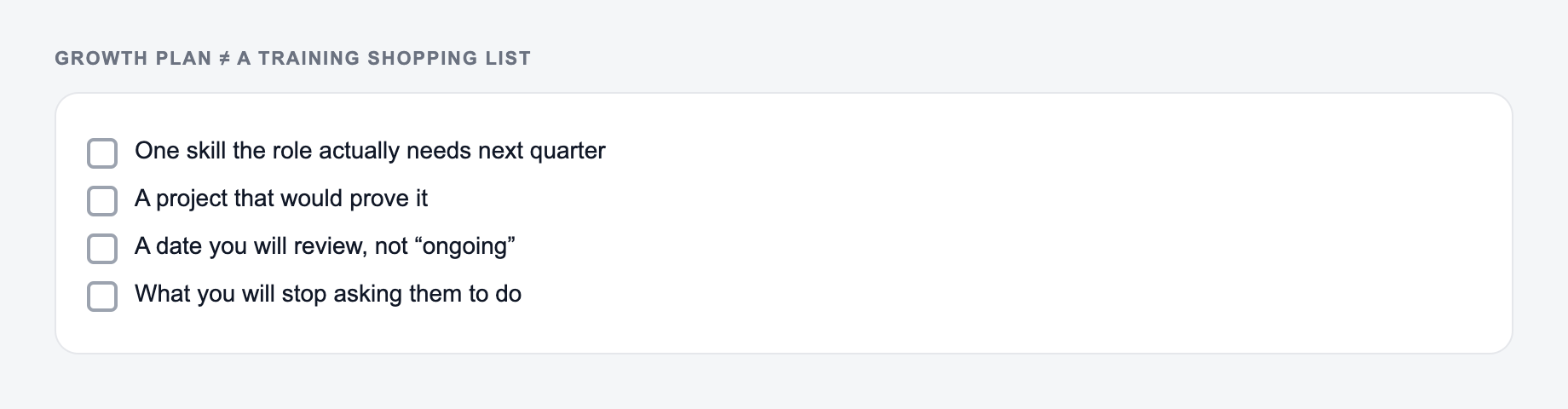
Role, one goal, and a review date belong on the form. A course list is not a plan.
Treat the Employee Growth Plan Generator as a first draft. Compensation, legal effect, medical content, and anything you would not say in the room still need a person — and often counsel — before they leave your outbox.
This is a draft aid, not legal, HR, or career advice.
For example, "take a communication course" becomes stronger when paired with "lead three stakeholder updates using a clear agenda, decision log, and risk summary." That gives the employee a real place to practice and gives the manager something to review.
For broader AI-assisted planning and writing workflows, Junia AI provides related tools that can help managers draft reviews, checklists, recognition notes, and employee documentation without starting from a blank page.
Final Checklist Before Sharing the Plan
- Is the main goal specific and realistic?
- Are the milestones observable in the employee's actual work?
- Does the plan include manager support?
- Is the evidence clear enough for a review conversation?
- Did you personalize the language before sharing it with the employee?
Frequently Asked Questions
What is an employee growth plan?+
An employee growth plan (also called an individual development plan or career development plan) is a structured document that defines skill-building goals, measurable milestones, learning activities, and manager support—typically over 30, 60, 90 days or a quarterly/annual cycle.
Is this growth plan generator free to use?+
Yes. You can generate a complete employee growth plan for free. Some advanced modes (like promotion readiness or leadership development) may be marked as premium depending on your site setup.
How do I write a strong employee development goal?+
Use SMART goals: specific, measurable, achievable, relevant, and time-bound. For example, instead of “Improve communication,” use “Lead 3 executive-ready QBRs by the end of 90 days and achieve an average stakeholder feedback score of 8/10 or higher.”
Can I use this for performance reviews?+
Yes. The output works well as a performance review development plan by translating feedback into strengths to leverage, gaps to close, and clear next-cycle goals with success metrics.
What if I don’t know the employee’s skill gaps yet?+
You can leave skill gaps blank. The generator will infer common competencies based on the goal and role context, then propose a practical plan you can refine during a 1:1 career conversation.
How can I measure progress in a growth plan?+
Track outcomes (metrics, quality, delivery), behaviors (leadership and collaboration signals), and artifacts (docs, projects shipped, presentations). The plan includes suggested KPIs and evidence so progress is clear and review-ready.