
Free Essay Intro Generator
Create essay introductions tailored to argumentative, analytical, expository, narrative, compare-and-contrast, or cause-and-effect writing. Generate a relevant hook, concise background context, and a focused thesis statement that gives your first paragraph clear direction.
Essay Introduction
Your essay introduction (hook + context + thesis) will appear here...
How the AI Essay Introduction Generator Works
Get results in seconds with a simple workflow.
Enter Your Topic (and Optional Thesis)
Add your essay topic. If you already have a thesis statement or claim, include it to keep the introduction aligned with your assignment and argument.
Choose Essay Type, Tone, and Length
Pick the essay type (argumentative, analytical, expository, narrative, etc.), then set tone and word count to match your class expectations and writing style.
Generate and Refine for Your Assignment
Get an introduction with a hook, context, and thesis. Customize details, add course-specific terms, and ensure your thesis precisely matches your body paragraphs.
See It in Action
Example of transforming a basic opening into a stronger essay introduction with a hook, context, and thesis statement.
Smartphones are used a lot in schools. Some people think they are bad. This essay will talk about smartphones in classrooms.
A buzzing notification can pull attention away in an instant—especially in a classroom where focus is already hard to maintain. As smartphones have become constant companions for students, schools are increasingly questioning whether these devices help learning or quietly undermine it. Schools should restrict smartphone use during class because constant access increases distractions, reduces meaningful participation, and can negatively affect academic performance.
Why Use Our AI Essay Introduction Generator?
Powered by the latest AI to deliver fast, accurate results.
Hook + Context + Thesis (Complete Intro Structure)
Generates a full essay introduction with an attention-grabbing hook, concise background context, and a clear thesis statement to guide the rest of the essay.
Supports Common Essay Types (Argumentative, Analytical, Expository, Narrative)
Adapts the introduction style to your essay type—persuasive claims for argumentative essays, interpretive framing for analytical essays, and story-based hooks for narrative essays.
Thesis Statement Generator (Optional Input)
If you don’t provide a thesis, the tool proposes a focused thesis that matches the topic and stays specific (avoiding vague, overly broad statements).
Roadmap Preview for Stronger Coherence
Optionally weaves in a brief roadmap of key points so your introduction clearly signals how the essay will be organized—improving clarity and academic writing quality.
Tone and Language Control for Academic Writing
Choose tone and output language to fit school requirements, college-level academic writing, or a more accessible style—while keeping the introduction clear and original.
Pro Tips for Better Results
Get the most out of the AI Essay Introduction Generator with these expert tips.
Make the thesis specific and arguable
A strong thesis goes beyond a topic statement. It takes a position (or makes a clear interpretive claim) and signals what the essay will prove or explain.
Match the hook to the topic—avoid generic openings
Hooks work best when they point directly toward your thesis. Skip broad statements like “Since the beginning of time…” and start with a focused angle.
Use a one-sentence roadmap for clarity
If your essay is multi-point, preview 2–3 key reasons or themes in a single sentence to improve structure and make your argument easier to follow.
Keep background context brief
Include only the context the reader needs to understand the problem or debate. Save detailed evidence and examples for the body paragraphs.
After generating, align body paragraphs to the thesis
Make sure each body paragraph supports the thesis. If the essay shifts, revise the thesis so it accurately reflects your final argument and organization.
Who Is This For?
Trusted by millions of students, writers, and professionals worldwide.
Generate Strong Essay Introductions with an AI Essay Intro Generator
The Essay Intro Generator is built for the moment before the draft starts: you know the topic, but the first paragraph still feels vague. Instead of giving you a generic opening, the tool turns your topic, essay type, tone, and optional thesis into a usable hook, brief context, and focused thesis statement.
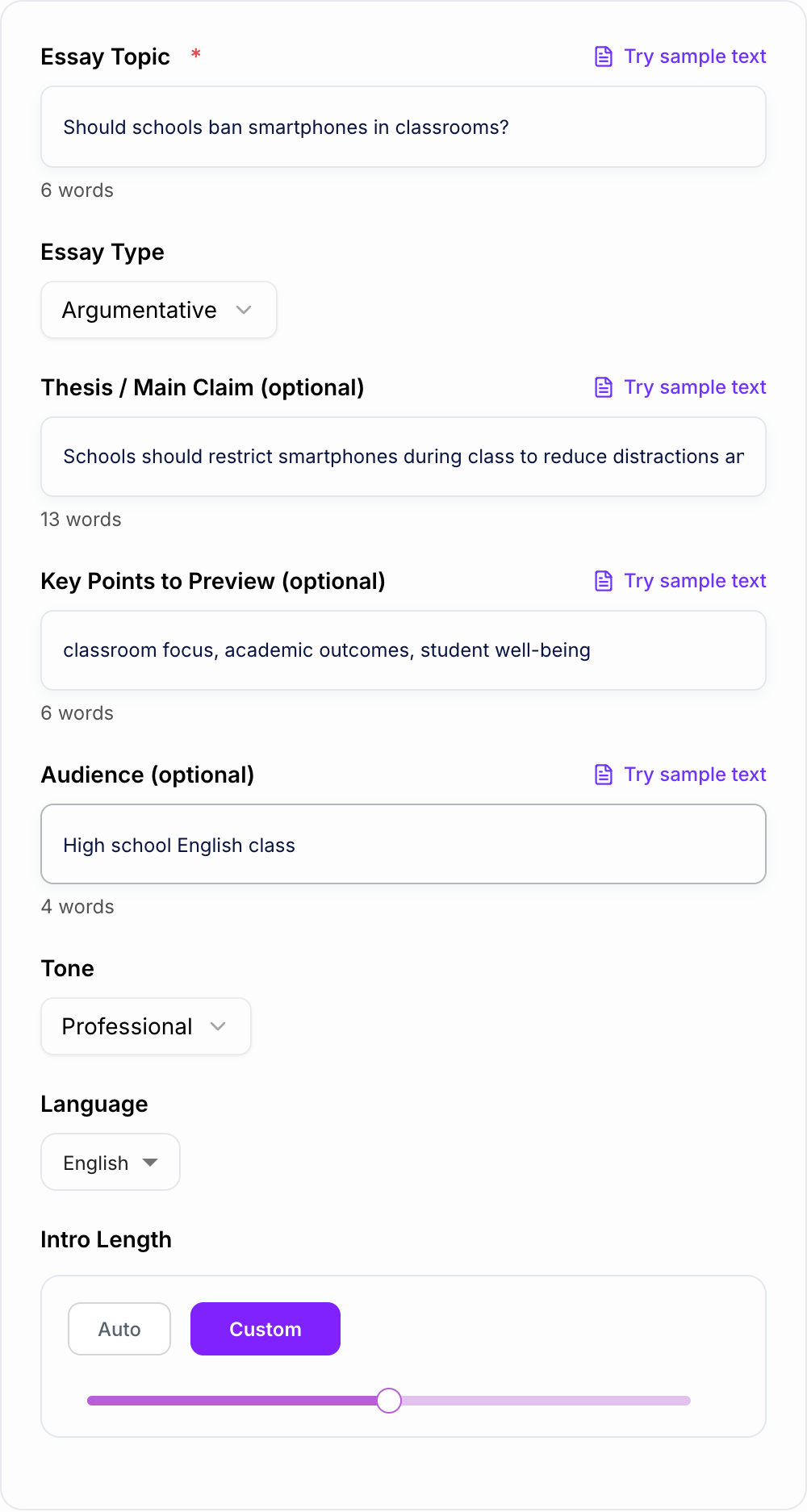
Use it as a structured first draft, not as a sentence you paste blindly. The best results come from giving the generator enough assignment context, then tightening the final intro so it matches your body paragraphs.
What to Enter Before You Generate
You can enter only a topic, but a better prompt produces a better introduction. Add these details when you have them:
- Essay topic: the subject or full prompt.
- Essay type: argumentative, analytical, expository, narrative, compare and contrast, or cause and effect.
- Thesis or main claim: even a rough version helps the generator aim the hook and context.
- Key points: the 2 to 3 reasons, themes, or examples your body paragraphs will cover.
- Audience and tone: high school, college, formal, direct, reflective, or another style your class expects.
- Length: short introductions need fewer background details; longer introductions can include a clearer roadmap.
For example, "school smartphone bans" is workable. "Argumentative essay for a high school English class arguing that schools should restrict smartphones because of focus, participation, and academic performance" gives the generator a much clearer target.
Choose the Right Essay Intro Mode
The mode matters because different essay types need different openings.
Argumentative
Use this when your essay takes a position. The generated intro should present the debate, make the issue feel important, and end with a thesis that someone could reasonably disagree with.
Analytical
Use this for literature, media, history, or concept analysis. The best analytical intros avoid broad summaries and move toward an interpretive thesis: what pattern, choice, symbol, or idea will the essay analyze?
Expository
Use this when the assignment asks you to explain, define, describe, or inform. The generated thesis should say what the essay will explain and how the information will be organized.
Narrative
Use this for personal or story-based essays. The intro should open with a specific moment, not a general life lesson, then point toward the theme the narrative will reveal.
How to Review the Generated Introduction
After the generator gives you a draft, check the three core parts separately.
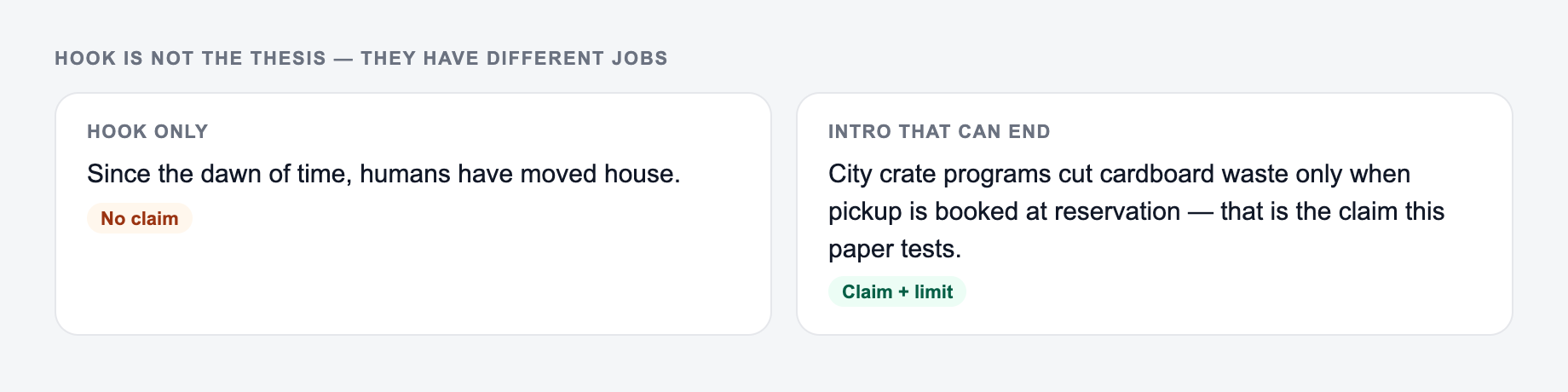
First, inspect the hook. It should connect directly to the topic. A surprising line, question, contrast, or mini scenario works only if it leads naturally into the essay. Delete openings like "In today's society" or "Since the beginning of time" because they add words without adding direction.
Second, check the context. Good context explains just enough background for the reader to understand the issue. It should not summarize the whole topic, introduce evidence too early, or drift into body paragraph material.
Third, tighten the thesis. The thesis is the promise of the essay. If the generated thesis sounds broad, add your exact claim, main reasons, text, author, time period, or point of comparison.
Example Input and Generated Direction
Input: Argumentative essay about whether schools should restrict smartphones in class. Key points: classroom focus, participation, academic performance. Tone: formal but clear.
Topic plus a stance you can support belong on the form. The generator should not invent sources.
Learning workflow:
- Enter only facts you have.
- Generate a structured draft.
- Check names, dates, citations, and units.
- Rewrite the sentences you would actually say in class or in the paper.
If the task is graded, cited, or used with students, the named writer still owns the claims.
Generated direction: The intro should start with a relevant classroom distraction hook, give brief context about smartphone use in schools, and end with a thesis such as: "Schools should restrict smartphone use during class because constant access increases distractions, reduces meaningful participation, and can weaken academic performance."
That structure gives you an opening paragraph and a body paragraph map at the same time.
Common Output Problems to Fix
- The hook is dramatic but unrelated: replace it with a question, contrast, or scenario tied to your actual topic.
- The context is too long: cut background that belongs in the body.
- The thesis only names the topic: revise it so it makes a claim or states the essay's exact purpose.
- The roadmap does not match the body: change either the roadmap or the body paragraph order before submitting.
- The tone sounds too casual: regenerate with a formal tone or edit contractions and conversational phrases.
When to Use This Tool with Other Writing Tools
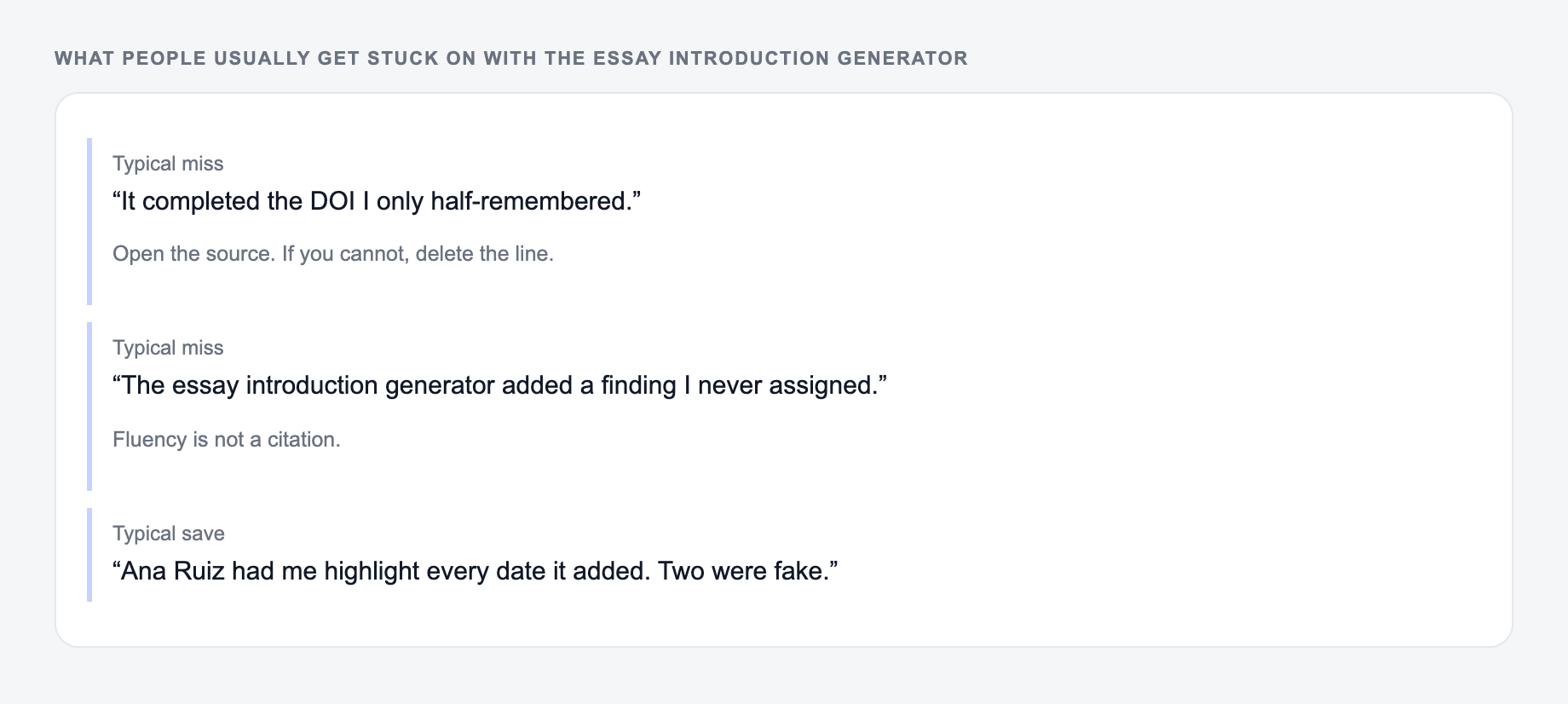
If the output felt generic, it is usually one of these three misses.
An introduction is easier to write when the rest of the essay has shape. If your thesis or body paragraph plan is still unclear, generate an outline first, then come back and generate the intro from that structure. Junia's broader AI writing tools can help you move from outline to draft to revision while keeping the introduction aligned with the final essay.
Final Checklist Before You Use the Intro
Before you copy the generated introduction into your draft, confirm that:
- the first sentence fits your topic, not any essay topic;
- the context is brief and accurate;
- the thesis is specific enough to guide the body paragraphs;
- the tone matches the class, prompt, and academic level;
- the intro length fits the assignment;
- every claim in the intro can be supported later in the essay.
The generator gives you structure quickly. Your final pass should make the intro precise, honest, and fully aligned with the essay you are actually writing.
Frequently Asked Questions
What does the Essay Intro Generator create?+
It generates an essay introduction with three core parts: a hook to capture attention, brief context to frame the topic, and a thesis statement that states your main argument or purpose.
Can it generate a thesis statement if I don’t have one?+
Yes. If you leave the thesis field blank, the tool will infer a clear, specific thesis based on your topic and essay type. You can then edit it to match your assignment requirements.
How long should an essay introduction be?+
Most essay introductions are about 10–15% of the total essay length. For many school and college essays, 100–180 words is a solid range, depending on complexity and required context.
Will the introduction be original and not plagiarized?+
The tool is designed to produce original writing. Still, you should review and personalize the intro with your own angle, course concepts, or sources—especially for academic integrity policies.
How do I make my hook stronger?+
Use a specific angle: a surprising fact (if you can cite it), a sharp question, a brief scenario, or a relevant contrast. Avoid clichés and overly broad statements; aim for a hook that directly relates to your thesis.
Can I use this for compare-and-contrast or cause-and-effect essays?+
Yes. Select the essay type and optionally add key points. The introduction will frame the comparison or causal relationship and end with a thesis that matches that structure.