
Free Essay Outline Generator
Build organized essay outlines from a topic, prompt, or rough thesis. Generate an introduction plan, body paragraph claims, evidence placeholders, counterarguments, rebuttals, and conclusion notes for argumentative, expository, compare-and-contrast, persuasive, and research essays.
Essay Outline
Your essay outline will appear here...
How the AI Essay Outline Generator Works
Get results in seconds with a simple workflow.
Paste Your Topic or Prompt
Enter your essay topic or the full assignment prompt. Add any constraints like required themes, number of paragraphs, or rubric criteria for best results.
Choose Essay Type and Options
Select the essay type (argumentative, expository, compare & contrast, persuasive, or research). Optionally add a thesis and key points to keep the outline aligned.
Generate and Draft Faster
Get a structured outline with paragraph-by-paragraph guidance. Use it to write your draft efficiently, then revise for clarity, evidence quality, and style.
See It in Action
Example of turning a broad prompt into a structured, thesis-driven essay outline with clear paragraph plans.
Topic: Social media and kids I need an outline about whether kids should be on social media.
Title: Should Social Media Platforms Verify Users’ Ages?
Thesis: Social media platforms should implement age verification because it reduces harm to minors, improves content safety, and encourages healthier online habits—while requiring privacy-conscious safeguards.
I. Introduction
- Hook: The gap between platform age rules and real usage
- Background: Why age matters (content exposure, contact risks)
- Thesis statement
- Roadmap: safety benefits, enforcement realities, privacy trade-offs
II. Body Paragraph 1 — Safety and Harm Reduction H3: Claim
- Age verification reduces exposure to inappropriate content and predatory contact H3: Evidence ideas
- Platform policy intent; examples of age-gated experiences H3: Analysis
- Connect safety outcomes to the thesis
III. Body Paragraph 2 — Practical Enforcement + Platform Responsibility H3: Claim
- Platforms already moderate content; age checks are a reasonable extension H3: Evidence ideas
- Current moderation tools; parental controls; account reporting systems H3: Analysis
- Trade-offs, implementation tiers, and realistic expectations
IV. Body Paragraph 3 — Privacy and Equity Concerns (and Mitigations) H3: Claim
- Age verification can increase data collection, but privacy-preserving methods reduce risk H3: Evidence ideas
- Third-party verification, minimal-data checks, device-level controls (examples) H3: Analysis
- Mitigation strategies and why benefits can outweigh costs
V. Counterargument + Rebuttal
- Counterargument: Age verification is invasive and easy to bypass
- Rebuttal: Use privacy-preserving verification, graduated access, and enforcement incentives
VI. Conclusion
- Restate thesis in fresh words
- Summarize main reasons
- Closing thought: balancing child safety with privacy-by-design
Why Use Our AI Essay Outline Generator?
Powered by the latest AI to deliver fast, accurate results.
Thesis Statement + Clear Essay Structure
Generates a focused thesis statement (or improves yours) and a logical essay outline with an introduction, body paragraphs, and a conclusion—ideal for academic writing and timed essays.
Body Paragraph Plans (Claim → Evidence → Analysis)
Creates paragraph-by-paragraph plans with topic sentences, supporting reasons, evidence ideas, and analysis notes—helping you write stronger, more coherent academic essays.
Counterargument and Rebuttal (Argumentative/Persuasive)
Includes a counterargument section with rebuttal guidance to strengthen your argument, improve critical thinking, and meet common essay rubric requirements.
Prompt & Rubric Alignment
Incorporates your prompt constraints and key requirements (like required themes, examples, or source expectations) to produce an outline that stays on-task and avoids tangents.
Adaptable to Common Essay Types
Supports argumentative, expository, compare-and-contrast, persuasive, and research essay outlines—useful for middle school, high school, and college writing.
Pro Tips for Better Results
Get the most out of the AI Essay Outline Generator with these expert tips.
Turn each body paragraph into a mini-argument
For stronger essays, make every body paragraph follow a simple chain: claim → evidence → explanation → link back to thesis. This improves coherence and grading outcomes.
Write a thesis that is debatable and specific
Avoid vague theses. A good thesis makes a clear claim and hints at your main reasons—making the outline easier to expand into a full draft.
Use the prompt’s keywords as a checklist
Look for verbs like analyze, compare, evaluate, or discuss. Make sure your outline directly addresses those tasks to avoid off-topic writing.
Plan your counterargument early
If you’re writing an argumentative or persuasive essay, choose a realistic opposing view. A fair counterargument plus a strong rebuttal strengthens credibility.
For research essays, label evidence needs instead of guessing
If you don’t have sources yet, use placeholders like [study], [statistic], or [expert quote] in the outline, then fill them with verified citations during drafting.
Who Is This For?
Trusted by millions of students, writers, and professionals worldwide.
Generate a Clear Essay Outline Before You Draft
The Essay Outline Generator turns a prompt, topic, or rough thesis into a paragraph-by-paragraph plan. That matters because most messy essays do not fail at the sentence level; they fail because the argument has no structure before the writing starts.
Use the generated outline as a blueprint. It should show what the introduction needs to do, what each body paragraph proves, where evidence belongs, and how the conclusion closes the argument.
What to Enter into the Essay Outline Generator
The tool can work from a short topic, but it performs better when you include the assignment details a human tutor would ask for:
- the full essay prompt or question;
- the essay type: argumentative, expository, compare and contrast, persuasive, or research essay;
- your draft thesis, if you already have one;
- required paragraph count, word count, sources, or rubric language;
- key examples, texts, events, or concepts you must include;
- tone and academic level.
For example, "social media and kids" will produce a broad outline. "Argumentative 5-paragraph essay on whether social media platforms should verify users' ages, with one counterargument and privacy concerns included" produces a much stronger plan.
Choose the Best Outline Mode
The Essay Outline Generator drafts structure. You still own the claim. If you cannot explain a sentence without looking it up, do not leave it in.
Argumentative
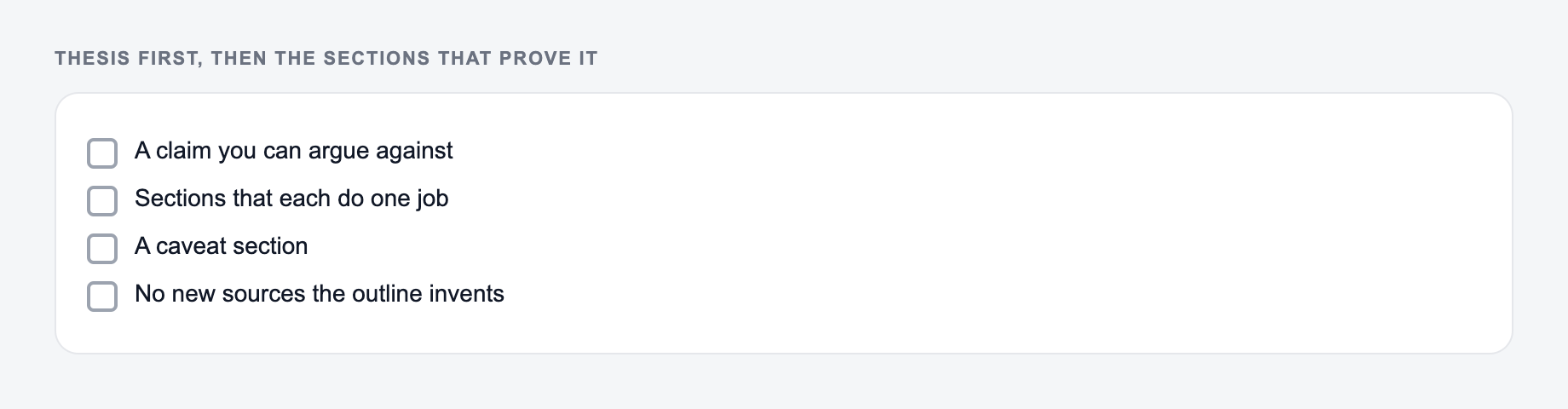
Use this when the essay needs a debatable thesis, body claims, evidence ideas, and a counterargument. The generated outline should make the position clear without ignoring the strongest opposing view.
Expository
Use this when the assignment asks you to explain a topic. The outline should move logically from definition or background to causes, effects, process, examples, or applications.
Compare and Contrast
Use this when the essay compares two subjects. Review whether the generator chose point-by-point or block structure, then pick the version that will be easiest for your reader to follow.
Research Essay
Use this when sources matter. The outline should label where evidence belongs without inventing facts or citations. Treat placeholders like [study], [statistic], or [expert quote] as research tasks.
How to Turn the Generated Outline into a Draft
Start with the thesis. If the generated thesis is too broad, add the exact claim, reason, text, method, population, or time period. A precise thesis keeps the rest of the outline from turning into a list of loosely related points.
Then check each body paragraph. A useful outline should give every paragraph a job:
- Claim: what this paragraph proves or explains.
- Evidence idea: what example, quote, statistic, case, or source could support it.
- Analysis note: how that evidence connects back to the thesis.
- Transition: why the next paragraph follows logically.
If two body paragraphs make nearly the same point, combine them or ask the generator for a revised outline with clearer paragraph roles.
Example Input and Output Direction
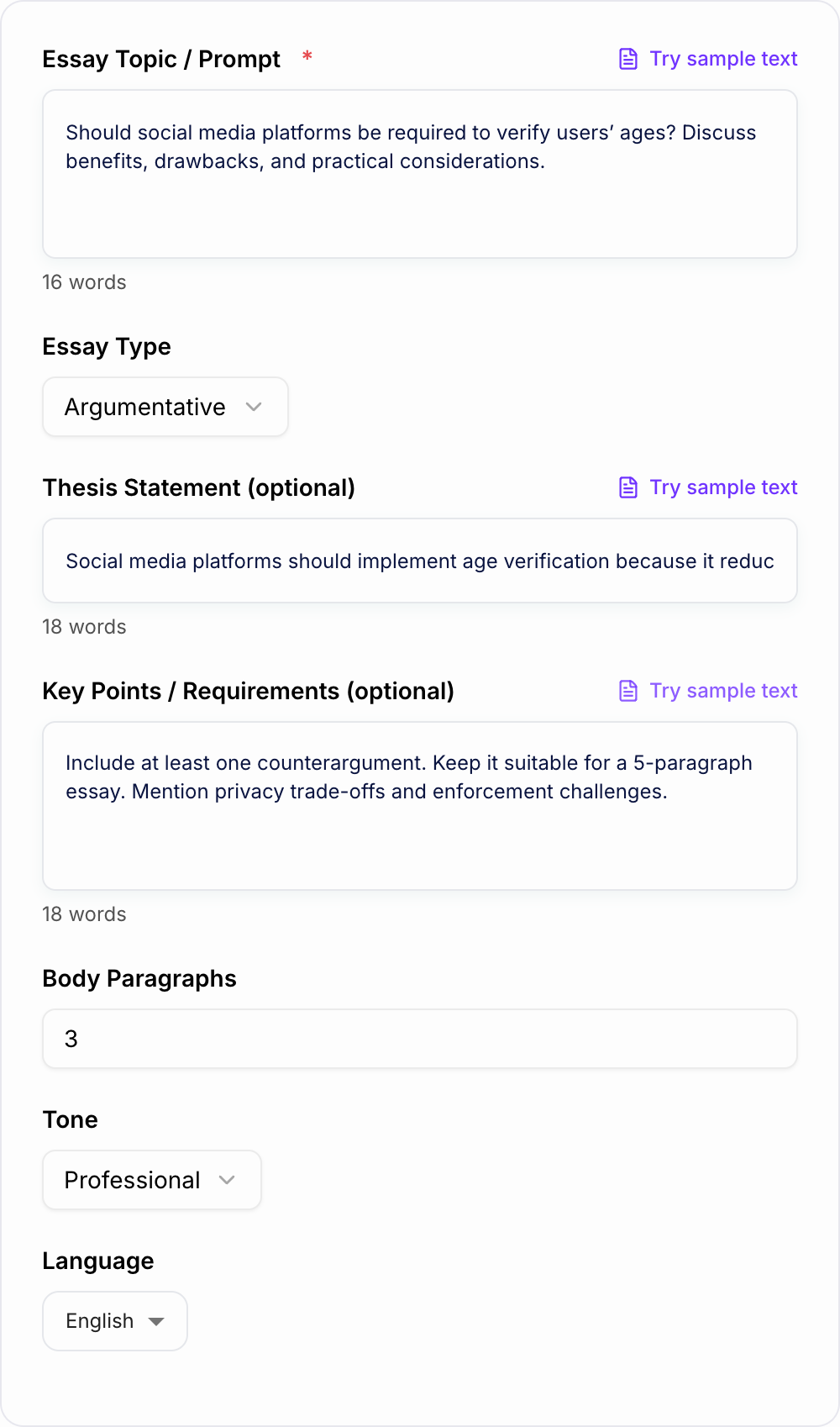
Input: Argumentative essay on whether social media platforms should verify users' ages. Include privacy concerns, child safety, and enforcement challenges. 5 body paragraphs. Formal tone.
Thesis and the points you already have belong on the form. Empty Roman numerals are not an outline.
Worked example
Input: A one-line request like “run the essay outline” with no audience, channel, or constraint.
Direction to keep: A brief the AI Essay Outline Generator can use: who it is for, where the output will appear, and what must stay true.
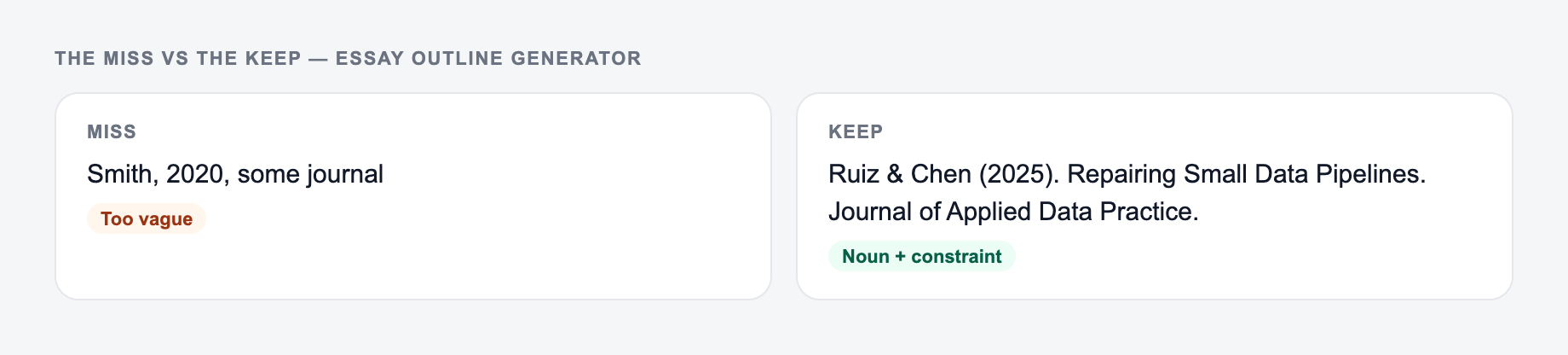
Then verify: highlight every name, date, citation, load, or measurement the AI Essay Outline Generator added. If you cannot source it, it does not ship.
If the task is graded, cited, or used with students, the named writer still owns the claims.
Good generated outline direction: The outline should include a thesis, one paragraph on safety benefits, one on platform responsibility, one on privacy risks, one counterargument with rebuttal, and a conclusion that balances safety with privacy-conscious design.
That gives you more than headings. It gives you decisions about what belongs in each paragraph and what evidence you still need to find.
How to Avoid Generic AI Outlines
Generic outlines usually come from generic inputs. Add the prompt's verbs: analyze, evaluate, compare, argue, explain, discuss. Add constraints from the rubric. Add the texts, authors, data points, or real examples you plan to use.
If the first outline is bland, regenerate with a stronger instruction such as: "Make each body paragraph distinct, include one counterargument, and label what evidence I need to research."
Using the Outline Responsibly
An AI outline is not a finished essay. Use it to plan faster, then do the academic work yourself:
- verify facts before drafting;
- add real sources where the outline marks evidence needs;
- rewrite claims in your own voice;
- remove sections that do not answer the prompt;
- make sure the final essay follows your teacher's instructions.
When you need to move from planning into drafting, Junia's AI writing tools can help with related steps such as intros, thesis statements, rewrites, and revision. Keep the outline as the control document so every generated section still follows the same argument.
Final Outline Review Checklist
The left side is what most people type. The right side is the brief that actually steers the draft.
Before drafting, confirm that:
- the thesis answers the prompt directly;
- every body paragraph supports one clear point;
- evidence placeholders are realistic and researchable;
- counterarguments are fair, not weak strawman points;
- the conclusion closes the argument without adding new evidence;
- the outline matches the required essay type and length.
A strong generated outline should make the draft easier to write, not make the essay feel prewritten. Use it to organize your thinking, then build the final paper with your own evidence and judgment.
Frequently Asked Questions
Is this essay outline generator free to use?+
Yes. You can generate an essay outline for free by entering your topic or prompt. Some advanced modes (like persuasive audience targeting or research-essay source planning) may be marked as premium.
What does an essay outline include?+
A strong essay outline typically includes a thesis statement, an introduction plan, body paragraph topic sentences with supporting points and evidence ideas, a counterargument (when relevant), and a conclusion summary.
Can it generate an outline from a full prompt?+
Yes. Paste your full essay prompt and any requirements (word count, number of paragraphs, required themes, or rubric criteria). The tool will structure the outline to match your assignment.
Will it write the full essay?+
This tool focuses on generating a detailed essay outline. You can use the outline as a blueprint to write your draft faster and with better organization.
Does it create citations or facts for a research essay?+
It can plan where citations should go and what types of sources you should use, but it should not invent facts or fake references. For research writing, add real sources and verify claims.
How do I make the outline more specific and less generic?+
Add a draft thesis, your key points, and any constraints (grade level, required examples, rubric items). The more context you provide, the more tailored and useful the outline will be.