
Free Manuscript Generator
Generate structured manuscript drafts for fiction, memoir, nonfiction, short books, and lead magnets. Add your premise, reader, voice, chapter count, and target length to create an outline, first chapter, sample chapters, or a full draft you can revise into a stronger book.
Manuscript Draft
Your manuscript draft will appear here...
How the AI Manuscript Generator Works
Get results in seconds with a simple workflow.
Describe Your Book Premise
Enter your book idea (topic + outcome for nonfiction, or conflict + main character for fiction). Add a target reader and style for a manuscript draft that matches your goals.
Choose Length, Chapters, and Mode
Set your target word count and chapter count, then choose whether you want an outline, a first chapter, sample chapters, or a full manuscript draft.
Generate, Then Edit for Publication
Use the draft as a foundation: refine structure, verify facts, add personal examples, improve continuity, and polish language before sharing or publishing.
See It in Action
Turn a rough book idea into a structured manuscript outline and draft with chapters, chapter goals, and consistent voice.
I want to write a book about SEO for small businesses. I’m not sure what chapters to include or how to structure it.
Working Title: The Practical SEO Playbook for Small Businesses
Outline (12 Chapters) H2: Chapter 1 — SEO Foundations: How Google Finds and Ranks Pages
- What SEO is (and isn’t)
- The small business advantage: focus, specificity, and local intent
- End-of-chapter checklist
H2: Chapter 2 — Keyword Research That Matches Real Customers
- Seed topics from services, FAQs, and sales calls
- Intent mapping: informational vs commercial vs local
- Exercise: build a 30-keyword starter list
...
Draft Excerpt (Chapter 1) A website without search traffic is like a storefront on a hidden street. SEO is the process of making sure the right people can find you—exactly when they’re looking for what you sell. In this book, you’ll build an SEO system you can run in a few hours a week: research keywords that customers actually use, publish pages that match search intent, and measure what moves revenue.
End-of-Chapter Checklist
- Define your top 3 services and 10 customer questions
- Identify the main goal of your website (leads, calls, bookings)
- Install Search Console and analytics before publishing new content
Why Use Our AI Manuscript Generator?
Powered by the latest AI to deliver fast, accurate results.
Book Manuscript Structure (Chapters + Clear Progression)
Generates a manuscript with logical chapter flow, chapter goals, and consistent pacing—ideal for drafting a nonfiction book, novel manuscript, or short-form book quickly.
Fiction or Nonfiction Modes (Outline, Chapter Drafts, Full Manuscript)
Choose an AI manuscript mode to generate a book outline, a strong first chapter, sample chapters, or a full manuscript draft—useful for validating an idea before deep editing.
Consistent Voice, Tone, and Target Reader Alignment
Adapts voice and tone to your audience (beginners, business readers, genre fiction fans) to create a manuscript that feels coherent and readable across chapters.
Nonfiction Value Adds: Frameworks, Checklists, Exercises
For nonfiction manuscripts, includes actionable frameworks, examples, end-of-chapter summaries, and optional exercises—great for writing a practical guidebook or playbook.
Scene + Dialogue Guidance for Fiction Drafts
For fiction manuscripts, emphasizes scenes, dialogue, tension, and chapter hooks—helpful for drafting a novel manuscript with momentum and clear story beats.
Pro Tips for Better Results
Get the most out of the AI Manuscript Generator with these expert tips.
Start with an outline before generating a full manuscript
A strong book outline improves coherence, reduces repetition, and makes revision easier. Generate the outline first, then draft chapters from it.
Give the manuscript a specific promise
For nonfiction: define the transformation (before/after). For fiction: define the central conflict and stakes. Clear promise = clearer chapter goals.
Use a short word count for your first draft
A lean manuscript draft (5k–20k words) is faster to revise. Once the structure works, expand sections or add scenes where needed.
Add your unique proof points
Improve credibility and originality by adding your experience, case studies, data you can verify, and examples that only you can provide.
Edit in passes: structure → clarity → style
First fix chapter order and gaps, then tighten clarity and transitions, then refine voice and sentence-level polish. This produces a stronger final manuscript.
Who Is This For?
Trusted by millions of students, writers, and professionals worldwide.
Generate a Better Book Draft with the AI Manuscript Generator
A manuscript generator works best when you treat it like a drafting system, not a publish button. Give it a clear premise, reader, voice, and target length, and it can produce an outline, Chapter 1, sample chapters, or a complete draft with a much cleaner starting structure than a blank page.
The important part is control. The tool can organize the manuscript, keep chapters moving, and help you test a voice quickly. You still decide what belongs in the book, what needs proof, and what should sound more like you.
If you are drafting inside Junia AI, use the manuscript generator as the first pass, then revise the output in stages instead of trying to perfect everything at once.
What to Enter Before You Generate
The premise field carries most of the weight. Do not write "a book about productivity" and expect a sharp manuscript. Give the generator the core promise.
For nonfiction, use this shape:
- Audience: who the book helps
- Pain: what they struggle with now
- Promise: what changes by the end
- Method: the approach, framework, or point of view
For fiction, use this shape:
- Protagonist: who drives the story
- Want: what they are trying to get
- Obstacle: what blocks them
- Stakes: what gets worse if they fail
A useful nonfiction input might be: "A practical guide for freelance designers who want steadier client work without relying on referrals. The book teaches a weekly outreach, portfolio, and follow-up system in a clear, direct voice."
Choose the Right Manuscript Mode
Use Outline Only when the idea is still loose. This gives you chapter order, chapter goals, and missing pieces before prose makes everything harder to move.
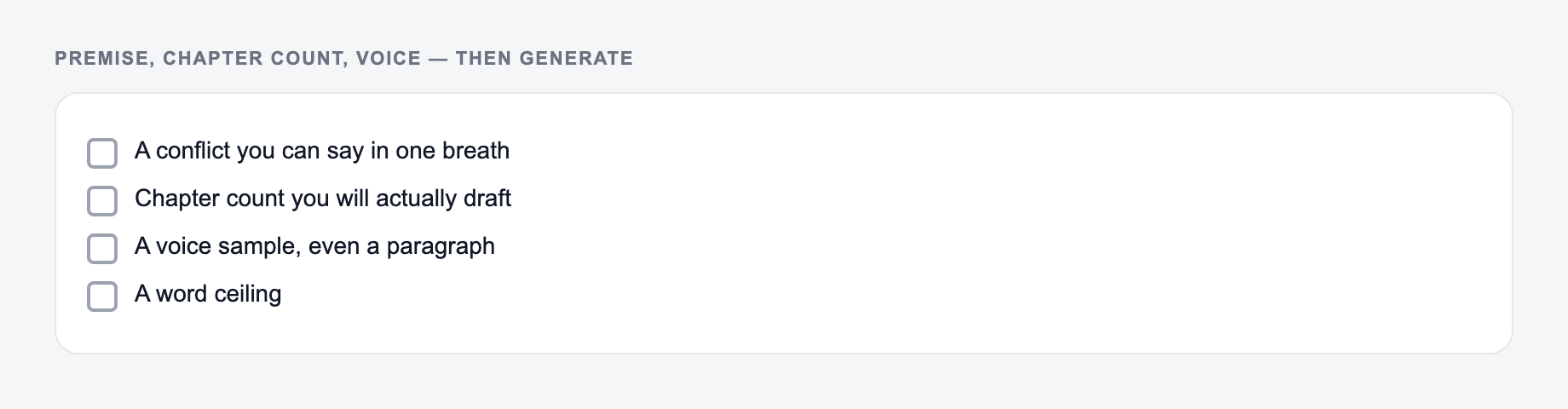
Use Chapter 1 Draft when you need to test the opening promise, hook, and voice. If the first chapter feels wrong, fix the premise or style before generating more.
Use Sample Chapters when you want to see whether the manuscript can hold together beyond the opening. This is useful for checking pacing, repetition, and transitions.
Use Full Manuscript Draft for short books, lead magnets, novellas, and early validation drafts. Keep the word count realistic so the output does not stretch a thin idea across too many chapters.
Use Nonfiction Playbook when you want frameworks, examples, checklists, exercises, and end-of-chapter takeaways. Use Fiction Novel when you need scenes, dialogue, tension, POV, and chapter hooks.
Set Voice, Chapter Count, and Word Count Carefully
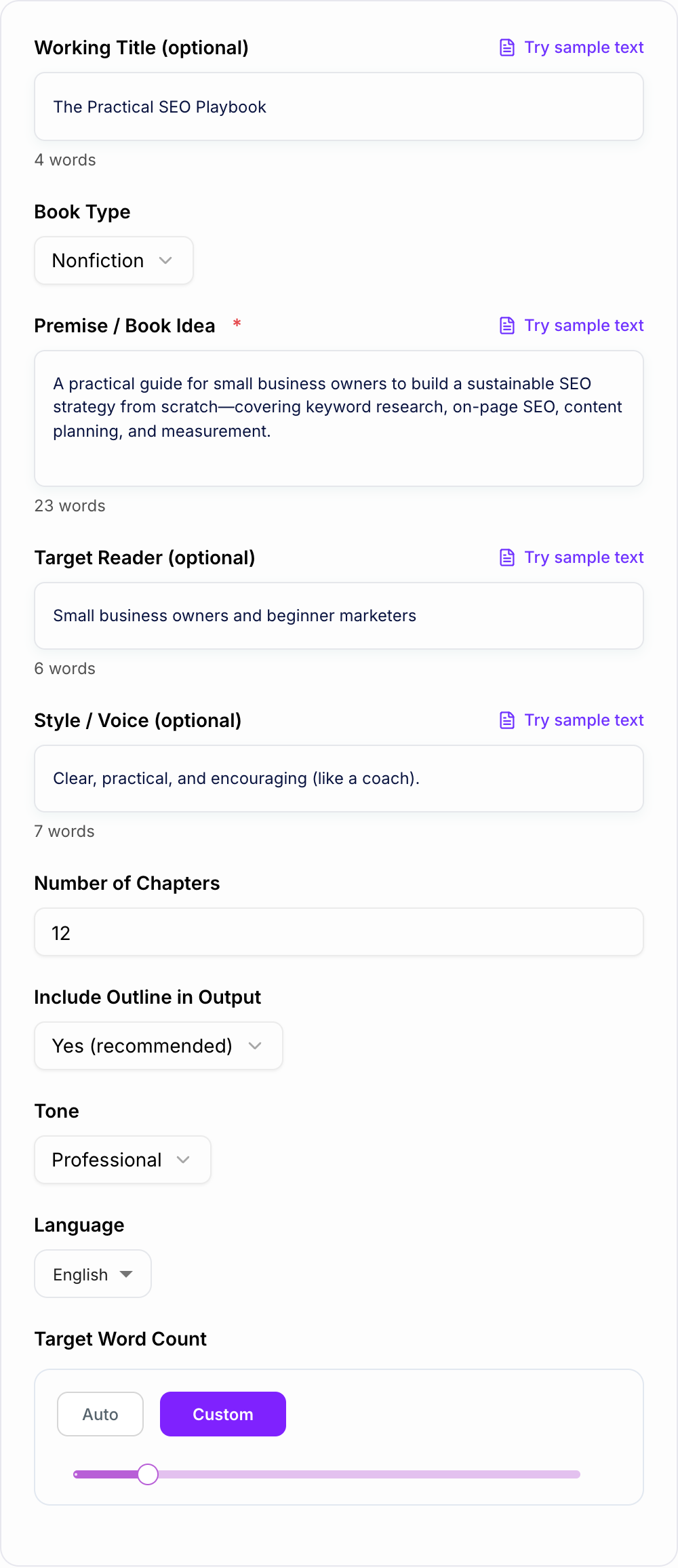
Voice instructions should be concrete. "Professional" is weak. "Clear, practical, short paragraphs, no hype, with examples after each concept" gives the manuscript generator much better guardrails.
Premise, chapter count, and voice on the form keep the draft bounded.
A shortlist is not a decision. After the AI Manuscript Generator runs, pick with a boring test: can a stranger repeat the promise, and can you keep that promise on the page?
Chapter count and word count also shape quality. A 10,000-word guide with 8 chapters usually works better than a 50,000-word draft from a two-sentence premise. Start smaller, repair the structure, then expand the sections that need more depth.
For a lead magnet or short nonfiction book, try 5,000 to 15,000 words. For a more complete short book draft, try 20,000 to 50,000 words only after the outline is strong.
Review the Generated Manuscript Like an Editor
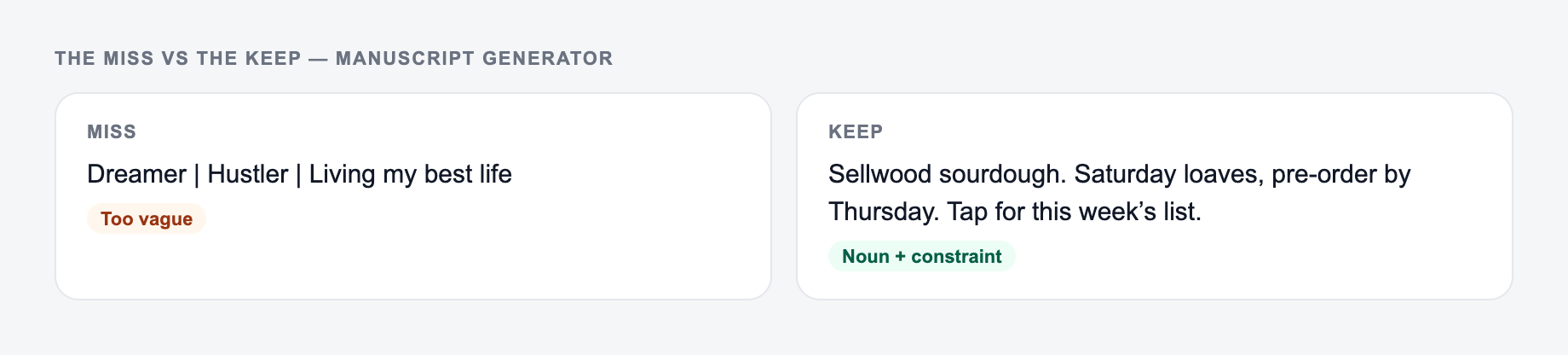
If your input looks like the miss, do not judge the tool yet — add the noun and the constraint first.
Do not edit sentence by sentence first. Start with structure.
Check whether every chapter has a different job. If Chapter 3 and Chapter 5 teach the same idea, merge them or give one a sharper role. Look for missing setup, weak transitions, and chapters that promise more than they deliver.
Then review accuracy. Nonfiction drafts need verified examples, current facts, sourceable claims, and no invented citations. Fiction drafts need continuity checks: names, timelines, motivations, point of view, and scene consequences.
Only after that should you polish voice. Replace generic phrases with your own examples, tighter metaphors, better scenes, or stronger teaching moments.
Common Manuscript Generator Mistakes
The first mistake is generating the full draft too early. An outline is easier to fix than 30 weak chapters.
The second mistake is changing voice instructions every run. That creates a manuscript that sounds patched together.
The third mistake is asking for too many chapters from too little material. Long output needs enough substance to support it.
The fourth mistake is treating the draft as authority. A manuscript generator can help with structure and momentum, but you are responsible for facts, originality, rights, and publication standards.
Before you publish manuscript generator output:
- A stranger can repeat the promise
- The page can keep that promise today
- No number, guest, or deadline you did not type
Final Checklist Before You Keep Drafting
Before expanding the manuscript, check these items:
- The premise is specific enough to guide every chapter
- The outline has a clear beginning, middle, and ending
- Each chapter has a distinct purpose
- The voice instructions are consistent
- Claims, examples, and statistics are marked for verification
- The draft has room for your stories, proof, and perspective
A good AI manuscript draft should make the book easier to finish. If it gives you structure, momentum, and clear revision targets, it has done its job.
Frequently Asked Questions
Is this manuscript generator free to use?+
Yes. You can generate manuscript drafts and outlines for free. Some advanced modes (like sample chapters or full manuscript drafts) may be marked as premium depending on your plan.
Can it generate both fiction and nonfiction manuscripts?+
Yes. Choose your book type (nonfiction, fiction, or memoir) and provide a premise. The tool adapts structure, pacing, and content elements (frameworks for nonfiction; scenes and dialogue for fiction).
Will the output be ready to publish?+
It’s designed to produce a strong first draft manuscript. You should revise for originality, accuracy, continuity, and your personal voice, then run professional editing (developmental + copyediting) before publishing.
How do I get a more coherent manuscript across chapters?+
Provide a clear premise, target reader, and preferred style. Keeping the chapter count reasonable and including an outline helps maintain consistency and reduces repetition in the manuscript draft.
Can I use this to write a short book for marketing or lead generation?+
Yes. Set a lower target word count (for example 5,000–15,000 words) and choose nonfiction. You’ll get a short, structured manuscript suitable for a lead magnet, newsletter funnel, or product onboarding guide.
Does this tool check facts and citations for nonfiction?+
No. It will avoid inventing statistics, but you’re responsible for verifying claims, adding citations, and ensuring compliance-sensitive content is accurate before publishing.