
Free Research Problem Statement Generator
Generate a focused research problem statement for a thesis, dissertation, proposal, capstone, grant, or UX research plan. Add your topic, context, population, and research type to get a clear gap, scope, significance, and aligned objectives.
Research Problem Statement
Your research problem statement will appear here...
How the AI Research Problem Statement Generator Works
Get results in seconds with a simple workflow.
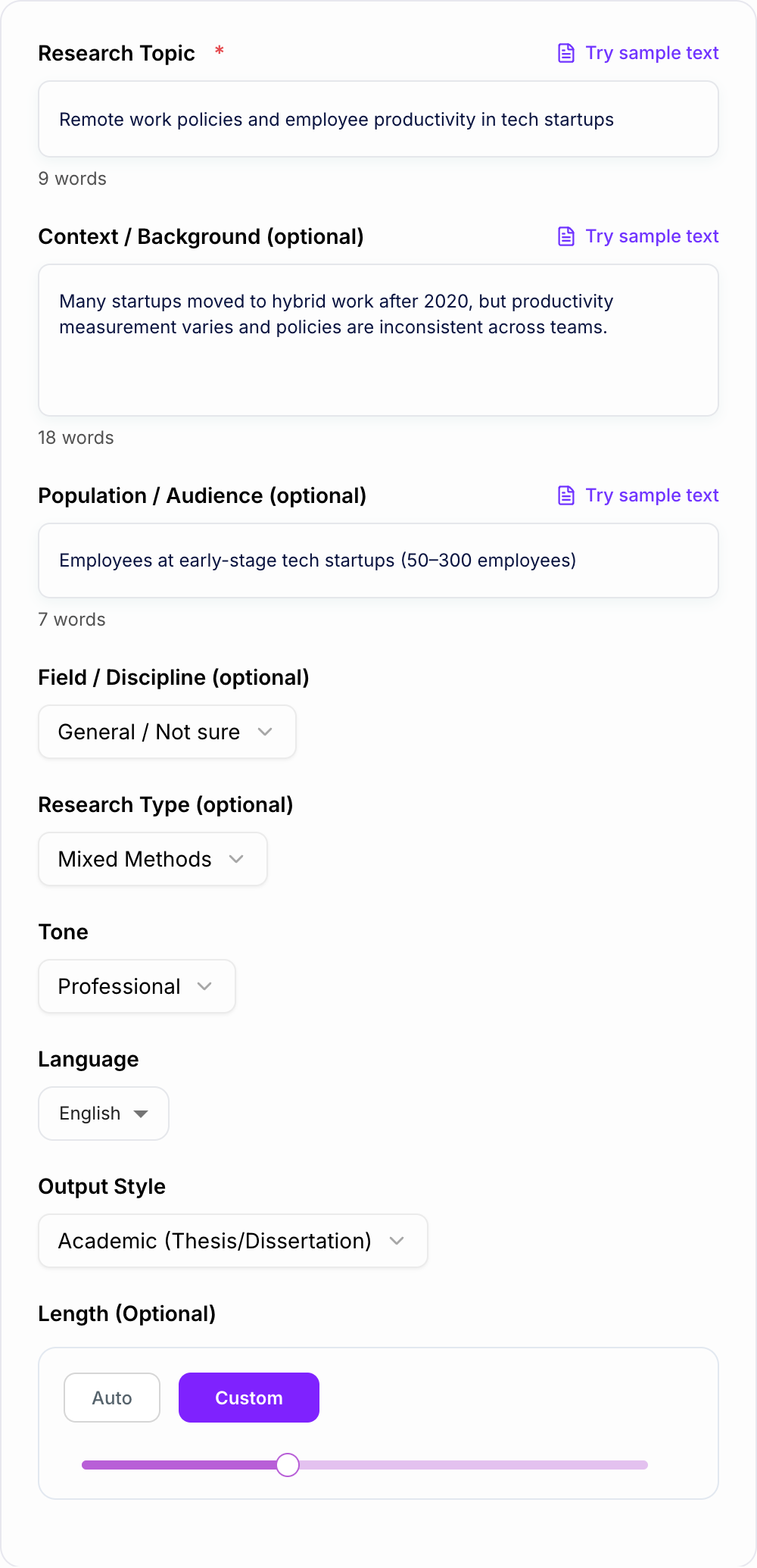
Enter Your Topic (Optional Context Helps)
Add your research topic and optionally include background, setting, and population to anchor the problem statement in a realistic scope.
Choose Discipline, Research Type, and Style
Select your field and whether the study is qualitative, quantitative, mixed, or literature-based—then choose an output style like Academic or Proposal.
Generate and Refine for Your Paper
Get a problem statement with a clear gap and aligned objectives. Edit to match your institution’s format, add citations in the introduction/literature review, and finalize research questions.
See It in Action
Transform a broad topic into a focused research problem statement with a clear gap, scope, and objectives.
Topic: Remote work and productivity
I want to research how remote work affects productivity.
Problem Statement: Remote and hybrid work models have become common in tech startups, yet organizations use inconsistent policies and productivity measures across teams. As a result, it remains unclear which remote work policy elements (e.g., meeting load, asynchronous communication norms, and in-office requirements) are most strongly associated with employee productivity outcomes in early-stage startups. This gap limits leaders’ ability to design evidence-informed remote work practices that support performance while maintaining sustainable workloads.
Research Objectives:
- Identify how early-stage tech startups define and measure employee productivity under remote or hybrid policies.
- Examine the relationship between specific remote work policy elements and reported productivity outcomes.
- Explore perceived mechanisms (e.g., focus time, collaboration friction) that may explain differences in productivity across policy approaches.
Why Use Our AI Research Problem Statement Generator?
Powered by the latest AI to deliver fast, accurate results.
Clear Research Problem + Gap (Not Just a Topic)
Turns a broad research topic into a focused problem statement by identifying context, the knowledge gap, and the specific issue your study will address—ideal for thesis and dissertation writing.
Scope, Population, and Variables/Factors
Defines who/what is affected (population), where the problem exists (context), and what factors to examine—helping you create a researchable, bounded problem statement.
Aligned Research Objectives and Direction
Generates concise objectives that match the problem statement, making it easier to write research questions, hypotheses, and methodology sections for a proposal.
Qualitative, Quantitative, or Mixed Methods Fit
Adapts wording to your research type: exploratory qualitative framing, measurable quantitative framing, or mixed-methods balance—without forcing unsupported claims.
Academic-Ready Language + Practical Clarity
Produces formal, precise writing suitable for academic submissions while keeping the problem statement readable and logically structured.
Pro Tips for Better Results
Get the most out of the AI Research Problem Statement Generator with these expert tips.
Turn the gap into a measurable direction
A strong problem statement implies what you will examine (variables, factors, or themes). After generating, ensure your objectives and research questions directly address the gap you stated.
Bound the scope to avoid an unmanageable study
Specify population, setting, and timeframe. Narrowing scope makes your methodology feasible and strengthens your proposal, thesis, or dissertation.
Use cautious, evidence-aware language
Avoid overclaims like “proves” or “always.” Use research-appropriate phrasing such as “is associated with,” “may influence,” or “is not well understood,” especially before you have results.
Align objectives, methods, and data sources
If an objective requires measurement, ensure you can collect the data. If it requires understanding perceptions, consider interviews or thematic analysis.
Add domain keywords for clarity (not stuffing)
Include key constructs relevant to your discipline (e.g., job satisfaction, learning outcomes, adherence, usability). It improves precision and helps reviewers quickly understand your study focus.
Who Is This For?
Trusted by millions of students, writers, and professionals worldwide.
Generate a Focused Research Problem Statement from a Broad Topic
A research problem statement generator helps when your topic is still too wide to support a proposal, thesis, dissertation, capstone, or research plan. The tool turns a general idea into a bounded problem with context, a gap, significance, scope, and aligned objectives.
The goal is not to make the topic sound academic. The goal is to make it researchable.
What to Enter Into the Problem Statement Generator
Better inputs create sharper problem statements. Try to give the tool more than the topic.
Useful details include:
- topic or research area
- setting, industry, institution, or location
- population or stakeholder group
- timeframe or current context
- what appears unknown, inconsistent, or unresolved
- research type: qualitative, quantitative, mixed methods, or literature-based
- output style: academic, proposal, capstone, business, or grant
Weak input: "remote work and productivity"
Better input: "Remote and hybrid work policies in early-stage SaaS startups, focusing on how meeting load, asynchronous communication norms, and manager clarity affect employee productivity measurement."
How to Choose the Right Output Style
The best mode depends on where the statement will be used.
Academic Thesis or Dissertation
Use this when you need formal wording with gap, significance, population, and scope. Keep the language cautious and avoid sounding like you already know the results.
Research Proposal
Use this when the statement needs to connect cleanly to objectives, research questions, and method. This is usually the safest default for coursework and early proposal drafts.
Capstone or Applied Project
Use this for real-world organizational or community problems. The output should name stakeholders, constraints, and practical outcomes.
Business or UX Research
Use this when the problem concerns customers, users, product behavior, market demand, or business metrics. Include assumptions and what still needs validation.
Grant-Ready
Use this when beneficiaries, urgency, feasibility, and measurable outcomes matter. Keep the claims evidence-aware rather than dramatic.
Problem Statement vs Research Topic
A topic names the area. A problem statement defines the issue inside that area.
Topic:
Remote work and productivity
Generated problem statement direction:
Although remote and hybrid work policies are now common in early-stage SaaS startups, productivity is measured inconsistently across teams. It remains unclear which policy elements, such as meeting load, asynchronous communication norms, and manager clarity, are most associated with employee productivity outcomes.
The second version gives you a study path. It names context, uncertainty, variables or factors, and a reason to investigate.
How to Review the Generated Problem Statement
After generating, check whether the statement answers five questions:
- Where does the problem exist?
- Who or what is affected?
- What is unknown, inconsistent, or under-examined?
- Why does the gap matter?
- What can the study realistically examine?
If any answer is missing, revise the input and generate again. A vague problem statement usually means the input did not include enough boundaries.
Align Objectives, Questions, and Methods
The Research Problem Statement Generator drafts structure. You still own the claim. If you cannot explain a sentence without looking it up, do not leave it in.
The problem statement should control the rest of the proposal.
If the statement says the study will examine relationships between variables, the objectives should support a quantitative or mixed-methods design. If it says the study will explore experiences, barriers, or perceptions, the objectives should support qualitative methods.
Do not let the generator create objectives that drift away from the gap. Keep only objectives that directly answer the problem.
Example Input and Output Review
Input:
Name the gap you can cite. A “hot topic” on the form is not a problem statement.
How to verify output from the AI Research Problem Statement Generator:
- Every citation resolves to a real work you opened
- Numbers match the source, not a rounded “about”
- Instructions are safe for the actual room, grade, or patient context
- Nothing was added that you did not type
If the task is graded, cited, or used with students, the named writer still owns the claims.
Topic: first-year university students and mental health service use. Context: large public universities. Gap: services have expanded, but early help-seeking remains low. Research type: qualitative.
A strong generated statement should include:
- first-year undergraduates as the population
- large public universities as the setting
- low early service use as the problem
- barriers or perceptions as the qualitative direction
- cautious language about what is not well understood
Before using it, add literature evidence that the gap exists and make sure the scope fits the project length.
Final Checklist Before You Use the Statement
If the output felt generic, it is usually one of these three misses.
Check that the final statement:
- is more specific than the topic
- names a real gap or unresolved issue
- includes population, setting, or scope
- avoids unsupported statistics
- uses language that matches your research type
- leads naturally into objectives or research questions
- can be supported with sources in the literature review
For longer academic projects, it helps to keep problem statements, outlines, and drafts in the same workspace. Junia AI can support that workflow when you need to move from research planning into structured writing.
Frequently Asked Questions
What is a research problem statement?+
A research problem statement is a concise, formal description of an issue or gap in knowledge that a study aims to address. It typically includes the context, what is currently known, what is missing or problematic (the gap), and why the problem matters.
How is a problem statement different from a research topic?+
A research topic is a broad subject area (e.g., remote work productivity). A problem statement narrows that topic into a specific, researchable problem by defining the gap, affected population, scope, and the consequences of not addressing the issue.
Will the generator create research objectives too?+
Yes. The output includes 2–4 research objectives aligned with the problem statement. You can use these to draft research questions, hypotheses (for quantitative studies), and a clearer methodology.
Can I use this for qualitative or quantitative research?+
Yes. Choose your research type and the tool will frame the problem accordingly—exploratory language for qualitative studies, measurable constructs for quantitative studies, or a balanced approach for mixed methods.
Does it cite sources or include statistics?+
No. It avoids inventing data or citations. If your institution requires sources, use the generated statement as a draft, then support it with literature review evidence and properly cited references.
How do I make the problem statement stronger?+
Add specific context (location, timeframe, organization/industry), clearly define the population, and include what is unknown or inconsistent in existing research. After generating, align your research questions and methods directly to the stated gap.