
Free Sonnet Generator
Generate a structured 14-line sonnet in Shakespearean, Petrarchan, or modern style. Add a theme, tone, keywords, rhyme strictness, and meter preference to create a poem with a clear volta, stronger imagery, and a more intentional ending.
Sonnet
Your sonnet will appear here...
How the AI Sonnet Generator Works
Get results in seconds with a simple workflow.
Pick a Theme (Optional) and Add Keywords
Enter a theme like love, time, grief, ambition, nature, or gratitude. Add optional words or phrases to personalize imagery and reduce generic phrasing.
Choose Sonnet Style, Rhyme Strictness, and Meter
Select Shakespearean, Petrarchan, or modern. Control how strictly the rhyme scheme is enforced and whether the poem should aim for an iambic pentameter feel.
Generate, Then Refine Your Favorite Lines
Get a complete 14-line sonnet instantly. If you want a stronger ending or clearer volta, tweak the theme or keywords and regenerate—then polish diction and imagery.
See It in Action
Example of turning a simple theme into a structured, rhyme-aware sonnet with a clear turn and a strong ending.
Theme: letting go
Write a sonnet about moving on from someone.
H1: (Title) I learn the shape of absence in the light, When morning finds your shadow off the wall; The kettle sings, yet nothing sounds quite right, And silent rooms refuse to hear me fall.
I keep your name like salt upon my tongue, A taste that lingers long past what it fed; I fold the days in letters left unsung, And read the spaces where you would have said.
Yet time, that patient thief with steady hands, Unknots the ties I begged it not to touch; It trades our vows for open, distant lands, And teaches memory to loosen clutch.
So let me bless the love that made me brave— Then set it down, and walk beyond its wave.
Why Use Our AI Sonnet Generator?
Powered by the latest AI to deliver fast, accurate results.
Authentic Sonnet Structure (14 Lines + Volta)
Generates a true sonnet with classic constraints—14 lines, a clear thematic turn (volta), and form-accurate progression for Shakespearean, Petrarchan, or modern sonnet styles.
Real Rhyme Schemes (Not Random Rhymes)
Uses accurate rhyme patterns like ABAB CDCD EFEF GG (English sonnet) or ABBA ABBA with a coherent sestet (Italian sonnet), while keeping phrasing natural and readable.
Tone and Diction Control for Better Poetry
Adjust tone (romantic, melancholic, playful, dramatic, inspirational, etc.) to match your intent—great for literary writing, school assignments, heartfelt messages, and creative prompts.
Keyword and Theme Guidance Without Keyword Stuffing
Optionally weave in specific words or motifs (names, places, symbols) to personalize the poem, improve specificity, and reduce generic AI-sounding output.
Multilingual Sonnet Writing
Generate sonnets in many languages for creative writing, language learning, and international audiences—while preserving the sonnet’s constraint-driven feel.
Pro Tips for Better Results
Get the most out of the AI Sonnet Generator with these expert tips.
Use 2–6 concrete keywords for stronger imagery
Abstract themes (like “love” or “time”) get better results with concrete anchors (e.g., “rusted key,” “midnight train,” “winter breath”) that guide metaphor and mood.
For Shakespearean sonnets, aim for a decisive final couplet
If the ending feels soft, add a keyword that signals resolution (e.g., “therefore,” “yet,” “still,” “at last”) or specify the message you want the couplet to land.
Choose Balanced rhyme strictness to avoid forced wording
Strict rhyme can occasionally produce unusual phrasing. Balanced keeps the rhyme scheme while improving clarity and modern readability.
Guide the volta with a contrast phrase
If you want a stronger turn, include a contrast in your theme like “hope after loss,” “beauty vs decay,” or “memory vs reality” so the poem pivots cleanly.
Revise for voice: swap a few key verbs and images
A small edit—changing 3–6 words—can make the sonnet feel uniquely yours. Replace generic verbs with vivid ones and tighten any line that feels vague.
Who Is This For?
Trusted by millions of students, writers, and professionals worldwide.
Generate a Sonnet With Form, Rhyme, and a Clear Turn
A sonnet generator is most useful when it respects the form. A real sonnet is not just 14 poetic lines. It needs structure, pressure, and usually a turn in thought or emotion.
This tool helps you generate Shakespearean, Petrarchan, or modern sonnets from a theme, tone, keyword list, rhyme preference, and meter setting. The output gives you a complete draft you can revise for voice, imagery, and rhythm.
What to Enter Into the Sonnet Generator
Start with a theme, but try to make it more specific than one abstract word.
Weak input:
Love.
Better input:
Loving someone after the timing has already passed. Tone: wistful but accepting. Keywords: train platform, winter breath, unopened letter.
Strong sonnet prompts often include:
- an emotional tension, such as hope after loss or beauty versus decay
- three to six concrete images
- a tone, such as romantic, mournful, playful, formal, modern, or devotional
- a desired form: Shakespearean, Petrarchan, or modern
- rhyme strictness and meter preference
- names, places, or phrases you want included
The clearer the tension, the easier it is for the generated sonnet to build toward a volta instead of circling the same idea for 14 lines.
How to Choose Shakespearean, Petrarchan, or Modern
A shortlist from the Sonnet Generator is not a decision. Keep a line you could publish after one edit. Reroll anything that only works if the reader already knows you. Throw away a line that invents proof.
Use Shakespearean when you want a clear build and a strong final couplet. This form works well for arguments, declarations, witty turns, romantic notes, and poems that need a memorable ending.
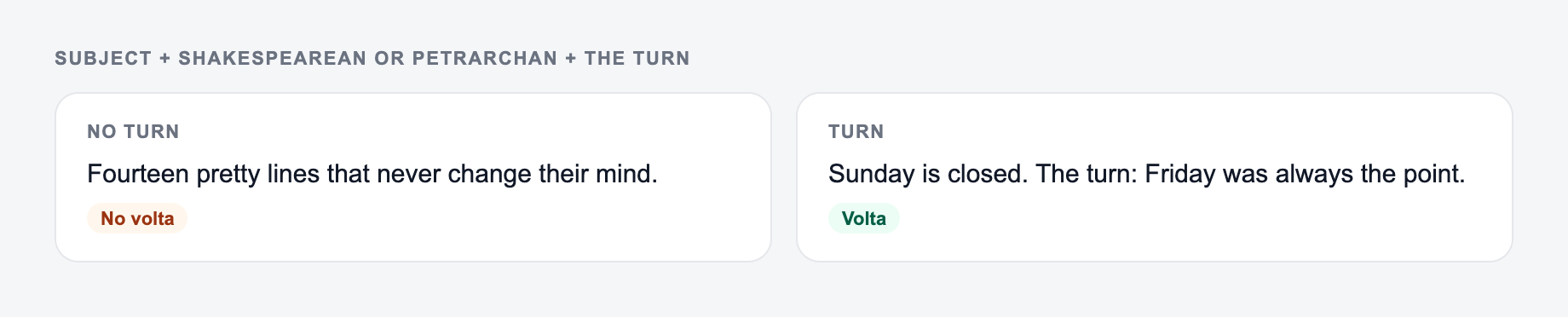
Use Petrarchan when the poem should feel like a problem followed by a turn. The octave introduces the emotional situation; the sestet responds, questions, resolves, or complicates it.
Use Modern Sonnet when you want 14-line pressure and a clear turn without making every line sound old-fashioned. This is often best for contemporary topics, social captions, personal writing, or looser creative prompts.
If you are writing for a class, follow the assigned form. If you are writing for a card, vow, caption, or personal draft, choose the form that best matches the emotional shape.
Rhyme and Meter Settings Matter
Choose Strict rhyme when form accuracy matters most. Expect more formal language.
Choose Balanced for the best everyday result. It keeps the rhyme scheme recognizable while reducing forced wording.
Choose Loose when you care more about natural phrasing than perfect rhyme, especially for modern sonnets.
For meter, Iambic-ish gives the poem a traditional pulse without making the lines feel mechanical. Stricter iambic is useful for study or formal assignments, but you should expect to revise. Flexible works best when the poem needs voice and imagery more than strict cadence.
How to Review the Generated Sonnet
After generating, check the poem like an editor:
- Does it have exactly 14 lines?
- Does the chosen form roughly match the expected rhyme pattern?
- Is there a clear volta or shift?
- Are the required keywords woven in naturally?
- Does the ending resolve, twist, or sharpen the idea?
- Are any rhymes forced enough to distract?
- Does the poem sound like the tone you requested?
If the structure is good but one line is weak, edit the line. If the whole poem lacks a turn, regenerate with a clearer contrast in the prompt.
Example Prompt to Better Output
Instead of asking for "a sonnet about moving on," try:
Subject and whether you want Shakespearean or Petrarchan belong on the form.
Weak brief
A one-line request like “run the sonnet generator” with no audience, channel, or constraint.
Brief that actually steers the ai sonnet generator
A brief the AI Sonnet Generator can use: who it is for, where the output will appear, and what must stay true.
Name the audience, the room it will appear in, and one thing the line is not allowed to invent.
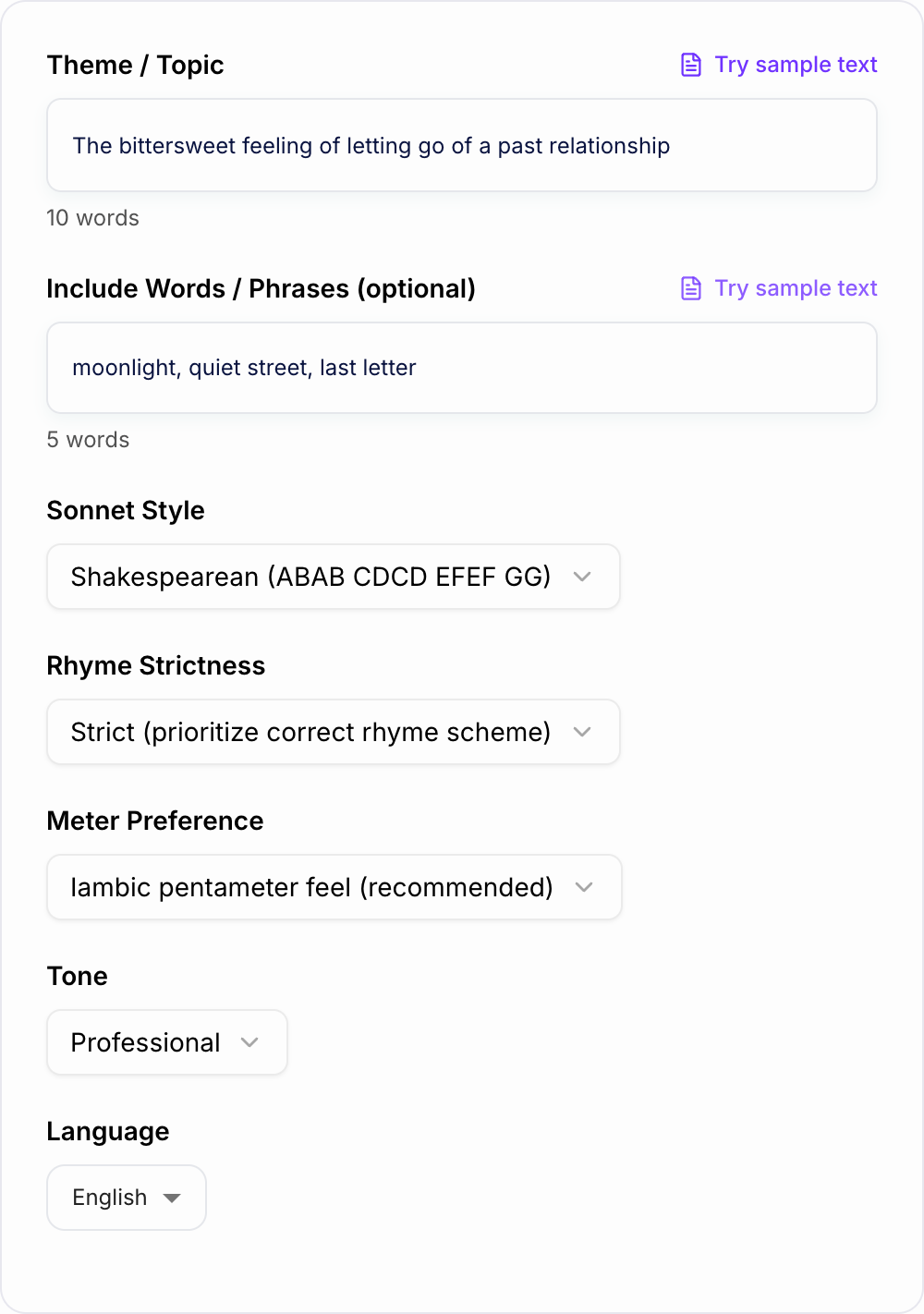
Write a Shakespearean sonnet about letting go of someone with gratitude instead of bitterness. Tone: tender, restrained. Keywords: last letter, morning light, open road. Rhyme: balanced. Meter: iambic-ish.
That prompt tells the generator the emotional arc: the poem should move from loss toward release. It also gives concrete images and a style choice, which helps the final couplet land with more intention.
Editing the Generated Sonnet So It Feels Yours
Do a short revision pass:
- Replace vague verbs with more precise ones.
- Cut any image that feels decorative but does not serve the theme.
- Strengthen the volta with a hinge word such as "yet," "but," or "still."
- Rewrite the final couplet or closing lines if they repeat the opening.
- Read the poem aloud to catch stiff rhythm.
For longer writing projects, poetry prompts, or content that needs to become captions, posts, or polished copy, you can keep drafts organized in Junia AI while you revise the poem into its final form.
Final Checklist Before You Use the Sonnet
Tick these before the output leaves your machine. A fluent miss is still a miss.
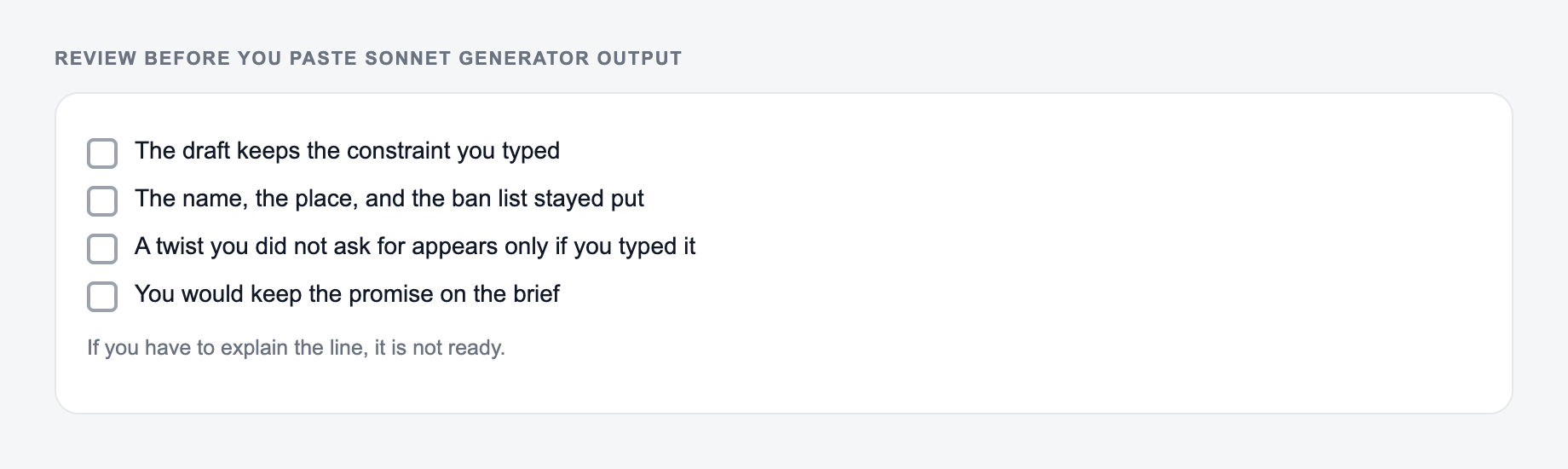
Before sharing or submitting the generated poem:
- The form matches the assignment or intended style.
- The volta is visible.
- The rhyme does not sound forced.
- The imagery is specific.
- The final lines add something new.
- The poem has been edited for your voice.
The generator can give you a strong sonnet draft quickly. The final polish comes from choosing the best lines and making the ending feel earned.
Frequently Asked Questions
What is a sonnet (and how many lines is it)?+
A sonnet is a 14-line poem with a structured progression of ideas. Traditional forms often use a set rhyme scheme and include a “volta” (a turn) where the poem shifts in argument, emotion, or perspective.
Can this generate a Shakespearean sonnet with the correct rhyme scheme?+
Yes. The Shakespearean (English) option targets ABAB CDCD EFEF GG and ends with a closing couplet designed to resolve or twist the theme—one of the signature features of the form.
Does it write Petrarchan (Italian) sonnets too?+
Yes. The Petrarchan option follows an octave (ABBA ABBA) and a sestet with a valid rhyme pattern, with a clear volta between the two parts to mirror the classic Italian sonnet structure.
Will the sonnet be iambic pentameter?+
You can choose a meter preference. The generator aims for an iambic pentameter feel by default (natural rhythm). Strict iambic pentameter is difficult to guarantee perfectly, but the tool will prioritize a consistent cadence when selected.
Can I include specific words or names in the poem?+
Yes. Add words or short phrases you want included. The tool will weave them in naturally without forcing awkward lines whenever possible.
Is the generated sonnet original?+
The tool creates a fresh poem based on your inputs and constraints. Always review and edit if you need a distinct personal voice or if the poem is for publication or assessment.