
Free Writing Prompt Generator
Generate writing prompts for fiction, journaling, essays, poetry, screenplays, blogs, and copywriting. Choose a goal, genre, prompt type, tone, difficulty, count, length, audience, and custom ingredients to get prompts with enough structure to start writing right away.
Writing Prompts
Your writing prompts will appear here...
How the AI Writing Prompt Generator Works
Get results in seconds with a simple workflow.
Choose Your Writing Goal and Prompt Type
Select what you’re writing (creative story, journaling, blog, etc.) and choose a prompt type like character, plot, opening line, scene, or mixed for variety.
Optional: Set Genre, Tone, and Constraints
Pick a genre, set a tone, and add any constraints (POV, theme, must-include details). These settings make prompts more specific and more useful.
Generate a Prompt Pack and Start Writing
Get a list of prompts you can use immediately. Choose one, write for 10–20 minutes, and regenerate with new constraints to keep momentum.
See It in Action
See how adding a few constraints turns a vague idea into a specific, high-quality writing prompt you can start immediately.
Give me a writing prompt about a mystery.
Prompt: In a quiet coastal town, a volunteer at the local archive discovers an unopened letter dated 1979—addressed to someone who died last week. Write the opening scene in first-person POV as the narrator realizes the handwriting matches their own. Include: a ticking deadline (24 hours), a small object hidden inside the envelope, and a lie the narrator tells in the first page.
Why Use Our AI Writing Prompt Generator?
Powered by the latest AI to deliver fast, accurate results.
Genre-Based Writing Prompts (Fiction, Journaling, Blog, and More)
Generate tailored writing prompts by genre and goal—short story prompts, novel ideas, journaling questions, poetry starters, screenplay scene prompts, and blog content angles.
Multiple Prompt Types for Stronger Ideas
Choose character prompts, plot prompts, setting prompts, opening lines, conflict prompts, what-if scenarios, or mixed prompt packs to spark fresh angles and avoid repetitive ideas.
Tone and Difficulty Controls
Adjust tone (e.g., funny, dark, inspiring, professional) and difficulty (easy to hard) to match your writing level, classroom needs, or creative challenge preferences.
Constraint-Driven Prompts to Beat Writer’s Block
Add constraints like point of view, theme, setting, or must-include items to get more specific, actionable prompts—ideal for overcoming writer’s block and starting faster.
Prompt Packs with Built-In Structure
Get prompts that include a hook, setup, and clear objective—plus optional elements to include—so you can write immediately without overthinking the next step.
Pro Tips for Better Results
Get the most out of the AI Writing Prompt Generator with these expert tips.
Use constraints to generate truly unique writing prompts
Add 2–4 ingredients (setting + character + object + conflict). Constraint-based prompts reduce generic outputs and make it easier to begin drafting a scene.
Turn one prompt into a full outline in 5 minutes
After picking a prompt, write: (1) goal, (2) obstacle, (3) stakes, (4) twist, (5) ending image. This converts a writing prompt into a workable story plan.
If you’re stuck, switch prompt types instead of forcing it
Try an opening-line or dialogue starter when plot prompts feel heavy. A strong first line often unlocks character voice and direction.
For blog prompts, align to a clear reader problem
Add an audience and a practical constraint (e.g., ‘for beginners’ or ‘for busy founders’) to get blog content prompts that are easier to turn into a helpful post.
Generate fewer prompts, then iterate
A smaller prompt pack (5–10) is easier to evaluate. Refine your constraints and regenerate to get better prompts rather than scrolling endless options.
Who Is This For?
Trusted by millions of students, writers, and professionals worldwide.
Generate Writing Prompts You Can Actually Draft From
A writing prompt generator should do more than hand you a clever sentence. The best prompts remove just enough decisions that you can start writing without feeling boxed in.
Use this AI Writing Prompt Generator to create story prompts, journal questions, scene starters, opening lines, blog angles, poetry ideas, essay prompts, and copywriting exercises. Choose the goal, genre, prompt type, tone, difficulty, length, audience, and custom ingredients, then generate prompts with a clearer starting point.
If you need prompts for broader ChatGPT tasks such as marketing, SEO, research, or productivity, use the AI prompt generator. For inspiration before you narrow the format, these AI prompt examples show how prompt structure changes across different use cases.
What to Enter Into the Prompt Generator
You can leave many fields open, but the output improves when you give the tool a few useful constraints.
Strong inputs include:
- writing goal: short story, journal, blog, screenplay, poem, essay, or copy
- genre or topic area
- prompt type: character, plot, setting, conflict, opening line, scene, what-if, journal, or blog angle
- tone, such as tense, playful, reflective, eerie, practical, or hopeful
- difficulty level
- prompt length
- audience
- 2-4 custom ingredients
The ingredients box is where the prompt starts to feel original. Add a person, place, object, pressure, theme, or rule.
How to Choose Prompt Type
Choose character prompts when voice and motivation matter most. These are good for fiction, monologues, and character studies.
Choose setting prompts when you want atmosphere first. They work well for fantasy, horror, travel writing, poetry, and descriptive practice.
Choose conflict prompts when you need motion. A conflict prompt gives the draft a problem before you start explaining the world.
Choose opening-line prompts when the blank page is the problem. You can always change the line later.
Choose journal prompts when the goal is reflection, not plot. Add a time frame or emotional focus to keep the question grounded.
Choose blog-angle prompts when you need a useful content idea. Add the reader, search intent, and outcome you want the article to deliver. If the goal is a full blog workflow rather than a single idea, these AI blog writing prompts are a more focused next step.
Use Constraints Without Overloading the Prompt
A useful formula is two to four ingredients:
- who is involved
- where it happens
- what object, rule, or detail must appear
- why it matters now
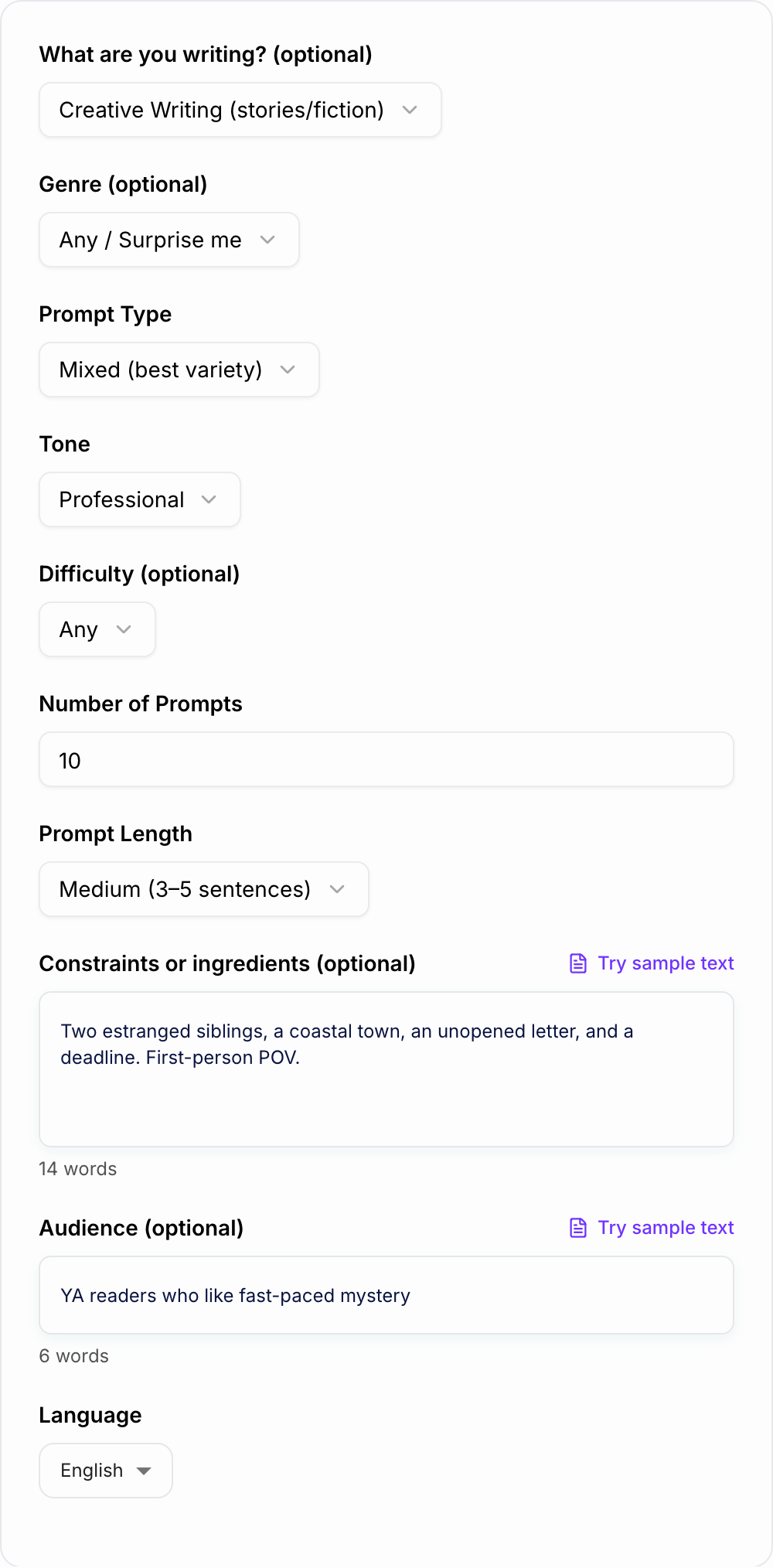
Example: two estranged siblings, a coastal town, an unopened letter, and a deadline.
That gives the generator enough material to create tension. Adding ten ingredients usually makes the prompt crowded and harder to draft.
Example Prompt Workflow
Start with this input:
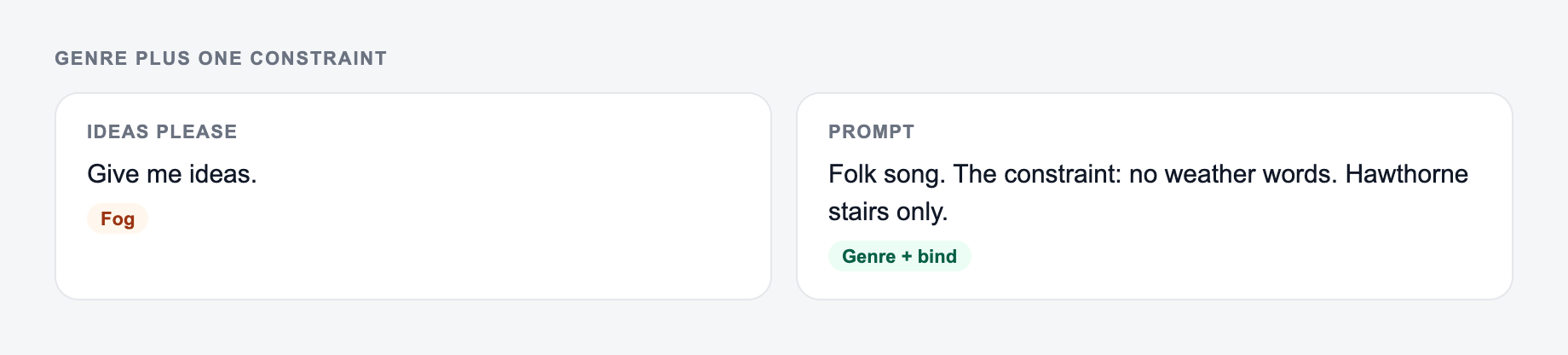
Genre plus one constraint on the form beats “give me ideas.”
A shortlist is not a decision. After the AI Writing Prompt Generator runs, pick with a boring test: can a stranger repeat the promise, and can you keep that promise on the page?
Goal: short story. Genre: mystery. Prompt type: dialogue starter. Tone: tense. Difficulty: medium. Length: medium. Constraints: one room, missing heirloom, unreliable narrator, storm outside.
After generating, do not browse every result for the perfect one. Pick the strongest prompt and write three quick beats:
- beginning: what the scene looks like when it starts
- turn: what changes or gets revealed
- ending: what image or decision closes the scene
Now draft for 10 minutes. The prompt has done its job if it gets words on the page.
How to Review Generated Prompts
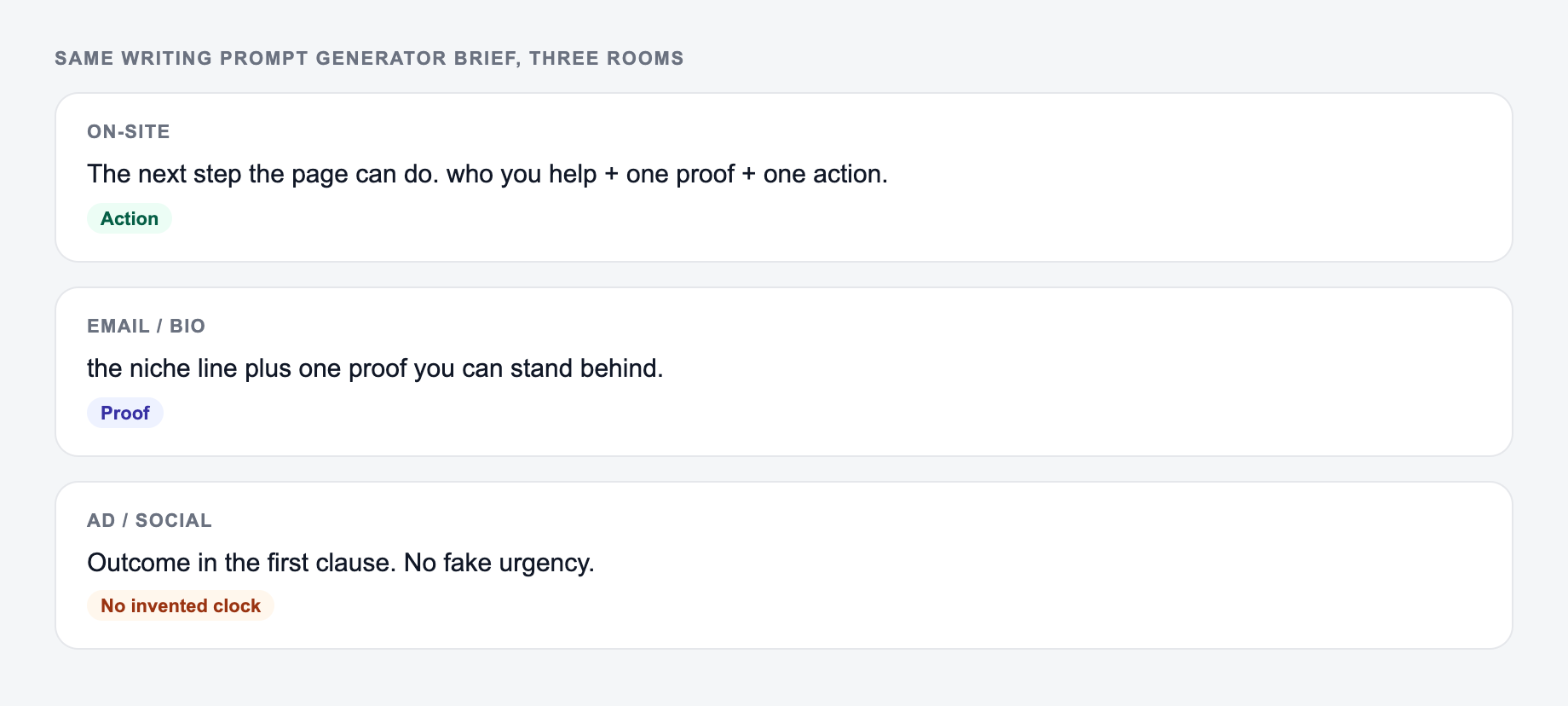
The output should change when the room changes. Synonyms across cards are a failed brief.
A good prompt should make you want to write a first paragraph. It should have a situation, tension, and a usable direction. It should not explain the whole story for you.
Reject or revise prompts that are too broad, too random, too crowded, or too dependent on a twist that does not affect the character. If the prompt feels flat, regenerate with a sharper prompt type or add one better constraint.
For blog prompts, check whether the output names a reader, a problem, and a practical outcome. A topic like productivity tips is weaker than a prompt for remote managers who need a weekly planning system their team will actually use.
Turn One Prompt Into a Bigger Writing Plan
Once a prompt works, expand it instead of generating endlessly. Ask what the main character wants, what blocks them, what changes halfway through, and what the ending image should be. For content prompts, turn the idea into a title, outline, examples, and a reader takeaway.
When you need more connected writing assets, Junia AI can help move from prompt to outline, draft, revision, and publishing workflow without losing the original angle.
Final Checklist Before You Write
Before you publish writing prompt generator output:
-
A stranger can repeat the promise
-
The page can keep that promise today
-
No number, guest, or deadline you did not type
-
The prompt has a clear starting point.
-
The tension or question is obvious.
-
The constraints are specific but not crowded.
-
The tone matches what you want to write.
-
You can write the first sentence within a minute.
-
You picked one prompt instead of collecting more.
Generate the prompts, choose quickly, and let the draft teach you what the idea can become.
Frequently Asked Questions
Is this writing prompt generator free to use?+
Yes. You can generate writing prompts for free. Some advanced modes (like extra-scaffolded writer’s block prompts or content prompt packs) may be marked as premium.
What types of prompts can I generate?+
You can generate prompts for creative writing (fiction), journaling, short stories, novels, screenplays, poetry, essays, blog content ideas, and even copywriting angles depending on your selected goal and prompt type.
How do I get more specific prompts (instead of generic ideas)?+
Add constraints (POV, setting, theme, must-include objects, time limit, audience) and choose a detailed mode. Specific ingredients produce more unique, actionable writing prompts.
Can I generate prompts in different languages?+
Yes. Choose your output language to generate writing prompts in many languages—useful for language learners, multilingual creators, and international classrooms.
Can I use these prompts for a book, blog, or commercial project?+
Prompts are meant to inspire original writing. You can use them as starting points for your own work, then develop your story, characters, or article with your unique voice and details.
How many prompts should I generate at once?+
For best results, generate 5–15 prompts, pick your favorite 1–3, then regenerate with tighter constraints. This balances variety with specificity.