
6 Best Rytr Alternatives in 2026: Which AI Writer Should You Switch To?

Yi
SEO Expert & AI Consultant

Rytr is still useful if you want a fast, low-cost AI writer for short copy. I would not call it broken. When I test tools in this category, Rytr still feels good for quick prompts, low-stakes drafts, and "just get me unstuck" moments. The problem is that many writers outgrow it once they need research, SEO structure, brand controls, workflow automation, or cleaner long-form editing.
That is the real search intent behind "Rytr alternatives." Most people are not looking for a random list of AI writing tools. They want to know which tool fixes the specific thing Rytr no longer handles well for them. I think that is the right way to shop in this category: start with the friction, then choose the tool.
So the comparison below sorts the best Rytr alternatives by use case, not just by feature count. That distinction matters. A tool can look stronger on a pricing page and still be the wrong fit once you put it into a real content workflow.
TL;DR: Best Rytr Alternatives by Use Case
If you want the quickest answer, here is how I would choose:
| Use case | Best Rytr alternative | Why it fits |
|---|---|---|
| SEO blog posts and long-form content | Junia AI | Combines AI writing, SEO optimization, internal linking, images, and publishing workflow in one place. |
| Broad marketing copy and beginner-friendly templates | Writesonic | Good for teams that want templates, article generation, and SEO-adjacent workflows without starting from scratch. |
| Campaign copy and GTM workflows | Copy.ai | Better fit for sales and marketing teams creating repeated assets across emails, ads, social, and outreach. |
| Rewriting and polishing existing drafts | QuillBot | Stronger than Rytr for paraphrasing, grammar, clarity, and sentence-level cleanup. |
| Research-led SEO briefs and outlines | Frase | Better when the bottleneck is SERP research, content briefs, and optimization rather than raw drafting. |
| Brand consistency at team scale | Jasper | More useful for larger marketing teams that need brand voice, collaboration, and governance. |
My simple recommendation: choose Junia AI if your main job is publishing SEO content, Copy.ai if you are building repeatable marketing campaigns, QuillBot if you mostly rewrite existing text, and Jasper if your team needs brand control more than cheap output. I would not overthink this part; the wrong fit usually becomes obvious within one real project.
For AI Search, the same rule applies: pick the tool that helps you produce specific, well-structured, source-supported content that is easy to summarize. A cheap generator is fine for quick copy, but it will not fix thin comparisons, vague claims, or unsupported recommendations.
Why Look Beyond Rytr?
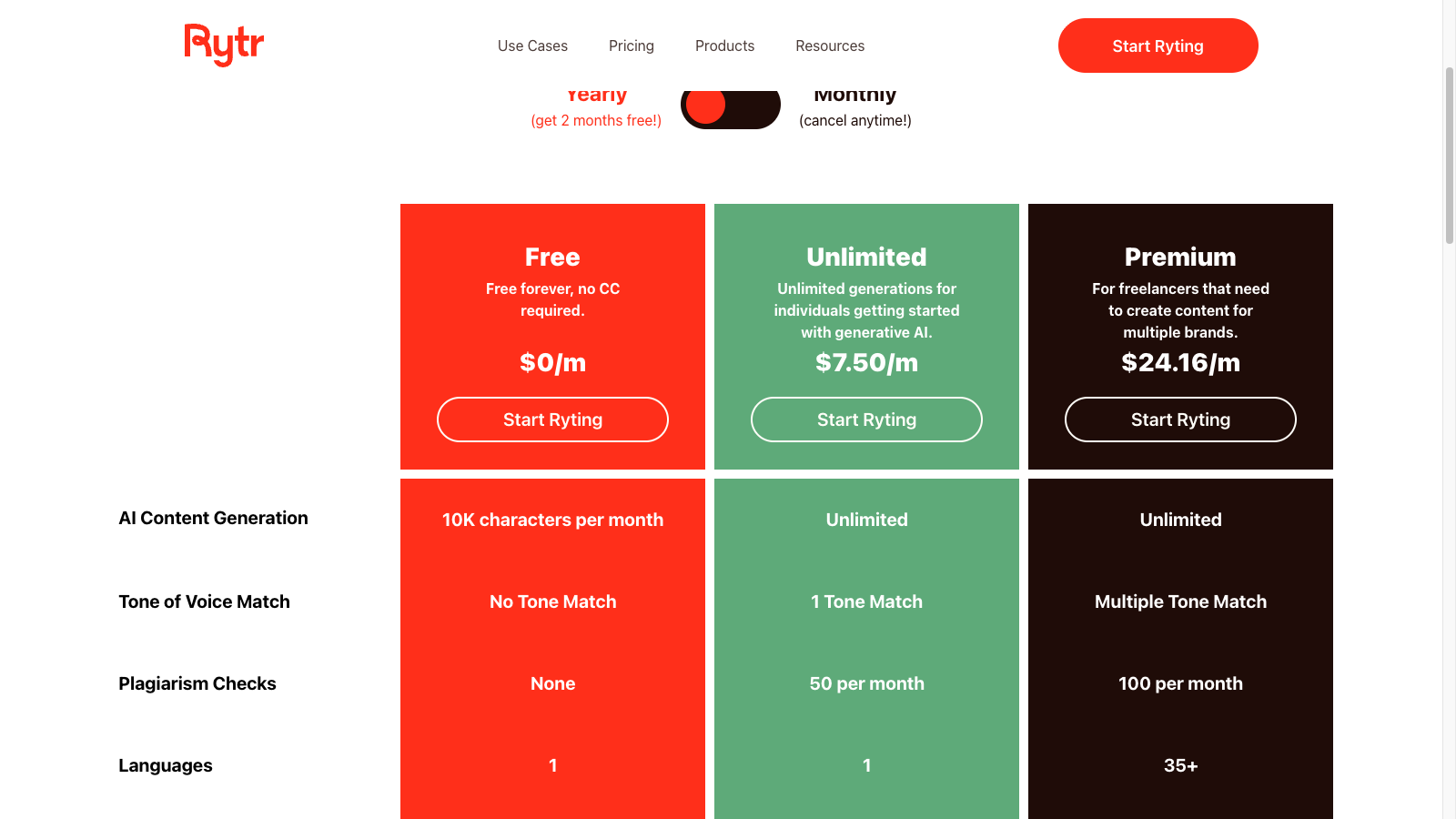
Rytr's strength is simplicity. You choose a use case, add a prompt, pick a tone, and get copy quickly. According to Rytr's own pricing page, it still positions itself around affordability, with a free plan capped at 10K characters per month and paid plans positioned around unlimited generation as of June 2026.
That makes Rytr attractive for:
- Short social posts
- Product descriptions
- Email drafts
- Simple blog sections
- Idea generation
- Quick rewrites
The tradeoff is workflow depth. Rytr can help you produce text, but it does not really solve the full content process: research, content strategy, SEO briefs, internal links, brand consistency, fact checking, publishing, or content refreshes. That is where I usually see the honeymoon period end. The tool still works, but the surrounding work starts piling up.
That matters more now because AI content is no longer impressive by default. Google's guidance on generative AI content says AI can help with research and structure, but content created at scale without added value may run into scaled-content-abuse problems. In practice, the tool is only part of the process. The real advantage comes from better inputs, better editing, and a stronger publishing system. I have found this is where lightweight writers start to feel expensive: not in the monthly price, but in the cleanup time.
What to Look for in a Rytr Alternative
Before comparing tools, decide what Rytr is failing to do for you. Otherwise, it is too easy to replace one generic AI writer with a slightly shinier generic AI writer.

| Choose this if… | Better fit | Skip if… |
|---|---|---|
| SEO articles + publishing | Junia AI | You only need captions |
| Broad marketing kits | Writesonic-style suites | You want the cheapest plan |
| Stay ultra-light | Keep Rytr | You need briefs and clusters |
Don’t upgrade tools and keep the same thin prompts. The editor is still the bottleneck.
Does Google see automatically generated content as a bad thing?
| If Rytr feels limited because... | Look for a tool with... |
|---|---|
| Blog posts come out thin | Research, outline generation, SEO scoring, and long-form editing |
| Copy sounds generic | Brand voice controls and reusable style guidance |
| You publish at scale | CMS integration, content calendars, internal linking, and workflow automation |
| You write for search | Keyword clustering, SERP analysis, meta support, and content optimization |
| You already have drafts | Rewriting, grammar, readability, and human editing tools |
| You work with a team | Roles, collaboration, approvals, shared knowledge, and brand governance |
I would avoid choosing the tool with the longest feature list. Most AI writing platforms now claim templates, brand voice, and SEO. The better question is: where does the tool sit in your actual workflow? If you cannot picture when you would open it and what step it replaces, the feature probably will not matter.
Pricing belongs in that decision, but it should not be the whole decision. A low monthly plan is not really cheap if the output needs heavy rewriting, separate SEO research, manual formatting, and another tool for publishing.
That workflow-fit problem shows up in public tool discussions too: users often separate Rytr's speed from the deeper context, technical writing, and blog-production needs that push them toward alternatives.
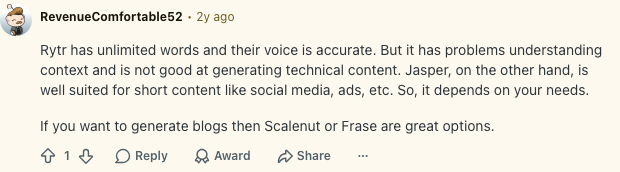
Source: a public r/WritingWithAI discussion about Jasper versus Rytr for writing tasks.
1. Junia AI: Best Rytr Alternative for SEO Content
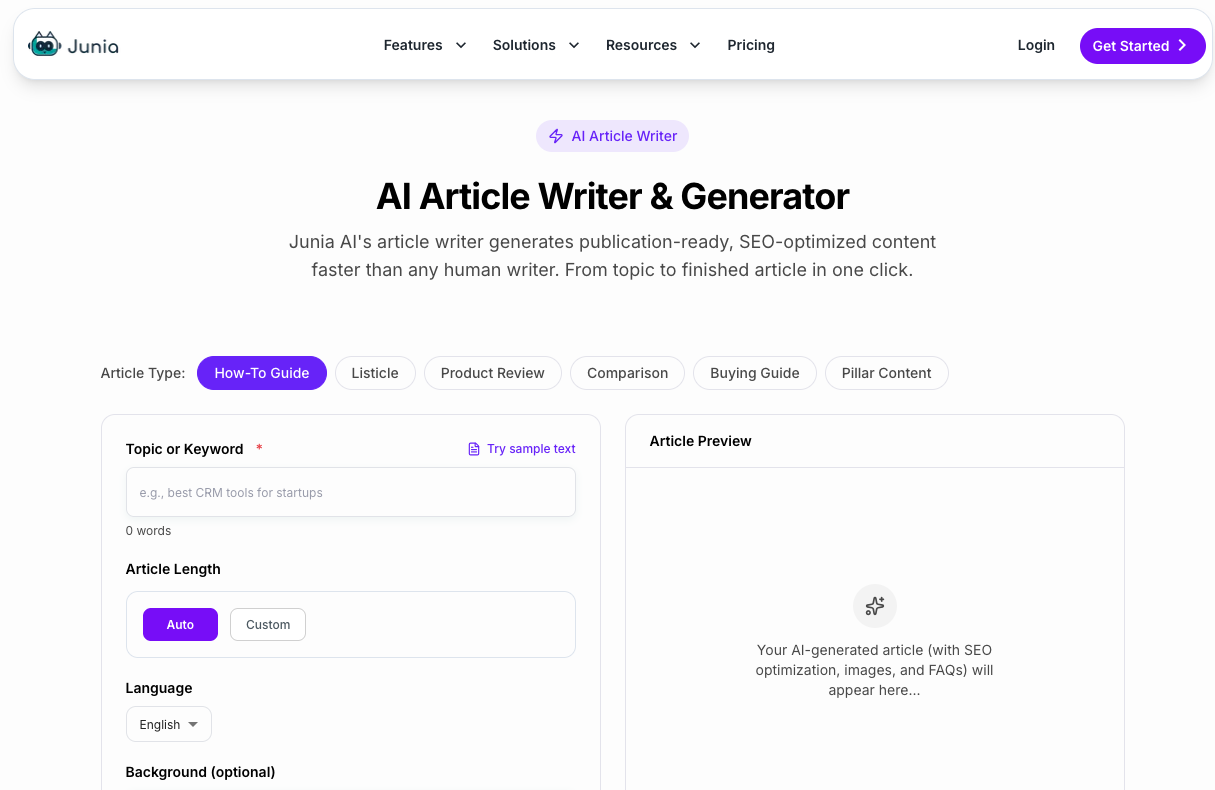
Junia AI is the strongest Rytr alternative if your goal is to publish search-focused content rather than generate isolated snippets. Personally, this is the switch I would make when the work has moved from "write me a paragraph" to "help me ship a page worth ranking." I care less about the first draft in that situation and more about whether the tool helps the article survive editing.
Rytr can help you write a section. Junia is built closer to the whole SEO content workflow: planning, writing, optimizing, adding visuals, improving internal links, and publishing. That makes it a better fit for bloggers, SaaS teams, affiliate sites, ecommerce brands, and content teams that care about organic visibility.
Where Junia Beats Rytr
Junia's biggest advantage is that it treats content as a publishing system, not just a prompt box. That sounds like a small distinction until you are building more than one article a month.
For example, if you are writing a product comparison or blog post, you usually need more than a draft. You need a useful structure, a clear search intent match, natural internal links, image support, metadata, and a final editorial pass. A dedicated AI article writer is more useful here than a lightweight copy generator because it is designed around long-form publishing rather than short-form ideation.
Junia is also stronger when SEO context matters. You can build articles around keyword intent, support the draft with internal and external links, and use related content workflows without stitching together five separate tools. For teams using AI to scale blog output, that difference matters more than having one more social caption template.
Best For
Choose Junia AI if you:
- Create SEO blog posts, product-led content, or long-form guides
- Want help with structure, optimization, images, and publishing
- Need a more complete workflow than Rytr's text generator
- Care about AI Search visibility, internal links, and content quality
- Want a tool that can support both writing and editorial cleanup
Main Limitation
Junia is more workflow-oriented than Rytr. If all you need is a cheap tool for a few short captions per week, Rytr may feel faster. Junia makes more sense once content quality, SEO, and publishing consistency are the real bottlenecks.
2. Writesonic: Best for Broad Marketing Content
Writesonic is one of the easier Rytr alternatives to understand because it covers many of the same jobs: blog intros, ads, product copy, social posts, landing-page copy, and longer drafts. I see it as the most natural upgrade for someone who likes Rytr's template-led feel but wants more room to grow, especially if they are not ready for a heavier team platform.
The main difference is scope. Rytr is lightweight. Writesonic has moved toward a broader content and AI-search platform, with pricing and features that reflect a more mature marketing workflow. That can be useful if you want one tool to handle more of the research and production process, but it can also feel heavier than Rytr. I would test it with a real campaign brief before assuming the extra structure is a win.
Where Writesonic Beats Rytr
Writesonic is better when you want more guided content creation. Instead of relying only on quick prompts, you can work through templates and article workflows that give the output more structure.
It is especially useful for:
- Blog drafts
- Product descriptions
- Landing-page sections
- Ad copy
- Search-focused content workflows
- Teams that want more than a bare writing assistant
If Rytr feels too simple but Jasper feels too enterprise-heavy, Writesonic sits somewhere in the middle. That middle ground is useful, but only if you actually want the extra structure.
Main Limitation
Writesonic's feature set can be more complex than Rytr's. If your main priority is speed and low cost, you may not use enough of the platform to justify switching. It is better for marketers who want research, drafting, and optimization in a more structured environment.
3. Copy.ai: Best for Campaigns and Sales Copy
Copy.ai is a better Rytr replacement if your writing work is tied to campaigns rather than standalone content. In my experience, this is where quick-copy tools start to strain: one asset is easy, but keeping a whole campaign consistent is harder.
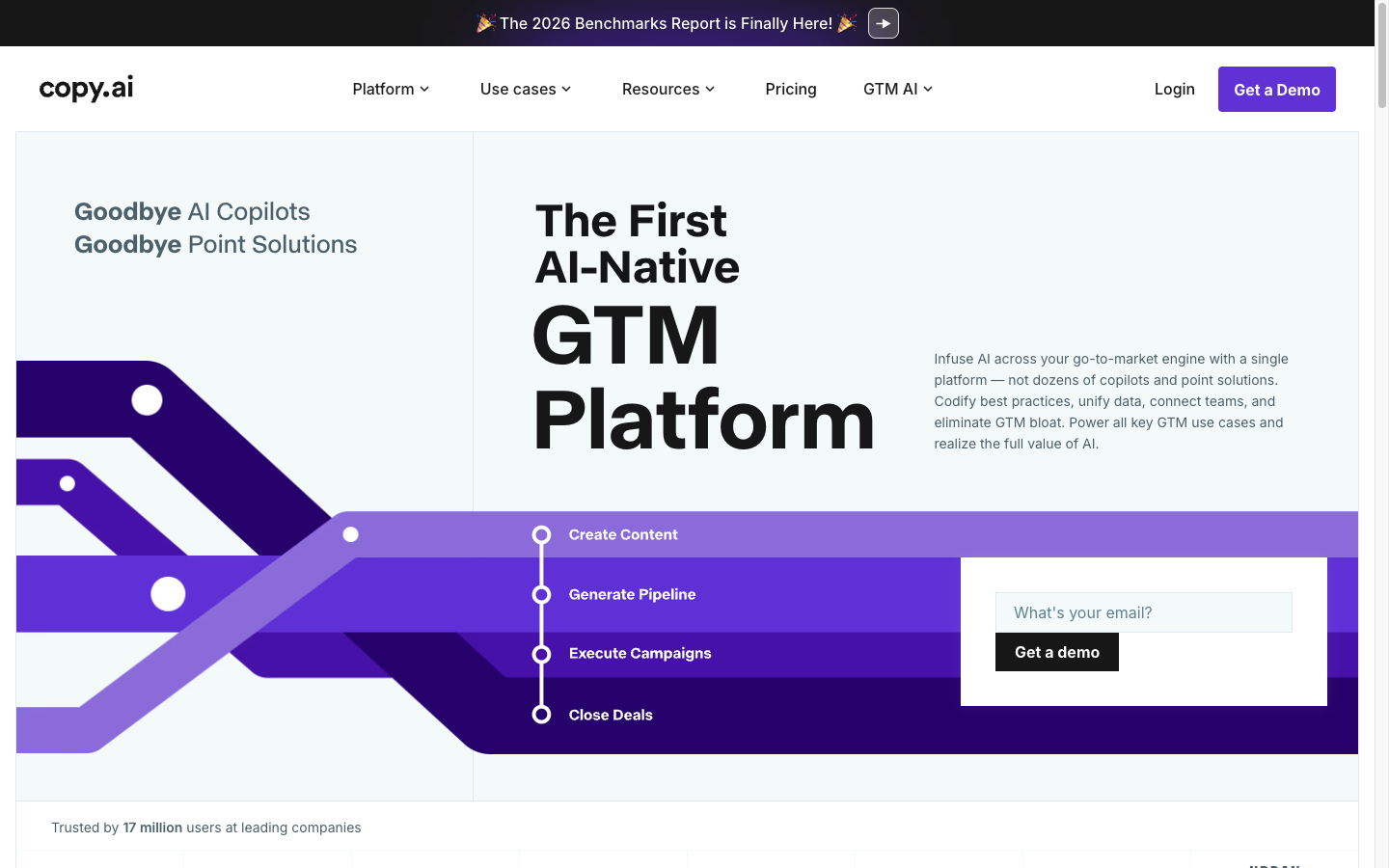
Rytr is useful for quick copy. Copy.ai is more focused on go-to-market workflows: sales emails, outbound sequences, campaign assets, product messaging, ad variations, and repeated marketing tasks. That makes it more useful for teams that need copy across many channels.
Where Copy.ai Beats Rytr
Copy.ai is stronger when you need repeatable workflows. For example, a team launching a product may need:
- Announcement emails
- Social posts
- Ad variations
- Landing-page copy
- Sales outreach
- Follow-up sequences
Rytr can generate each piece one at a time. Copy.ai is better suited to turning one brief into a set of related assets. That is the difference I care about most: not whether the tool can write an email, but whether it can keep the email, landing page, and follow-up sequence pointed at the same message.
Main Limitation
Copy.ai can be overkill for a solo writer who just wants blog sections or rewrites. It makes the most sense when copy production is part of a larger sales or marketing process.
4. QuillBot: Best for Rewriting and Polishing
QuillBot is not a direct Rytr clone, and that is why it belongs on this list. I would not use it to plan a serious content program, but I would absolutely keep it in the editing stack.
If your issue with Rytr is that the output needs too much editing, QuillBot may be a better companion than a replacement. It is built around paraphrasing, grammar checking, summarizing, and improving sentence clarity. That makes it less exciting than a full AI writer, but often more practical for messy drafts. I like it most when the thinking is already there and the sentence-level texture just needs help.
Where QuillBot Beats Rytr
Rytr helps create new text. QuillBot helps improve text you already have.
That makes QuillBot useful for:
- Rewriting awkward AI-generated paragraphs
- Cleaning up grammar
- Simplifying dense sentences
- Adjusting tone
- Summarizing notes
- Helping non-native English writers polish drafts
I would use QuillBot after a draft exists, not as the main tool for planning a content strategy.
Main Limitation
QuillBot does not replace a full AI writing or SEO content platform. It will not build a content calendar, plan internal links, research search intent, or write a complete article workflow for you. It is best as a refinement tool.
5. Frase: Best for SEO Briefs and Content Research
Frase is a strong Rytr alternative when your real problem is not writing speed, but SEO research. This is a different kind of upgrade: less about generating more words, more about making sure the article is aimed at the right target before anyone starts writing. In my experience, that upstream work is where many AI-written articles either win or quietly fail.
Rytr can generate copy from a prompt. Frase helps you understand what a search page expects: topics, questions, headings, competing pages, and optimization gaps. That makes it more useful for content teams that start with SERP analysis before drafting.
Where Frase Beats Rytr
Frase is better for:
- SEO content briefs
- Competitor topic analysis
- Outline planning
- Content optimization
- Refreshing existing articles
- Matching search intent before writing
If you publish SEO content regularly, this step matters. A generic AI draft may be readable, but it can still miss the actual intent behind the keyword. I have seen plenty of AI drafts fail for that reason: polished sentences, weak search fit. Frase is designed to reduce that gap.
Main Limitation
Frase is not the most natural choice for social copy, emails, or fast creative brainstorming. It is strongest when the article needs research and optimization before writing.
6. Jasper: Best for Brand Control and Larger Teams
Jasper is best for teams that have outgrown simple AI writing and need brand consistency at scale. I would frame it less as a Rytr replacement for individuals and more as a system for teams that cannot afford scattered brand voice.
This is a different problem from Rytr's core use case. Rytr helps individuals write faster. Jasper helps teams keep many writers, campaigns, and assets aligned to the same brand guidelines.
Where Jasper Beats Rytr
Jasper is stronger for:
- Brand voice management
- Team collaboration
- Campaign assets
- Marketing departments
- Multi-channel content production
- Workflows where approvals and consistency matter
If five people are producing content for the same brand, Jasper's structure can be valuable. It helps reduce the "every draft sounds different" problem that appears when teams use disconnected AI tools. I would care about that a lot more in a marketing department than in a solo blog workflow.
Main Limitation
Jasper is usually more expensive and more involved than Rytr. I would not recommend it for someone who just wants occasional low-cost content. It makes sense when content operations are mature enough to need governance.
Rytr Alternatives Compared
| Tool | Best for | Strongest advantage | Main tradeoff |
|---|---|---|---|
| Junia AI | SEO articles and publishing workflows | Long-form content, optimization, internal links, and publishing support | More workflow than casual users may need |
| Writesonic | Broad marketing content | Templates plus more structured content workflows | Can feel heavier than Rytr |
| Copy.ai | Campaign and sales copy | Repeatable GTM workflows across channels | Less ideal for simple solo writing |
| QuillBot | Rewriting and editing | Sentence-level polish, paraphrasing, grammar, and clarity | Not a full content strategy tool |
| Frase | SEO research and briefs | SERP analysis, outlines, and optimization | Less useful for short-form creative copy |
| Jasper | Brand-controlled team content | Brand voice, governance, and collaboration | Higher cost and setup overhead |
Should You Replace Rytr or Pair It With Another Tool?
You may not need to replace Rytr completely. In fact, keeping it for the narrow job it does well can be the more sensible move. I am generally skeptical of replacing a working tool just because a newer one has a broader pitch.
If Rytr handles your short-form copy well, keep it for that job and add a specialist tool for the weak part of your workflow. For example:
- Use Rytr for quick ideas and short drafts.
- Use Junia AI for SEO articles and publishing.
- Use QuillBot or a humanizer for final tone cleanup.
- Use Frase for research briefs before writing.
- Use Copy.ai when campaign assets need to stay coordinated.
This matters because AI writing workflows often fail from unrealistic expectations. A tool that is good at quick copy is not automatically good at SEO strategy. A tool that is good at rewriting is not automatically good at publishing. Matching the tool to the job is the simplest way to avoid disappointment.
How to Test a Rytr Alternative Before Paying
Do not evaluate AI writing tools by asking each one for a generic blog post. Most tools can produce something that looks fine at first glance. The real test is what happens after the first output: how much judgment, fixing, and manual assembly does the tool leave for you? When I compare tools, the draft itself is only half the test. The editing burden tells me more.
Instead, run the same practical test across your shortlist:
- Give each tool the same real brief.
- Ask for the same output type, such as a landing-page section, product description, or blog outline.
- Check how much editing the result needs.
- Test whether the tool remembers your brand voice.
- See whether it supports your next step, such as optimization, rewriting, or publishing.
- Compare the actual workflow time, not just the generated text.
For SEO content, I would also run the draft through a stricter editorial check. Look for missing sources, vague claims, repeated points, weak headings, and paragraphs that sound polished but say very little. A good AI text detector can flag obviously synthetic patterns, but human review still matters more than a score.
Common Mistakes When Switching From Rytr
The first mistake is switching only because another tool has more features. More features do not help if they sit outside your workflow. I would rather use a narrower tool that saves one painful hour every week than a giant platform that looks impressive but adds another dashboard to manage.
The second mistake is treating the cheapest plan as the cheapest option. If a tool saves editing time, supports publishing, or prevents weak SEO drafts, it may cost less in practice than a cheaper generator that creates cleanup work. I have learned to treat cleanup time as part of the price.
The third mistake is ignoring content quality. Google's AI-content guidance is clear that automation is not the issue by itself. The issue is whether the content adds value for users. That means your process still needs research, examples, editing, and original judgment.
The fourth mistake is using a rewrite tool as a full writer. A grammar checker can clean the surface, but it will not fix a weak argument, unsupported claim, or wrong search intent.
The fifth mistake is publishing AI output without an editorial pass. If a draft feels bland, repetitive, or too smooth, use a more deliberate process for editing AI-generated text before it goes live.
Final Recommendation
The best Rytr alternative depends on the job Rytr is failing to do. That is the lens I would keep coming back to, because "better than Rytr" means different things for an SEO editor, a founder, a student, and a campaign team.
For SEO content, I would choose Junia AI because it covers more of the real publishing workflow. For short-form marketing and templates, Writesonic is a natural upgrade. For campaigns and sales copy, Copy.ai is stronger. For rewriting, QuillBot is more practical. For research briefs, Frase is the better fit. For larger brand teams, Jasper makes the most sense.
Rytr is still a good lightweight AI writer. But if you are trying to publish better content, rank in search, maintain brand consistency, or scale a repeatable workflow, the better choice is the tool that improves the whole process, not just the first draft. That is the switch I would make: from buying output to buying a better workflow.