
Global Content Marketing Strategy for Small Teams

Thu
AI SEO Specialist, Full Stack Developer

A global content marketing strategy for a small team should not start with "translate everything."
That is how teams burn through budget, ship weak localized pages, and end up with five versions of the same article that nobody owns.
The better system is simple:
- Pick a small number of priority markets.
- Audit the content that already works.
- Decide which assets deserve translation, localization, or full local creation.
- Build one editorial calendar that tracks language, owner, channel, and launch date.
- Pilot in one or two markets before scaling.
- Measure performance by market, not just globally.
This is especially important if you have a lean content team. The Content Marketing Institute's 2025 B2B research points to a familiar pressure: content teams are asked to produce more useful work while improving strategy, alignment, and measurement. Going global makes that pressure worse unless you turn the work into a system.
The goal is not to sound local in every country overnight. The goal is to build a repeatable workflow that lets a small team publish content that is accurate, searchable, culturally aware, and worth maintaining.
What Global Content Marketing Really Means
Global content marketing is the process of planning, creating, adapting, publishing, and measuring content for audiences in different countries, languages, or regions.
It is not the same as basic translation.
Translation changes the words. Localization changes the content so it fits the market. A proper global content strategy also changes the SEO research, examples, channels, calls to action, product framing, pricing references, and sometimes the content format itself.
For example, a US article about "small business accounting software" might not work in Germany if it keeps US tax examples, US pricing, English-only search terms, and US customer stories. The core topic may be useful, but the page still needs local keyword research, local examples, and a localized conversion path.
That is the balance small teams need:
| Decision | Central team owns | Local input improves |
|---|---|---|
| Brand voice | Message, tone, positioning, quality bar | Local phrasing, taboo phrases, cultural nuance |
| Content strategy | Priority topics, pillar pages, calendar, workflows | Market demand, customer objections, channel fit |
| SEO | URL structure, technical setup, internal links, measurement | Local keywords, SERP intent, competitor gaps |
| Production | Source drafts, briefs, templates, approvals | Examples, quotes, customer proof, local review |
| Measurement | Global dashboard, reporting cadence | Market-specific interpretation and next actions |
If you centralize everything, your content feels generic. If you decentralize everything, your brand fragments. Small teams usually need a hybrid model: central strategy, local validation.
Start With Market Triage
The first mistake is treating every market as equally important.
If you have a three-person team, you cannot properly localize content for 12 countries at once. You need a scoring model that tells you where to start.
Use a simple market triage table:
| Market | Search demand | Revenue potential | Localization effort | Local support | Priority |
|---|---|---|---|---|---|
| Germany | High | High | Medium | Sales rep available | Pilot |
| France | Medium | High | Medium | No reviewer yet | Next |
| Brazil | Medium | Medium | High | Partner available | Test |
| Japan | High | High | High | No local support | Later |
Score each market against five questions:
- Is there proven search demand for your main topics?
- Can this market realistically generate leads, trials, demos, purchases, or affiliate revenue?
- How much adaptation will the content need beyond translation?
- Do you have anyone who can review market accuracy?
- Can you publish and promote content in the channels people actually use there?
This keeps your strategy grounded. A market can look exciting on paper and still be a bad first pilot if you have no reviewer, no distribution path, and no way to explain the product locally.
For SEO-led teams, this is where tools such as AI keyword research help you move faster. But the final decision should still combine keyword data with business reality. A country with slightly lower search volume may be a better first market if sales already has traction there.
Audit Existing Content Before Creating Anything New
Small teams should globalize from strength.
Before you brief new content, audit the assets that already work in your primary market. You are looking for pages that have clear demand, strong conversion intent, and a topic that can travel across markets.
Sort your current content into four buckets:
| Bucket | What it means | Global action |
|---|---|---|
| Proven evergreen | Already ranks, converts, or earns links | Translate and localize first |
| High-intent product support | Helps users choose, compare, or implement | Localize examples, screenshots, pricing, CTAs |
| Local-sensitive content | Depends on laws, culture, seasonal behavior, or market norms | Rewrite with local review |
| Low-performing filler | Weak traffic, weak intent, outdated angle | Skip or refresh before localization |
This is where many teams waste time. They translate old blog posts because they are easy to move through a workflow, not because they deserve to exist in another market.
Instead, pick the smallest set of pages that can prove the strategy. For most small teams, that means:
- 3-5 high-intent blog posts
- 1 localized landing page
- 1 comparison or use-case page
- 1 local proof asset, such as a case study, testimonial, or region-specific example
If you already run a larger content operation, bulk content creation can help scale production. But the audit should come first. Automation multiplies whatever strategy you feed into it.
Build a Localization Tier System
Not every content asset needs the same level of localization.
A technical help article, a product comparison page, and a brand campaign should not go through the same workflow. One may only need accurate translation and terminology checks. Another may need full transcreation because the hook, examples, and emotional appeal do not carry over.
Use three tiers:
| Tier | Best for | Workflow |
|---|---|---|
| Tier 1: Translate and QA | Documentation, support articles, simple tutorials | Machine or AI translation, terminology check, formatting QA |
| Tier 2: Localize | SEO blog posts, product guides, landing pages | Translation plus local keywords, examples, CTAs, internal links, reviewer notes |
| Tier 3: Create Locally | Campaigns, thought leadership, legal or cultural topics | Local brief, local writer/reviewer, central brand approval |
This one decision can save a small team a lot of pain.
For example, a glossary page may be fine with Tier 1. A "best software for small businesses" page probably needs Tier 2 because search intent, competitor sets, and product expectations can differ by country. A campaign around a local holiday or regulatory change needs Tier 3.
If you use AI for translation, keep human review in the workflow for anything that affects trust, conversion, compliance, or brand perception. Tools such as bulk blog translation and multilingual workflows can speed up the first pass, but they should not be the only quality control layer for important pages.
Create One Global Content Brief Template
A global content strategy becomes much easier when every page starts from the same brief.
Your brief does not need to be long. It needs to stop ambiguity before content reaches translation, review, and publishing.
Use this template:
| Brief field | What to include |
|---|---|
| Market | Country, language, region, and audience segment |
| Search intent | What the reader is trying to understand, compare, or do |
| Primary keyword | Local keyword, not just translated English keyword |
| Secondary topics | Related questions, entities, and subtopics from local SERPs |
| Page type | Blog post, landing page, comparison, tutorial, case study |
| Localization notes | Examples to change, cultural risks, currency, units, screenshots |
| CTA | Trial, demo, signup, download, internal next step |
| Owner | Writer, reviewer, SEO owner, publisher |
| Success metric | Ranking, qualified traffic, leads, signups, assisted conversions |
The most important line is search intent. A phrase can translate neatly and still mean something different in search.
For example, people searching for "content calendar" in one market may want a free template. In another, they may expect an enterprise workflow tool. A small team should catch that before writing, not after the page fails.
Junia's content calendar generator can help turn strategy into an actual publishing plan, but the brief is what keeps each item tied to intent and market reality.
Plan the Calendar Around Capacity, Not Ambition
Your editorial calendar is the operating system for global content.
It should show more than titles and publish dates. For multilingual content, the calendar needs to track the messy middle: translation, local review, SEO QA, legal review if needed, publishing, promotion, and post-launch measurement.
At minimum, track:
- Source page or source brief
- Target market and language
- Localization tier
- Writer or translation owner
- Local reviewer
- SEO reviewer
- Publish date
- Distribution channel
- Primary CTA
- 30-day and 90-day performance checks
This also helps you avoid the classic global content bottleneck: every region waiting on the same person.
For a small team, a realistic monthly cadence might look like this:
| Week | Global team | Local reviewer | SEO/content owner |
|---|---|---|---|
| Week 1 | Choose assets and prepare briefs | Validate market notes | Check local keyword intent |
| Week 2 | Translate or draft localized versions | Review examples and terminology | Add internal links and metadata |
| Week 3 | Edit and approve | Confirm final accuracy | Run technical and on-page QA |
| Week 4 | Publish and distribute | Share in local channels | Record baseline performance |
You can scale from there. But if this cadence already looks impossible, reduce the number of markets before you reduce the quality bar.
Get International SEO Right Early
Global content does not work if search engines cannot understand which page belongs to which language or region.
| Localization tier | What you change | When it is enough |
|---|---|---|
| Translate only | Body copy | Low-stakes support pages |
| Localize | Titles, examples, CTAs, currency, proof | Pages that need to convert |
| Rebuild | Angle + evidence for the market | Competitive commercial queries |
Capacity rule: If your team cannot review a market in the local language, do not pretend a raw machine translation is “global SEO.”
Internationalization & hreflang | Search Off the Record
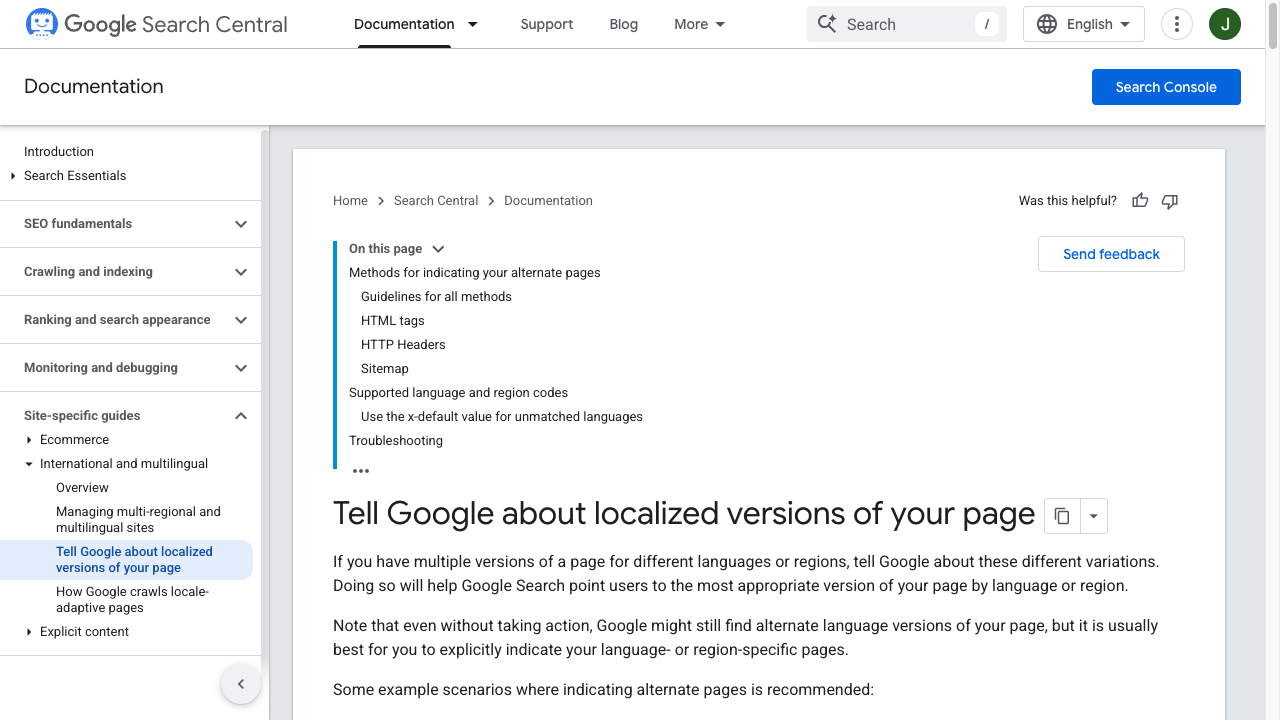
Google's guidance on multi-regional and multilingual sites is clear on the big point: if you use different URLs for different language versions, use hreflang annotations to help Google show the right version to the right users. Google also explains how to mark localized versions of your pages using HTML tags, HTTP headers, or sitemaps.
For small teams, the practical checklist is:
- Use a clean URL structure, such as
/de/,/fr/, or/es/, unless your setup has a strong reason to use subdomains or country-code domains. - Give each localized page a self-referencing canonical.
- Add reciprocal
hreflangtags between every language or region variant. - Include an
x-defaultURL when you have a global selector or default page. - Translate title tags, meta descriptions, headings, image alt text, and CTAs.
- Build same-language internal links where possible.
- Avoid sending German readers from a German article to an English-only conversion page unless there is no local option.
The last point is underrated. A localized blog post with English-only next steps creates a broken journey. If you cannot localize the whole funnel yet, be honest about the limits and choose pages where the next step still makes sense.
This is also where AI internal linking can help you map relevant next pages, especially when you are building topic clusters across languages. Just make sure internal links point readers to pages they can actually use.
Choose Channels Market by Market
Do not assume your home-market distribution playbook will travel.
In one market, organic search may be the strongest channel. In another, webinars, local newsletters, YouTube, WhatsApp groups, partner communities, or regional business networks may matter more.
Before launch, answer three questions for each market:
- Where does this audience already discover advice like this?
- Which formats do they trust most?
- Which channel can your small team maintain consistently?
That third question matters. A channel you cannot maintain becomes noise.
Use a simple distribution map:
| Market | Primary channel | Support channel | Reusable assets |
|---|---|---|---|
| Germany | SEO blog posts | Partner newsletter | Localized checklist, LinkedIn post |
| Spain | Search and YouTube | Short explainer, translated guide | |
| Brazil | Social communities | SEO | Carousel, short-form video, blog summary |
For lean teams, one strong channel plus one support channel is usually enough for a pilot. You can expand after you know the content is working.
Use Pilots Before You Scale
The strongest competitor insight on this topic is also the most practical: do not go global all at once.
Run a pilot in one or two markets first. Keep it narrow enough that your team can learn quickly and fix the workflow before multiplying it.
A good pilot might include:
- One priority market
- One language
- Five localized content assets
- One landing page or conversion path
- One local reviewer
- One 60- or 90-day measurement window
Choose pilot markets using practical criteria:
| Pilot criterion | Why it matters |
|---|---|
| Strategic value | The market can produce meaningful business results |
| Search demand | There is enough demand to evaluate SEO impact |
| Local reviewer access | Someone can catch language, cultural, and factual issues |
| Sales or customer signal | You already see leads, customers, or product interest |
| Operational simplicity | The team can publish without major platform or legal delays |
The point of a pilot is not just traffic. It is operational proof.
Can you brief the work cleanly? Can the content move through translation and review without stalling? Can the CMS handle language variants? Are hreflang tags correct? Do local examples improve engagement? Does the CTA make sense?
Once the answer is yes, you can roll the same system into the next market.
Define Roles Clearly
Small teams can run global content, but only if ownership is obvious.
You do not need a big department. You need named responsibilities.
| Role | Responsibility |
|---|---|
| Strategy owner | Chooses markets, goals, content priorities, and reporting cadence |
| Content owner | Manages briefs, source drafts, editing, calendar, and publishing quality |
| SEO owner | Handles keyword research, metadata, internal links, URL structure, and technical QA |
| Local reviewer | Checks terminology, examples, cultural fit, market accuracy, and local CTA relevance |
| Distribution owner | Adapts promotion for local channels and tracks launch activity |
One person can hold more than one role. What matters is that the role exists.
For example, a two-person team might have one person own strategy, SEO, and reporting while the other owns content, editing, and publishing. Local review can come from a contractor, partner, customer-facing teammate, or regional sales contact.
If you serve clients, the same structure works for agencies. It is also the foundation for offering multilingual SEO without more headcount: standardize the central workflow, then plug in local review where it matters most.
Measure by Market and Content Job
Global averages hide local problems.
A page can look successful globally while failing in the one market it was meant to support. Track performance by market, language, and content purpose.
For a simple dashboard, use:
| Content job | KPI | Useful metrics |
|---|---|---|
| Build awareness | Reach qualified readers | Organic sessions by country, impressions, rankings, new users |
| Capture demand | Move readers toward action | CTA clicks, demo clicks, signup clicks, scroll depth |
| Support conversion | Help buyers decide | Assisted conversions, form fills, trial starts, sales-qualified leads |
| Improve retention | Help existing users succeed | Support deflection, product adoption clicks, returning users |
Do not judge every localized page by the same metric. A glossary page, a comparison page, and a customer story do different jobs.
Also review qualitative signals:
- Are local sales teams using the content?
- Are readers clicking to the next localized page?
- Are search queries matching the intended topic?
- Are reviewers repeatedly fixing the same terminology?
- Are certain examples or formats performing better by market?
This is how your global content strategy improves. The first version gives you structure. The data tells you what to localize next.
Where AI Helps, and Where It Needs Guardrails
AI is useful for small global content teams because it reduces the repetitive parts of the workflow.
It can help with:
- First-pass translations
- Local keyword expansion
- Content brief drafts
- Metadata variations
- Internal link suggestions
- Content repurposing
- Calendar planning
- Formatting and QA checks
Junia can support several pieces of this workflow, including programmatic SEO, bulk content generation, brand voice control, and multilingual blog workflows such as automating multilingual blogging.
But AI should not be the final reviewer for important localized content.
Keep human review for:
- Legal or regulated topics
- Product claims
- Pricing and plan comparisons
- Cultural references
- Customer stories
- Sales pages
- Anything where a mistranslation could damage trust
The best small-team setup is AI for speed, structured briefs for consistency, and human review for judgment.
A Simple 30-Day Launch Plan
If you are starting from scratch, use this 30-day plan.
| Day range | Work |
|---|---|
| Days 1-3 | Pick one pilot market and define the business goal |
| Days 4-7 | Audit existing content and choose 3-5 assets |
| Days 8-10 | Run local keyword research and SERP checks |
| Days 11-14 | Create briefs and localization notes |
| Days 15-20 | Translate, localize, or draft the pages |
| Days 21-24 | Run local review and SEO edits |
| Days 25-27 | Publish, add internal links, check metadata and hreflang |
| Days 28-30 | Promote through one or two channels and record baseline metrics |
This is intentionally small. A focused launch teaches you more than a messy 30-page rollout.
After 60-90 days, decide whether to:
- Expand the market with more content
- Improve the first pages before scaling
- Add another language
- Localize more of the funnel
- Pause the market because the signal is weak
That decision should come from performance and operational learning, not from the original plan alone.
Common Mistakes to Avoid
The most common global content mistakes are predictable:
| Mistake | Why it hurts | Better approach |
|---|---|---|
| Translating every blog post | Wastes effort on weak or irrelevant assets | Start with proven pages and high-intent topics |
| Using translated keywords only | Misses local search intent | Run local keyword and SERP research |
| Publishing without local review | Creates trust and accuracy issues | Use reviewers for Tier 2 and Tier 3 content |
| Linking to English-only next steps | Breaks the reader journey | Localize the most important conversion paths |
| Measuring only global traffic | Hides market-specific failure | Report by country, language, and content job |
| Scaling before a pilot works | Multiplies process problems | Test one market, fix the workflow, then expand |
Most of these mistakes come from moving too fast without a system. Small teams can move quickly, but only when the workflow is clear enough to repeat.
Final Pre-Publish Checklist
Before you publish a localized content batch, check:
- The market was chosen for business and search reasons, not guesswork.
- Each page has a clear search intent and local keyword target.
- The content asset belongs in the right localization tier.
- Local examples, currencies, units, screenshots, and CTAs have been checked.
- Metadata is written for the target language and SERP.
- Internal links point to useful same-language pages where possible.
hreflang, canonicals, and URL structure are correct.- A local reviewer has approved important pages.
- The editorial calendar includes promotion and measurement dates.
- The dashboard can separate performance by market and language.
A small team does not need an enterprise content operation to go global. It needs discipline.
Pick the right markets. Localize the right content. Keep the workflow small enough to manage. Then scale only what proves itself.