
Multilingual SEO for Affiliate Marketing: The Practical Playbook

Thu
AI SEO Specialist, Full Stack Developer

Most affiliate marketers fight for the same English keywords.
That is why multilingual SEO is such a useful edge. You are not just translating an affiliate site into Spanish, German, French, Portuguese, or Japanese. You are finding markets where buyers still search, compare, and click, but the SERPs are not as crowded as the English ones.
The opportunity is real, but the lazy version rarely works. If you translate your best English pages word for word, keep the same product recommendations, leave prices in USD, and send everyone to the same affiliate landing page, you are not doing multilingual affiliate SEO. You are just creating thinner versions of the same page.
A stronger multilingual affiliate strategy answers three questions:
- Which language and market combinations have buying intent you can realistically rank for?
- Which affiliate offers actually work for those readers?
- How will you keep the content, links, disclosures, and technical SEO accurate as you scale?
That is the playbook this article covers.
The Quick Version
Multilingual SEO for affiliate marketing is the process of creating and optimizing affiliate content for searchers in different languages, regions, or both. The goal is to rank for localized buying-intent searches and convert readers with offers, pricing, examples, and disclosures that make sense in their market.
Here is the simple workflow:
| Step | What to do | Why it matters |
|---|---|---|
| 1. Pick markets by demand, not language size | Use analytics, Search Console, keyword tools, and affiliate EPC data to find markets with search demand and commercial fit. | A large language market is useless if the offer cannot convert there. |
| 2. Localize keyword research | Build keyword sets from how native speakers search, not from direct translations. | Buying intent changes by country, dialect, brand awareness, and product category. |
| 3. Match affiliate programs to the market | Check shipping, software availability, payout currency, cookie terms, local landing pages, and support language. | Traffic does not become revenue if the offer is wrong for the reader. |
| 4. Translate and localize the page | Adapt examples, comparisons, CTAs, currency, units, screenshots, and objections. | Readers need a local recommendation, not a foreign article in their language. |
| 5. Set up technical SEO | Use separate URLs, hreflang, localized metadata, language switchers, and same-language internal links. | Search engines need clear signals about which page serves which audience. |
| 6. Track by language and country | Measure rankings, clicks, affiliate CTR, EPC, and revenue per locale. | You scale the winners and stop funding markets that only look good on paper. |
If you already have a mature English affiliate site, this can be one of the fastest ways to expand without building a completely new niche site from scratch. If you are still building the site, multilingual SEO can also shape your content architecture from day one.
Why Affiliate Marketers Use Multilingual SEO
The obvious reason is traffic. English SERPs are crowded because every affiliate marketer can see the same high-volume keywords.
Non-English SERPs are different. You will still find strong competitors in valuable markets, but many niches have fewer detailed reviews, weaker comparison pages, outdated buying guides, and thinner product explainers. That creates room for a focused affiliate site to win.
There is also a conversion reason. CSA Research reported from its "Can't Read, Won't Buy" research that 76% of online shoppers prefer products with information in their own language. That does not mean every translated page will convert. It means language is part of trust, especially when a reader is comparing products, prices, guarantees, and risk.
For affiliate marketers, that trust shows up in practical ways:
- A Brazilian reader wants pricing, payment methods, and availability that apply in Brazil.
- A German software buyer may care more about GDPR, invoice handling, and local support.
- A Spanish-speaking reader in the United States may search in Spanish but still need US-specific products and services.
- A French reader comparing AI tools may expect different examples, tone, and compliance language than a US reader.
That is why multilingual SEO works best when it is language-led and market-aware.
Start With Markets, Not Translation
Do not begin by asking, "Which language should we translate into?"
Ask, "Where can this affiliate offer realistically earn money?"
For each market, check five things before you create content:
| Market check | What to look for |
|---|---|
| Existing audience | Countries and languages already appearing in Google Analytics, Search Console, affiliate dashboard clicks, email subscribers, or social traffic. |
| Keyword opportunity | Local search volume, difficulty, SERP quality, and buying-intent modifiers such as "best," "review," "alternative," "coupon," "pricing," and "vs." |
| Offer fit | Whether the merchant sells there, supports the language, accepts local payment methods, and has a landing page that can convert. |
| Commission reality | EPC, refund rates, payout currency, cookie duration, and country restrictions. |
| Content gap | Whether current ranking pages are thin, outdated, generic, poorly localized, or missing the specific comparison a buyer needs. |
This is where many affiliate sites get multilingual SEO wrong. They pick Spanish because it is large, German because it seems valuable, or French because it feels easy to outsource. Then they translate 100 pages and only later discover that the best affiliate programs do not support the market, the SERPs are dominated by local publishers, or the translated keywords do not match real buying behavior.
Start smaller. Pick one language-market combination and prove the economics.
For example, "Spanish" is not a market. Spanish speakers in Mexico, Spain, Colombia, Argentina, and the United States may use different words, trust different brands, expect different prices, and click different offers.
The same applies to English. A SaaS affiliate page for "best accounting software" can behave very differently in the United States, the United Kingdom, Australia, and India, even though the language is broadly shared.
Build Local Keyword Maps
Multilingual keyword research is not direct translation.
A direct translation gives you vocabulary. Local keyword research gives you demand.
Start with your English money pages, then build a local keyword map for each target language or market:
| English intent | What to localize |
|---|---|
| Best product category | Local category phrase, common modifiers, buying concerns, and whether users search in English or the local language. |
| Product review | Product name usage, review terms, local spelling, pricing terms, and refund/support questions. |
| Product A vs Product B | Local brand awareness and whether both products are available in that market. |
| Alternatives | Local competitors, regional tools, local marketplaces, and cheaper substitutes. |
| Coupon or discount | Local promo terms, currency, merchant restrictions, and seasonal sales patterns. |
Use tools like Ahrefs, Semrush, Google Search Console, Google Trends, and local SERP checks. Junia's AI keyword research tool can help you expand seed topics, but still validate the final keyword list against real SERPs.
Also check how searchers mix languages. In many niches, users keep the product name or category in English but search the problem in their own language. Software, WordPress, SEO, AI, gaming, crypto, and developer topics often behave this way.
For example, a reader may search:
- "meilleur outil SEO IA"
- "ChatGPT alternative deutsch"
- "best VPN Mexico"
- "como usar Jasper AI"
- "prezzo Shopify Italia"
Those mixed-language queries are often where affiliate intent appears first.
Choose Affiliate Programs That Can Convert Locally
Traffic is only useful if the offer converts.
Before you translate a whole content cluster, inspect the affiliate programs behind it. A program that performs well in the US may be weak in another market because the checkout, support, pricing, legal terms, or product availability creates friction.
Use this checklist before committing:
| Affiliate program factor | Why it matters |
|---|---|
| Local landing pages | Readers should not click from a Spanish article into an English-only sales page unless that is normal for the niche. |
| Product availability | Physical products need local shipping, stock, warranties, and returns. |
| Local pricing | SaaS, finance, and ecommerce offers convert better when users see familiar currency and tax handling. |
| Payment methods | Cards are not enough in every market. Local methods can affect conversion sharply. |
| Support language | A reader may understand your article but still need native-language support before buying. |
| Tracking reliability | Some networks route users to regional stores and break tracking if links are not mapped correctly. |
| Disclosure requirements | Affiliate disclosures must be understandable in the language of the page. |
For software and AI affiliate sites, this is especially important. A tool may support English prompts well but perform poorly in Japanese, Arabic, Hindi, or German. Do not recommend it in a localized guide until you know the product experience fits the audience.
If you are scaling many translated pages, create a link map before publishing:
| Source page | Locale | Affiliate destination | Notes |
|---|---|---|---|
/best-ai-writing-tools/ | English US | US landing page | USD pricing, US examples |
/es/mejores-herramientas-ia-redaccion/ | Spanish Spain | Spanish or EU landing page | EUR pricing, GDPR note |
/pt-br/melhores-ferramentas-ia-texto/ | Portuguese Brazil | Brazil-supported landing page | BRL references if available |
/de/beste-ki-schreibtools/ | German Germany | German or EU landing page | German screenshots/support if possible |
This prevents a common problem: the article is localized, but the affiliate link still behaves like the English version.
Localize the Article, Not Just the Words
Good affiliate content answers the reader's buying question. Multilingual affiliate content has to answer that question in the reader's context.
That means adapting:
- Product order and recommendations
- Pricing and currency references
- Screenshots and examples
- Local competitors and alternatives
- Units, sizes, tax, shipping, or availability
- Legal and compliance notes
- CTAs and trust language
- Affiliate disclosures
- Internal links to same-language pages
This is where AI can save time, but it still needs editorial control. You can use AI translation tools, ChatGPT translation workflows, or Junia's bulk blog translation tool to create first drafts quickly. For larger sites, a multi-language bulk translate workflow can help you process whole batches.
But do not publish the first translation without review.
For affiliate SEO, review each localized page for three things:
- Search intent: Does the page answer what local searchers expect from that query?
- Commercial fit: Are the recommended products actually available and relevant?
- Language quality: Does it sound like a native affiliate editor wrote it, not a translation layer?
If you want to scale responsibly, use a workflow like this:
| Stage | Automation can help with | Human review should check |
|---|---|---|
| Keyword expansion | Translating seed keywords, clustering topics, drafting title variants | Search intent, local phrasing, SERP quality |
| Content translation | First draft translation, metadata, image alt text | Accuracy, examples, tone, claims, affiliate links |
| Localization | Currency, examples, CTA variants, product details | Cultural fit, offer availability, legal disclosures |
| Internal linking | Suggested links and anchor text | Same-language relevance and crawl path |
| QA | Missing tags, broken links, duplicate metadata | Final publish judgment |
Junia's programmatic SEO tool is useful when your content has repeatable structure, such as "best X for Y" pages across several languages. Just keep the templates flexible enough to include local examples and editorial notes.
Get the Technical SEO Right
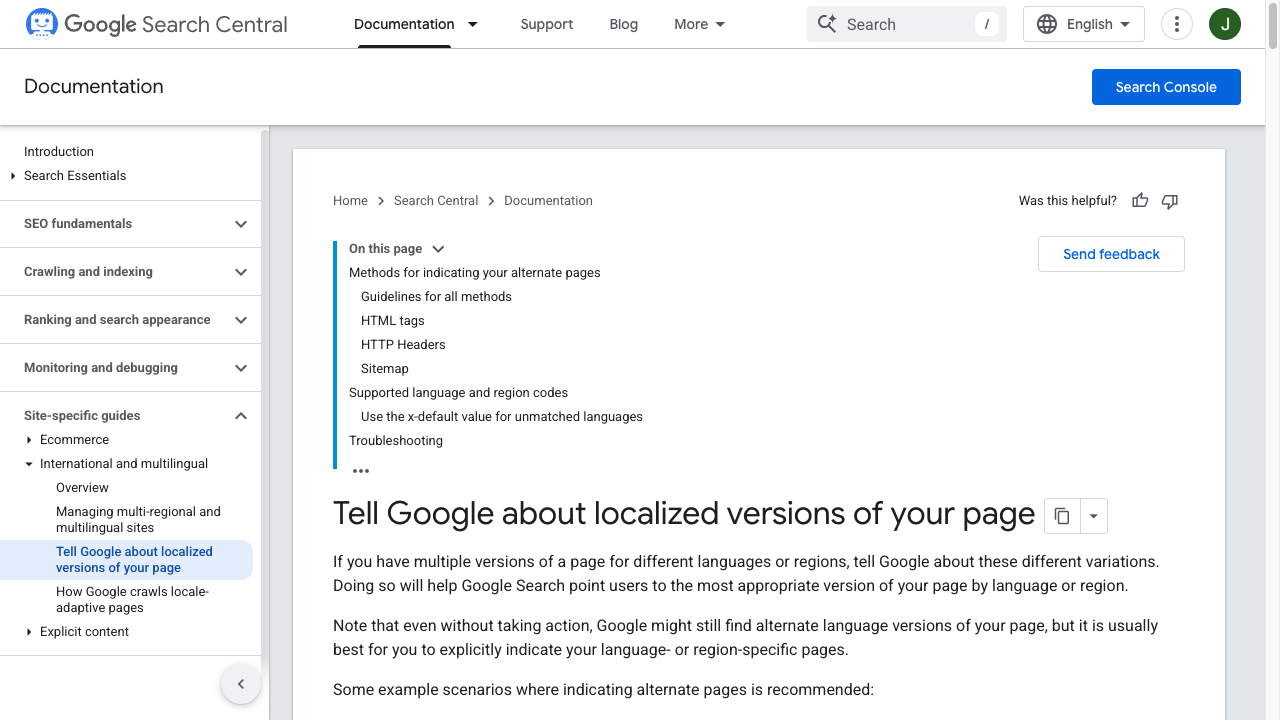
Google's multilingual guidance is clear on a few basics: use different URLs for different language versions, make the page language obvious, avoid automatic redirects that block users or crawlers, and use hreflang annotations to help Google serve the right URL to the right searcher.
| Before you translate | Pass | Fail |
|---|---|---|
| Local demand | Keyword map shows real local queries | Only English terms machine-translated |
| Offer fit | Affiliate program pays/ships in-market | Program is US-only but page targets FR |
| Intent match | Local SERP wants reviews/comparisons you can write | SERP wants local stores you cannot cover |
Markets first, language second. Translating a weak English affiliate post into five languages multiplies thin pages, not revenue.
How should I handle localized content?
For affiliate sites, the safest structure is usually subfolders:
| Structure | Example | Best fit |
|---|---|---|
| Subfolders | example.com/es/best-vpn/ | Most affiliate sites that want to keep authority on one domain. |
| Subdomains | es.example.com/best-vpn/ | Larger teams that need technical separation. |
| ccTLDs | example.de/beste-vpn/ | Brands with serious country-level operations. |
| Parameters | example.com/best-vpn/?lang=es | Usually avoid for SEO-focused multilingual content. |
Subfolders are not automatically better in every case, but they are simpler to manage for most affiliate publishers. They keep content under one domain, make internal linking easier, and avoid the operational burden of separate country domains.
Then implement the basics:
- Use one primary language per page.
- Translate title tags, meta descriptions, headings, image alt text, and comparison tables.
- Add reciprocal hreflang tags between every alternate version.
- Include an
x-defaultversion when it makes sense. - Link to alternate language versions visibly for users.
- Build same-language internal links between related guides.
- Keep canonicals self-referencing unless there is a very specific reason not to.
- Submit XML sitemaps that include localized URLs or hreflang annotations.
If hreflang is new to you, start with a dedicated guide like hreflang explained for multilingual websites. If you are scaling content across many languages, read programmatic SEO for multiple languages before you build the URL structure.
Technical setup matters more for affiliate sites than people think. If Google indexes the Spanish page but keeps showing the English page to Spanish searchers, your localized content and affiliate links do not get a fair test.
Use Same-Language Internal Links
Internal links are easy to overlook in multilingual SEO.
If you translate 50 affiliate pages into German but keep linking most of them back to English guides, the German cluster feels unfinished. Users bounce into a language they did not choose, and search engines get weaker signals about the German content hub.
A better structure is:
- German review pages link to German comparison pages.
- Spanish buying guides link to Spanish tutorials.
- Portuguese alternatives pages link to Portuguese product reviews.
- English pages still link to multilingual hubs where useful, but they do not become the default destination for every localized page.
Junia's AI internal linking tool can help surface opportunities, but you should still check the reader journey manually. Internal links should help the buyer move from problem to shortlist to decision.
Useful internal link targets for multilingual affiliate sites include:
- Bulk translating affiliate content
- AI multilingual SEO
- How Google ranks translated content
- AI website translation vs human translation for SEO
- Ranking affiliate sites with programmatic SEO
Do not force every link onto every page. Link where the next step is natural.
Make Disclosures Local and Clear
Affiliate disclosures are not just a US checkbox.
If a reader sees a recommendation and you may earn a commission, the relationship should be clear in the language the reader understands. The FTC's endorsement guidance says disclosures should be clear and conspicuous, and its examples include affiliate-link wording. Other markets have their own consumer-protection rules, so you should check local requirements before scaling serious revenue in a region.
Practically, that means:
- Put the disclosure near the affiliate content, not only on a separate legal page.
- Translate the disclosure into the page language.
- Do not hide it in a footer, tooltip, or generic "partners" page.
- Make sure comparison tables, buttons, and product cards do not imply independence if rankings are influenced by commercial relationships.
- Keep disclosure wording simple enough for a normal reader.
Example:
| Language | Simple disclosure style |
|---|---|
| English | We may earn a commission if you buy through links on this page. |
| Spanish | Podemos recibir una comisión si compras a través de los enlaces de esta página. |
| German | Wir erhalten möglicherweise eine Provision, wenn du über Links auf dieser Seite kaufst. |
| French | Nous pouvons recevoir une commission si vous achetez via les liens de cette page. |
Have a legal reviewer check your final wording for important markets. The point is not to turn every affiliate article into a legal document. The point is to make the commercial relationship understandable.
Track Revenue by Locale
Do not judge multilingual SEO by traffic alone.
Affiliate sites can get impressive traffic from a new language and still make very little money if the offer fit is weak. Track each locale separately so you can see which markets deserve more content.
At minimum, monitor:
| Metric | What it tells you |
|---|---|
| Impressions by country/language | Whether Google understands and surfaces the localized pages. |
| Click-through rate | Whether localized titles and descriptions match search intent. |
| Rankings by local SERP | Whether the page is gaining visibility in the target market. |
| Affiliate link CTR | Whether the article builds enough trust to move readers forward. |
| EPC by locale | Whether clicks are commercially valuable. |
| Conversion rate | Whether the merchant landing page works for that market. |
| Refund or cancellation rate | Whether the recommendation fits the buyer after purchase. |
This helps you avoid a common mistake: expanding into every language because traffic goes up.
Traffic is the input. Revenue is the proof.
If Spanish pages get traffic but weak EPC, the issue may be offer fit, landing-page language, payment options, or product availability. If German pages get fewer visits but strong EPC, that may be the market to double down on.
A Sensible 30-Day Launch Plan
You do not need to translate your whole affiliate site at once.
A better first test is one language, one topic cluster, and one revenue hypothesis.
| Week | Work |
|---|---|
| Week 1 | Pick one market, validate local keywords, review affiliate programs, and choose 5-10 pages to localize. |
| Week 2 | Translate and localize the pages, update product recommendations, map affiliate links, and rewrite metadata. |
| Week 3 | Implement URL structure, hreflang, internal links, language switchers, disclosures, and tracking. |
| Week 4 | Publish, submit sitemaps, check indexing, monitor Search Console, test affiliate clicks, and document fixes. |
The first cluster should include:
- One main comparison or "best" page
- Two to four product reviews
- One alternatives page
- One informational support page that helps the buying journey
For example, an AI writing affiliate site might start with:
- Best AI writing tools in Spanish
- Jasper AI review in Spanish
- Copy.ai review in Spanish
- Jasper vs Copy.ai in Spanish
- AI writing tools for Spanish bloggers
- How to use AI to write blog posts in Spanish
That is enough to test rankings, internal links, affiliate clicks, and conversions without overcommitting.
Common Mistakes
The biggest mistakes are usually boring, but they are expensive.
| Mistake | Why it hurts |
|---|---|
| Translating every page before testing one cluster | You create a large QA and maintenance burden before proving revenue. |
| Using direct keyword translations | You miss the real phrasing, search intent, and product vocabulary in the local market. |
| Keeping English-only affiliate links | Readers click into a page that breaks trust or cannot convert them. |
| Ignoring hreflang | Search engines may show the wrong page version or fail to understand alternates. |
| Linking localized pages mostly to English content | The local cluster feels shallow and sends weak topical signals. |
| Publishing AI translation without native review | Small language mistakes can damage trust in money pages. |
| Forgetting disclosure localization | Readers may not understand the commercial relationship. |
| Measuring only traffic | You scale pages that rank but do not earn. |
If you fix only one thing, fix offer fit. A beautifully localized article cannot save an affiliate program that does not support the reader's market.
Final Takeaway
Multilingual SEO gives affiliate marketers a way out of overcrowded English SERPs, but it only works when you treat each market like a real business opportunity.
Translate less at first. Localize more deeply.
Pick one market where the keywords, affiliate programs, and buyer behavior line up. Build a small cluster. Use automation to move faster, but keep human review on the parts that affect trust: recommendations, claims, pricing, disclosures, and links.
Once the first cluster earns, repeat the system in the next market.
That is how multilingual affiliate SEO becomes a revenue channel instead of a translation project.