
How Google Ranks Translated Content: What Helps and What Hurts

Thu
AI SEO Specialist, Full Stack Developer

Yes, translated pages can rank on Google.
But Google does not rank a page just because it exists in another language. A translated page has to work as a real page for that audience: the language needs to be clear, the search intent needs to match the local market, and Google needs to crawl a separate URL for that language or region.
The simplest way to think about it is this:
| Translation approach | Likely SEO outcome |
|---|---|
| Raw machine translation published at scale | Risky, especially if the pages add little value and exist mainly to capture search traffic |
| Machine translation with human review and localization | Often viable, if the final page is useful and natural for readers |
| Full localization with local keyword research, examples, metadata, and technical SEO | Best chance of ranking as a standalone page in that market |
| Browser or widget translation only | Useful for visitors, but usually not an SEO growth strategy because Google may not see separate indexable language pages |
That last distinction matters. Google can rank translated content, but only when the translated version is something Google can discover, understand, and confidently serve to searchers.
If you are planning a serious multilingual SEO program, this is where tools like Junia's bulk blog translation and blog post translator can help with production. The SEO work still comes from the review layer: choosing the right pages, adapting the content, checking the language, and setting up the multilingual signals correctly.
The Short Answer: Google Ranks Translated Pages Like Other Pages
Google's ranking systems are not looking for "translated content" as a special category that automatically wins or loses.
They are trying to show helpful, reliable, relevant pages to the searcher. For a translated page, that means Google is still judging the basics:
- Does the page satisfy the search intent in that language?
- Is the translated text clear and useful?
- Does it add enough value for the target audience?
- Is the page crawlable and indexable?
- Does Google understand which language or regional version should appear?
- Is the site publishing translations to help users, or mainly to scale thin search pages?
Google's own helpful content guidance says its systems are designed to prioritize content created for people rather than content made primarily to manipulate rankings. That applies whether the page was written originally in English, translated into Spanish, or localized into French for Canadian buyers.
So the real question is not "does Google rank translations?"
The better question is: would this translated page deserve to rank if it were the only version a reader ever saw?
Automated Translation Is Not Automatically Bad
There is a lazy answer in SEO that says: "machine translation is bad."
That is too broad.
Machine translation can be a useful first draft. Modern AI translation tools are much better than old word-for-word translation software, especially when the original article is clean, structured, and factual. I would not be afraid to use AI as part of a translation workflow.
But I would be careful about publishing the output untouched.
Google's spam policies specifically call out scaled content abuse: large amounts of content created primarily to manipulate rankings and provide little value. The examples include automated transformations such as translating or obfuscating content where little value is added.
That is the line.
It is not "AI touched this page, so it cannot rank." It is "you created lots of low-value pages for search traffic and did not make them useful."
A better workflow looks like this:
- Start with source pages that already deserve to rank.
- Translate with an AI or human workflow.
- Review the translation with someone who understands the language and topic.
- Localize terms, examples, currency, product names, CTAs, screenshots, and metadata.
- Check local search intent before publishing.
- Add hreflang and internal links so Google can understand the language set.
- Monitor each language section in Search Console after launch.
This is also why a page translated with ChatGPT for language translation can be fine if it is reviewed and improved, while a thousand untouched auto-translated URLs can become a quality problem.
What Actually Helps Translated Content Rank
Translated pages usually rank when three things line up: content quality, local relevance, and technical clarity.
If one of those is missing, the page may still get indexed, but it will struggle to earn stable search visibility.
1. The Translation Reads Like Native Content
The first quality check is obvious but often skipped: does the page sound natural?
A weak translation creates friction everywhere. The headline feels off. The examples feel imported. The CTA uses the wrong level of formality. Product terms sound technically correct but not like the words people actually search for.
That kind of page may be "translated," but it is not localized.
Good translated content usually changes:
- the title and H1 when the direct translation is awkward
- keyword phrasing to match local search behavior
- examples that depend on culture, geography, law, or shopping habits
- screenshots and product references when the interface differs by region
- currency, units, date formats, and shipping or payment details
- internal links so readers stay inside the same language section when possible
This is the difference between translation and SEO localization. If you want the deeper comparison, Junia's guide on AI website translation vs human translation for SEO is a useful companion.
2. The Page Matches Local Search Intent
This is where many translation projects fail.
The original page might rank in one country because the search intent is informational. In another market, the same topic might be commercial, local, comparison-heavy, or dominated by government and documentation pages.
For example, translating an English article about "best CRM software" into German is not enough. You still need to check the German SERP. Searchers may expect EU compliance notes, German-language support, local pricing, or different comparison criteria.
Before translating a page, I would check:
| Question | Why it matters |
|---|---|
| Do people search this topic in the target language? | Some English keywords do not have equal demand in other markets |
| Are the ranking pages articles, product pages, forums, videos, or local businesses? | The format tells you what Google thinks satisfies the query |
| Are local brands, laws, or platforms expected? | A generic translation may miss decisive details |
| Is the market more or less competitive than the source market? | A page that ranks in a smaller market may be too thin for a larger one |
| Does the article need new visuals or examples? | Translated visuals can drive image search and reader trust |
One competitor example I studied for this rewrite was a translation experiment where the author translated 50 strong Hungarian articles into English. The result was modest: some rankings and impressions, but not the easy traffic jump expected. The useful lesson is that hreflang and translation do not transfer ranking power by themselves. Competition, authority, keyword difficulty, and local intent still matter.
3. The Translated Page Adds Value Beyond the Source
A translated page does not need to become a totally different article. But it should feel intentionally prepared for its audience.
That can be as simple as:
- adding a short local example
- rewriting the intro around the target market's pain point
- replacing a U.S.-specific tool or reference with a local equivalent
- changing the comparison table to include local pricing or availability
- adding a note about how the advice changes by region
Google's helpful content guidance asks whether content provides original information, substantial coverage, and a satisfying experience. For translated content, the "original" value often comes from localization, editorial judgment, and practical market adaptation.
This is also why a good AI multilingual SEO workflow should not stop at translation. It needs keyword research, review, linking, and measurement per language.
What Hurts Translated Content in Google
Most translated-content SEO problems fall into one of these buckets.
Publishing Raw Auto-Translations at Scale
This is the highest-risk move.
If you take hundreds of articles, translate them automatically, publish them as indexable pages, and do little or no review, you are betting that Google will treat those pages as useful content. Sometimes large platforms appear to get away with aggressive AI translation, especially when they already have massive authority and user-generated content. That does not make it a clean playbook for normal sites.
For most brands, raw auto-translation creates four problems:
- the language quality is uneven
- the content does not match local search behavior
- the site suddenly adds a large block of weak pages
- users bounce because the page feels untrustworthy
The problem is not only the tool. The problem is publishing without adding value.
Translating Low-Quality Source Content
Translation amplifies whatever is already in the source article.
If the original page is thin, outdated, generic, or poorly structured, the translated page will usually inherit those problems. It may even make them worse because awkward language draws more attention to weak ideas.
Before translating, choose pages with:
- proven organic traffic or conversions
- evergreen search intent
- clear structure
- accurate information
- strong internal links
- enough depth to compete in the target market
If the source article is weak, improve it first. Then translate.
Using Widget Translation as an SEO Strategy
Browser translation and on-page translation widgets can help visitors understand a page. They are not the same as creating indexable translated pages.
Google recommends using different URLs for different language versions when you want Google Search to find and serve those versions. If the language changes only through cookies, browser settings, JavaScript widgets, or automatic redirects, Google may not crawl all variations.
So if your goal is international SEO, give each important language version its own URL.
For example:
example.com/es/guia-seo/example.com/fr/guide-seo/example.com/de/seo-leitfaden/
Then connect those pages with hreflang.
Assuming Hreflang Makes Pages Rank
Hreflang is important, but it is not a ranking booster.
It helps Google understand that a set of URLs are language or regional variants of the same page. That can help Google show the right version to the right searcher. But hreflang does not make a weak translation competitive.
Think of hreflang as routing, not authority.
If the Spanish page is poor, hreflang will not rescue it. If the Spanish page is strong, hreflang helps Google serve it correctly.
Technical Setup: How Google Understands Translated Pages
Google needs a clean technical setup to crawl and classify multilingual content.
| Helps ranking | Hurts ranking |
|---|---|
| Native-quality localization + local intent | Raw auto-translate at scale |
| Separate URLs + correct hreflang | Widget-only “translation” as the SEO plan |
| Unique local proof/examples | Cloning thin source pages into 10 languages |
Hreflang is plumbing, not a ranking boost. It helps Google serve the right language version. It does not make a bad translation useful.
Expanding your site to more languages
Use Separate URLs for Separate Language Versions
Google's multilingual site documentation recommends using different URLs for different language versions. It also warns that if content changes dynamically based on language settings, Google may not find every variation because Googlebot usually crawls without an Accept-Language header.
For most sites, subdirectories are the easiest structure:
| URL structure | Example | Best for | Tradeoff |
|---|---|---|---|
| Subdirectory | example.com/fr/ | Most multilingual blogs and SaaS sites | Simple to manage, but needs clean internal linking |
| Subdomain | fr.example.com | Separate teams or technical setups | More operational overhead |
| ccTLD | example.fr | Country-specific businesses | Strong local signal, but expensive and harder to scale |
My default recommendation is subdirectories unless you have a strong reason to use ccTLDs.
If you are comparing local and international strategies, read international SEO vs local SEO before choosing a structure. The wrong setup can make every later translation workflow harder.
Add Hreflang Correctly
Use hreflang when you have multiple language or regional versions of the same page.
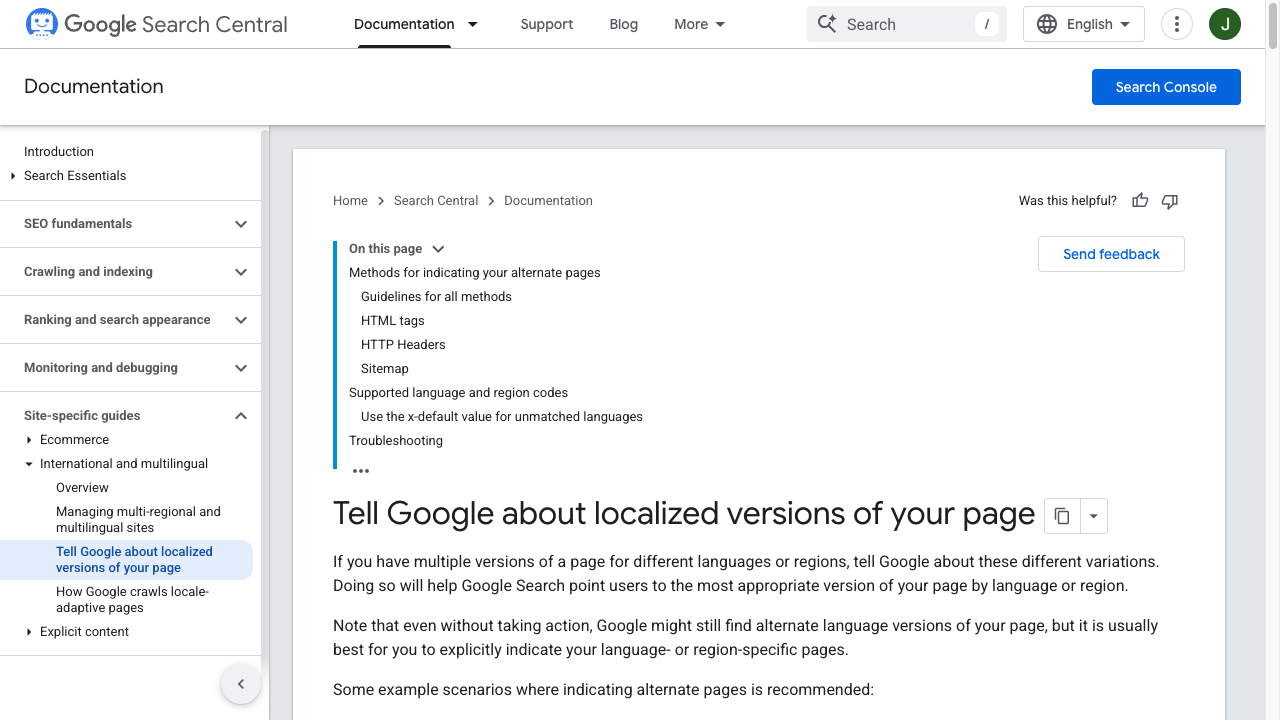
Google's localized versions documentation explains that hreflang helps Google understand these pages as localized variants. A few rules matter:
- every variant should list the other variants
- each page should include a self-referencing hreflang entry
- language codes must be valid
- use region codes only when region targeting is real
- do not use a country code alone
- add
x-defaultwhen you have a global fallback page
Example:
<link rel="alternate" hreflang="en" href="https://example.com/blog/seo-guide/" />
<link rel="alternate" hreflang="es" href="https://example.com/es/blog/guia-seo/" />
<link rel="alternate" hreflang="fr" href="https://example.com/fr/blog/guide-seo/" />
<link rel="alternate" hreflang="x-default" href="https://example.com/blog/seo-guide/" />
If hreflang is a weak spot, use Junia's hreflang guide for multilingual websites before scaling into dozens of pages.
Use Canonicals Carefully
Each translated page should usually canonicalize to itself.
Do not canonicalize every translated page back to the original English page unless you intentionally do not want the translated versions indexed. If your Spanish page has a canonical pointing to the English page, you are telling Google the English URL is the preferred version.
That is the opposite of what you want for multilingual SEO.
A typical setup looks like this:
- English page canonical points to the English URL
- Spanish page canonical points to the Spanish URL
- French page canonical points to the French URL
- hreflang connects the full set
Keep Internal Links Language-Aware
Internal links are easy to forget during translation.
If a Spanish blog post keeps linking users back to English articles, the experience feels unfinished. It also makes it harder for Google to understand the Spanish section as a strong cluster.
When possible, link from Spanish pages to Spanish pages, French pages to French pages, and so on. If you do not have a translated supporting article yet, linking to the original can still be useful, but it should be a deliberate choice.
This matters for scaled workflows like bulk translating affiliate content, where product pages, comparison pages, disclosures, and supporting articles need to stay coherent inside each language version.
A Practical Workflow for Translating Content That Can Rank
Here is the workflow I would use if I wanted translated pages to rank without creating a quality problem.
Step 1: Pick Pages Worth Translating
Do not translate everything first.
Start with pages that already have a reason to exist:
- articles with steady organic traffic
- pages that convert
- topics with clear demand in the target market
- evergreen guides that are not heavily tied to one country
- pages that can be localized without rewriting from scratch
This is the smarter version of "translate your best content." Best does not only mean highest traffic. It means highest chance of being useful in the new market.
Step 2: Check the Local SERP
Before translating, search the target keyword in the target language.
Look at the ranking formats, not just the keywords. If the SERP is full of comparison tables, your translated essay probably needs a table. If the SERP is full of official documentation, you may need clearer sourcing. If forums rank heavily, readers may want lived experience, examples, and direct answers.
This is also where you decide whether to translate, localize, or write a new article from scratch.
Step 3: Translate the Page
Use the workflow that fits your budget:
- human translation for legal, medical, financial, enterprise, or brand-sensitive content
- AI translation plus expert review for blog posts and scalable SEO content
- AI first draft plus native editor for large multilingual publishing programs
For high-volume work, Junia's guide on how to bulk translate articles is useful because the operational challenge is not just language quality. It is version control, review, formatting, metadata, and publishing consistency.
Step 4: Localize the SEO Layer
Do not only translate body copy.
Localize:
- title tag
- meta description
- H1
- subheadings
- slug
- image alt text
- internal links
- examples
- CTAs
- schema fields where relevant
If your English page targets "AI blog writer," the best Spanish phrase may not be the literal translation. Let local keyword research shape the metadata and headings.
Step 5: Add Technical Signals
Before publishing, check:
- separate indexable URL
- self-referencing canonical
- hreflang cluster
- XML sitemap inclusion
- no accidental
noindex - translated metadata
- language selector links
- same-language internal links where possible
This is the difference between "we translated the article" and "we published a multilingual SEO asset."
Step 6: Measure by Language and Region
Do not judge all translated pages as one bucket.
Track each language section in Search Console. Look at impressions, clicks, query language, indexed pages, and pages with no search traction. A translated page may fail because the language is poor, but it may also fail because the market is more competitive, the keyword is wrong, or the page is not internally linked well enough.
For a broader publishing system, pair this with how to automate multilingual blogging. Automation helps most when it is wrapped in QA, not when it replaces QA.
Should You Translate Every Article?
No.
This is one of the biggest mistakes in multilingual SEO. Translating every article feels efficient because the content already exists. But it can flood your site with pages that have no real demand in the target language.
Translate selectively.
Good candidates:
- how-to guides with international search demand
- product-led articles where the product works in that market
- evergreen educational pages
- comparison pages where the competitors also exist locally
- articles that support a cluster you are building in that language
Poor candidates:
- news posts that are already stale
- posts tied to one country's laws or prices
- thin listicles
- articles with weak source quality
- pages that only ranked because the original market had low competition
If you are trying to rank in another country, the guide on how to rank blog posts in foreign countries goes deeper into the country-level SEO side.
A Pre-Publish Checklist for Translated Pages
Use this before you let translated pages get indexed.
| Check | Pass criteria |
|---|---|
| Translation quality | A fluent reader would not know it was machine-translated |
| Search intent | The page matches the current SERP in the target language |
| Local relevance | Examples, terminology, currency, units, and CTAs fit the market |
| Metadata | Title and meta description are localized, not just translated |
| URL | The page has a clean, separate, indexable URL |
| Canonical | The translated page canonicalizes to itself |
| Hreflang | All equivalent language versions are connected correctly |
| Internal links | Links point to same-language pages where possible |
| Source quality | Claims, examples, and data still make sense in the new market |
| Measurement | The language section can be monitored in Search Console |
If a page fails several of these checks, keep it out of the index until it is fixed.
So, How Does Google Rank Translated Content?
Google ranks translated content when the translated page is genuinely useful, technically discoverable, and relevant to the searcher in that language or region.
The winning formula is not complicated:
- start with content worth translating
- adapt it for local search intent
- review the translation before publishing
- use separate URLs
- add hreflang correctly
- keep canonicals self-referencing
- build internal links inside each language section
- measure performance by market
The risky version is also simple: mass-publish raw translations and hope domain authority carries them.
That may work for some large platforms in some situations, but it is not the standard playbook I would build a business on.
If your goal is real international growth, treat translated pages like first-class content. Use AI to move faster, but let human review, local search intent, and technical SEO decide what gets published.