
How Agencies Publish 1,000+ Localized Pages Without Hreflang or Brand-Voice Chaos

Thu
AI SEO Specialist, Full Stack Developer

For agencies, multilingual SEO usually breaks in the handoffs.
The strategist creates the plan. The writer drafts the English content. The translator localizes it. The client reviews it. The developer adds metadata and hreflang. The SEO checks indexing. Then someone has to report performance by market.
That is manageable for five pages. It is not manageable for 500 pages unless the workflow is designed on purpose.
If you are still shaping the client offer, start with the playbook on offering multilingual SEO to clients without hiring more people. Once the service is sold, the delivery question becomes more practical:
How does an agency deliver localized content at scale without losing brand voice, technical SEO quality, or client trust?
The Agency Problem: Scale Creates Drift
Multilingual content gets messy because every project has more moving parts than a normal SEO campaign.
Agencies have to manage:
- Multiple languages
- Multiple reviewers
- Different CMS setups
- Local keyword research
- Translation memory and glossaries
- Metadata in every language
- Hreflang and canonical rules
- Internal links
- Client approvals
- Market-level reporting
The more pages you add, the more drift appears.
One translator uses one term for "customer success." Another uses a different phrase. One market gets localized examples. Another gets a direct translation. One developer implements hreflang correctly. Another forgets reciprocal tags. Suddenly the agency has a quality problem, not just a production problem.
Automation helps only if it reduces that drift.
A Better Model: Separate The Workflow Into Gates
The mistake is treating multilingual content as one big task called "translate and publish."
A stronger agency workflow uses gates:
| Gate | Purpose | Owner |
|---|---|---|
| Intake | Define client goals, markets, languages, and page types | Strategist |
| Research | Validate local keywords, SERPs, and competitors | SEO lead |
| Brief | Create language-specific content requirements | Content lead |
| Draft | Generate or translate the first version | Writer/AI workflow |
| Review | Check language, brand voice, claims, and terminology | Native reviewer |
| Technical QA | Validate metadata, hreflang, canonicals, schema, links | SEO/technical owner |
| Publish | Push approved pages to the correct CMS/location | CMS owner |
| Report | Measure by market, page type, and business outcome | Account/SEO lead |
This structure matters because it gives every page a clear path. It also makes automation safer. You can automate parts of a gate without removing the gate itself.
Gate 1: Intake Should Define The Real Scope
Before production starts, the agency needs to know which type of multilingual project this is.
Ask:
- Are we translating existing pages or creating new localized pages?
- Which countries and languages matter first?
- Is the client ready to serve those markets?
- Which pages affect revenue, legal claims, or brand positioning?
- Which CMS will the content live in?
- Who approves terminology and tone?
- Are there existing glossaries, style guides, or translation memories?
- What does success look like: rankings, leads, trials, revenue, or coverage?
This prevents a common agency mistake: accepting a "translate 200 pages" brief when the client actually needs market prioritization, content pruning, technical cleanup, and reviewer alignment first.
Gate 2: Research Each Market Before Translating
Direct keyword translation is not enough.
For each target market, the SEO lead should check:
- Local search volume
- SERP format
- Local competitors
- Search intent
- Regional wording
- Product-category terms
- Questions and comparison queries
- Whether Google is the main search engine
This is where localizing articles for multiple markets becomes important. Good localization starts with how the market talks about the problem, not how the source language talks about it.
The output should be a market note, not a huge research document. It should tell the production team what changes in that language.
Example:
| Market | What Changes |
|---|---|
| Germany | More formal tone, stronger privacy/security proof, careful product claims |
| Spain | Local phrasing may differ from Latin America, examples need regional review |
| Japan | More detail may be needed before the CTA, trust signals matter early |
| Brazil | Pricing sensitivity and payment context may need clearer explanation |
The point is not to stereotype markets. It is to force the team to check assumptions before translating at scale.
Gate 3: Create A Reusable Localization Brief
The brief is the control layer.
For every page type, define:
- Source URL
- Target language and country
- Primary keyword
- Secondary keywords
- Search intent
- Required internal links
- Terminology rules
- Claims that need approval
- Examples to localize
- CTA rules
- Metadata requirements
- Review level
Agencies should template this. A blog post, product page, location page, and comparison page should not use the same brief.
For example:
| Page Type | Review Priority |
|---|---|
| Blog article | Intent, terminology, internal links |
| Product page | Claims, feature accuracy, CTA, proof |
| Pricing page | Currency, payment terms, offer wording |
| Legal/compliance page | Expert review, no automated approval |
| Comparison page | Competitor accuracy, claims, regional relevance |
This is how agencies keep speed without losing control.
Gate 4: Use AI For Drafting, Not Ownership
AI is useful in multilingual production because it can remove repetitive work.
Use AI to:
- Translate first drafts
- Preserve markdown or CMS structure
- Suggest localized metadata
- Apply glossary terms
- Flag untranslated text
- Compare source and target structure
- Summarize reviewer changes
- Create content variants for review
AI tools for translation review can make this stage much faster, especially when the agency has a glossary and a clear prompt.
But AI should not be the final owner of:
- Legal claims
- Product claims
- Pricing claims
- Market positioning
- Cultural sensitivity
- Final keyword selection
- Client approval
The workflow should make this explicit. If a page is high-risk, it cannot move from AI draft to publish without review.
Gate 5: Review With A Risk-Based Model
Not every page needs the same review depth.
A risk-based model helps agencies avoid spending senior reviewer time on low-risk pages while still protecting important content.
| Risk Level | Example Pages | Review Needed |
|---|---|---|
| Low | Simple evergreen blogs, glossary pages | Light native review |
| Medium | Use-case pages, help docs, product-led blogs | Native review plus product check |
| High | Pricing, comparison, landing pages | Senior marketing and native review |
| Critical | Legal, medical, finance, compliance | Expert review |
This model also helps agencies price the work correctly. A 500-word informational blog translation is not the same service as a localized pricing page with legal implications.
Gate 6: Automate Technical SEO QA
The biggest multilingual SEO failures are often technical.
| Gate | Automate | Never skip |
|---|---|---|
| Research | SERP scrapes, keyword clusters | Local intent judgment |
| Draft | AI translation / rewrite | Brand-voice and offer accuracy |
| Tech QA | Hreflang/canonical checks | Indexing spot-checks after publish |
Scale without gates creates brand-voice chaos. Automation should enforce the checklist, not replace the reviewer.
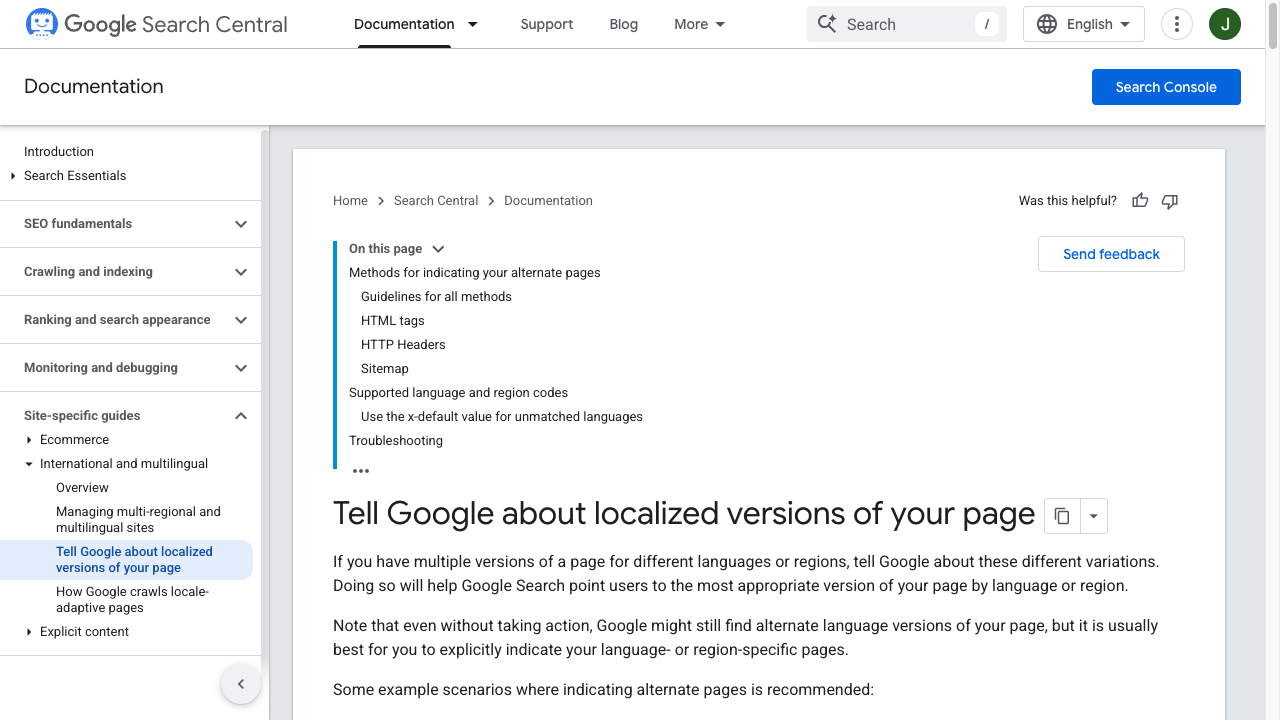
Internationalization & hreflang | Search Off the Record
Every localized page needs a QA checklist:
- Unique crawlable URL
- Correct title and meta description
- Self-referencing canonical when appropriate
- Complete hreflang alternates
- Reciprocal hreflang relationships
- Sitemap inclusion
- Localized internal links
- Valid schema
- No accidental noindex
- Correct language switcher behavior
AI-assisted localization QA workflows can help audit these checks across many pages. SEO automation tools can also standardize metadata, schema, and internal linking rules.
But the agency still needs a clear exception process. If a page fails a check, who fixes it? The translator, SEO, developer, or CMS editor? Define that before launch.
Gate 7: Centralize Publishing
Publishing should not depend on random file handoffs and Slack messages.
For large campaigns, the agency needs one source of truth. If the client needs a dedicated platform evaluation, use this guide to choosing a localized SEO platform workflow before committing to a workflow.
- Page status
- Language version
- Reviewer
- Approval stage
- CMS location
- Publish date
- QA status
- Indexing status
- Notes and blockers
The actual platform can be a project management tool, CMS workflow, spreadsheet, or custom system. The tool matters less than the rule: no page should be published if its status is unclear.
For large batches, tools like bulk translate tool for multiple languages can help process content faster, but publishing still needs gates. Bulk translation without workflow control just creates bulk cleanup.
Gate 8: Report By Market And Page Type
Client reporting should not say, "We published 1,000 pages."
That is an output, not a result.
Report performance by:
- Language
- Country
- Page type
- Topic cluster
- Indexing status
- Organic clicks
- Rankings
- Assisted conversions
- Leads or trials
- Revenue where available
This helps the agency answer better questions:
- Which markets are getting indexed quickly?
- Which language versions are stuck?
- Which page types produce leads?
- Which topics need more internal links?
- Which pages need better localization?
- Where does the client need more product or sales support?
Good reporting turns multilingual SEO from a production service into a growth system.
What Agencies Should Package As The Service
If I were packaging this as an agency offer, I would not sell "AI translation." I would choose the stack from a tool stack for multilingual SEO shortlist, then sell the controlled production system around it:
I would sell a controlled multilingual SEO production system:
- Market and keyword validation
- Localization brief creation
- AI-assisted translation or drafting
- Native-language review
- Metadata and internal linking
- Hreflang and technical SEO QA
- CMS publishing support
- Market-level reporting
- Iteration based on performance
That is a much stronger offer because it solves the client’s real problem. Clients do not just want translated words. They want international pages that can be indexed, trusted, and measured.
Common Mistakes To Avoid
Watch for these:
- Translating pages before validating search intent
- Using one glossary across markets without regional review
- Publishing translated pages with English metadata
- Linking every localized page back to English pages
- Forgetting reciprocal hreflang
- Treating all page types as the same risk level
- Reporting only page count instead of performance
- Letting AI rewrite claims without approval
- Creating local pages without local proof
- Scaling before the first market workflow works
Most of these are process problems. That is good news because process problems can be fixed.
A 30-Day Agency Rollout Plan
Here is a realistic way to start.
Week 1: Build The System
Choose one client, one market, and one page type. Create the brief template, glossary, review checklist, and technical QA checklist.
Week 2: Run A Small Batch
Translate or localize 10 to 20 pages. Do not scale yet. Track every blocker: terminology issues, CMS friction, reviewer delays, metadata problems, and hreflang errors.
Week 3: Fix The Workflow
Improve the brief, adjust the AI prompt, update glossary rules, and clarify ownership for technical fixes.
Week 4: Expand Carefully
Move to the next batch only after the first batch is indexed, reviewed, and technically clean. Add another language or page type only when the workflow can handle it.
This is slower than promising 1,000 pages immediately. It is also how agencies avoid creating 1,000 pages of cleanup. When the client needs template-led scale rather than editorial localization, the better fit is the programmatic localization playbook.
Final Takeaway
Multilingual SEO automation is not about replacing translators, SEOs, editors, or developers.
It is about giving them a workflow that can scale without losing control.
For agencies, the winning system is clear: validate the market, brief the page, use AI for the repetitive draft work, review by risk level, automate technical QA, publish through a controlled process, and report by market outcome.
That is how you deliver localized content at scale without turning brand voice, hreflang, and client reporting into chaos.