
Stop Translating: How to Rank Blog Posts in Foreign Countries

Thu
AI SEO Specialist, Full Stack Developer

If you're only targeting English-speaking audiences with your blog posts, you’re honestly leaving a lot of potential revenue on the table. The internet connects billions of people all over the world, and a huge chunk of them are right now searching for content in their own languages, not just English.
Global SEO kind of opens this whole new door for you. It gives you access to markets where the competition might be way less intense than what you see in English-speaking countries. When you rank blog posts in foreign countries, you’re suddenly in front of people who are actually hungry for good content in their language. I’ve literally seen blogs double their traffic just by expanding into like two or three extra markets. Not even that many.
The cool thing about international content marketing is how it multiplies your results. One solid, well-optimized blog post can be tweaked and adapted for several countries, and each version can rank on its own and bring in organic traffic from different regions. So you’re not just translating words. You’re kind of creating fresh chances to connect with new audiences, and sometimes they even convert better than your current readers. Which is a little wild but true.
To pull this off well, you should think about using AI for efficient multilingual SEO strategies. That kind of setup helps you get more accurate translations and better cultural sensitivity, so your content doesn’t feel weird or out of place. And it really boosts your global reach and visibility a lot.
So yeah, the question isn’t really whether you should rank in foreign countries. It’s more like how fast you can actually get started.
Understanding Global SEO and Its Role in International Content Marketing
Global SEO is basically about getting your website and content to show up in search engines for people in different countries and languages. So, instead of just trying to rank in one place, you’re thinking a lot bigger. Unlike traditional SEO that usually focuses on a single market, a global SEO strategy means you really need to understand how search engines work in different regions, and also how people there actually search for stuff online. What they type, what they expect to see, all that.
Key Components of SEO for Foreign Countries
The main pieces of SEO for foreign countries basically come down to a few things:
- Multilingual keyword research means figuring out what people actually type into search, in their own languages, not just direct translations that might sound weird
- Technical implementation is about setting up the right site structure and language signals so search engines can tell who your pages are really for
- Localized content creation is where you adjust your message so it actually makes sense and feels right in different cultures, not just copy pasted text
- Regional link building is getting backlinks from trusted websites inside your target regions, so your site looks more legit there
To handle regional link building more easily, using tools like AI-Powered Internal Linking can really help a lot. This free AI SEO tool basically lets you do internal linking without much effort by adding natural anchor links inside your content. That way you can boost your domain authority, SEO and also the user experience at the same time.
The Connection Between Global SEO and International Content Marketing
International content marketing kind of works hand-in-hand with your global SEO efforts. So, like, SEO helps your content get discovered in search engines, right? And then content marketing steps in and actually builds relationships with people in those regions by sharing helpful, culturally relevant information. Basically, you create content that talks directly to the specific pain points, interests, and questions of users in each target market. It’s very focused on what they care about.
Overcoming Challenges with AI Tools
Some of the biggest challenges you'll run into are stuff like dealing with language barriers, trying to make sense of different cultural nuances, and keeping track of all the different versions of your content. It can get kinda messy. This is where AI Article Writers really come in handy. These tools help you create high-quality content pretty fast and in a really efficient way, so you end up saving both time and resources, and honestly, a bit of stress too.
On top of that, using an AI Text Generator can make your content creation process even smoother by generating coherent, plagiarism-free text for you, almost effortlessly. You just set it up and let it do the heavy lifting.
Seizing Opportunities in Less Competitive Markets
So here’s the thing. In a lot of foreign markets, there’s actually significantly less competition than in English-speaking ones. That means you can build authority way faster and actually rank for competitive keywords that would be almost impossible to go after in crowded places like the United States or United Kingdom. And if you use an AI Bulk Content Generator, you can mass-generate ready-to-rank articles in bulk, with auto-scheduled publishing on top of that, which really boosts your productivity and helps you go after these opportunities much more easily and effectively.
Selecting Target Countries for Your Blog Posts
Before you jump into international SEO, you really have to think about your target countries selection. Just randomly translating your blog into a bunch of languages sounds cool at first, but honestly it just eats up time and money and usually does almost nothing.
Your best starting point is the Google Analytics international traffic data. Go into your Google Analytics dashboard, then click Audience > Geo > Location. There you can see which countries are already sending people to your site. But don’t just stare at the basic traffic numbers. Look at stuff like bounce rate, pages per session, and conversion rates too. Sometimes a country with not that much traffic, but super good engagement, is actually a big sign that there is a lot of hidden potential there.
When you’re trying to pick one or two markets to focus on, think about things like:
- Existing audience interest: Countries that already bring you organic traffic are showing you that people there actually want your content
- Market size and competition: Think about how many people you could possibly reach compared to how many other sites are already trying to win that same audience
- Language accessibility: Pick languages where you can get help from native speakers or professional translators who actually understand your niche and don’t mess it up
- Business objectives: Your country choice should match your revenue goals, where your product is available, or where your services can realistically be offered
- Cultural fit: Your content needs to feel right for local values and interests, not just technically translated
Honestly, you’ll usually get much better results by really owning one or two carefully chosen markets instead of trying to be everywhere in ten countries at once. Start with the places that show the strongest mix of existing interest and manageable competition. After you build up solid authority in those first target countries, then you can slowly and kind of systematically roll out into more regions later on.
Translating and Localizing Content Effectively for International Audiences
You might think translating your blog posts into another language is enough to rank in foreign countries, but honestly, that approach will probably leave you pretty disappointed with the results. Content translation is just the starting point, like step one. What you really need is full localization that turns your content into something that actually feels natural and real to your target audience on a cultural level.
So yeah, simple translation just converts words from one language to another and keeps the basic meaning. But it doesn’t really deal with cultural stuff. For example, a translator might correctly change "it's raining cats and dogs" into Spanish word for word, but that literal translation would just confuse Spanish-speaking readers, since they don’t use that idiom at all. This is where localization goes way deeper. It adapts cultural references, idioms, jokes, and examples so they match what your target audience actually knows and sees in their everyday lives.
When I localized content for the German market, I didn’t just translate it and call it a day. I replaced American football analogies with soccer examples, because that’s what German readers actually get and care about. I changed all the money examples from dollars to euros, swapped U.S.-based case studies for European ones, and even adjusted the tone so it matched German business communication, which usually feels more formal than American English. It’s small stuff sometimes, but it really adds up.
The Critical Role of Foreign Language Keyword Research
You really can't just assume that a direct translation of your English keywords is going to work in another language. It almost never lines up perfectly. Keyword research foreign language work shows that people in different cultures search in totally different ways, even when they want the exact same information.
For example, look at the English term "content marketing." In French, yeah, some people type "marketing de contenu" which is the direct translation. But a lot of others actually search for "stratégie de contenu" which kind of means content strategy, or even "inbound marketing" more often. So if you skip proper keyword research in your target language, you might end up optimizing for words that basically nobody is typing into Google.
Here's how to do effective foreign language keyword research, step by step, kind of:
- Use Google Keyword Planner with the target country and language set correctly
- Analyze competitor websites that already rank in foreign countries and see what they’re doing right
- Talk to native speakers who actually understand how people search in that market
- Check Google's autocomplete suggestions in the target language and see what pops up
- Look at the "People Also Ask" sections on search results pages in that country
I've seen blog posts that were translated really well, like grammatically perfect, but they got literally zero traffic because the author skipped this research step. The content was great, but for keywords nobody was searching for, which kind of defeats the whole point. You really need to spend time understanding how AI content generators can help with this. They can give you insights into keyword optimization and at the same time make content creation a lot faster and easier.
Structuring Your Website for International Reach: Subdomains vs Subfolders vs Country-Specific Domains
So when you’re finally ready to grow your blog and reach people in other countries, picking the right international site structure suddenly becomes a pretty big deal. It’s actually a decision that can shape your SEO performance for a long time, like years. You usually have three main choices to think about: subdomains, subfolders, and country-specific domains. Each one has its own benefits and its own annoying downsides, so you really have to look at them closely and decide what fits your situation best.
Subdomains (fr.example.com)
Subdomains treat each language or country version like its own separate thing. So Google looks at fr.example.com as different from your main domain. Kind of like a whole new site. This means:
Pros:
- Pretty easy to set up and manage using your existing hosting, nothing too wild there
- You can host different language versions on completely separate servers, which can make local loading times faster for people in that region
- The clear separation makes it simple to track analytics for each market on its own, which is nice when you want to compare stuff
Cons:
- Each subdomain starts with zero domain authority, so it has to build backlinks on its own from scratch
- You're basically creating multiple websites, which ends up needing more time, more content, more everything honestly
- Link equity from your main domain doesn’t automatically transfer over, so you don’t get that built in boost
Subfolders (example.com/fr/)
With the subfolder approach, everything stays under your main domain, and you just sort content by language or country. So like, example.com/fr/ for French, example.com/de/ for German, and so on. This setup has actually become pretty popular with international marketers lately.
Pros:
- All subfolders get the benefit of your main domain's existing authority, which is really nice long term
- It's easier to maintain since everything basically lives on one website
- Backlinks to any page end up helping your entire domain, not just that one page
- Lower setup costs compared to running and managing a bunch of different domains
Cons:
- You can't put different folders on different servers for geo-targeting, which can be limiting sometimes
- The URL structure is a bit more complex and can be a little harder for some users to understand at first
- All your content has to use the same Content Management System, so you don't get much flexibility there
Country-Specific Domains (example.fr)
Country-code top-level domains (ccTLDs) like .fr for France or .de for Germany kind of send really strong signals to search engines about who your target audience is. Basically it tells them “hey, this site is for people in this country.”
Pros:
- Strongest geo-targeting signal to search engines, so they know exactly where to show your site
- Builds trust with local audiences who usually prefer local domains and feel more comfortable with them
- You can host each domain on local servers for optimal speed, which is nice for user experience and stuff
Cons:
- Most expensive option because it needs separate domain registrations for each country
- Each domain builds authority from scratch, so you kind of start over every time
- Significantly higher maintenance burden across multiple properties, since you have to manage and update all of them separately
Implementing Technical SEO Elements That Support Global Reach
Once you've chosen your site structure, you still have to set up the technical stuff that tells search engines exactly which version of your content should show up for which audience. This part is kind of important, actually. The most critical tool in your international SEO arsenal is the hreflang tag, and knowing how to use it the right way can honestly make or break your global ranking efforts.
Understanding Hreflang Tags Implementation
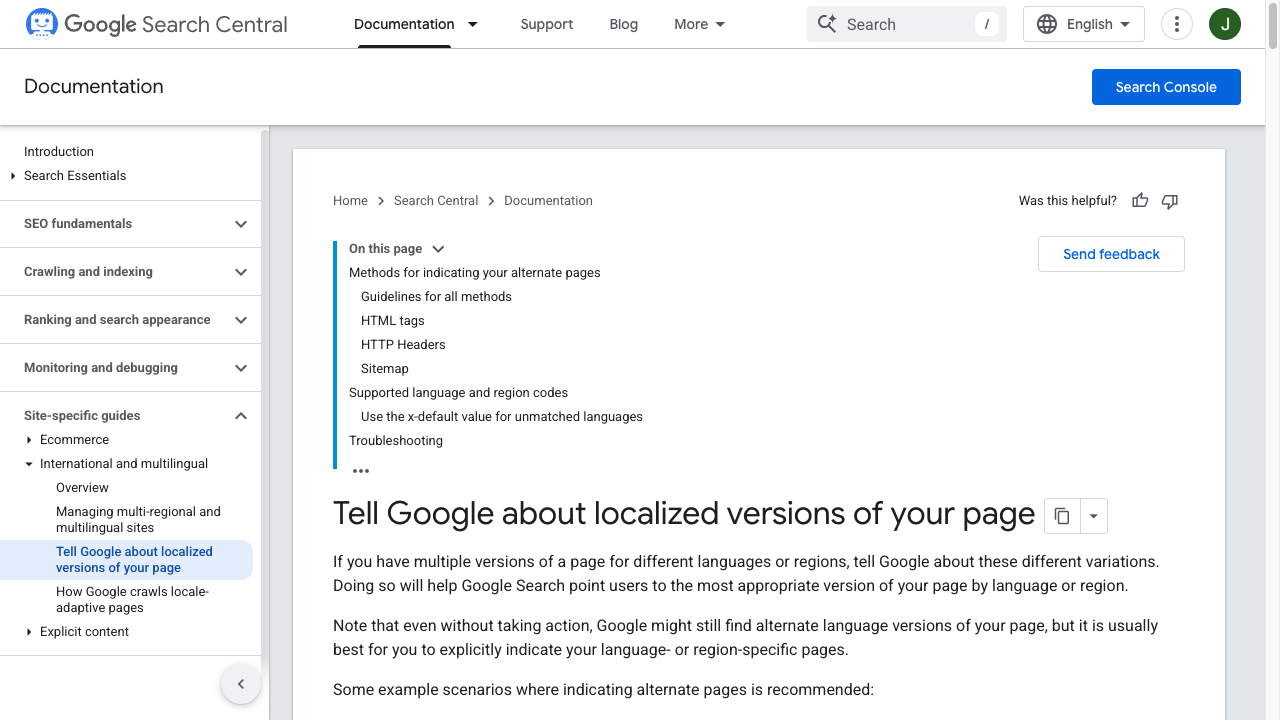
Hreflang tags are HTML attributes that tell search engines what language a webpage is in and what country or region it’s meant for. You usually put these tags in the <head> section of your HTML or in your XML sitemap. The basic syntax kind of looks like this:
| Do this | Stop doing this |
|---|---|
| Local keyword research + intent | Translating English keywords literally |
| Localize examples and proof | Shipping raw machine translation |
| Pick URL structure you can maintain | Launching ccTLDs you cannot support |
Stop translating first. Rank abroad by matching local search jobs, then localize the page.
How should I handle localized content?
html
Each page needs to reference itself and all its alternate language versions. So yeah, that means every language version needs to mention all the others. This creates a sort of bidirectional relationship between pages. Like, if your English page points to your French page, then your French page has to point back to your English page too. When I audit international websites, forgetting this reciprocal linking is honestly one of the most common mistakes I run into.
You should also include an x-default tag for users whose language settings don’t really match any of your specific versions:
html
This usually points to your default language version or sometimes a language selector page where people can pick what they want.
Preventing Duplicate Content Issues
When you make a bunch of versions of the same content for different regions, search engines might think those pages are just duplicates. And yeah, that can be a problem. This is where duplicate content prevention international SEO really starts to matter. Hreflang tags help fix this by telling Google and other search engines that these pages are meant to be different versions on purpose, not duplicate content trying to cheat or manipulate rankings.
To make sure each language version actually has unique, properly translated content, and not just a few words changed here and there, you might want to use AI-powered multilingual bulk translation tools. These tools can help you create real, culturally adapted content that actually connects with local audiences and doesn’t feel like some lazy copy paste job.
Also, it’s really important to know that thin translations or automatically translated content that hasn’t been properly localized are pretty easy for search engines to detect. They’re not fooled. A solid, comprehensive guide on how to write and localize articles in multiple languages can give you a lot of helpful tips and insights for making this kind of content the right way.
On top of that, using long-form articles can really boost your SEO work by driving more web traffic and improving user engagement. People stay longer, read more, that kind of thing.
For businesses that want to speed up their content creation process while still keeping their brand style consistent, checking out the best AI text generators available today could honestly be a game-changer.
Building Local Backlinks to Boost Authority in Foreign Markets While Ensuring Mobile Optimization for a Seamless User Experience Across All Devices
Backlinks from websites in your target country are actually super important when you're trying to rank in foreign countries. Search engines like Google use geographic signals to figure out what’s relevant and where, and links from local domains (.fr, .de, .jp) send really strong signals that your content matters to that specific market. You’ll probably notice that getting these backlinks usually has less competition compared to English-language link building, which kind of gives you a nice advantage for your international SEO efforts.
Practical Local Link Building Strategies
Guest posting on industry-relevant blogs in your target country is still one of the most effective ways to do this. You just have to find good, trustworthy websites in your niche that actually accept contributions in the local language. So yeah, spend some time researching blogs your target audience already reads, then pitch content ideas that fit their style and their editorial rules. The main thing is to give real value with your content, not just chase a link for the sake of it.
Collaborating with local influencers can also really help, since it gives you access to their audiences and their network of websites. You can offer product reviews, expert interviews, or co-created content that helps both you and them. These kinds of partnerships usually lead to natural backlinks from different places, because the influencer will share your collaboration on their platforms and sometimes even more than once.
Participating in local directories and business listings that are specific to your target country also helps you build a presence. Industry-specific directories usually matter more than general ones, so try to focus on quality instead of just signing up for every single directory you see.
Utilizing a Google Indexing Tool can also be really helpful. This tool lets you bulk submit your web pages or backlinks to search engines so they can
Engaging Your International Audience Through Community Building Efforts That Go Beyond Just Content Creation
Getting your blog posts to rank in other countries is about more than just technical optimization and writing good content. You also really need to interact with your international readers, talk to them, and build a real connection that goes beyond the language barrier and, like, feels actually human.
1. Use Social Media Targeted Advertising in Foreign Languages
Social media targeted advertising foreign languages is honestly one of the strongest tools you’ve got for building real connections. When you make ads that are clearly built for the language and cultural background of your target audience, you’re doing more than just trying to promote your stuff. You’re basically telling your readers that you get where they’re coming from and that you actually care about having them in your community.
From what I’ve seen, running Facebook and Instagram ads in the native language of your target market can seriously boost engagement compared to basic English-only campaigns. And it’s not just about switching the words to another language. You’ll want to tweak the imagery, the jokes, the tone, and those little cultural references too. Something that really clicks with people in Germany might totally miss the mark in Brazil, even if both ads are technically translated correctly.
The big thing here is authenticity. People reading from other countries can tell pretty fast if you just tossed your content into a translation tool, instead of actually taking time to understand their culture. It’s worth thinking about hiring native speakers to look over your ad copy and creative stuff before you launch anything. That extra effort usually pays off with better click-through rates and higher quality traffic coming to your blog.
2. Build Trust Through Responsive Communication
Building trust through responsive communication is really the base of any international community that actually works. When readers from Spain, Japan, or Argentina take a moment to leave comments on your blog posts, they’re kind of opening the door and inviting you into a conversation. You need to reply, and not like a week later, but pretty quickly and with some actual thought, no matter what language they’re using.
I try to respond to every comment within 24 hours. Sometimes that means I’m sitting there with translation tools open, just trying to understand and answer in a way that makes sense. You don’t have to be fluent in every language your readers speak. The big thing is that you recognize their effort, acknowledge what they said, and show real interest in what they think.
Here’s what responsive engagement looks like in real life:
- Monitor comments across all language versions of your blog every day, not just once in a while
- Use professional translation services when the topic is complicated or kind of sensitive
- Ask follow-up questions that actually invite a deeper conversation, not just “thanks”
- Share user-generated content from your international audience on your social channels so they feel seen
- Create polls and surveys in multiple languages to collect feedback from more than just one group
The relationships you build by staying consistent with this kind of engagement turn casual visitors into loyal readers who keep coming back to your blog and, even better, share your content with others.
Conclusion
Effective global SEO means you’ve got to juggle a bunch of connected strategies at the same time. You really can’t just depend on translation alone, not if you want real results. You need full-on localization plus solid technical work. The hreflang tags you set up basically tell search engines exactly which content should go to which audience, so you avoid duplicate content problems and still give people a better experience.
Your rank in foreign countries really comes down to three main things working together:
- Content adaptation: Keyword research in native languages, cultural localization, and region-specific examples
- Technical foundation: Proper site structure, hreflang implementation, and mobile optimization for varying internet speeds
- Authority building: Local backlinks from country-specific domains and active community engagement through targeted social media campaigns
All of this kind of feeds into each other. Your localized content pulls in local backlinks. Those backlinks raise your authority. Then your technical setup helps search engines show the right content to the right people at the right time. And your community engagement slowly builds loyal readers who share your content on their own, which is honestly the best part.
So yeah, start with just one or two target countries. Don’t rush it. Get these strategies working well there first before you try to go bigger. You’ll build momentum and figure out what really works for your niche in international markets.