
How to Reword Text So It Sounds Human (2026 Playbook)

Yi
SEO Expert & AI Consultant

Rewording text well is not about hiding copied material behind different words. It is about keeping the meaning, improving the delivery, and making the final version sound like a real person wrote it for a real reader.
The fastest method I have found is simple: identify the point, rewrite the sentence structure, change the tone where needed, then check the new version against the original for meaning drift. AI can speed up that process, but the final pass still needs human judgment. That is where most weak rewrites either become useful or fall apart.
TL;DR: The Best Way to Reword Text
| Step | What to do | Why it works |
|---|---|---|
| 1. Find the core idea | Write the point in plain language before editing the sentence. | You avoid swapping words without understanding the message. |
| 2. Change the structure | Break long sentences, reorder clauses, or turn passive wording into active wording. | Human-sounding rewrites usually change rhythm, not just vocabulary. |
| 3. Match the tone | Decide whether the text should sound formal, simple, persuasive, warm, or direct. | Tone control keeps the rewrite useful for the audience. |
| 4. Check meaning | Compare the rewrite with the original line by line. | This catches accidental exaggeration, missing nuance, and factual drift. |
| 5. Polish manually | Cut filler, vary sentence length, and replace generic phrases with specific details. | This is what separates a clean rewrite from obvious AI output. |
For quick sentence-level edits, Junia's AI rewording tool is useful when you already know the meaning you want to keep and need a cleaner version fast.
What Rewording Text Actually Means
Rewording means expressing the same idea in a new way. I think of it as controlled rewriting: enough change to improve the sentence, not so much that the original point disappears. A good rewrite can simplify a sentence, make it more natural, shift the tone, or adapt the wording for a different channel. It should not change the facts, invent new claims, or make the source sound more certain than it was.
Here is the practical distinction:
| Task | Meaning | Example use |
|---|---|---|
| Rewording | Changing wording while keeping the same basic idea. | Making a sentence clearer or less repetitive. |
| Paraphrasing | Restating a passage with a fuller change in structure and expression. | Explaining a source in your own words with an AI paraphraser or a manual rewrite. |
| Summarizing | Condensing the main points into a shorter version. | Turning a report into a short brief. |
| Humanizing | Editing AI-like text so it sounds more natural and specific. | Removing stiff phrasing from an AI draft. |
The boundaries overlap, which is why people often use these terms loosely. The cleaner distinction is covered in Junia's guide to paraphrasing vs rewording, but the core rule is this: if the meaning changes, you are no longer just rewording.
Before-and-After Rewording Examples
Examples make this easier than definitions. When I review rewrites, I usually look for one thing first: did the new version become clearer, or did it just become different? Below are common rewording problems and stronger ways to fix them.
| Original | Weak rewrite | Better rewrite | Why the better version works |
|---|---|---|---|
| AI tools can help people write faster and improve productivity. | AI tools assist users in writing more quickly and enhancing productivity. | AI tools can speed up first drafts, but the final version still needs a person to check the facts, tone, and flow. | It adds a concrete use case instead of just replacing words. |
| Businesses should use content marketing to reach more customers. | Companies must utilize content marketing to access more consumers. | Content marketing works best when a business answers the questions buyers already have before they speak to sales. | It makes the idea more specific and less generic. |
| The report was written by the team after reviewing the data. | The team wrote the report after looking at the data. | After reviewing the data, the team wrote a report that explained the main trends and risks. | It keeps the meaning but gives the sentence a clearer ending. |
| This product is very good and useful for many people. | This product is excellent and beneficial for numerous users. | This product is useful when you need a simple way to organize notes, tasks, and reminders in one place. | It replaces vague praise with a practical reason. |
The weak rewrites are technically different, but they still sound mechanical. The better rewrites change the sentence shape, add context, and make the point easier to understand.
A Practical Workflow for Rewording Any Passage
I would not start by asking an AI tool to "rewrite this." That prompt usually creates polished but generic text, especially when the original sentence is already vague. Start with the job the sentence needs to do.
| Reword pass | Goal |
|---|---|
| Structure first | New sentence shape |
| Tone second | Audience fit |
| Compare last | Meaning preserved |
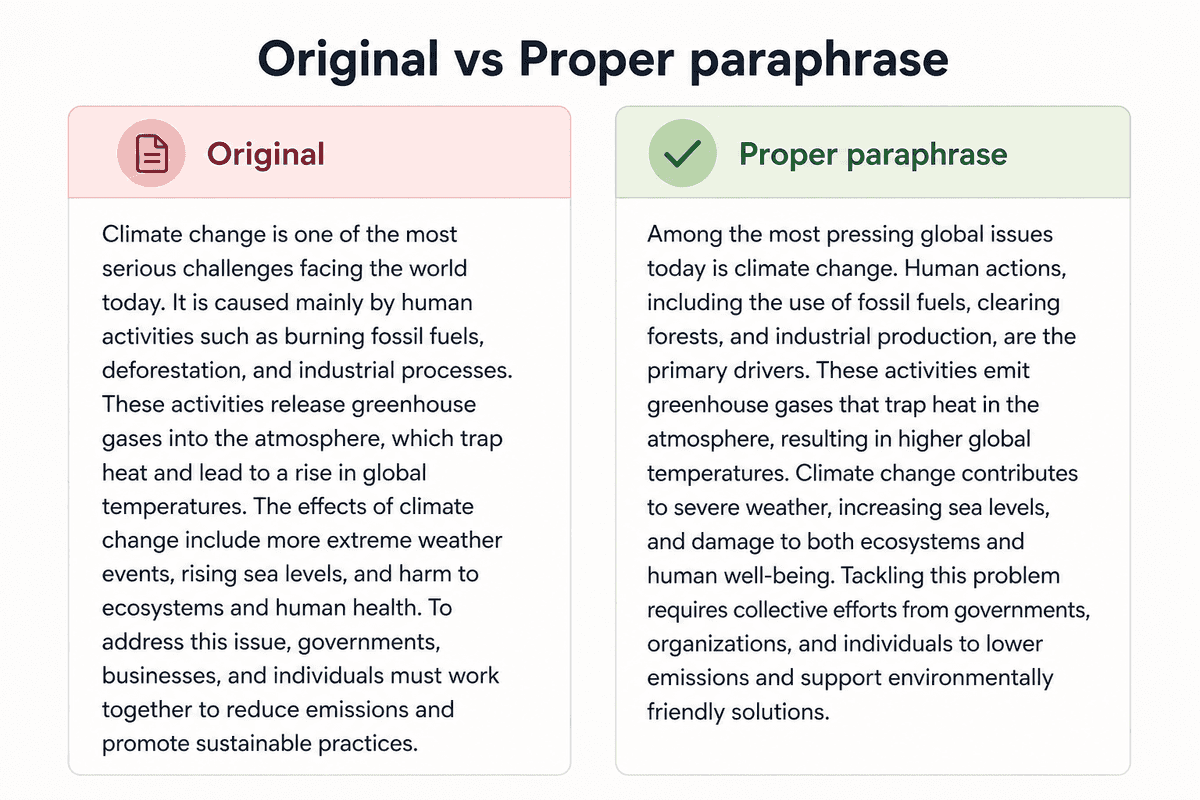
If you only swap synonyms, you didn’t reword — you camouflaged.
How to Paraphrase in 5 Easy Steps | Scribbr
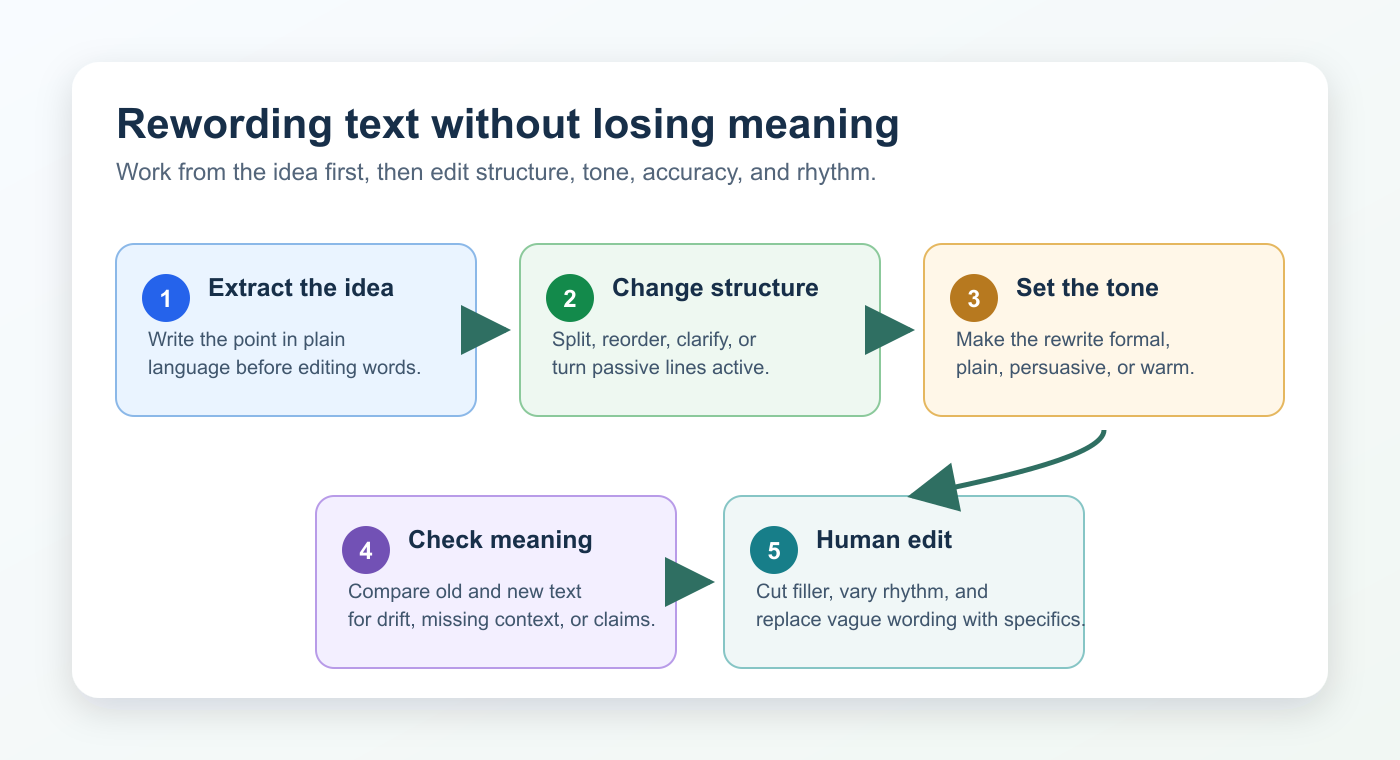
1. Identify the point before changing words
Ask: what does this sentence need the reader to understand?
If the sentence says, "Our platform leverages automation to streamline workflow efficiency," the point might be much simpler: "The tool saves time by handling repeat tasks." Once you know that, you can write a better version instead of dressing up the original. In my experience, this one step removes more awkward wording than any synonym swap.
2. Rewrite the structure, not just the vocabulary
Most bad rewording is synonym replacement. It keeps the same sentence shape and swaps "important" for "crucial" or "use" for "utilize." That rarely sounds human. It often sounds like someone tried to hide the original sentence instead of improving it.
Try one of these structural edits instead:
- Split one long sentence into two shorter ones.
- Move the most important point to the beginning.
- Turn passive voice into active voice.
- Replace a vague noun phrase with a concrete action.
- Add a short example if the idea is abstract.
For passive wording, a tool like Junia's passive to active voice converter can help you spot the line that needs attention, but you should still read the result aloud before using it.
3. Choose the tone on purpose
The same idea can sound academic, casual, persuasive, technical, or plain. Rewording gets messy when the tone is not defined.
For example:
- Formal: The revised policy reduces ambiguity and improves compliance.
- Plain: The new policy is easier to understand and follow.
- Marketing: The new policy gives every team a clearer way to stay aligned.
None of these is automatically better. The right version depends on where the text will appear and who needs to act on it. If a draft keeps shifting between stiff and casual, define the tone first; Junia's guide to types of tone in writing is useful when you need clearer labels before rewriting.
4. Compare the rewrite against the original
This is the step people skip. Put the original and new version side by side, because meaning drift is much easier to spot when the two versions are close together. Check three things:
- Did the rewrite preserve the same meaning?
- Did it remove any important qualifier?
- Did it add a claim that was not in the original?
This matters most in academic, legal, medical, technical, and SEO content. A rewrite can sound smoother while becoming less accurate.
5. Give the final version a human edit
AI rewriters are good at generating alternatives. They are weaker at knowing which version fits the reader, the page, and the surrounding context. That choice still belongs to the editor.
In the final pass, cut throat-clearing phrases, vary sentence length, and replace empty claims with specific details. A readability improver can help flag dense phrasing, but do not let the score override your judgment. One precise sentence is often better than a shorter sentence that loses the point.
How to Reword AI Text So It Sounds Human
AI-written text often has the same problems: smooth sentences, broad claims, predictable transitions, and not enough detail. Rewording it requires more than telling a tool to "make this human." The drafts I see struggle less with grammar and more with judgment: they do not know which detail actually matters.
Use this checklist:
| AI-text problem | What to change |
|---|---|
| Generic claims | Add a concrete example, use case, or constraint. |
| Repetitive rhythm | Mix short and medium-length sentences. |
| Over-polished wording | Replace formal filler with plain language. |
| Vague transitions | Use transitions that explain the actual relationship between ideas. |
| Samey paragraph openings | Start some paragraphs with a decision, example, warning, or question. |
| Missing judgment | Say what matters most and what the reader should avoid. |
Here is a simple prompt that usually works better than "humanize this":
Rewrite the passage below so it sounds natural, specific, and written for [audience].
Keep the meaning intact. Do not add facts. Avoid generic AI phrases.
Use plain language, varied sentence length, and concrete examples where the source supports them.
After rewriting, list any meaning changes you made.

Passage:
[paste text]
If the draft still sounds machine-made, a humanizer can be a useful second pass, especially for stiff AI phrasing. I would still review the output manually because "more human" should mean clearer and more specific, not just less detectable. Personally, I am wary of any rewrite that gets more casual while losing the point.
Rewording for SEO and AI Search
For SEO, the goal is not to create endless near-duplicate versions of the same page. The goal is to make each page clearer, more useful, and better matched to a real search intent. I am skeptical of rewording as an SEO tactic when it only produces a second version of the same thin answer.
Google's guidance on using generative AI content emphasizes accuracy, quality, and relevance.
Its newer guidance for generative AI features in Search also stresses unique, helpful, non-commodity content over tricks built only for AI systems.
That has a direct lesson for rewording: do not rewrite just to create another page. Rewrite when you can add clearer examples, better structure, stronger definitions, original judgment, or a more useful answer. Different wording is not enough; the page needs to earn its difference.
For content meant to rank, check these points before publishing:
- The rewritten version answers the main question in the first few paragraphs.
- Headings are written around reader tasks, not generic concepts.
- The page includes examples, steps, definitions, or comparison points that are easy to cite.
- Keywords appear naturally because the page is actually about the topic.
- Internal links help the reader move to the next useful step.
This is where rewording connects with E-E-A-T principles. A rewrite should make the writer's judgment, examples, and usefulness more visible. If it only makes the words different, it probably will not help search performance.
Choosing the Right Rewording Tool
The best rewording tool depends on the kind of text you are fixing. A student essay, blog post, landing page, support article, and social caption all need different controls. After trying this across different formats, I care less about flashy rewrite modes and more about whether the tool lets me keep control over meaning, tone, and scope.
| Need | Useful tool feature | What to watch for |
|---|---|---|
| Cleaner sentences | Rewrite modes and grammar checks | Do not accept a version that sounds more formal but less clear. |
| Better readability | Simplification and sentence-length feedback | Keep technical terms when they are necessary. |
| Human-sounding AI text | Humanizing and tone controls | Do not chase detector scores at the expense of accuracy. |
| SEO copy | Keyword-aware editing and structure suggestions | Avoid keyword stuffing and repeated page variations. |
| Academic or sourced writing | Meaning-preservation checks | Cite the original idea when required. |
Junia's grammar checker is useful after a rewrite because rewording can introduce small grammar issues even when the meaning is correct. That happens more often than people expect, especially when a long sentence gets split into two shorter ones.
For dense writing, a text simplifier can help you test whether the passage can be made easier without losing important detail.
When comparing AI rewriter tools, the main feature worth prioritizing is control: modes, tone options, side-by-side review, and a way to regenerate only weak sections instead of rewriting the whole document every time.
When Rewording Becomes Plagiarism
Rewording is not a shortcut around attribution. If you use someone else's idea, argument, data, or structure, changing the words does not make it yours. This is one place where I would be strict: a cleaner sentence does not erase the source of the thinking.
A safer rule is:
- Reword your own drafts freely.
- Reword source material only when you understand it.
- Cite the source when the idea, evidence, argument, or wording comes from someone else.
- Do not keep the original structure if you are pretending the work is original.
- Do not use a rewriter to disguise copied passages.
Academic and professional contexts are stricter than casual writing. If you are working from sources, explain the idea in your own structure and cite it properly. A rewrite should prove understanding, not hide dependence on the source. When in doubt, over-crediting a source is safer than pretending a borrowed argument is original.
Common Rewording Mistakes
The first mistake is changing words without improving the sentence. If the new version has the same vague point in more formal language, it is not better. This is the most common problem I see with quick AI rewrites.
The second mistake is letting the meaning drift. This often happens when AI replaces a careful phrase with a stronger one. "May reduce risk" is not the same as "prevents risk."
The third mistake is over-humanizing AI text. Some tools optimize for detector scores by adding odd phrasing, unnecessary contractions, or awkward sentence breaks. If you care about quality, use AI detector feedback as a signal, not a final verdict. I would not publish a worse paragraph just because a detector likes it more.
The fourth mistake is skipping the editing pass. Junia's guide on how to edit AI-generated text covers this in more detail, but the short version is that editing should check facts, rhythm, structure, examples, and reader usefulness, not just grammar.
The fifth mistake is using the same rewrite everywhere. A sentence that works in a blog post may feel too casual in a report and too slow for an ad. Good rewording adapts the idea to the format.
Final Rewording Checklist
Before you publish, submit, or send the rewritten text, check:
- Does the new version keep the original meaning?
- Is the sentence structure actually different, not just the vocabulary?
- Does the tone fit the audience and format?
- Are claims still accurate and properly qualified?
- Did you cite any source ideas that need attribution?
- Is the text clearer than the original?
- Does it sound natural when read aloud?
- Are any AI-like phrases, filler transitions, or vague claims still there?
Rewording text well is a writing skill, not just a tool feature. AI can help you generate options quickly, but the best version usually comes from a simple human decision: what is the clearest, most honest way to say this for the reader in front of me? That question is still the best final filter I know.