
How Preply Grew Organic Traffic 8x With Programmatic SEO in 50 Languages

Thu
AI SEO Specialist, Full Stack Developer

Preply is one of the cleaner examples of what programmatic SEO looks like when it is tied to a real product database.
I would not study it as a "make 60,000 pages" story. I would study it as an operating system: tutor supply, localized demand, educational content, user questions, internal links, and digital PR. That is why this case study is useful for agencies. It shows the difference between programmatic SEO as a shortcut and programmatic SEO as a system.
Third-party SEO analyses using Ahrefs estimates put Preply's organic growth at roughly 500,000 monthly visits to about 3.8-4 million monthly visits over a three-year period. The exact number will move as tools update their databases, but the pattern is clear: Preply turned a large marketplace into a large search footprint.
Here is the simple version:
| Layer | Approximate scale reported by competitor research | SEO job |
|---|---|---|
| Blog content | ~5,000 pages | Capture language-learning questions and middle-of-funnel topics |
| Forum / Q&A content | Large indexed question base | Capture long-tail questions created by real learners and tutors |
| Programmatic service pages | ~48,000 pages | Match commercial searches such as "Spanish tutor" and "English tutor in London" |
| International localization | 50+ languages / many markets | Serve the right page variant for the right language or region |
| Digital PR | 20,000+ new backlinks reported since 2021 | Build authority that helps the whole content system rank |
For agencies, the lesson is not "make 60,000 pages." The lesson is: if a client has structured data, repeatable search patterns, and real inventory, you can build a scalable SEO system around it.
Why Preply Was a Good Fit for Programmatic SEO
Programmatic SEO works best when three things are true:
- People search using repeatable patterns.
- The business has structured data that can satisfy those searches.
- Each page can be genuinely useful without being written from scratch.
Preply had all three.
Language learners search in patterns:
- "[language] tutor"
- "online [language] classes"
- "[language] tutor in [city]"
- "how to learn [language]"
- "what does [phrase] mean"
- "[grammar topic] in [language]"
Preply also had structured supply: tutors, languages, subjects, locations, prices, availability, ratings, specialties, and profile data. That is exactly the kind of database that can support data-driven SEO templates.
This matters because a programmatic page is only as good as the dataset behind it. If the data is thin, the pages feel thin. If the data is useful, the page can answer a real search need at scale.
Preply's own public materials describe the marketplace as having more than 50,000 tutors teaching over 50 languages, with learners across many countries. That kind of supply gives Google something better than a generic SEO landing page: an actual list of available tutors matched to the query.
The Three-Part SEO System Behind Preply's Growth
The strongest competitor articles did one thing well: they broke Preply's SEO strategy into three content engines instead of treating it as one giant programmatic SEO play.
That framing is important. Preply's growth did not come from service pages alone. It came from a full-funnel structure where each page type had a different job.
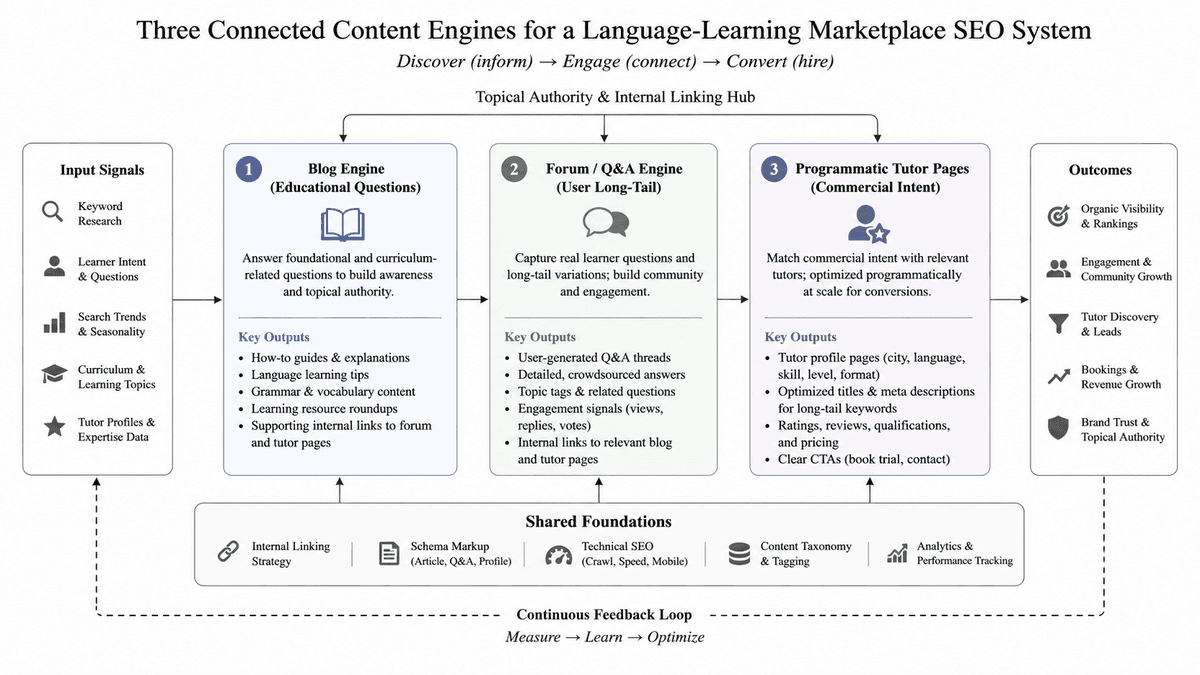
1. Blog Content Captured Language-Learning Demand
Preply's blog targets a huge amount of top- and middle-of-funnel demand.
These are not always searches from people ready to buy a lesson today. Many are educational searches from learners trying to understand a language problem:
- "basic Japanese words"
- "indirect object pronouns Spanish"
- "how to learn French"
- "how to learn English step by step"
- "present simple in English"
This is where many agencies get programmatic SEO wrong. They only chase bottom-of-funnel pages and ignore the informational layer that builds brand familiarity, internal links, and topical authority.
Preply's blog gives the site a way to meet learners earlier. A person searching for grammar help may not book a tutor immediately, but the topic is still close to the product. Over time, that creates a natural path from "I need help learning this" to "I should book someone who can teach me."
The better blog pages also support conversion with trust elements:
- Tutor authors or expert-led bylines
- FAQs built into the article template
- Topic-relevant calls to action
- Custom visuals that make language concepts easier to understand
- Internal links to relevant tutor and language pages
For agencies, this is the usable takeaway: programmatic pages work better when they are supported by a content hub that explains the broader problem.
If you are building a similar strategy for a client, plan the editorial layer alongside the templates. Use AI keyword research to find the repeatable patterns, but manually decide which topics deserve editorial pages, which deserve programmatic pages, and which should be ignored.
2. Forum Content Created a User-Generated Long-Tail Engine
Preply's forum is a second growth loop.
Learners ask language questions. Tutors answer them. Google indexes many of those threads. The answers create more search entry points without the editorial team writing every page manually.
This is powerful because language questions are naturally long-tail. People search in messy, specific ways:
- "what does this sentence mean in English"
- "is French harder than German"
- "how long does it take to learn Spanish"
- "how do I pronounce this word"
Traditional keyword research misses a lot of these phrasings. User-generated content captures them because real users create the wording.
The forum also reinforces Preply's marketplace. Tutor answers are not just content; they are proof that real teachers exist on the platform. When the answer is useful, the tutor profile becomes a natural next click.
This model is not available to every client. A SaaS company with no community probably cannot copy it directly. But agencies can copy the principle:
| If the client has... | Build this content layer |
|---|---|
| A marketplace | Expert answers, provider Q&A, profile-led advice |
| A SaaS product | Use-case templates, customer workflows, troubleshooting pages |
| A directory | Location guides, category explainers, comparison pages |
| A service business | Problem pages, cost pages, qualification checklists |
The goal is not user-generated content for its own sake. The goal is to create a repeatable way to answer real long-tail questions with real expertise.
3. Programmatic Service Pages Captured Commercial Intent
The service pages are where Preply's programmatic SEO becomes most obvious.
Instead of creating one generic "language tutors" page, Preply can create pages around combinations of subject, language, location, and format:
- Spanish tutors
- Online English tutors
- Japanese tutors near me
- English tutors in London
- Business English classes
- Math tutors online
This works because the searcher is already close to the product. Someone searching "online Spanish tutor" does not need a 2,500-word essay. They need relevant tutors, prices, filters, reviews, availability, and enough supporting copy to understand the offer.
A useful programmatic service page usually needs:
| Page element | Why it matters |
|---|---|
| Real inventory | Makes the page more than a keyword shell |
| Query-matched heading and intro | Confirms the page matches the search |
| Filters or sorting | Helps the user narrow choices |
| Pricing or availability data | Reduces friction before conversion |
| Reviews or profile signals | Builds trust |
| FAQs | Covers objections and related long-tail queries |
| Internal links | Connects related subjects, languages, and locations |
This is also where risk shows up. Google warns against scaled content created primarily to manipulate rankings instead of helping users. The line is simple: if the page exists only because a keyword exists, it is weak. If the page exists because the business can satisfy that search with specific data, it has a much stronger reason to be indexed.
That is the standard agencies should use before recommending bulk content creation: can each generated page give the user something materially useful?
How Localization Made the SEO System Bigger
Preply's market is naturally international. Language learning crosses countries, cities, native languages, and target languages.
That creates a huge SEO opportunity, but it also creates technical risk. If localized pages are handled poorly, you can create duplicate pages, wrong-language search results, cannibalization, and a messy crawl path.
This is where multilingual programmatic SEO becomes more than translation.
Preply needed the same basic page systems across many markets, but each page still had to feel appropriate for the user's language and location. That means:
- Localized headings and metadata
- Correct currency or pricing context where relevant
- Market-specific examples and wording
- Internal links between related localized pages
- Technical handling for language and regional alternates
Google's documentation says hreflang helps it understand localized page variants and show the right version by language or region. For a site like Preply, that is not a small technical detail. It is part of the growth system.
If you are planning a similar rollout, read Junia's guide to hreflang for multilingual websites before launching thousands of localized URLs.
The Backlink Layer Made the Pages Easier to Rank
Competitor research also pointed to a major off-page component: Preply appears to have invested heavily in digital PR.
That matters because programmatic pages often struggle to earn links directly. A page like "English tutors in London" can convert well, but it is not naturally linkable in the same way a data study or useful guide is.
Preply's reported approach was to create localized research campaigns and PR stories that could earn media coverage across countries. Those links then strengthened the domain, which helped the broader content library rank.
This is the part agencies should not skip. Programmatic SEO without authority can turn into a large set of indexed pages that never meaningfully rank. Authority building gives the template system a better chance of compounding.
A practical version looks like this:
| SEO asset | Linkability | Conversion role |
|---|---|---|
| Data study / report | High | Brand and authority |
| Educational blog post | Medium | Awareness and trust |
| Comparison or guide | Medium | Consideration |
| Programmatic service page | Low to medium | Conversion |
| Tutor / provider profile | Low | Conversion and proof |
The strongest strategy uses all of them. Linkable assets build authority. Editorial content builds topical coverage. Programmatic pages capture high-intent demand.
What Agencies Can Copy From Preply
You do not need Preply's budget to apply the model. You do need discipline.
Here is the agency version of the playbook.
Step 1: Find the Search Pattern
Start with the query formula, not the page template.
Good programmatic SEO patterns usually look like:
[service] in [location][product] for [use case][software category] for [industry][template] for [job to be done][language] tutor[competitor] alternative
Then validate whether search demand exists and whether the client has enough data to make each page useful.
This is where a programmatic SEO tool helps: it can turn patterns into page sets faster than a manual content process. But the strategy still has to come first.
Step 2: Decide Which Pages Deserve to Exist
Do not generate every possible combination.
Preply can justify many combinations because the tutor marketplace has real supply. A smaller client may only have enough useful data for 50 pages, not 5,000.
Before launch, score each page group:
| Question | Good sign | Warning sign |
|---|---|---|
| Is there search demand? | Repeated query pattern | No clear keyword pattern |
| Is there real data? | Inventory, pricing, reviews, locations, examples | Mostly boilerplate |
| Is the page useful alone? | User can compare or act | User gets a generic paragraph |
| Can it be internally linked? | Fits a hub or taxonomy | Orphaned page group |
| Can it convert? | Clear next action | Informational dead end |
This one filter prevents most bad programmatic SEO projects.
Step 3: Build the Template Around Usefulness
A programmatic template should not be a mad-lib article.
For a marketplace, the useful part is usually the inventory. For a SaaS site, it may be a workflow, comparison, integration, or template. For a local service business, it may be pricing, service area proof, reviews, and project examples.
The copy should support the data, not hide the lack of data.
For example, a strong tutor page template might include:
- Query-matched intro
- Tutor listings
- Filters
- Price range
- Review snippets
- Availability
- Related languages or cities
- FAQ block
- Internal links to learning guides
That is much stronger than 700 words of generic "why learn Spanish" copy.
Step 4: Localize the System, Not Just the Text
For international SEO, translation is only one layer.
You also need localized keyword research, market-specific internal links, localized metadata, correct hreflang, and quality checks for every language group. Junia's guide on automatically translating a blog into 60 languages is useful if you are building this at scale, but do not treat translation as the whole strategy.
If you are working across many countries, bulk blog translation can speed up the first pass. Then add review steps for the markets that actually convert.
Step 5: Connect the Page Network
Internal linking is not optional in a programmatic SEO project.
Preply's model works partly because the site can connect:
- Blog posts to tutor pages
- Forum answers to related learning pages
- Tutor pages to nearby cities or related languages
- Localized versions to the right language or region
- High-authority editorial pages to commercial pages
For agencies, this is where automation saves a lot of work. Build rules for related links before publishing, not after the pages are already live.
If the client is expanding globally, use a structure similar to Junia's international SEO automation platform: one system for content production, translation, internal linking, and technical SEO checks.
Where Preply's Strategy Has Risk
This case study is strong, but it is not risk-free.
The biggest risk is doorway-page perception. Some localized tutoring pages may look very similar, especially when the service is online and the city modifier is doing a lot of SEO work. Google has historically been cautious about pages created only to capture geographic variants. This is the distinction agencies should watch before copying the template at scale:
Doorway Pages vs. Programmatic SEO: How to Avoid a Google Penalty
If there is no inventory, there is no page. I would rather launch 80 useful combinations than 8,000 shells with the city name swapped. Scale is not the strategy. Useful data is.
The way to reduce that risk is to make the local or language-specific value real:
- Show tutors actually relevant to that market
- Use local examples where they help the searcher
- Avoid publishing pages with no inventory
- Keep boilerplate under control
- Use unique FAQs only when the question set differs
- Monitor indexed pages and prune weak groups
Another risk is content drift. When a company publishes thousands of pages, some topics will inevitably be too broad, too distant from the product, or no longer worth maintaining. Competitor analysis called this out in Preply's blog strategy: some top-of-funnel topics may be too far from tutoring intent.
That is normal at scale, but agencies should plan for it. Build pruning, refreshing, and consolidation into the project from day one.
The Real Lesson From Preply's Programmatic SEO Case Study
Preply's growth was not just a content volume story.
It was a system story:
- A large marketplace database gave the site useful commercial pages.
- Blog content captured educational demand before people were ready to buy.
- Forum content added long-tail questions in the language of real users.
- Localization expanded the same system across many markets.
- Hreflang and site architecture helped Google understand the page variants.
- Digital PR built authority that supported the whole domain.
That combination is why the strategy compounded.
If you are an agency, the best way to copy Preply is to start smaller. Pick one pattern, one market, and one template. Launch enough pages to test the model. Measure indexation, rankings, traffic, assisted conversions, and page quality. Then expand only the page groups that prove they can rank and help users.
Programmatic SEO is not about publishing the most pages. It is about turning structured business data into search pages people actually want.