
AI SEO for Dentists (2026): Get More Patients From Google Maps

Yi
SEO Expert & AI Consultant

AI SEO for dentists is not about letting a chatbot write another forgettable blog post about cavities.
It is about making sure Google, Google Maps, AI Overviews, Gemini, ChatGPT, Perplexity, and other answer engines can clearly understand your practice: where you are, what you treat, who you help, why patients trust you, and how someone can book. The same discipline shows up when practices use SEO to reach ideal customers instead of chasing every nearby keyword.
That matters because dental search is no longer just a list of blue links. A patient might still type "dentist near me" into Google, but they might also ask:
"Who is the best emergency dentist near me that is open today and takes nervous patients?"
That kind of query rewards practices with complete, specific, consistent information across their website, Google Business Profile, reviews, directories, and service pages. AI can help you build and maintain that information faster. But I would be careful about treating speed as the win. Dental content affects real health decisions, so the real advantage is making accurate information easier to find without making the practice sound generic.
TL;DR: AI SEO for dentists
If you only do one thing, use AI to make your local dental information clearer and more complete, not just longer.
| Priority | What to fix first | Why it matters |
|---|---|---|
| Google Business Profile | Categories, services, hours, photos, posts, Q&A, and reviews | Google says local ranking is influenced by relevance, distance, and prominence, so incomplete profiles lose easy visibility. |
| Service pages | One clear page for each core treatment and location intent | AI systems need readable text about what you offer, who it is for, and where it is available. |
| Reviews | Ask for specific, recent reviews that mention treatments and patient experience | "Great dentist" helps less than a review mentioning emergency care, Invisalign, gentle treatment, or same-day availability. |
| Structured data | Add LocalBusiness/Dentist schema where appropriate | Local Business structured data gives search engines clearer facts about your practice, hours, location, and departments. |
| AI-search readiness | Answer natural patient questions directly | Google's AI-search guidance still starts with helpful, unique content and strong SEO fundamentals. |
Personally, I would start with your Google Business Profile and your top five treatment pages before publishing any new blog content. That is where most dental practices have the fastest fixable gaps.
What AI SEO means for a dental practice
AI SEO is the use of artificial intelligence to plan, improve, and maintain the work that helps search systems understand and recommend your website.
For a dental practice, that usually includes:
- Finding patient questions and local keywords.
- Improving Google Business Profile content.
- Writing clearer treatment pages.
- Turning real patient concerns into FAQs.
- Drafting review replies for human approval.
- Checking competitors and local map results.
- Finding missing internal links, schema, and technical issues.
- Rewriting content so it is easier for AI systems to summarize.
The important part is that AI should make the practice easier to understand. I am usually less impressed by polished dental copy than by copy that answers the practical question in front of the patient. If your website says "comprehensive dental solutions" everywhere but never says you offer same-day tooth extractions in Austin, no AI tool can confidently recommend you for that emergency query.
SEO vs GEO: what dentists need to understand
Traditional SEO helps your practice rank in Google Search, Google Maps, and organic results. GEO, or generative engine optimization, is the newer term people use for visibility inside AI-generated answers.
I would not treat them as separate strategies. For dentists, the same foundation supports both.
| Search behavior | What the patient wants | What your practice needs |
|---|---|---|
| "dentist near me" | A nearby practice they can call now | Complete Google Business Profile, strong reviews, local landing pages, accurate NAP |
| "best dentist for anxious patients in Phoenix" | A trusted recommendation with context | Clear service copy, sedation/anxiety details, patient-friendly reviews, specific FAQs |
| "does this dentist take Delta Dental?" | Insurance clarity before calling | Written insurance information, GBP services, front-desk-ready answers |
| "who can fix a chipped tooth today?" | Urgent care and availability | Emergency dentistry page, hours, same-day language, review evidence |
| "is [practice name] good?" | Trust check | Recent reviews, doctor bios, credentials, photos, consistent directory data |
The mistake is chasing "AI search tricks" while your basic local SEO is still thin. I would not spend much time on GEO tactics until the practice has clean local facts, useful treatment pages, and review signals that match the services it wants to be known for. Google's guidance for generative AI features says SEO fundamentals still matter, including unique, helpful content and pages Google can access and understand.
Step 1: Run an AI visibility audit
Before changing anything, check how AI systems currently describe your practice.
Open ChatGPT, Gemini, Perplexity, and Google Search. Then test questions like:
- "Who are the best dentists in [city] for dental implants?"
- "Which dentist near [neighborhood] is good with anxious patients?"
- "Where can I get an emergency tooth extraction today in [city]?"
- "Is [practice name] a good dental office?"
- "Which family dentist near me has strong reviews?"
Write down three things:
| Audit question | What to record |
|---|---|
| Does your practice appear? | If not, look for missing service, location, review, or directory signals. |
| Is the information accurate? | Wrong hours, old addresses, and outdated doctors create trust problems. |
| Which competitors appear instead? | Study what they make clearer than you: services, reviews, insurance, location, or proof. |
This is not a perfect ranking test, because AI responses vary by location, login state, and data source. But it is a useful reality check. If your website and listings do not give clear answers, AI tools will often choose a competitor with better public information.
Step 2: Fix your Google Business Profile first
For most dentists, Google Business Profile is the highest-leverage part of local SEO. It is also where I would expect the most embarrassing gaps to show up: missing services, old holiday hours, thin photos, unanswered questions, and review replies that sound copied from a template. Google's Business Profile documentation says businesses with complete and accurate information are more likely to show up for relevant local searches, and local ranking is based mainly on relevance, distance, and prominence.
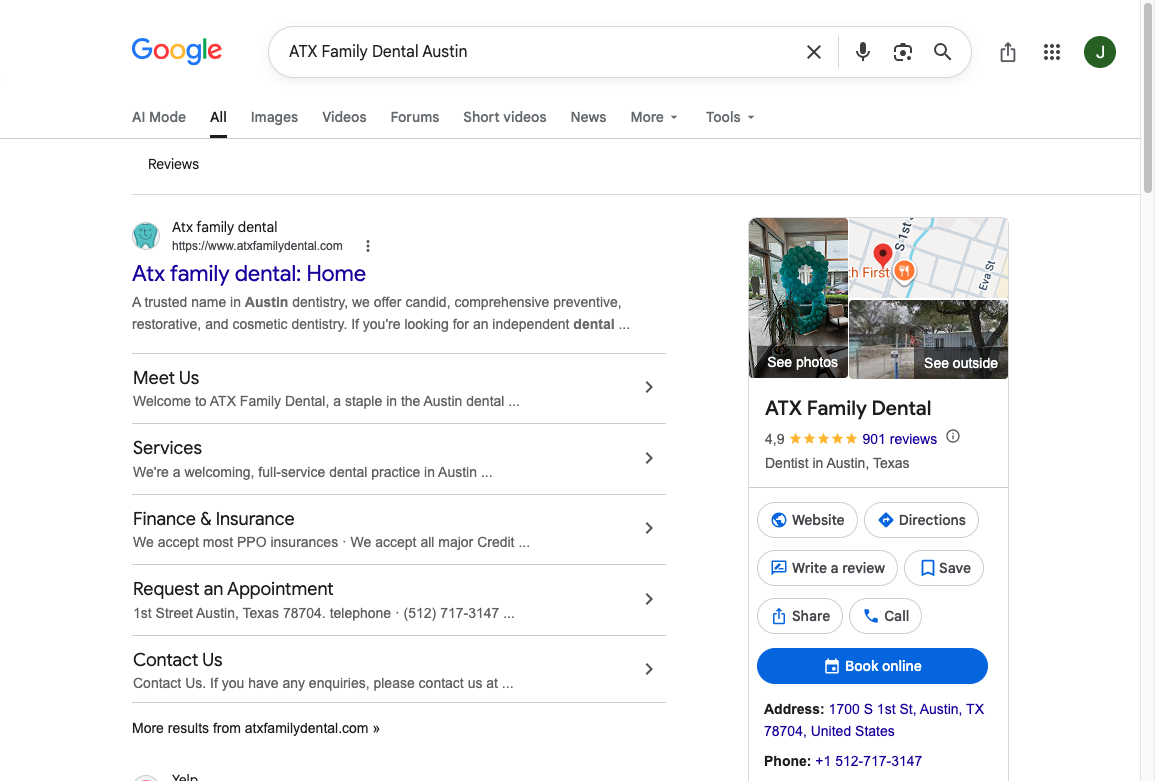
That panel is what a patient sees before they ever open your website. Hours, phone, reviews, and the booking button have to match the site. If they do not, the map pack still wins the click. You just lose the call.
The same pattern shows up in local SEO case-study discussions: service-specific profile details, review velocity, and fresh local proof usually matter more than publishing another generic dental blog post.
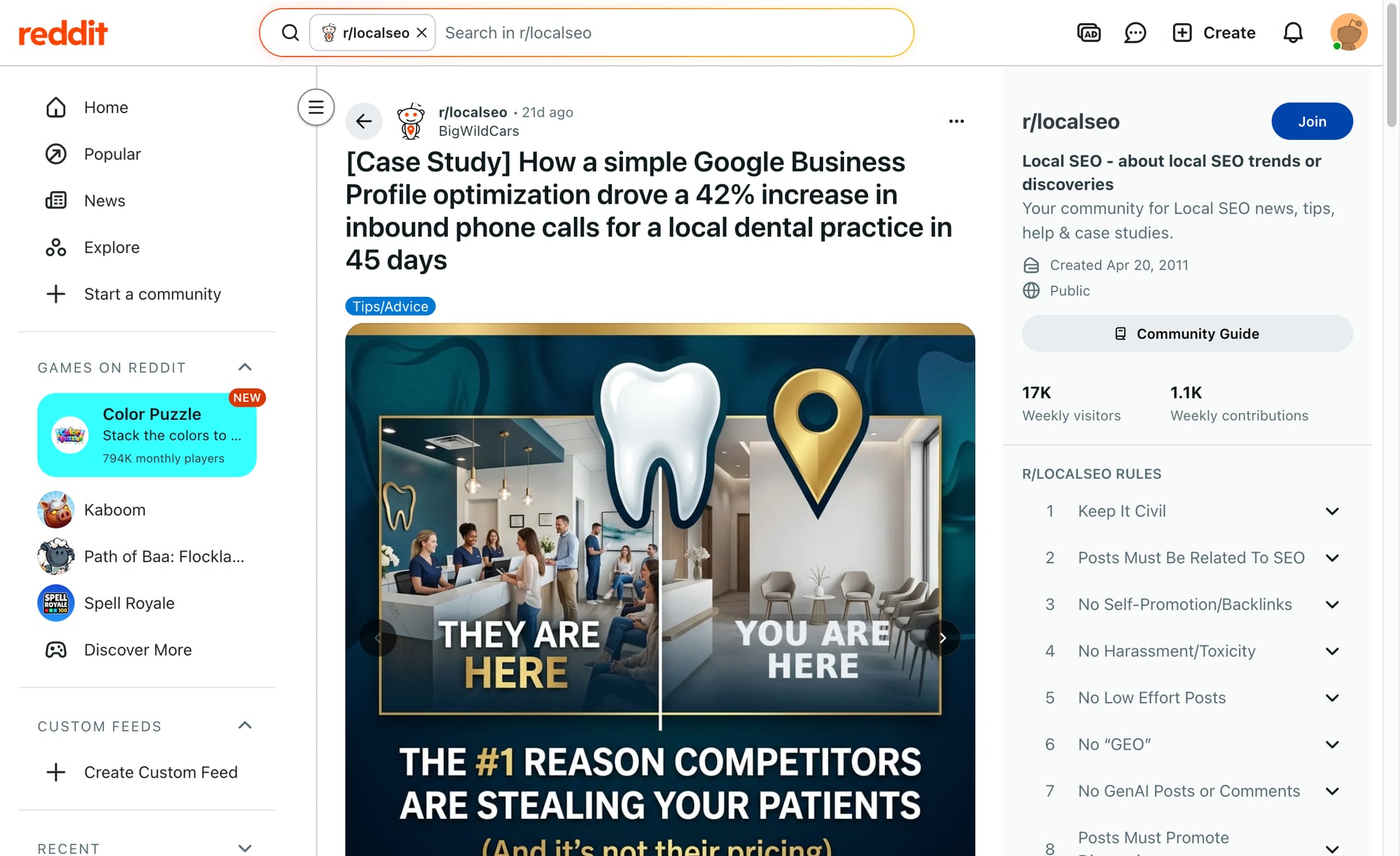
That gives you a simple checklist:
| Profile area | What AI can help with | Human review needed |
|---|---|---|
| Categories | Compare competitor categories and suggest primary/secondary category options | Confirm the category accurately reflects the practice |
| Services | Draft short descriptions for cleanings, implants, Invisalign, whitening, emergency care, and other treatments | Check clinical accuracy and avoid promises you cannot support |
| Posts | Turn promotions, seasonal reminders, and treatment education into short updates | Make sure offers, prices, and dates are correct |
| Q&A | Draft answers to common questions about insurance, emergency visits, sedation, parking, and new patients | Confirm front-desk policy before publishing |
| Reviews | Draft polite responses that mention the patient's concern without exposing private health details | Remove anything that could create a privacy issue |
Junia's Google Business Profile post generator can turn practice updates into a first draft. I would still have a real person approve every post, especially when it mentions treatment, pain, insurance, or a complaint.
NAP mismatches cost calls. This matters most when the website has a tracking number, Yelp still shows an old suite, and Google has last year's holiday hours. Pick one public name, one public phone number, and one address. Copy those details everywhere else. AI can find the mismatches. It cannot decide which version is the real practice.
The same profile work shows up in every serious local SEO walkthrough. Sterling Sky's GBP checklist is the useful version: categories, services, photos, and reviews, not another dental blog calendar.
Sterling Sky: 5 secrets to optimize your Google Business Profile in 2026
Step 3: Build service pages AI can actually understand
Many dental websites have one generic services page with a list like "cleanings, fillings, crowns, implants, whitening." That is not enough for AI search, and frankly it is not very helpful for patients either.
Each important treatment should have its own page with plain answers:
- What the treatment is.
- Who it is for.
- Common symptoms or situations.
- Whether same-day care is available.
- What patients should expect at the visit.
- Insurance or financing basics.
- Location and appointment details.
- Dentist credentials or relevant experience.
- FAQs written in patient language.
For example, a weak emergency dentistry page says:
We provide emergency dental care for patients in the area.
A stronger AI-ready page says:
Our Phoenix dental office offers same-day emergency appointments for toothaches, chipped teeth, broken crowns, dental abscess symptoms, and knocked-out teeth. Call before visiting so our team can confirm availability and tell you what to do before you arrive.
That second version gives search systems usable facts. More importantly, it helps a nervous patient decide faster.
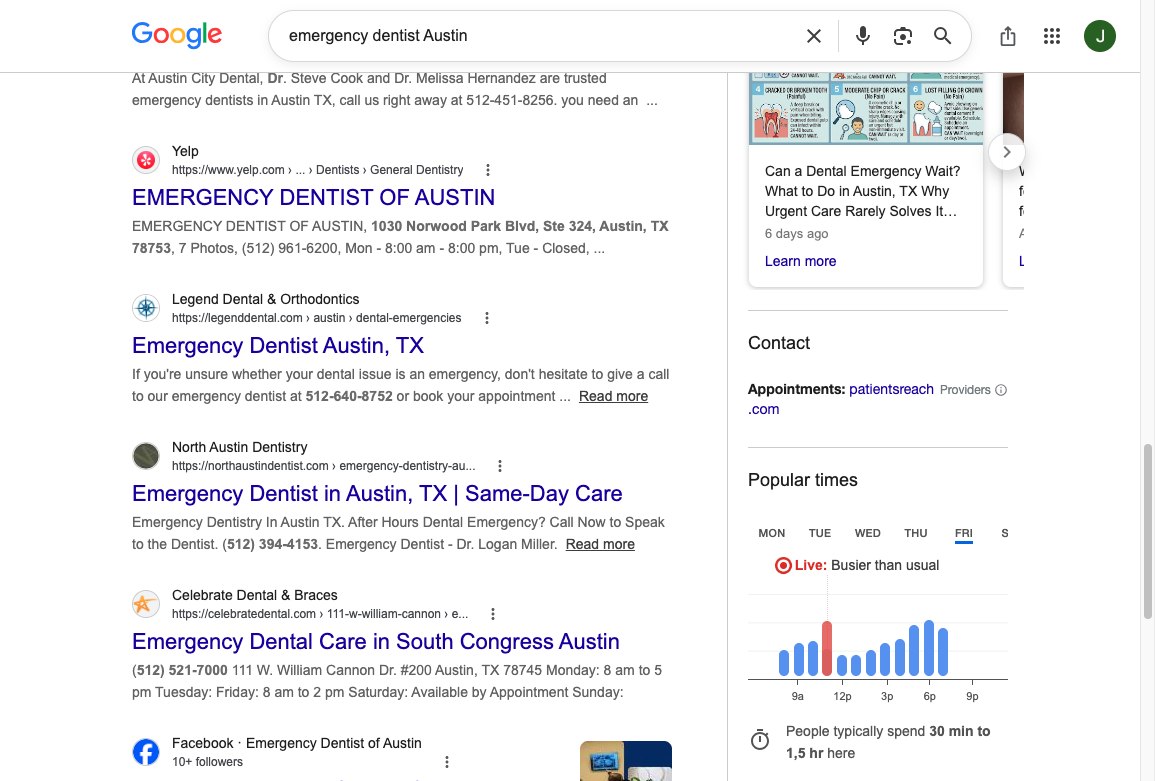
Those results are service pages, not "benefits of flossing" posts. I like treatment pages that feel as if the front desk and dentist both had input: clear enough to answer booking questions, careful enough not to overpromise clinical outcomes.
If you are planning pages at scale, an SEO content brief generator can turn a target service and city into a structure for writers. Just avoid publishing the brief as-is. Dental content needs clinical review, local details, and practice-specific proof.
Step 4: Use AI keyword research for patient language
Dentists and patients often use different words.
A dentist might say "endodontic therapy." A patient might search "root canal pain," "tooth nerve treatment," or "do I need a root canal." A dentist might say "clear aligner therapy." A patient might ask "Invisalign for crowded teeth."
An AI keyword research workflow helps translate clinical terms into patient language. The goal is not to stuff every phrase onto the page. The goal is to understand the questions patients ask before they book.
Here is a practical prompt:
Act as a local SEO strategist for a dental practice in [city]. Build a keyword and question map for [service]. Group queries by patient intent: urgent symptoms, treatment options, cost, insurance, anxiety, recovery, and appointment readiness. Flag which queries deserve a service page, FAQ, Google Business Profile Q&A answer, or blog post.
Then edit the output manually. Remove phrases that do not match your actual services. Add language your front desk hears every week. In my view, the best dental SEO copy usually comes from real patient questions, not keyword tools alone. Keyword data tells you what people type; patient conversations tell you what they are worried about.
Step 5: Make reviews more useful for AI search
Reviews influence trust, conversions, and local visibility. For AI search, the words inside reviews matter too.
An AI assistant can learn much more from this:
"Dr. Patel fit me in the same day for a broken molar, explained the crown options clearly, and the front desk helped me understand my insurance."
than this:
"Great office!"
You should never script fake reviews or pressure patients. That line matters. I am much more comfortable using AI to improve the request than to shape the review itself. You can ask better questions after a good visit:
- "Would you mind mentioning the treatment you came in for?"
- "Could you share what made the visit comfortable?"
- "If our team helped with insurance, scheduling, or anxiety, those details help other patients."
- "If this was an emergency visit, a short note about timing can help people in the same situation."
AI can help draft SMS or email review requests, but the review itself has to come from the patient. For reputation work, the safest use of AI is organizing feedback themes, drafting compliant replies, and spotting recurring issues the practice should fix. A review response generator is a starting point, not a send button.
Step 6: Add structured data without overcomplicating it
Structured data will not magically rank a weak dental site. I think of it as clarification, not persuasion. It helps search engines read important business facts more clearly, but it cannot compensate for vague pages, inconsistent listings, or thin local proof.
Google's LocalBusiness structured data documentation explains that markup can help describe business hours, departments, reviews, and other business details. For dentists, the useful fields usually include:
| Structured data item | Why it helps |
|---|---|
| Practice name | Confirms the exact entity name |
| Address and phone | Reinforces local identity and NAP consistency |
| Opening hours | Supports appointment and local availability queries |
| Dentist or local business type | Clarifies what kind of business the page represents |
| Service area | Helps connect the practice to nearby communities |
| SameAs links | Connects the site with official profiles and directories |
AI structured data SEO can speed up the first draft of JSON-LD markup. Still, a developer or SEO specialist should validate it before publishing. Incorrect schema is worse than no schema because it creates conflicting information.
Step 7: Use AI to improve local pages, not clone them
Location pages can help multi-location practices and service-area strategies, but only when the pages are genuinely useful.
A thin page that says "dentist in [city]" and swaps the city name across 20 pages is not useful. I would rather publish five genuinely local pages than 50 near-duplicates. A strong local page explains:
- Which location serves that area.
- Parking, transit, or neighborhood details.
- Services available at that office.
- Doctors who work there.
- Emergency or same-day availability.
- Insurance and financing basics.
- Local photos and patient proof.
- Questions people in that area actually ask.
Step 8: Prepare content for AI Overviews and answer engines
AI search systems tend to favor content that is easy to parse, summarize, and verify. That means dental pages should be direct.
Good AI-ready dental content usually includes:
- A short answer near the top.
- Clear H2 and H3 headings.
- Plain-language definitions.
- Service-specific FAQs.
- Tables where patients compare options.
- Step-by-step appointment or treatment workflows.
- Real credentials, photos, and practice details.
- Citations for claims about search behavior or platform requirements.
Google's AI-search guidance says site owners should focus on unique, valuable content, make sure Google can access content, and avoid blocking important page resources. That is not glamorous, but it is exactly the kind of foundation many dental websites still miss. The boring work is often the work that makes the difference.
Here is a simple structure for a treatment page:
| Page section | Example for dental implants |
|---|---|
| Direct answer | "Dental implants replace missing teeth with a titanium post and crown. They are often used when a patient wants a fixed alternative to dentures." |
| Who it is for | Missing tooth, loose denture, failed bridge, healthy enough for oral surgery |
| What to expect | Consultation, imaging, treatment plan, placement, healing, crown |
| Cost factors | Number of implants, bone grafting, imaging, sedation, insurance |
| Local proof | Dentist experience, office location, patient reviews, before/after policy |
| FAQ | Pain, timeline, candidacy, maintenance, financing |
That page is easier for patients, easier for Google, and easier for AI systems to summarize accurately.
Step 9: Create a practical AI SEO workflow
AI SEO works best as a repeatable workflow, not a one-time project.
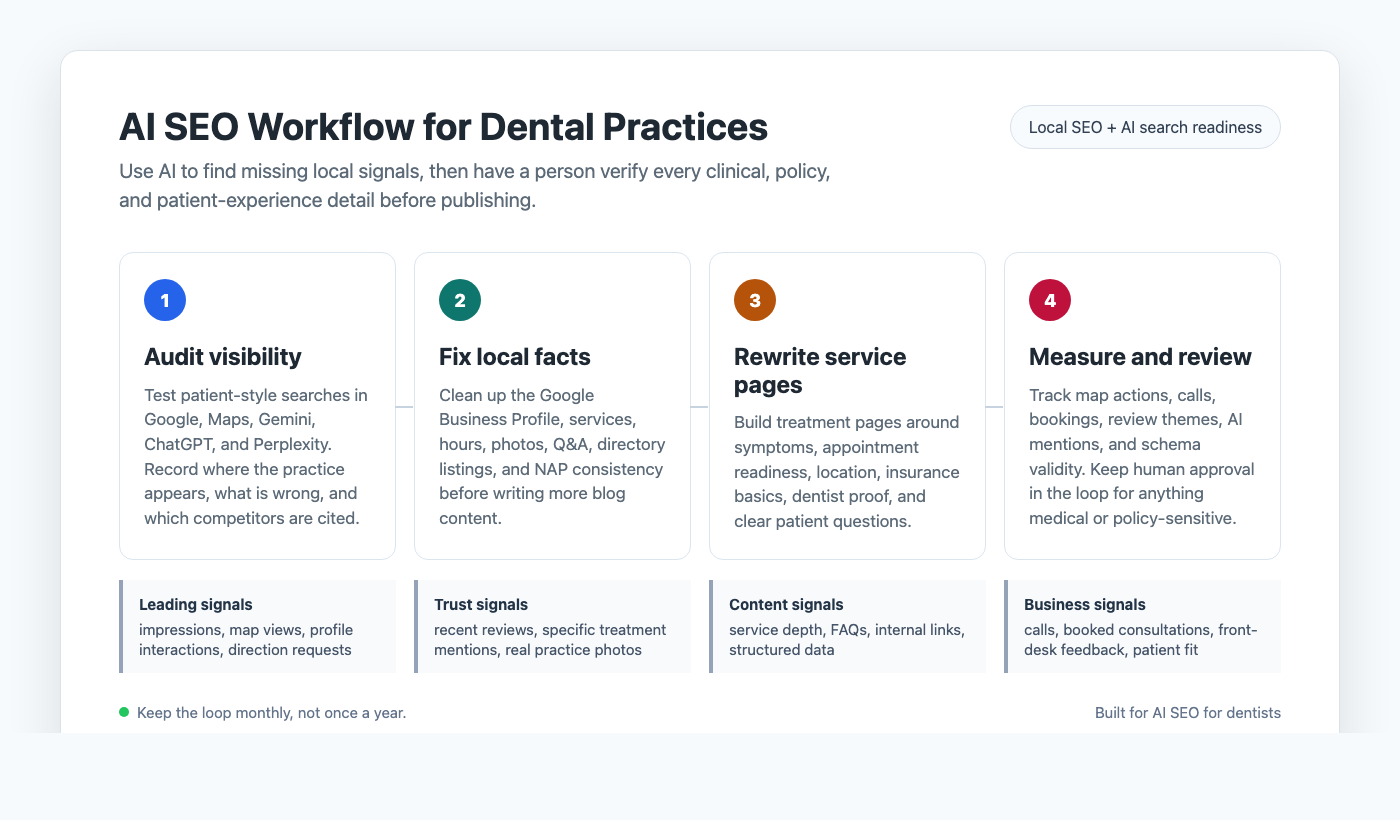
| Frequency | Task | AI role | Human role |
|---|---|---|---|
| Weekly | Review new Google reviews | Summarize themes and draft replies | Approve replies and fix real service issues |
| Weekly | Publish a GBP post | Draft post ideas from current services or seasonal needs | Confirm accuracy and publish |
| Monthly | Check top service pages | Find missing questions, weak headings, and internal link gaps | Edit for clinical accuracy and practice voice |
| Monthly | Run local competitor checks | Compare GBP services, reviews, pages, and FAQs | Decide what gaps are worth addressing |
| Quarterly | Audit schema and technical SEO | Flag missing markup, broken links, crawl issues, and slow pages | Implement and validate fixes |
| Quarterly | Test AI visibility | Ask patient-style questions in AI tools | Record mentions, errors, and competitor patterns |
An AI SEO agent can support parts of this workflow, especially audits, briefs, and optimization recommendations. I would use it as a second set of eyes, not as the publisher of record. The practice still needs someone accountable for accuracy, compliance, and patient experience.
Common mistakes dentists make with AI SEO
The first mistake is publishing generic AI-written dental blogs. "Top 10 benefits of oral hygiene" will not help much if your emergency dentistry page, Google Business Profile, and reviews are weak.
The second mistake is ignoring Google Maps. For many dental searches, the map pack is the real battleground. A polished blog strategy cannot compensate for inaccurate hours, missing services, weak reviews, or inconsistent directory listings.
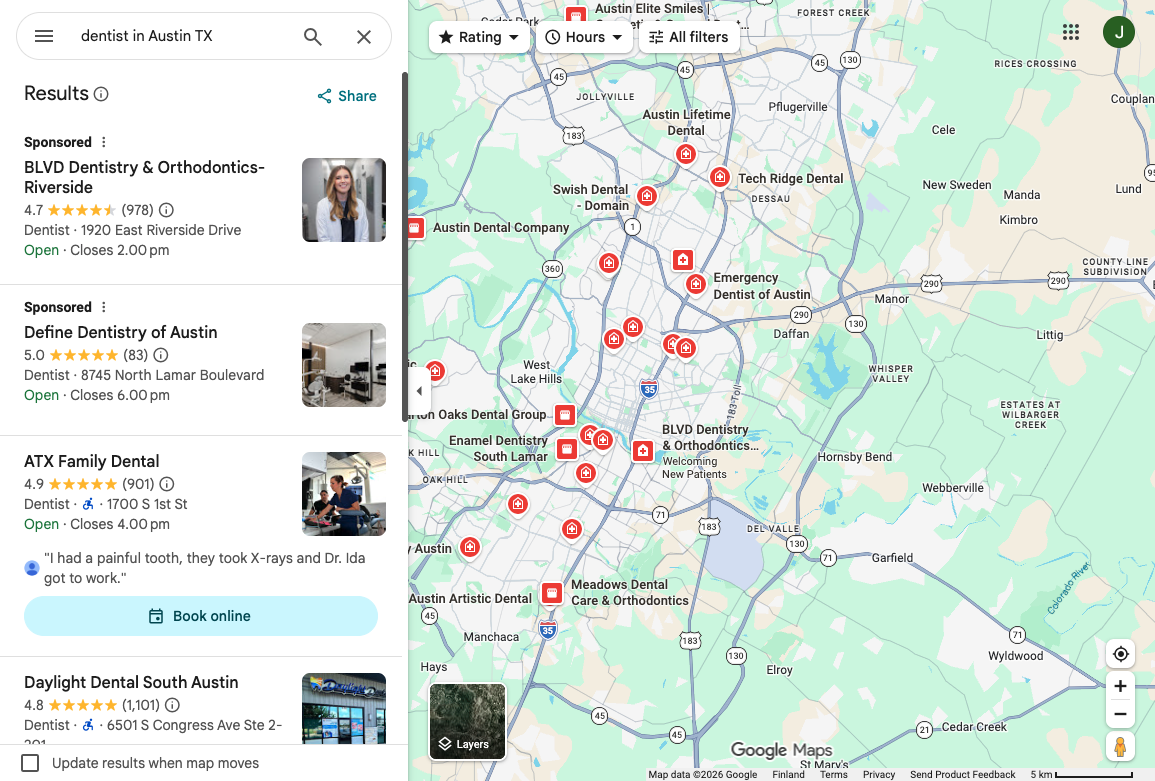
This is the SERP that sends patients to the phone. If you are not in that pack, blog volume will not save the month.
The third mistake is making service pages too vague. AI systems need specifics: treatment names, location, appointment availability, patient concerns, insurance context, and proof.
The fourth mistake is overusing exact-match city keywords. "Best dentist Los Angeles dentist near Los Angeles dental clinic" reads badly to humans and does not build trust. Use natural language and answer the question directly.
The fifth mistake is treating AI-generated content as final. AI can draft a page about implants, but it cannot know your actual dentist's experience, your equipment, your insurance policy, your scheduling capacity, or your clinical judgment unless you provide that information. This is where I see the quality gap widen: practices that feed AI real details sound specific, while practices that accept the first draft sound interchangeable.
Best AI SEO tools for dentists
You do not need a giant stack. You need a small set of tools that cover the core workflow. Most AI SEO tools fail dentists when they get used to write blogs instead of to clean the listing, the service pages, and the review loop.
| Need | Useful tool type |
|---|---|
| Keyword and question research | AI keyword tools, Google Search Console, Semrush, Ahrefs |
| Local profile content | GBP post generator, service description drafts, Q&A drafts |
| Review management | Review request templates, sentiment summaries, response drafts |
| Content planning | SEO brief tools, competitor analysis tools, content optimization tools |
| Internal linking | AI internal linking tools for connecting service pages, location pages, and supporting articles |
| Technical cleanup | Crawlers, schema validators, speed testing, page quality audits |
For most practices, I would rather see three tools used consistently than twelve tools used once. Start with GBP, reviews, and service pages. Then expand into blog content, schema improvements, and deeper competitor analysis. Consistency beats a crowded dashboard.
A 30-day AI SEO plan for dentists
Here is a realistic plan a dental practice can run without turning marketing into a full-time job.
| Week | Focus | What to complete |
|---|---|---|
| 1 | Audit | Run AI visibility tests, export GBP details, list top services, check directory consistency |
| 2 | Google Business Profile | Update categories, services, hours, photos, Q&A, posts, and review response templates |
| 3 | Service pages | Rewrite the top three treatment pages with clear answers, FAQs, location details, and proof |
| 4 | Reviews and schema | Improve review requests, add or validate LocalBusiness/Dentist schema, and create a monthly tracking sheet |
By the end of 30 days, you should have a cleaner local SEO foundation and a better sense of where AI systems misunderstand or ignore your practice. I would treat that as the real deliverable: not a pile of new content, but a clearer public record of what the practice actually does.
Final thoughts
AI SEO for dentists is really local SEO with sharper information hygiene. That may sound less exciting than "ranking in AI," but it is the version I trust.
Your practice needs to be easy to find, easy to understand, and easy to trust. AI can help with research, drafts, briefs, reviews, structured data, and audits, but it cannot replace the facts that make your practice credible: real services, real locations, real reviews, real doctors, and real patient experience.
If you want the fastest win, do not start by asking AI for ten blog posts. Start by asking whether a patient, Google Maps, and an AI assistant can all answer the same basic question:
"Why should someone nearby choose this dental practice for this exact problem?"
When your website, Google Business Profile, reviews, and local pages answer that clearly, AI SEO becomes much less mysterious.