
AI Translation vs Human Translation for SEO: What to Automate and What to Review

Thu
AI SEO Specialist, Full Stack Developer

AI translation is good enough to speed up multilingual SEO. It is not good enough to publish every page without review.
That is the practical answer.
If you are translating a large website, the winning workflow is rarely AI translation vs human translation as a clean either-or choice. AI gives you speed, coverage, consistency, and lower first-draft cost. Human translators and native SEO reviewers protect the parts that actually decide whether the page ranks and converts: local search intent, keyword choice, tone, accuracy, trust, and compliance.
The risk is quiet. A machine-translated page can look complete while still targeting the wrong keyword, using unnatural phrasing, weakening the CTA, or sending users to the wrong language version through messy internal links. That is how a translated page can get indexed and still fail.
If you mainly need a tool shortlist, start with AI translation tools. This article is about the SEO decision: what to automate, and what still needs a native reviewer.
Quick Answer: Use AI for Drafts, Humans for SEO Judgment
Use AI translation for first drafts, repetitive pages, terminology consistency, and large-volume content operations. Use human review for pages where mistakes cost rankings, trust, revenue, or legal risk.
| Page or task | AI-only | AI + human review | Human-led |
|---|---|---|---|
| Product specs and repetitive catalog fields | Often fine | Better for priority categories | Usually unnecessary |
| Help center articles | Sometimes | Usually best | Useful for complex technical topics |
| Blog posts and informational SEO pages | Risky if published raw | Usually best | Best for thought leadership |
| Homepages, landing pages, pricing pages | Not recommended | Good baseline | Strong choice |
| Legal, medical, financial, or regulated content | Not recommended | Sometimes, with expert review | Usually required |
| Brand campaigns, slogans, and conversion copy | Weak fit | Sometimes | Best choice |
| Metadata, titles, and headings | Good for options | Required before publishing | Best for major pages |
| Keyword localization | Good for rough ideas | Required | Best for competitive markets |
The rule I would use is simple:
Automate the first pass. Do not automate final SEO judgment.
That keeps the benefit of AI without pretending language quality is the only ranking issue.
Why Direct Translation Breaks SEO
Translated pages do not rank because they exist in another language. They rank when they satisfy the local version of the query.
That sounds obvious, but it is where many multilingual SEO projects go wrong. Teams translate the English page, preserve the same structure, keep the same keyword assumptions, and publish at scale. The translated page may be readable, but it is not necessarily aligned with local demand.
Here are the common failure points.
| SEO signal | What goes wrong with raw AI translation | What a human or SEO reviewer checks |
|---|---|---|
| Keyword targeting | Source-language keywords are translated literally | Native search terms, synonyms, regional wording, search volume |
| Search intent | The translated page answers the original market's intent | Local buyer stage, comparison habits, expectations, objections |
| Titles and metadata | AI keeps the meaning but loses click appeal | SERP fit, front-loaded terms, natural phrasing |
| Headings | The outline is copied even when the local query needs a different order | Better section order for the target market |
| Internal links | Pages link back to the source-language journey | Language-matched internal links and localized topic clusters |
| Trust | Copy feels slightly foreign or generic | Native phrasing, local examples, brand voice |
| Compliance | Legal or regulated claims are translated loosely | Jurisdiction-specific wording and expert review |
For example, an English page targeting "running shoes" might translate cleanly into another language, but the target market may use a different phrase for training shoes, running sneakers, sport shoes, or a specific product category. The translation is not "wrong" linguistically. It is wrong for search.
Fluency is not localized SEO. A page can read smoothly and still rank for the wrong query, or for nobody.
That is why Google's guidance on helpful content matters here. The page still has to be useful for people, not just mechanically converted into another language. Google also says automation, including AI, is a problem when used primarily to manipulate rankings. For translated SEO pages, the safe line is quality and usefulness, not whether a machine helped produce the first draft.
What AI Website Translation Is Actually Good At
AI website translation is useful when the work is high-volume, structured, and easy to review.
Modern neural machine translation and generative AI systems can process full sentences, preserve context better than older word-by-word tools, and keep terminology more consistent across a large site. Tools like ChatGPT can also rewrite output for tone, simplify difficult language, or create multiple metadata options quickly. I still treat that output as a draft, not a ranking strategy. ChatGPT for language translation is useful for that first pass.
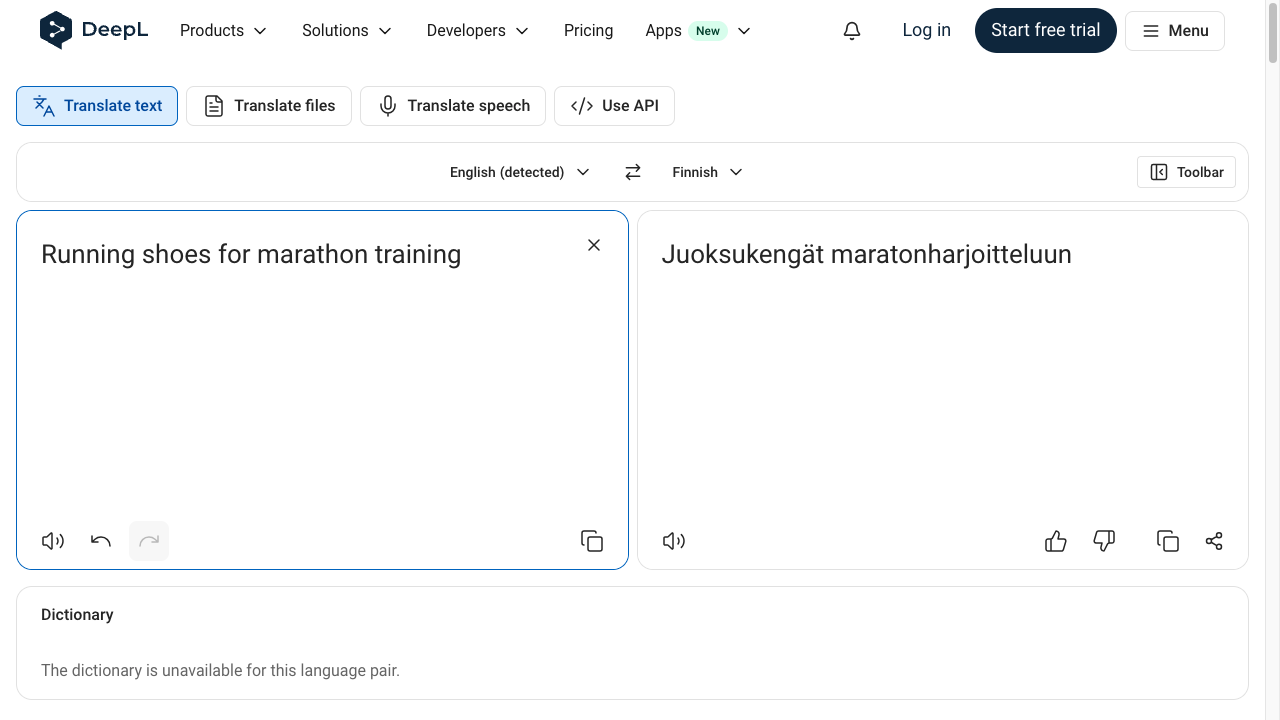
A fluent machine translation like this is the easy part. The SEO question is whether Finnish searchers actually use that phrasing, and whether the rest of the page was localized around it. Google Translate vs AI localization for SEO is the same distinction: readable output is not a market-ready page.
The strongest AI use cases are:
- First-pass translation: AI can create a working draft fast.
- Repetitive product content: Specs, attributes, short descriptions, and support snippets are easier to standardize.
- Terminology consistency: Approved terms can be reused across thousands of pages.
- Metadata ideation: AI can generate title and description options for a human to choose from.
- Bulk content operations: AI can help teams translate and update large libraries without starting from zero each time.
- Low-risk internal content: Documentation drafts, internal knowledge bases, or early-stage market tests can move faster.
This is where platforms built for bulk blog translation make sense. The value is not that the machine replaces review. The value is that it removes the blank page and lets humans spend time on the parts that matter most.
For one-off pages, a blog post translator may be enough. For larger batches across several locales, multi-language bulk translation is a better fit.
Where Human Translation Still Wins
Human translation matters most when the page has persuasion, ambiguity, risk, or local nuance.
This includes sales pages, product positioning, pricing pages, comparison pages, legal language, healthcare content, financial claims, and any article where trust depends on sounding native. A human reviewer can catch problems that a translation model may miss because the sentence is grammatically fine.
Human translators and native SEO editors are especially useful for:
- choosing the keyword people actually search for
- replacing idioms, jokes, slogans, and metaphors that do not travel well
- making CTAs sound natural instead of translated
- adapting examples, currencies, measurements, product terms, and cultural references
- checking whether the page answers the local version of the query
- spotting compliance risks before publication
- preserving brand voice across languages
This is also where the difference between translation and localization becomes real. Translation transfers meaning. Localization adapts the page so the reader feels it was written for their market in the first place.
That distinction is important for SEO because search behavior is local. A native speaker may use different phrasing than a dictionary would suggest. A buyer in one market may want price comparison first, while another may care more about trust, delivery, certification, or implementation details.
If the real choice is staffing versus software, compare human translation agencies vs AI localization platforms after you have decided which pages need native review.
AI Translation vs Human Translation: SEO Comparison
Here is the clearest way to compare them for SEO work.
| Criteria | AI translation | Human translation |
|---|---|---|
| Speed | Very fast | Slower |
| Cost per first draft | Low | Higher |
| Scale | Strong for large websites | Harder to scale without a team |
| Literal accuracy | Often good for common content | Strong |
| Cultural nuance | Inconsistent | Strong |
| Keyword localization | Weak without guidance | Strong when paired with SEO knowledge |
| Metadata quality | Good for options, weak for final judgment | Stronger for final SERP copy |
| Brand voice | Needs rules and editing | Stronger with a trained translator |
| Regulated content | Risky | Safer with subject-matter review |
| Best role | Production acceleration | Quality, strategy, and risk control |
The mistake is expecting one side to do everything.
AI can handle volume. Humans can handle judgment. SEO needs both.
A Better Workflow: Machine Translation Post-Editing for SEO
For most companies, the best workflow is machine translation post-editing, or MTPE.
MTPE means AI creates the first draft, then a human editor reviews and improves it before publication. For SEO pages, that review should include more than grammar. It should include keyword localization, metadata, internal links, search intent, and technical checks.
Here is a practical workflow.
- Segment pages by risk and value. Put homepages, product pages, comparison pages, legal pages, and high-traffic SEO pages into a higher-review tier.
- Generate the first translation with AI. Use a glossary, brand style guide, product terminology, and target locale instructions.
- Run native keyword research. Do not just translate the English keyword list. Validate how people search in that country and language.
- Rewrite titles, descriptions, and H1s. Treat metadata as new SERP copy, not a translation chore.
- Review headings and intent. Reorder sections if the local search intent needs a different answer first.
- Check examples, CTAs, and claims. Replace awkward phrasing and localize anything that affects trust or conversion.
- Fix internal links. Link to the correct language version of related pages where available.
- Validate technical SEO. Check canonical tags, hreflang, URL structure, sitemap inclusion, and indexability.
- Publish in batches. Avoid shipping thousands of unreviewed pages at once if quality has not been proven.
- Monitor by locale. Track impressions, rankings, CTR, engagement, conversions, and index coverage by language or country.
This workflow is slower than raw AI translation, but much safer than publishing machine output directly. It also scales better than fully human translation for every page.
For a larger rollout, how to bulk translate articles is the operations layer. Prove quality on a small batch first. Then scale.
The Technical SEO Checks Matter as Much as the Translation
A strong translation can still underperform if the technical setup is weak.
Google's documentation for multi-regional and multilingual sites recommends using different URLs for different language versions and using hreflang annotations when you have alternate language or regional pages. Its documentation on localized versions also explains that hreflang helps Google understand pages as localized alternatives.
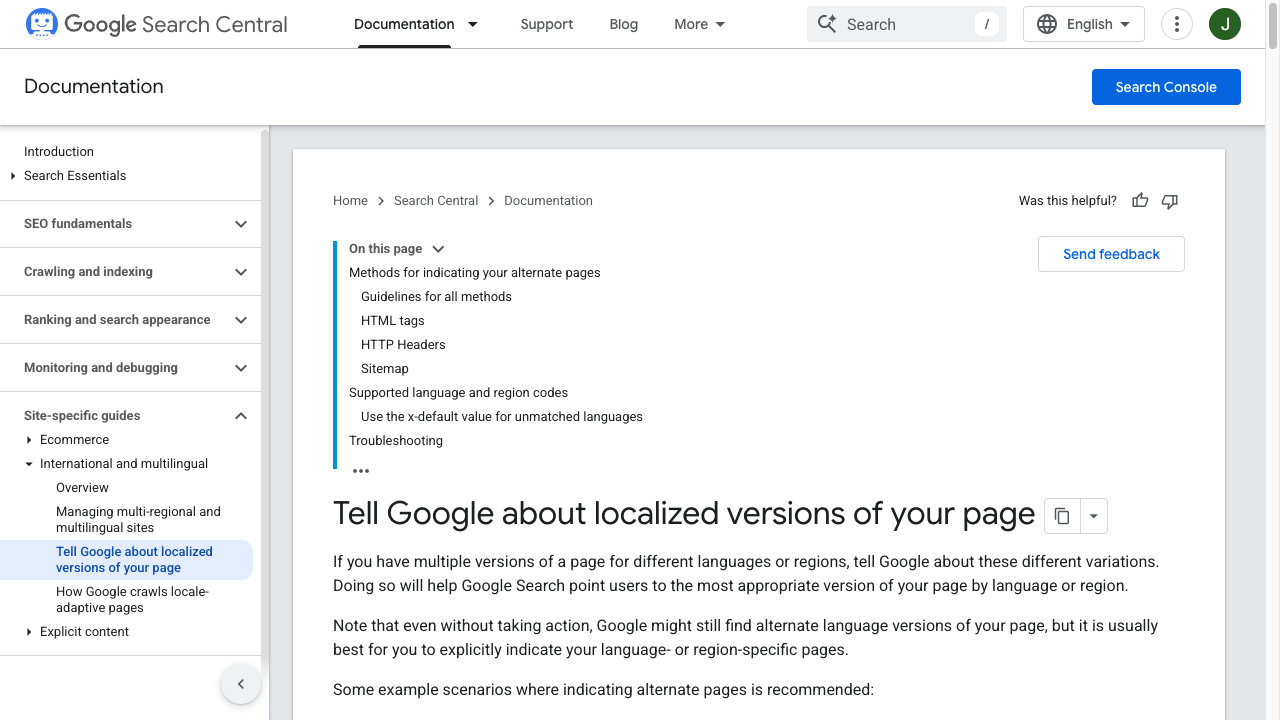
I would not ship a multilingual batch until this is implemented. Beautiful translations still fail when Google cannot tell which version belongs to which market.
Internationalization and hreflang | Search Off the Record
For SEO teams, the practical checklist is:
- Use a consistent URL structure, such as
/es/,/fr/, or another clear language-region setup. - Add hreflang annotations for each alternate version.
- Include reciprocal hreflang references between language versions.
- Use
x-defaultwhere a global fallback page makes sense. - Keep canonicals self-referencing unless you have a specific consolidation reason.
- Translate or localize slugs where it helps users and search clarity.
- Localize title tags, meta descriptions, image alt text, and on-page headings.
- Keep internal links inside the same language journey when possible.
- Submit updated multilingual URLs through your normal indexing and sitemap workflow.
If hreflang is already messy, fix hreflang for multilingual websites before you add more languages. Technical mistakes can show the wrong version, split signals, or hide new pages.
What to Human-Review Before Publishing
You do not need the same review depth for every page. You do need a clear gate before translated SEO content goes live.
Use this checklist for any page that matters.
| Review area | What to check |
|---|---|
| Search intent | Does the page answer what local searchers actually want? |
| Primary keyword | Is the target term native to the market, not just translated? |
| Secondary terms | Are local variants, questions, and synonyms covered naturally? |
| Title tag | Would a native searcher click this result? |
| Meta description | Does it match the query and sound natural? |
| H1 and headings | Are headings clear, local, and useful? |
| Body copy | Does the page read like native content? |
| CTAs | Are offers, buttons, and next steps natural for the market? |
| Claims | Are legal, medical, financial, or product claims accurate locally? |
| Internal links | Do links point to the right language versions? |
| Technical SEO | Are canonicals, hreflang, slugs, and sitemaps correct? |
| Measurement | Is the page included in locale-level reporting? |
This is also when you should stop polishing grammar and start adding local examples, clearer sections, and phrasing that does not sound imported. Adding a human touch to AI-generated content matters more here than another translation pass.
When AI-Only Translation Is Acceptable
AI-only translation can be acceptable when the page is low-risk, formulaic, and easy to audit after publication.
Good candidates include:
- short product attributes
- repetitive catalog descriptions
- support articles with simple instructions
- internal documentation
- temporary market tests
- low-traffic pages that are not legal, medical, financial, or conversion-heavy
Even then, it helps to use glossaries, translation memory, style rules, and spot checks. AI-only should mean "lightly governed," not "uncontrolled."
Avoid AI-only translation for:
- pages that drive paid or organic revenue
- pages with legal, medical, financial, or safety claims
- homepage and pricing copy
- high-competition SEO articles
- thought leadership
- brand campaigns and slogans
- markets where your team does not understand the language well enough to evaluate output
Publishing raw AI translations at scale is where multilingual SEO can turn into thin content. The safer approach is to scale in layers: automate the draft, review the important pages, measure performance, then expand.
A Simple Page-Tiering System
If you are not sure how much human review to budget for, tier your pages.
| Tier | Page types | Recommended workflow |
|---|---|---|
| Tier 1: High value or high risk | Home, product, pricing, legal, medical, financial, core landing pages | Human-led or deep MTPE with native SEO review |
| Tier 2: SEO growth pages | Blog posts, comparison pages, category pages, buying guides | AI draft + native SEO edit |
| Tier 3: Structured scale pages | Product catalogs, templates, support articles | AI draft + glossary + spot checks |
| Tier 4: Low-risk internal content | Internal docs, draft knowledge base pages | AI translation with light review |
This system keeps review resources where they matter. It also makes the workflow easier to explain internally: not every page needs the same investment, but no important page should be published just because the AI output looks fluent.
How to Measure Whether Translation Is Helping SEO
Do not judge multilingual SEO only by how many translated pages went live. Judge it by whether each market starts earning useful visibility. That is the difference between a translation project and AI multilingual SEO.
Track these signals by language or country:
- indexed URLs
- impressions
- rankings for localized keywords
- click-through rate
- engagement and scroll depth
- conversions or assisted conversions
- revenue by locale
- pages with high impressions but low CTR
- pages with traffic but weak engagement
- pages indexed in the wrong language or region
The most useful pattern is often mismatch. A translated page may get impressions but few clicks because the title sounds unnatural. Another may get clicks but low engagement because the page answers the wrong intent. Another may rank in the wrong country because hreflang or internal linking is messy.
That is why translation QA should continue after launch. Search data tells you where local users are not responding.
Ranking blog posts in foreign countries is the same loop: publish in batches, compare markets, and fix pages that get demand but weak engagement.
If you are choosing between raw machine translation and a localization workflow, this comparison of AI localization vs DeepL vs Weglot is the practical next read.
What I Would Automate First
I would automate drafts, catalogs, and glossary-backed updates. I would not automate keyword choice, titles, CTAs, or hreflang.
Use AI for speed. Use humans for the parts that decide whether the page belongs in that market:
- native keyword research, not dictionary translation
- metadata written for the local SERP
- claims, legal language, and conversion copy
- language-matched internal links
- hreflang, canonicals, and locale reporting
If the page can affect rankings, revenue, reputation, or compliance, do not publish raw AI translation. How Google ranks translated content still comes down to usefulness in that market, not whether the sentences were machine-made. Fluency is cheap. Localized SEO is not.