
How to Bulk Translate Affiliate Content Without Killing SEO

Thu
AI SEO Specialist, Full Stack Developer

I treat bulk translating affiliate content as an SEO and localization project, not a copy-paste translation job. The basic idea is simple: take your best affiliate pages, translate them into multiple languages, localize the keywords, adjust the buying context, preserve the disclosures, and publish each version with the right technical signals.
The hard part is doing that across 50, 100, or 500 pages without creating thin affiliate pages in 10 languages.
That is the part most people get wrong.
Google's spam policies specifically call out thin affiliate pages when product descriptions or reviews are copied without original value. That risk gets bigger when you translate the same weak review template across many URLs. A translated page still needs useful comparisons, local buying context, original judgment, and a reason to exist beyond the affiliate link.
So the winning workflow is not:
- Export English article.
- Translate everything.
- Publish 10 versions.
- Hope hreflang fixes the rest.
It is closer to this:
- Choose pages that already deserve to rank.
- Pick markets where the affiliate offer, language, and search demand make sense.
- Localize keywords before translating the article.
- Translate in bulk with a glossary, style rules, and human review tiers.
- Localize prices, availability, examples, disclosures, CTAs, and internal links.
- Add hreflang, canonical rules, and language-specific sitemaps.
- Track rankings, clicks, and affiliate revenue by locale.
If you need a tool for the execution layer, Junia's bulk blog translation tool is the starting point I would actually open. The rest of this article is the affiliate SEO strategy around it.
The Fast Answer
To bulk translate affiliate content safely, start with 20 to 50 proven English pages, map each page to a target language and country, run separate keyword research for that locale, translate with a glossary and translation memory, then review the money sections manually before publishing.
Do not translate every affiliate page just because you can.
Start with pages that meet all or most of these conditions:
| Page type | Good candidate? | Why |
|---|---|---|
| Product comparison pages with original testing or strong selection logic | Yes | They can be localized into country-specific buying guides. |
| "Best X" affiliate roundups with thin merchant descriptions | Not yet | Improve the source page before translating it. |
| How-to guides that naturally recommend tools | Yes | Search intent often transfers well across languages. |
| Coupon, deal, and price pages | Maybe | They need local prices, shipping, tax, and availability updates. |
| Programmatic pages with swapped product names only | Risky | Translation can multiply thin-content problems. |
The safest mindset is this: translated affiliate content should feel like it was created for that market from the start.
Why Affiliate Translation Is Different From Normal Website Translation
Normal website translation is usually about making existing information understandable.
Affiliate translation has a second job: it has to preserve trust and buying intent.
That means the translated page must still answer questions like:
- Is this product available in my country?
- Does the price make sense in my currency?
- Are there better local alternatives?
- Is the review based on real experience or just rewritten merchant copy?
- Can I trust the recommendation?
- Is the affiliate relationship clearly disclosed in my language?
This is where many bulk translation projects fail. They translate the words but leave the buying context in the original market.
For example, a US article about "best VPNs for streaming" may mention Hulu, ESPN+, US pricing, and American payment methods. If you translate that article into German, the reader may care more about DAZN, RTL+, EU privacy expectations, local tax-inclusive pricing, and German-language support.
The original article can still be the source. But the translated version needs local judgment.
Pick Markets Before You Pick Languages
Do not choose 10 languages because they look impressive in a launch plan.
Choose markets where all four pieces line up:
| Decision point | What to check |
|---|---|
| Search demand | Are people searching for this topic in the target language? |
| Ranking difficulty | Is the local SERP easier than the English one? |
| Affiliate monetization | Does the merchant accept traffic and conversions from that country? |
| Localization effort | Can you make the page genuinely useful without rebuilding everything? |
This is one of the most useful ideas from the competitor research for this topic. WPML's affiliate SEO article makes a simple point: English keywords often have higher volume, but they also attract much heavier competition. Non-English versions of the same topic can have lower difficulty while still offering meaningful demand.
Ahrefs takes that further by separating language targeting from regional targeting. A page can target Spanish speakers in the United States, English-speaking expats in Japan, or French speakers in Canada. Language and country are related, but they are not the same thing.
That matters for affiliate content because commission potential is usually country-specific.
Before translating, build a simple market matrix:
| Source page | Target language | Target country | Affiliate program available? | Local keyword validated? | Priority |
|---|---|---|---|---|---|
| Best email marketing tools | Spanish | Mexico | Yes | Yes | High |
| Best email marketing tools | Spanish | United States | Yes | Yes | High |
| Best email marketing tools | German | Germany | Maybe | Yes | Medium |
| Best email marketing tools | Japanese | Japan | No | Yes | Low |
If the affiliate program does not pay for a market, do not prioritize that translation unless the page supports another business goal.
Do Keyword Localization Before Translation
The biggest SEO mistake is translating English keywords literally.
People do not always search by translating your English phrase into their language. They use local terms, borrowed English terms, product nicknames, dialect differences, and country-specific modifiers.
For affiliate pages, keyword localization should cover:
- Main topic keyword
- Product category terms
- "Best", "review", "alternative", and "comparison" modifiers
- Local price and availability modifiers
- Country-specific merchant names
- Local compliance or tax terms when relevant
- Search intent differences between English and the target language
Let's say your English page targets "best website builders for small business."
A weak translation workflow sends that phrase into a translation API and uses the output as the target keyword.
A stronger workflow checks what people actually search in the target market:
| English intent | Possible localized angle |
|---|---|
| best website builders for small business | best website builder for freelancers in Germany |
| website builder comparison | Wix vs Jimdo vs IONOS comparison |
| cheapest website builder | website builder with VAT-inclusive pricing |
| website builder for ecommerce | shop system for small online stores |
This is where Junia's AI keyword research tool can help you build language-specific keyword sets before the translation starts.
Once you have those terms, feed them into the translation workflow as required terminology. The article should not be translated first and optimized later as an afterthought.
Build a Source Page That Is Worth Translating
Bulk translation multiplies whatever is already true about the source page.
If the English page is useful, translation can scale that value.
If the English page is thin, translation scales the problem.
Before translating an affiliate page, improve the source version until it has enough original value. At minimum, it should include:
- A clear selection method for products or tools
- Original comparisons instead of copied merchant descriptions
- Specific pros, cons, use cases, and tradeoffs
- Screenshots, examples, test notes, or practical observations where possible
- A clear affiliate disclosure
- Updated pricing or availability notes when those affect decisions
- Internal links that help readers continue the journey
This is not just editorial polish. It is SEO risk control.
Google says good affiliate pages can add value through original reviews, ratings, product navigation, price information, comparisons, and other useful features. That gives you a practical standard for deciding whether a page is ready for translation.
If the page would not be useful without the affiliate links, fix it before you localize it.
Translating a thin affiliate page just creates thin pages in more languages. I would rather delay a market launch than multiply a review that is still merchant copy with a language dropdown.
The Bulk Translation Workflow I Would Use
Here is a clean workflow for translating affiliate content in batches.
1. Export the content and page data
For each source page, export:
- Markdown or HTML body
- Title tag
- Meta description
- H1 and headings
- Image alt text
- Internal links
- Affiliate links
- Schema fields
- Product names and brand terms
- Existing disclosure text
Do not treat the article body as the only thing that needs translation. Meta titles, image alt text, comparison table labels, button text, and schema fields matter too.
2. Create a glossary
A glossary keeps your translations consistent across hundreds of pages.
Include:
- Brand names that should never be translated
- Product category terms
- Approved translations for recurring SEO terms
- Words to avoid
- Tone rules
- Disclosure wording
- CTA wording
- Currency and measurement conventions
For affiliate sites, I would also include a "do not localize" list for merchant names, coupon codes, tracking IDs, and URL parameters.
3. Translate in batches
Use a translation system that can preserve markdown, shortcodes, embeds, affiliate URLs, and HTML blocks.
This is where AI translation tools or a translation API can save a lot of time. A purpose-built multilingual platform is useful later, once the glossary and review tiers exist. For a broader comparison of machine vs human work, see AI website translation vs human translation for SEO.
But keep the batch size reviewable. Translating 1,000 URLs in one run sounds efficient until you have to debug broken anchors, mixed-language headings, and duplicated disclosures across 10 language folders.
For the first launch, I would rather translate 30 pages into 3 markets and review them properly than translate 300 pages into 12 markets and discover the issues after indexing.
4. Localize the money sections manually
Not every paragraph needs the same review depth.
Use a tiered review model:
| Section | Review level |
|---|---|
| Introduction and summary | Native or fluent human review |
| Product recommendations | Native or fluent human review |
| Comparison tables | Manual fact and localization check |
| Affiliate disclosures | Compliance and language check |
| Generic background sections | AI translation plus spot check |
| Internal links | Automated mapping plus manual sample QA |
The product recommendation sections deserve the most attention because they carry the trust and revenue.
Ask reviewers to check:
- Does this recommendation make sense in the target country?
- Are prices, shipping, features, and availability accurate?
- Are local competitors missing?
- Does the tone feel natural?
- Are the affiliate disclosures understandable?
- Would a local reader feel this page was written for them?
5. Map affiliate links by locale
Affiliate links are easy to break during translation.
Before launch, decide how links should behave for each market:
| Link situation | Better handling |
|---|---|
| Merchant has local storefronts | Use locale-specific affiliate links. |
| Merchant ships internationally | Keep the global link, but clarify shipping or currency. |
| Merchant does not serve the market | Replace it with a local alternative or remove the recommendation. |
| Affiliate program has country-specific terms | Use the correct program, disclosure, and tracking ID. |
| Product is unavailable locally | Do not recommend it as a top pick. |
This is also where you should check program rules. Some affiliate programs restrict paid search, coupon wording, brand bidding, email promotion, or international traffic. Translation does not remove those obligations.
Use Hreflang, But Do Not Expect It To Save Bad Pages
Hreflang is important, but it is not magic.
Google's documentation on localized versions of pages says you can indicate alternates through HTML tags, HTTP headers, or sitemaps, and that each language version should list itself and the other alternates. Google also notes that localized versions are not considered duplicates if the main content is fully translated.
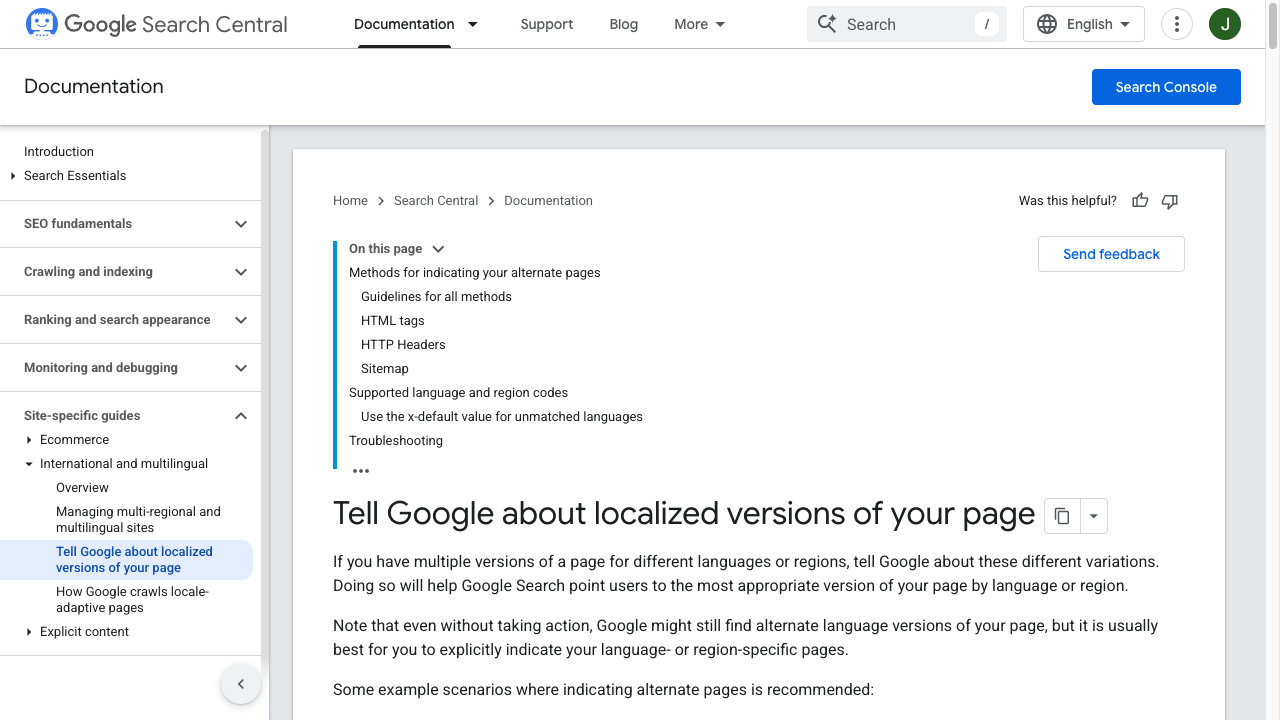
Google Search Central on hreflang and localized versions of pages
That gives you the baseline:
- Use a stable URL structure such as
/es/,/de/, or/fr/. - Add self-referencing hreflang on every localized page.
- Include all alternate versions in the same hreflang cluster.
- Add
x-defaultwhen you have a fallback or selector page. - Keep canonicals self-referencing unless you intentionally do not want a page indexed.
- Make sure internal links point to same-language pages where possible.
- Add localized URLs to XML sitemaps.
If you need a deeper technical walkthrough, Junia's guide to hreflang for multilingual websites is the one I would keep open while implementing tags. Ranking behavior of translated URLs is a separate question, and it depends on whether the localized page is actually useful.
One useful competitor insight came from GSQi's AI search testing: Google and Bing were generally better at returning the right language URL than several standalone AI search tools, while AI systems were inconsistent across languages. That does not mean you should optimize only for AI search. It means your language signals, internal links, and page quality need to be clean enough for both classic search and AI-assisted discovery.
Do Not Forget Affiliate Disclosures
Affiliate disclosures need to survive translation.
In the United States, the FTC says affiliate relationships should be disclosed clearly and conspicuously, and its endorsement guidance says the disclosure should be close enough to the recommendation that readers understand the relationship before acting on it.
For multilingual affiliate content, that means:
- Translate the disclosure into the page language.
- Put it near the recommendation or affiliate links, not only in the footer.
- Do not hide it behind vague wording.
- Make sure button text and comparison tables do not imply neutrality if the links are paid.
- Check local advertising rules for markets outside the United States.
This is especially important when you bulk translate comparison pages. A disclosure that is clear in English may be awkward, vague, or legally weak in another language.
A simple disclosure pattern is usually better than a clever one:
This article contains affiliate links. If you buy through these links, we may earn a commission at no extra cost to you.
Then translate that naturally for each language.
Localize More Than Text
The best multilingual affiliate pages usually localize the whole decision environment.
That includes:
- Currency
- Tax and VAT expectations
- Shipping and delivery notes
- Payment methods
- Product availability
- Local alternatives
- Screenshots
- Customer support language
- Trust badges or guarantees
- Date, number, and measurement formats
- Right-to-left layout needs for languages such as Arabic
Ahrefs' competitor article gave a useful example here: Canva does not only translate text. It adapts visual examples and design choices for different audiences. For affiliate content, the equivalent is updating screenshots, product examples, comparison criteria, and CTAs so the page feels local.
This is also where many affiliate pages can beat generic translated pages.
For example, instead of translating:
Best CRM software for small businesses
you might localize the page into:
Best CRM software for small businesses in Germany, including GDPR-friendly options, German-language support, EUR pricing, and local invoicing integrations
That is not just translation. That is a better page.
Internal Links Need Their Own Translation Plan
Internal links are often messy after bulk translation.
If every Spanish article links back to English pages, the site feels unfinished. If every translated page links only to translated versions that do not exist yet, you create broken or thin pathways.
Use three rules:
- Link to the same-language version when it exists.
- Link to the best English source when no localized version exists and the article is still useful.
- Avoid forcing the same internal links into every translation.
That is the same discipline I would use in how affiliate marketers use multilingual SEO: the next click should help the reader finish the buying decision in their language, not dump them back into an English hub because the CMS defaulted that way.
The same rule shows up in AI multilingual SEO. Technical signals do not replace a useful next page.
The goal is not to stuff the translated page with internal links. It is to help the reader move to the next useful page in the same language or topic path.
A Practical QA Checklist Before Publishing
Before you publish a batch, check a sample manually and crawl the rest.
Use this checklist:
| QA item | What to verify |
|---|---|
| Language quality | No mixed-language headings, awkward literal translations, or untranslated UI labels. |
| Search intent | The page answers the localized keyword, not only the English source keyword. |
| Affiliate links | Tracking IDs, local storefronts, and program rules are correct. |
| Disclosures | Translated, visible, and close to recommendations. |
| Product facts | Prices, availability, shipping, taxes, and local alternatives are accurate. |
| Internal links | Same-language links are used where possible. |
| Hreflang | Self-referencing and reciprocal alternates are present. |
| Canonicals | Each indexable localized page canonicalizes to itself. |
| Sitemaps | Localized URLs are included. |
| Schema | Language-specific titles, descriptions, FAQs, and product fields are correct. |
| Images | Alt text is translated and screenshots still match the market. |
| Thin content risk | The page adds original value beyond translated merchant copy. |
For larger sites, this should become a repeatable QA process, not a one-time check.
How To Measure Results
Measure translated affiliate content by locale, not only by total traffic.
Track:
- Indexed URLs by language
- Impressions and clicks by country
- Rankings for localized keywords
- Conversion rate by language
- Affiliate revenue by market
- Pages with high impressions but low CTR
- Pages with traffic but weak affiliate clicks
- Pages that rank in the wrong country or language
Google Search Console can show search performance by country and query. GA4 can help you segment users by geography and language settings. Affiliate dashboards can show whether the traffic is actually converting.
The most important metric is not "how many pages did we translate?"
It is "which translated pages are earning enough to justify deeper localization?"
After 30 to 60 days, sort pages into three groups:
| Result | Action |
|---|---|
| Ranking and converting | Add more internal links, improve comparisons, and expand the cluster. |
| Ranking but not converting | Rework CTAs, product fit, pricing, and local alternatives. |
| Not ranking | Recheck keyword intent, hreflang, content quality, and SERP competition. |
This is how bulk translation becomes a compounding SEO system instead of a one-time publishing push.
Common Mistakes
The fastest way to ruin a multilingual affiliate rollout is to scale before the workflow is stable.
Watch for these mistakes:
- Translating every page instead of prioritizing proven winners
- Using literal keyword translations
- Keeping US prices, examples, and merchants on non-US pages
- Publishing pages where the affiliate offer is unavailable
- Forgetting translated affiliate disclosures
- Canonicalizing all translated pages back to English
- Missing reciprocal hreflang tags
- Linking every localized article back to English pages
- Reusing merchant descriptions without adding original value
- Measuring traffic without measuring affiliate revenue
Bulk translation is powerful because it gives you leverage. But leverage cuts both ways. It can multiply strong content, and it can multiply weak content just as quickly.
The Best Way To Start
If I were launching this from scratch, I would not begin with 100 pages in 10 languages.
I would start with 20 strong affiliate pages, two or three target markets, one glossary, one internal link map, one hreflang pattern, one review checklist, and a 60-day measurement window. Then I would scale the combinations that prove they can rank and convert.
That is the real advantage of bulk translation. You do not have to guess your way into global SEO. You can test markets quickly, learn where non-English demand is easier to win, and build localized affiliate content that actually helps someone buy.
Translate the content, yes. Localize the reason someone should trust it.