
E-E-A-T for AI Content: How to Use AI Writing Tools Without Losing Trust

Thu
AI SEO Specialist, Full Stack Developer

AI writing tools do not automatically violate E-E-A-T. I have seen them become a problem for a more ordinary reason: the final page has no real experience, no clear author, weak sourcing, generic advice, and no reason for readers to trust it.
Google's own guidance on AI-generated content in Search is fairly direct: automation is not the issue by itself. Low-effort content created mainly to manipulate rankings is the issue. That distinction matters, because it means the practical question is not "Did AI help write this?" It is "Does the finished page deserve to be trusted?"
TL;DR: The E-E-A-T Checklist for AI Content
Use this quick pass before publishing any AI-assisted article:
| E-E-A-T signal | What to add before publishing | What weak AI content usually misses |
|---|---|---|
| Experience | First-hand notes, screenshots, tests, examples, workflow details, product use, or real editorial judgment | Generic advice that could appear on any site |
| Expertise | Accurate terminology, clear tradeoffs, reviewed claims, useful explanations, and subject-matter input where needed | Confident wording without real depth |
| Authoritativeness | Strong author profile, consistent topical coverage, reputable citations, case studies, and internal topic support | Anonymous or disconnected posts with no credibility trail |
| Trustworthiness | Sources, dates, transparent methods, clear limitations, readable formatting, and no exaggerated claims | Unsupported claims, vague statistics, and polished filler |
My rule is simple: use AI for speed, structure, and cleanup, but do not let it become the source of trust. Trust has to come from your process, your evidence, and the choices you make after the draft exists.
What E-E-A-T Means for AI-Written Content
E-E-A-T stands for Experience, Expertise, Authoritativeness, and Trustworthiness. It is not a single score you can optimize like a title tag. It is a quality framework Google uses in its Search Quality Rater Guidelines, and Google also recommends evaluating helpful content through the lens of Who, How, and Why.
For AI-assisted content, those questions are especially useful:
- Who created or reviewed the content?
- How was AI used in the process?
- Why does the page exist beyond trying to capture search traffic?
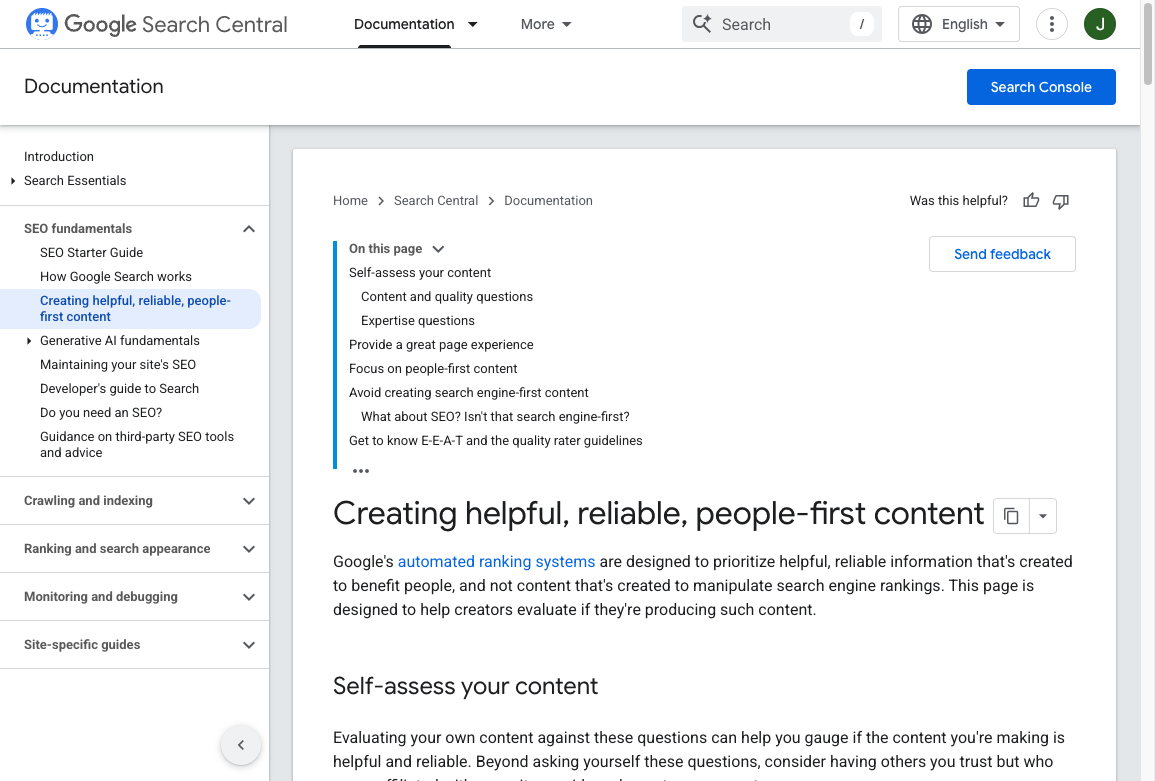
If those answers are invisible, the article may still read smoothly, but it will feel thin. That is where I see many AI drafts fail. They summarize what is already known, then stop right before the part that would make the page worth trusting: proof, interpretation, and accountability.
Does Google Penalize AI Content?
No, not simply because AI was involved.
| E-E-A-T gap AI usually leaves | What to add before publish |
|---|---|
| Experience | First-hand tests, screenshots, “what failed when we tried…” |
| Expertise | Named reviewer, credentials where relevant, source pack |
| Authoritativeness | Consistent authorship + citations to primary sources |
| Trust | Accurate claims, clear limits, no invented stats |
Don’t confuse fluency with trust. Smooth AI prose can still fail E-E-A-T if nobody verified the claims.
Does Google see automatically generated content as a bad thing?
Google has repeatedly framed the issue around helpfulness, originality, and people-first value. Its guidance for succeeding in AI search experiences also emphasizes unique, non-commodity content that satisfies real user needs.
That means an AI-assisted article can perform well if the final version is useful, accurate, original, and trustworthy. It also means a human-written article can perform badly if it is shallow, copied, outdated, or written mainly for search engines.
The risk with AI is scale. A team can now publish 100 average articles faster than it can properly review 10 strong ones. In my experience, this is where the quality gap opens. If your workflow is prompt, paste, publish, you are not building E-E-A-T. You are creating a larger quality-control problem.
Where AI Writing Tools Help and Where They Hurt
AI writing tools are useful when they reduce busywork. They are risky when they replace judgment.
| AI task | Good use | E-E-A-T risk |
|---|---|---|
| Research support | Summarizing source material and surfacing questions to verify | Treating AI summaries as facts |
| Outlining | Organizing search intent, sections, and comparison points | Copying the same structure as every competitor |
| Drafting | Creating a rough first version for human editing | Publishing generic paragraphs with no original value |
| Optimization | Improving metadata, headings, readability, and formatting | Over-optimizing anchors, keywords, or repeated phrases |
| Refreshing | Finding outdated claims, missing examples, and thin sections | Updating wording without checking whether the claim is still true |
I like using AI at the messy middle of the process: when the idea is clear but the structure needs work, or when a draft needs a sharper outline. I do not trust it as the final source for facts, product claims, legal/medical/financial advice, or first-hand experience.
For SEO teams, this is also where the difference between "AI-assisted" and "AI-replaced" becomes obvious. A good workflow still follows SEO best practices: clear intent, useful structure, crawlable links, accurate metadata, and content that actually answers the query.
A Practical E-E-A-T Workflow for AI Writing Tools
The strongest AI content workflows usually have the same shape: human strategy first, AI support second, human verification last.
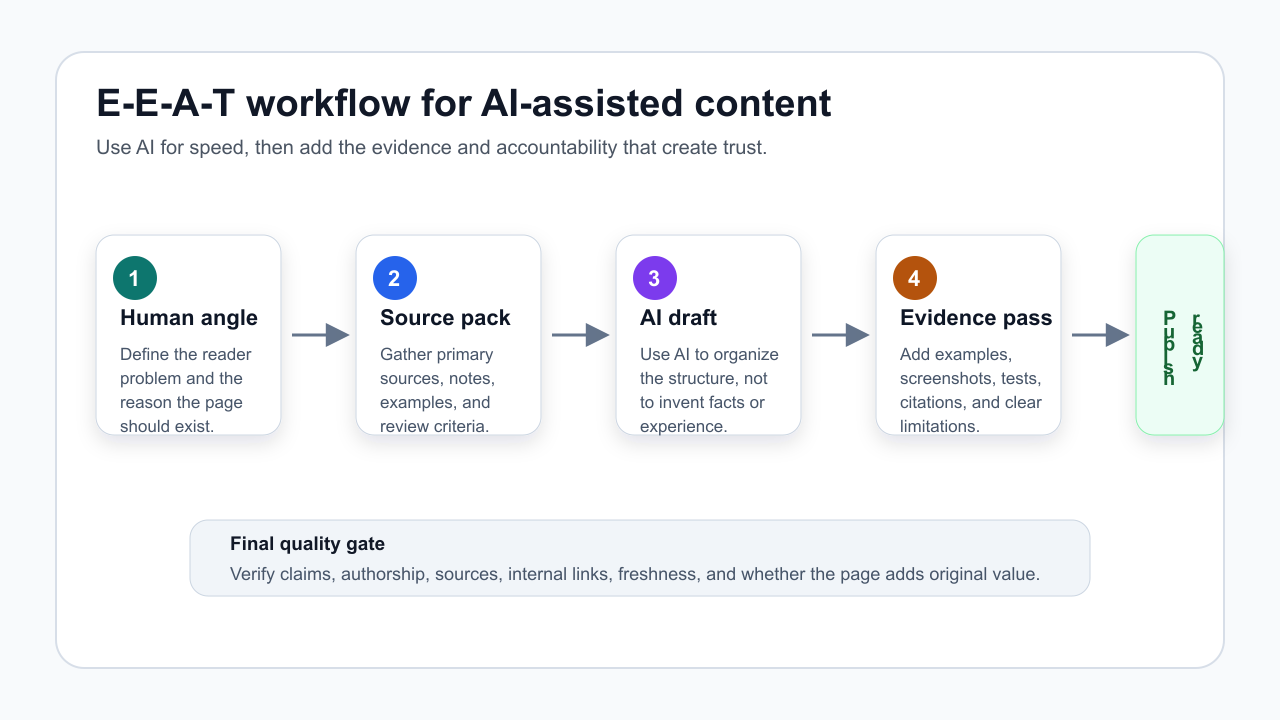
1. Start With the Reader's Real Problem
Before opening an AI writer, write down the reason the page should exist. Not the keyword. The reader problem.
For this topic, the real problem is not "what is E-E-A-T?" It is more specific: "Can I use AI writing tools without damaging trust, quality, or rankings?"
That difference changes the article. Instead of another definition-heavy post, the page needs a checklist, workflow, examples, source-backed guidance, and warnings about common mistakes.
2. Build a Source Pack Before Drafting
Do not ask AI to invent the research base. Build one.
For an E-E-A-T article, that source pack might include:
- Google's AI content guidance
- Google's helpful content documentation
- Search quality or spam policy references
- product documentation if tools are mentioned
- internal data, examples, screenshots, or editorial notes
- expert comments or reviewer notes for high-risk topics
A citation generator can help format sources cleanly, but it cannot decide whether the source is good enough. I would rather use three strong primary sources than ten weak links that merely make the page look researched. Source quality is still an editorial decision.
3. Prompt for Structure, Not Final Truth
AI is useful for turning messy notes into a first outline. The prompt should force it to work from your materials instead of filling gaps with confident guesses.
Use a prompt like this:
Create an outline for an article about E-E-A-T and AI writing tools. Use only the source notes below. Separate verified claims from ideas that still need review. Include a practical checklist, examples of weak AI content, and a final pre-publish workflow. Do not invent statistics, case studies, or Google statements.
That prompt is boring on purpose. I have had better results with restrictive prompts like this than with clever ones, because they force the tool to organize evidence instead of performing confidence. For E-E-A-T, that tradeoff is usually worth it.
4. Add Experience the AI Cannot Fake
Experience is the easiest E-E-A-T signal to talk about and one of the hardest to fake well.
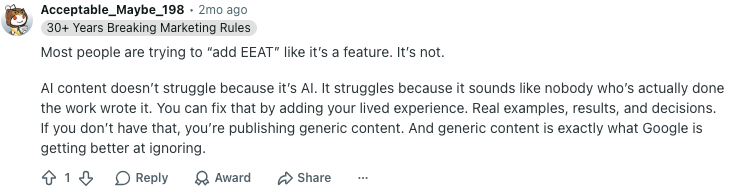
For AI content, experience can come from:
- screenshots of a tool workflow
- before-and-after edits
- notes from testing prompts
- examples from a real content refresh
- lessons from a failed ranking or recovery project
- a clear explanation of what the editor changed and why
If the article is about AI writing quality, include concrete editing examples. If it is about search recovery, show what was changed. If it is about tools, explain what the tool did well and where it broke down.
This is also where a draft can benefit from a human pass. Tools that add a human touch to AI-generated content can help with rhythm and readability, but they cannot invent credible experience. The useful part has to come from the person reviewing the work.
5. Review Claims Like an Editor, Not a Prompt Engineer
AI drafts often sound right before they are right. Check every claim that could affect a reader's decision.
Pay special attention to:
- statistics and dates
- tool features and pricing
- Google policy claims
- medical, legal, finance, or safety advice
- comparisons between products
- statements about ranking factors
If you cannot verify a claim, remove it or soften it. I do this even when the sentence sounds persuasive. A weaker but accurate line is better than a confident claim that creates trust problems later.
6. Make Authorship and Review Visible
For E-E-A-T, the page should make it easy to understand who is responsible for the content. That usually means a clear author, reviewer where appropriate, updated date, and a short explanation of relevant experience.
Google's Article structured data documentation recommends accurate article fields such as headline, image, author, datePublished, and dateModified where applicable. Structured data will not make a weak page authoritative, but it can make important page information easier for systems to understand.
If the author has no obvious connection to the topic, build that credibility honestly. Add reviewer input, cite stronger sources, or narrow the claim until it matches the author's actual expertise. I would not try to solve that gap with an inflated bio; readers can usually feel the mismatch.
What Strong E-E-A-T Looks Like in AI Content
Here is the difference in practice.
| Weak AI-assisted content | Strong AI-assisted content |
|---|---|
| "AI tools can improve SEO by creating high-quality content faster." | "AI can speed up outlines and first drafts, but every claim, example, and recommendation still needs review before publication." |
| "E-E-A-T is important for rankings." | "E-E-A-T is not a simple ranking score; it is a quality framework that helps evaluate whether a page deserves trust." |
| "Use credible sources." | "Cite the original Google guidance when discussing AI content, and avoid quoting secondary summaries as if they were policy." |
| "Add a human touch." | "Replace generic claims with testing notes, examples, screenshots, and specific editorial judgment." |
The strong version is not necessarily longer. It is more accountable.
How to Make AI Content Ready for AI Search
AI Search adds another layer to the problem. A page now needs to work for human readers, traditional search results, and AI systems that summarize, compare, and cite sources.
That does not mean stuffing the article with schema or turning every section into an FAQ. I am skeptical of that approach because it treats AI Search like a formatting trick. The better goal is simpler: make the page easy to understand and easy to trust.
Focus on five things:
- Answer early. Give the direct answer near the top so both readers and AI systems can understand the page quickly.
- Use clear sections. Headings should describe the actual question or task, not vague themes.
- Make entities clear. Name the author, brand, tools, sources, and concepts consistently.
- Support important claims. Link to primary sources when discussing Google policy, tool behavior, or high-stakes advice.
- Keep the page updated. AI search experiences are more likely to reward pages that stay useful as the topic changes.
This is why AI content should not be treated as a one-time asset. The first draft is only the start. I have found that the best pages often improve after the first update, once real search data, reader questions, and tool changes expose what the original draft missed.
Internal Links Should Support Trust, Not Distract From It
Internal links can strengthen E-E-A-T when they help readers move into deeper supporting material. They weaken the article when they feel like SEO inventory.
For example, if you mention whether AI content can rank, it is useful to connect that point to a deeper explanation of AI content and Google rankings. The link belongs because the reader may need more context on that specific question.
If the draft is still rough, do not hide that behind links. Edit the text first. A practical guide on how to edit AI-generated text is most useful after the article explains what needs fixing: weak claims, repetitive phrasing, generic examples, missing sources, and awkward structure.
The same applies to tools. A humanizer can improve phrasing, but it should not be used to disguise unsupported content. A readability pass helps only after the facts and structure are already solid.
Common E-E-A-T Mistakes With AI Writing Tools
The first mistake is publishing AI drafts because they sound finished. Smooth writing is not the same as useful writing. Personally, this is the mistake I watch for first, because polished filler can slip through review faster than obviously messy copy.
The second mistake is adding sources after the fact. That usually creates citation stuffing, where links decorate claims instead of supporting them. Sources should shape the article before drafting; otherwise, the citations are only cosmetic.
The third mistake is hiding the human role. If a subject-matter expert reviewed the article, say so in the page metadata or author area. If a team tested tools, show the test. If AI helped with drafting, make sure the final page still reflects human judgment.
The fourth mistake is using AI to scale weak content. If a site publishes dozens of similar pages with no original value, the problem is not the tool. The problem is the content strategy. This is exactly why bulk workflows need quality gates before they turn into bulk content generation that can hurt a website.
The fifth mistake is treating AI detectors as truth. They can be useful as a rough signal, but they are not reliable enough to decide whether a page is trustworthy. If you use an AI text detector, treat the result as a prompt for manual review, not a verdict.
Pre-Publish Checklist for AI-Assisted E-E-A-T Content
Before publishing, run this checklist:
| Check | Pass condition |
|---|---|
| Search intent | The article answers the real query early, not after a long definition section |
| Experience | The page includes examples, observations, screenshots, tests, or practical judgment |
| Expertise | The claims are accurate, specific, and reviewed by someone who understands the topic |
| Authority | The article has a clear author, relevant internal support, and credible external sources |
| Trust | Important claims are sourced, limitations are clear, and the page avoids hype |
| AI use | AI helped with workflow, but humans verified facts and final recommendations |
| Links | Internal links are natural, useful, and not duplicated just for SEO |
| AI Search | The page has concise answers, clear headings, entity clarity, and updated information |
If a page fails several of these checks, do not try to fix it with a better prompt. I would go back to the evidence, structure, and editorial process first. Better prompting can improve the draft, but it cannot rescue a page with nothing specific to say.
Final Recommendation
AI writing tools can fit E-E-A-T, but only when they sit inside a stronger editorial workflow.
Use AI to move faster: outline, summarize, rewrite, compare, and clean up. Then slow down where trust matters: source checking, examples, authorship, expert review, and final judgment.
That is the practical standard for AI content now. The page does not need to prove that no AI touched it. It needs to prove that a knowledgeable human took responsibility for the final result. That is the part I would optimize for before worrying about whether the prose sounds perfectly "human."