
International SEO for SaaS: Avoid the Mistakes That Kill Global Rankings

Thu
AI SEO Specialist, Full Stack Developer

International SEO for SaaS is the process of helping your product rank in the right countries, languages, and search engines without creating a fragmented mess. For SaaS teams expanding beyond one core market, it is not a side project. It directly affects discoverability, demo volume, and how efficiently you can enter new regions.
People in Germany, Japan, and Brazil do not search the same way. They use different terminology, compare vendors differently, and expect content that reflects local context. A strong international SEO strategy accounts for those differences so your product appears where buyers are already looking.
The upside of doing this well is clear:
- More organic traffic from regions where paid acquisition is expensive or underdeveloped
- Better acquisition efficiency because buyers find content in their own language and context
- Earlier market presence in regions where competitors have not built strong localized content yet
- Stronger regional trust because your pages reflect local terminology, proof, and expectations
- More durable growth as localized pages keep compounding beyond a single campaign
You are not just translating pages. You are building a repeatable system for localization, technical targeting, and market-specific content. AI translation workflows can speed up execution, but they work best when paired with real keyword research, localized examples, and a sound technical setup.
Start with the strategy: which markets to enter, how to structure URLs, how to localize content, how to implement hreflang, and how to measure regional performance. After that, an international SEO platform requirements can help enforce the technical workflow, while a SaaS team can use SaaS multilingual SEO operating model to scale execution across more languages.
Understanding International SEO for SaaS
Traditional SEO usually assumes one primary market. International SEO changes that. You need to help search engines understand which language and region each page serves, while also making the content feel native to the people reading it.
For SaaS teams, that means coordinating technical signals, localized keyword research, and market-specific messaging. A buyer searching in Germany may use different terminology, expect different proof points, and care about different compliance issues than a buyer in the US or Brazil.
The Localization Imperative
Localization is not the same as translation. Translating a landing page word for word can preserve meaning, but it often misses search intent, tone, and commercial context. If you are using AI-driven multilingual SEO workflows, the real win is speed paired with review, not speed alone.
The strongest international SaaS pages adapt examples, product positioning, and proof to local expectations. They also map content to regional buying behavior, which is why international SEO works best when it is tied closely to product marketing, customer research, and support insights.
Common Roadblocks in Global Markets
International SaaS SEO usually breaks down in the same places:
- Content duplication across near-identical country or language pages
- Resource strain when several markets need consistent quality at once
- Technical complexity around URL structure, indexing, and geo signals
- Search engine differences in markets where Google is not the only priority
- Regulatory requirements that affect messaging, forms, and trust signals
Long-form content still plays a role here, especially when you need clearer market education and deeper topical coverage. But it only works when the page is aligned to a specific locale instead of acting like a generic translated asset.
Global Reach and Localization Strategies
Website localization is more than simple translation. It means shaping the page so it feels natural in the target market. That can include currency, date formats, measurement units, screenshots, examples, support hours, and the level of formality in the copy.
The SaaS teams that do this well treat cultural adaptation as part of the product experience. Pricing pages should reflect local purchasing power and payment expectations. Case studies should use proof that the market recognizes. Product screenshots should show the interface in the local language when possible.
Enhancing Regional Search Visibility
Getting strong regional search visibility is not about luck. It comes from a clear plan for how each localized page is created, optimized, and connected:
- Local keyword integration: Research how people in each market describe your solution. German users may search for
Projektmanagement-Software, while French users may search forlogiciel de gestion de projet. - Region-specific content: Create guides, product pages, and resources that address local problems, regulations, and buying expectations. A multi-language bulk translation workflow can speed up drafts, but the output still needs localization review.
- Local business information: Add region-specific contact details, office addresses, support hours, and availability when those details affect trust.
- Mobile optimization: Some markets are heavily mobile-first, so localized pages should be tested on the devices buyers actually use.
You should also account for search engine differences. Google is dominant in many markets, but China may require Baidu, Russia may require Yandex, and South Korea may require Naver. Each platform has its own technical and content expectations.
The better your localization, the stronger the user experience. When visitors land on a page that uses their language, currency, and buying context, they are more likely to sign up, request a demo, or keep reading.
Technical Considerations for Global SaaS Platforms
Your URL structure shapes how easy international SEO will be to manage. Most SaaS teams end up choosing between ccTLDs (example.de), subdomains (de.example.com), and subfolders (example.com/de/).
| Structure | Best for | Main advantage | Main tradeoff |
|---|---|---|---|
ccTLDs | Separate country teams and strong local branding | Strongest geo-targeting signal | Highest cost and split authority |
Subfolders | Most SaaS companies scaling from one main domain | Centralized authority and easier maintenance | Slightly weaker local signal than ccTLDs |
Subdomains | Teams that need technical separation between regions | Cleaner operational separation | Can dilute authority and add complexity |
1. ccTLDs
ccTLDs give the strongest geo-targeting signal to search engines. When you use yoursite.de, the country target is immediately clear. This setup can also build trust with local users because the domain extension feels familiar.
The downside?
You are effectively building separate sites. That means split link equity, separate maintenance overhead, and a higher content production burden in every market.
2. Subfolders
Subfolders are usually the easiest and most efficient path for international SEO for SaaS companies. With this setup, you keep all your link authority on one main domain, but you still get to clearly organize your content by region so it doesn’t turn into a mess.
Why are subfolders usually the default choice?
- Implementation is straightforward
- Maintenance is simpler over time
- You build one stronger domain instead of splitting authority across several
This structure works especially well when you're trying to expand to several markets at the same time and you don’t want to juggle too many sites at once.
3. Subdomains
Subdomains sit between subfolders and ccTLDs. They give you clearer separation than subfolders, but they do not send the same country signal as ccTLDs. Search engines can treat them as semi-independent properties, which may dilute authority if the setup is not managed carefully.
Importance of Hreflang Tags
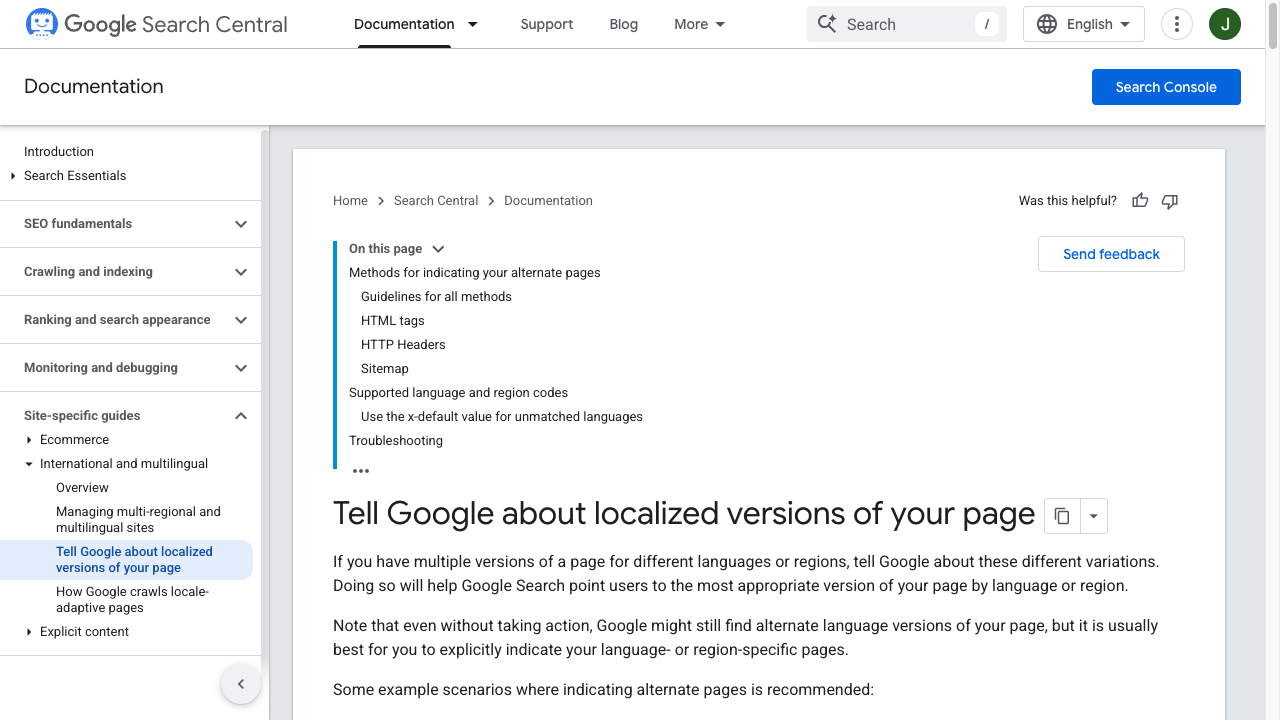
Hreflang tags are non-negotiable if you serve multiple language or country variants. They tell search engines which version of a page belongs to which audience, whether that is en-us, en-gb, de-de, or another locale.
| Structure | Usually best when… | Watch out |
|---|---|---|
| Subfolders | One product, shared authority | Weak local hosting/CDN needs |
| ccTLDs | Strong country brands/legal needs | Expensive to maintain |
| Subdomains | Separate teams/apps | Authority split |
SaaS dies on thin localized marketing sites. Localize docs and money pages first; don’t clone blog spam into 12 languages.
Internationalization & hreflang | Search Off the Record
When implemented correctly, hreflang helps with three things:
- It prevents search engines from guessing which localized page should rank.
- It reduces the risk of the wrong market page appearing in search results.
- It improves click-through rates because users land on the version that matches their language and location.
Use self-referencing tags on each page, keep mappings reciprocal across variants, and define an x-default version for unmatched users. This article covers hreflang as part of the broader international SEO strategy. For implementation mistakes and fixes, use the dedicated guide to hreflang troubleshooting checklist. For editorial planning, pair hreflang with a stronger multilingual content marketing process so technical targeting and localization stay aligned.
Keyword Research and Content Localization in International Markets
Localized keyword research is where international SEO becomes real. Translating English keywords directly into German, Spanish, or Japanese usually produces the wrong page targets because search behavior rarely maps one-to-one across markets.
Understand How Users Search
Start by validating the exact phrases buyers use in each market. A French prospect might search for logiciel de gestion de projet while a German prospect searches for Projektmanagement-Software, but similarity in meaning does not guarantee similar volume, intent, or competition. That is why local research and native review matter.
Identify Market-Specific Opportunities
Regional keyword research often reveals demand you would miss from a headquarters view. In some markets, people search by feature, integration, or regulation rather than by broad product category. That is one reason a market-by-market framework for how to rank blog posts in foreign countries tends to outperform direct translation.
Go Beyond Translation with Your Content Strategy
Your content strategy should reflect local buying context, not just local language. German buyers may want technical specs and privacy details early. US buyers may care more about onboarding speed and pricing. If you are building a broader multilingual content marketing motion, those differences should shape your outlines, examples, and calls to action.
Tailor Your Content to Local Expectations
Adapt tone, proof, screenshots, regulations, and use cases to the market you want to win. A healthcare SaaS page for Europe should surface GDPR concerns early, while the US version may need stronger HIPAA framing. If you are scaling this process, how SaaS companies localize content without translators is a useful companion workflow for keeping speed and quality in balance.
Building Authority Through Local Backlinks and Partnerships
Domain authority in international markets needs a pretty different approach compared to regular domestic link building. You can’t just copy whatever worked in your home market and hope it does the same thing everywhere else, in every region. It usually doesn’t work like that.
Acquiring High-Quality Local Backlinks
Local backlinks from trusted websites in your target markets send strong relevance and credibility signals. Start with industry directories, local business associations, and regional trade publications that accept listings or guest contributions. These platforms already have trust in their markets, which makes them useful early authority sources.
You should also spend time building actual relationships with local media outlets and journalists who write about your industry. Tools like Prowly or Muck Rack can help you figure out which journalists are relevant in specific countries, instead of just guessing. When you pitch stories, make sure they’re really tied to local market trends and problems, not just some generic company announcement that could be from anywhere.
Sponsoring local events, conferences, or webinars in your target markets can also create natural backlink opportunities from event websites, partner pages, and industry coverage. These links usually have geographic relevance, which quietly boosts your position in regional search results and helps you show up where it actually matters.
Strategic Partnerships for Link Acquisition
Industry influencers and organizations in your target markets can speed up authority building. Look for complementary SaaS companies or service providers that reach the same audience without directly competing. Co-created research reports, webinars, or simple tools can earn links from established local domains while giving both sides something useful to promote.
Local technology associations, startup incubators, and business chambers often feature members or partners on their websites. These relationships can lead to credible backlinks, guest posts, expert roundups, and local partnership opportunities that support your localized content.
On top of getting local backlinks, structured internal linking can help boost your domain authority and SEO performance by adding naturally fitting anchor links into your content. Making sure your web pages and important backlinks are discoverable is also important for visibility.
Monitoring Performance and Overcoming Challenges in International SaaS SEO
Google Analytics 4 and Google Search Console should be your core reporting stack. If you want clean data, separate regional performance clearly with dimensions, content groupings, or dedicated reporting views so one market does not hide another.
Tracking User Interaction with Google Analytics 4
In Google Analytics 4, set up reporting that breaks traffic down by language and region. That makes it easier to monitor:
- Session duration
- Conversion rates
- User engagement
Also watch the "User acquisition" and "Traffic acquisition" reports. They help you see which channels bring qualified traffic in each region, not just raw sessions.
Analyzing Search Performance with Google Search Console
Google Search Console adds the market-level search view that GA4 cannot. Use it to:
- Filter queries by country to see how search language changes by market.
- Spot indexing issues tied to hreflang or localization rollouts.
- Compare click-through rates across regional variants of the same page.
Also, the "International Targeting" report in Google Search Console shows you how Google understands your geographic and language signals, so you can see if things are set up the way you actually meant them to be.
Common Challenges in International SaaS SEO
Strong reporting helps, but most international SEO problems are operational rather than theoretical. You usually see them in four places:
Managing Duplicate Content Issues
Near-duplicate regional pages are one of the fastest ways to waste crawl budget and confuse search engines. Audit hreflang, canonicals, and template reuse regularly so your regional variants stay distinct and indexable.
Overcoming Content Localization Hurdles
Sometimes the technical setup is fine and the page still underperforms. That usually points to weak localization rather than weak implementation. The fix is better regional research, sharper local positioning, and a more realistic review process for translated content.
Navigating Resource Allocation Complexities
Do not try to scale every market equally. Prioritize countries where search demand, conversion potential, and product-market fit are already visible. That makes it easier to invest where localization work can compound instead of spreading the team too thin.
Accounting for Currency Fluctuations and Pricing Localization
Pricing, currency, and measurement mismatches can quietly damage conversions even when rankings look healthy. Make sure your analytics, pricing pages, and localized UX reflect what users actually expect in that region before you interpret SEO performance in isolation.
Conclusion
Expanding a SaaS company internationally requires more than translated landing pages. The teams that win usually make three things work together: clean technical infrastructure, localized keyword research, and content that feels native to each market.
That is why international SEO for SaaS is best treated as a market-entry strategy, not a one-time translation task. Pick a scalable URL structure, implement hreflang correctly, localize around real search behavior, and keep refining with market-level performance data.
Once the strategy is clear, the next step depends on the problem you need to solve. Use the automation platform guide when you are choosing or auditing software for hreflang, canonicals, sitemaps, CMS workflows, and QA. Use the multilingual automation workflow when you need the operating model for prioritizing pages, assigning review levels, and expanding into more languages without adding a full localization team.