
International SEO vs Local SEO: Which One Do You Actually Need?

Thu
AI SEO Specialist, Full Stack Developer

Choose local SEO if customers search for you by city, neighborhood, service area, or "near me" intent. Choose international SEO if you need search visibility in multiple countries, languages, or regional versions of the same market.
That sounds simple, but the wrong choice gets expensive fast. I have seen local businesses chase broad national keywords because the traffic looked bigger, only to attract visitors who were never going to call, visit, or book. The reverse is just as common: a SaaS company enters Germany, France, and Japan with translated pages, then wonders why search engines and users both treat those pages as second-rate.
The better question is not "which SEO type is more powerful?" It is:
Where does revenue actually come from, and what geographic signals does Google need to understand that market?
Use this guide to compare international SEO and local SEO, decide which strategy fits your business, and avoid the setup mistakes that usually cause underperformance.
Quick Decision Guide
| Choose this strategy | Best fit | Main search signals | Typical assets you need |
|---|---|---|---|
| Local SEO | Local services, stores, restaurants, clinics, agencies, franchises, multi-location businesses | Google Business Profile, proximity, reviews, NAP consistency, local pages, local links | Business profile, location pages, reviews, citations, local schema, local content |
| International SEO | SaaS, ecommerce, publishers, marketplaces, global services, multilingual brands | Localized URLs, hreflang, country/language targeting, market-specific content, regional links | Locale pages, multilingual content, hreflang, translation QA, international keyword research |
| Hybrid SEO | Multi-location brands, hotels, ecommerce with stores, global companies with local branches, agencies serving multiple markets | Both global market signals and local entity signals | International site structure plus local landing pages, profiles, reviews, and market-level reporting |
| Need | Choose | Skip if… |
|---|---|---|
| Rank in one city/service area | Local SEO + GBP | You have no real local presence |
| Serve multiple countries/languages | International SEO | You only want one map pack |
| Both | Sequence local first, then expand | You clone thin pages worldwide on day one |
These are different games. Local is proximity + proof. International is structure + localization.
Local vs. International SEO: What’s the Difference?
If you serve one city, start local. If you sell into multiple countries, build international. If you have both physical locations and cross-border demand, use a hybrid model instead of forcing one strategy to do both jobs. In practice, this decision is less about ambition and more about where buyers can realistically convert.
The Core Difference
International SEO and local SEO both improve organic visibility, but they answer different questions.
International SEO asks: Which country, language, or regional version of this page should rank for this searcher?
Local SEO asks: Which nearby business or service-area provider is most relevant, trusted, and accessible for this searcher?
That difference changes the work.
Local SEO is entity-driven. Google needs to understand the business name, address or service area, categories, opening hours, reviews, local relevance, and nearby search intent. Google's own Business Profile ranking guidance says local results are mainly influenced by relevance, distance, and prominence. That is why a complete profile, accurate business information, review activity, and local proof matter so much.
International SEO is market-driven. Google needs to understand which page version belongs to which language or region. Google's documentation on multi-regional and multilingual sites distinguishes multilingual sites from multi-regional sites and recommends explicit locale signals when content differs by language, country, or region. I usually think of this as a routing problem first and a content problem second: the right page has to exist, and Google has to know when to show it.
International SEO vs Local SEO: Side-by-Side
| Factor | International SEO | Local SEO |
|---|---|---|
| Geographic scope | Countries, regions, and languages | Cities, neighborhoods, service areas, and physical locations |
| Search intent | "Best CRM software in Germany," "logiciel CRM pour PME," "US tax software for expats" | "dentist near me," "SEO agency in Austin," "emergency plumber Brooklyn" |
| Content approach | Localized pages for each market, not just translated copies | Location pages, service-area pages, community proof, local FAQs |
| Technical setup | URL structure, hreflang, canonical logic, international sitemaps, CDN planning | Google Business Profile, NAP consistency, local schema, map visibility |
| Link strategy | Regional publications, country-specific industry sites, local-language authority | Chambers of commerce, local media, local partners, directories, sponsorships |
| Reviews | Useful for trust, especially for products and local branches | Central ranking and conversion signal for many local businesses |
| Reporting | Country, language, locale, currency, conversion path | Calls, direction requests, local rankings, map pack visibility, booked appointments |
| Main risk | Scaling thin translations without market fit | Optimizing a website while neglecting the local entity signals that drive map results |
What Is International SEO?
International SEO is the process of optimizing a website so search engines can rank the right content for users in different countries, languages, or regions.
It is not the same as publishing one English page and hoping it ranks everywhere. Search behavior changes by market. A buyer in the United States, Spain, and Japan may use different terms, expect different proof, compare different competitors, and respond to different page formats.
Strong international SEO usually includes:
- Market-by-market keyword research
- Localized URLs for country or language versions
- Proper hreflang implementation
- Native-level translation and cultural adaptation
- Local examples, currencies, spelling, screenshots, and terminology
- Regional internal linking and backlink acquisition
- Separate performance tracking by country, language, and conversion type
If you are building multilingual content at scale, start with AI multilingual SEO to understand how translation, localization, and organic search fit together.
SaaS teams should also account for product-led queries, regional competitors, and conversion paths, which is where international SEO for SaaS becomes more useful than a generic checklist. For large page sets, programmatic SEO for multiple languages only works when templates, localization rules, and QA are planned before publishing.
International SEO Site Structure
Most international sites use one of three URL structures:
| Structure | Example | Best when | Trade-off |
|---|---|---|---|
| ccTLD | example.de | You need a strong country signal and have resources for separate domains | Expensive to manage; authority is split by domain |
| Subdirectory | example.com/de/ | You want centralized authority and easier operations | Country signal is less direct than ccTLD, but usually practical |
| Subdomain | de.example.com | Teams, products, or markets need separation | Can be harder to manage as one unified SEO system |
For many SaaS, ecommerce, and content-led companies, subdirectories are the most practical starting point because they keep authority on one domain while allowing clean language or country folders. Personally, I would only push for ccTLDs when the brand has the budget, team structure, and local authority plan to justify the extra complexity.
The bigger mistake is choosing a structure before choosing markets. Do not build /fr/, /de/, and /es/ just because translation is easy. Build them because there is search demand, conversion potential, and a plan to maintain those pages.
Hreflang and Localized Versions
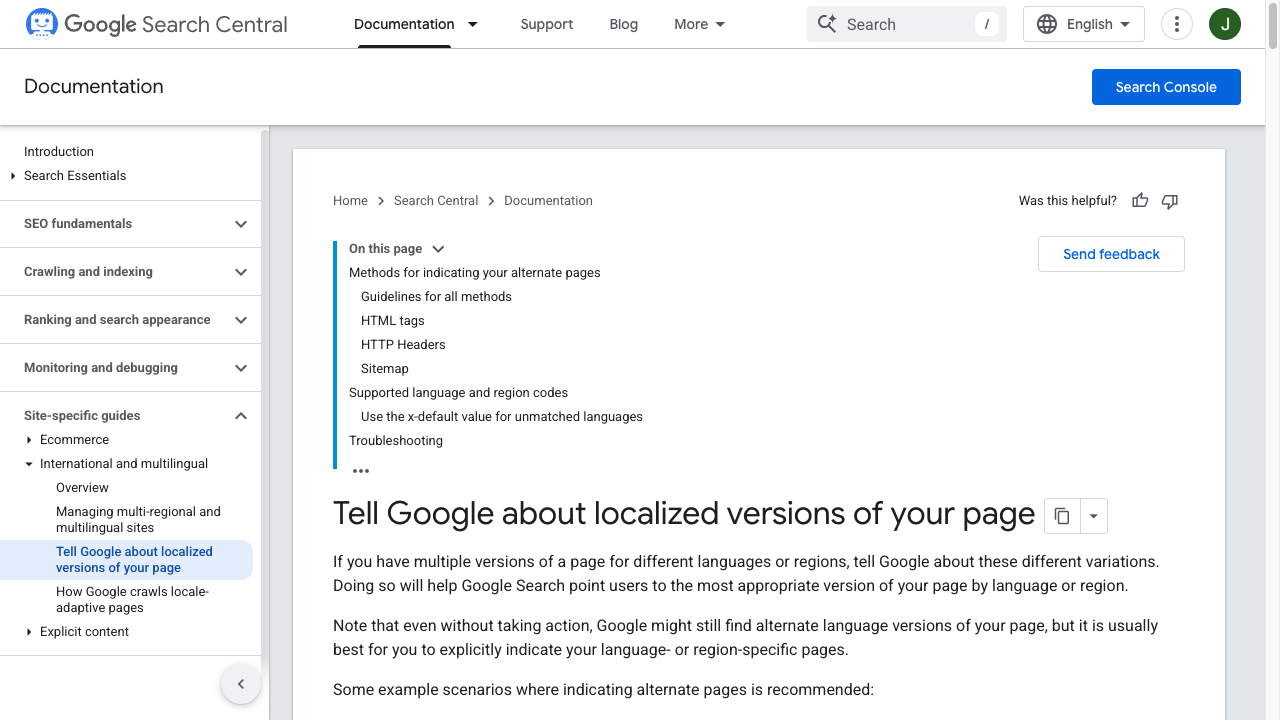
Hreflang helps Google understand language and regional alternates of a page. Google's localized versions documentation explains that each page variant should reference every alternate version, including itself.
For example:
<link rel="alternate" hreflang="en-us" href="https://example.com/us/" />
<link rel="alternate" hreflang="en-gb" href="https://example.com/uk/" />
<link rel="alternate" hreflang="x-default" href="https://example.com/" />
Hreflang does not make weak content rank. It prevents the wrong locale page from appearing when you already have localized versions. If the German page is just a rough translation of the US page, hreflang will not fix missing local intent.
Use Junia's hreflang guide if you need a deeper implementation walkthrough.
International Content Needs Localization, Not Just Translation
Translation changes language. Localization changes fit.
A localized page may need different:
- Keyword targets
- Product examples
- Units, currencies, dates, and compliance references
- Screenshots or product flows
- Testimonials and proof points
- Calls to action
- Comparisons against local competitors
This is where many international SEO programs break. They scale hundreds of translated pages but keep the original market's assumptions. I do not worry much about whether every localized page sounds perfectly literary. I worry much more about whether the examples, objections, proof, and calls to action feel native to the market. A page can be grammatically correct and still fail because it does not match how people in that market search, compare, or buy.
For execution, choose the review model before choosing the software. AI website translation vs human translation for SEO helps frame the trade-off between speed and editorial control, while how Google ranks translated content explains why indexed translations still need quality, uniqueness, and clear locale signals.
What Is Local SEO?
Local SEO is the process of improving visibility for searches tied to a specific place or service area.
It matters when geography is part of the buying decision. A person searching "emergency dentist near me" is not looking for the best dental article in the world. They want a credible nearby option that is open, relevant, reviewed, and easy to contact.
Local SEO usually includes:
- Google Business Profile optimization
- Local landing pages or location pages for SEO
- Consistent name, address, and phone number across listings
- Review generation and review responses
- Local business schema
- Local backlinks and citations
- Service-area content
- Mobile usability and fast conversion paths
If the business relies on calls, bookings, foot traffic, consultations, or local appointments, local SEO is usually the priority before any broader content expansion. Broad informational content can help later, but it should not distract from the search moments closest to revenue.
Google Business Profile Is Not Optional for Local SEO
For most local businesses, the Google Business Profile is the public search result before the website. It can show hours, services, photos, reviews, directions, posts, phone numbers, and questions.
Treat it like a conversion asset, not a directory listing.
At minimum, keep these fields accurate:
- Primary and secondary categories
- Business name
- Address or service area
- Phone number and website
- Opening hours and holiday hours
- Services or products
- Photos
- Reviews and owner responses
- Questions and answers
Junia AI's local SEO software can support the operational side of location pages, listings, and local optimization. A Google My Business post generator can help maintain profile activity, but the foundation is still accurate business information, relevant local proof, and consistent service details.
Local Pages Need Local Proof
A city page that says "we serve Dallas" twenty times is not a strong local page. A useful local page gives searchers reasons to trust the business in that location.
Good local proof includes:
- Services available in that city or neighborhood
- Local customer examples
- Photos from the area or location
- Staff, office, or service-area details
- Local reviews or testimonials
- Parking, directions, service radius, or appointment details
- Local FAQs based on real buying concerns
- Links from local organizations, events, or partners
For multi-location brands, each location page should be genuinely useful on its own. Duplicate location pages with swapped city names usually perform poorly and create a weak user experience. My rule of thumb: if a local salesperson would be embarrassed to send the page to a real prospect, the page probably is not specific enough.
When to Choose Local SEO
Choose local SEO when the business has one or more of these traits:
- Customers visit a physical location
- The business visits customers in a defined service area
- Searchers commonly use "near me" or city modifiers
- Reviews strongly influence conversion
- The website's main goal is calls, bookings, directions, or appointments
- The business cannot realistically serve national or international customers
Examples include dentists, restaurants, plumbers, law firms, clinics, gyms, salons, home services, local agencies, real estate offices, and regional B2B services.
Local SEO can also be the better first step when budget is limited. It is usually narrower, faster to diagnose, and closer to revenue than a broad content campaign. I would rather see a local business fix its profile, reviews, location pages, and call tracking before funding a large blog strategy that may take months to prove itself.
When to Choose International SEO
Choose international SEO when the business has one or more of these traits:
- Customers already come from multiple countries
- The product can be sold or delivered across borders
- Different markets need different language or regional pages
- Search demand exists in multiple countries
- The company can support localization, sales, compliance, and customer service in those markets
- International organic traffic is already converting, even without a mature strategy
Examples include SaaS companies, ecommerce brands, marketplaces, publishers, online education businesses, global agencies, travel companies, and software platforms.
Before scaling, validate demand. Ranking blog posts in foreign countries is rarely a pure translation project. It is a market-entry project with SEO as one channel. That distinction matters because rankings alone do not prove the market is ready, profitable, or supportable.
When a Hybrid Strategy Makes Sense
Some businesses need both strategies.
A hotel group may need international SEO to reach travelers from different countries and local SEO for each property. A franchise may need national or international brand visibility plus location pages and profiles for each branch. A SaaS company may run international SEO for product pages while using local SEO for regional offices, events, or partner pages.
Use a hybrid approach when:
- The brand serves multiple countries and has physical locations
- Local branches need map visibility
- Regional pages need different language, pricing, or compliance details
- Online demand and local demand both produce revenue
- The business has enough resources to maintain both systems
The risk is operational clutter. A hybrid strategy needs clear ownership: who manages hreflang, who manages local profiles, who updates location pages, who monitors reviews, and who reports by market. Without that ownership, hybrid SEO tends to become two half-maintained systems instead of one coordinated growth plan.
Common Mistakes
Mistake 1: Treating International SEO as Bulk Translation
Bulk translation can help with scale, but it should not replace market research. I am comfortable using AI-assisted workflows for first drafts and repetitive localization tasks, but only when someone still reviews terminology, intent, proof, and conversion fit.
The right level of automation depends on the content risk. AI localization vs DeepL vs Weglot is useful when comparing translation systems, while translating a blog into 60 languages automatically needs a stronger process for templates, QA, and post-publish monitoring.
Mistake 2: Ignoring Hreflang Until After Launch
Hreflang is easier to plan before pages go live. Retroactively fixing hundreds of language and region alternates can become messy, especially when canonical tags, redirects, and sitemap entries are inconsistent. The painful part is not adding a tag; it is untangling all the page relationships after the site has already been indexed.
Mistake 3: Building Thin Local Pages
Location pages should help people make a local decision. If every page is the same except for the city name, the content is probably too thin. Add services, proof, local details, reviews, photos, and practical next steps. The goal is not to mention the city more often; it is to prove that the business actually belongs in that result.
Mistake 4: Optimizing the Website but Neglecting the Business Profile
For local SEO, the website is only one part of the system. If the Google Business Profile has wrong hours, weak categories, no photos, and unanswered reviews, the site alone will not carry the local campaign. This is one of the easiest local SEO gaps to spot, and it is often one of the quickest to fix.
Mistake 5: Expanding Before You Can Support the Market
Ranking in a country where you cannot serve customers well can create low-quality leads, poor reviews, refund issues, and wasted support time. International SEO should follow operational readiness, not just keyword opportunity. I would rather delay a market launch than publish pages that create demand the business cannot handle.
Practical Implementation Checklist
Use this checklist before committing budget. Treat it as a readiness check, not a one-time setup list.
If You Are Starting With Local SEO
- Define the exact service area or location set.
- Audit the Google Business Profile for accuracy, categories, services, hours, photos, and reviews.
- Check NAP consistency across major directories and industry platforms.
- Build or improve location pages with real local proof.
- Add clear calls, booking links, directions, and service-area details.
- Earn local backlinks from partners, associations, sponsorships, and local media.
- Track calls, direction requests, form fills, local rankings, and profile interactions.
If You Are Starting With International SEO
- Choose target countries and languages based on demand and business readiness.
- Research keywords separately for each market.
- Pick a scalable URL structure before publishing localized pages.
- Create localized content briefs, not just translation tasks.
- Implement hreflang and canonical rules correctly.
- Localize internal links, examples, currency, units, and proof.
- Build market-specific authority through regional links and partnerships.
- Track rankings, traffic, conversions, and revenue by country and language.
Final Recommendation
If your customers choose you because you are nearby, prioritize local SEO. Win the map results, build local proof, improve reviews, and make your location pages genuinely useful. In my view, this is the most underrated SEO path for service businesses because it connects search visibility directly to calls, routes, bookings, and appointments.
If your customers choose you across countries or languages, prioritize international SEO. Build a clean site structure, localize content properly, implement hreflang, and measure each market separately.
If both are true, do not blur the strategies together. Use international SEO to structure country and language demand, then use local SEO to make each physical location or service area visible and trustworthy.
The right strategy is the one that matches how customers actually search, buy, and convert. Start there, and the SEO roadmap becomes much easier to defend.