

The challenge: strategy wasn't the bottleneck—production was
The agency already knew how to build SEO strategies for its clients.
The problem was execution.
Every new article required keyword research, clustering, briefing, drafting, optimization, internal linking, and editorial review. As the client roster grew, those repetitive production steps consumed more of the strategists' time.
Hiring more writers could increase capacity, but it would also increase costs and create another layer of management.
The agency needed to increase output without sacrificing editorial control.
Turning repeatable SEO work into a scalable workflow
The team used Junia AI to standardize the parts of content production that happened repeatedly across clients.
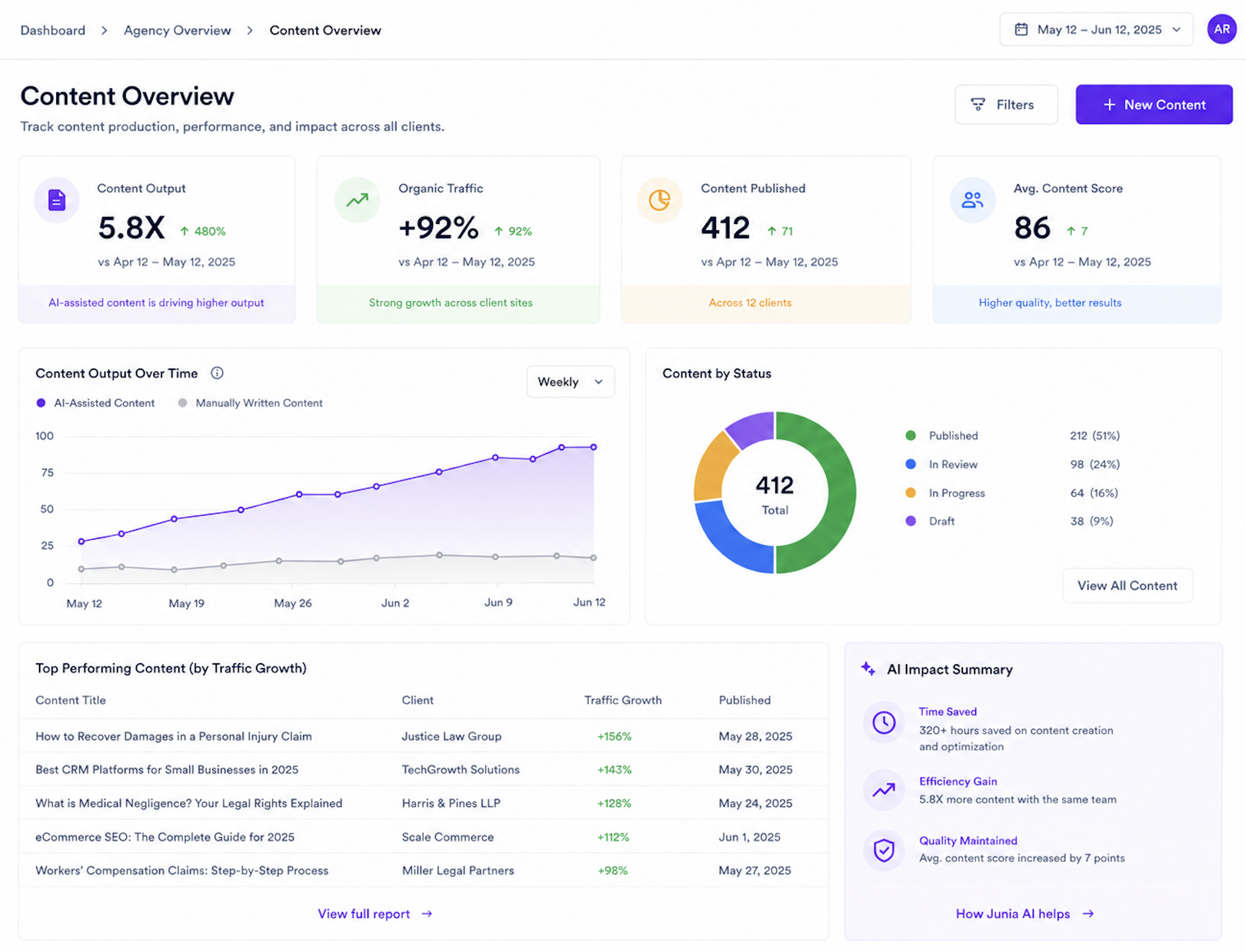
Keyword research was organized into clusters, and those clusters were turned into client-specific content briefs.
Instead of starting every article from a blank document, strategists could move from an approved topic to a structured first draft much faster.
Junia AI handled much of the repetitive execution while the agency remained responsible for strategy, positioning, fact-checking, and final approval.
Scaling first drafts without removing editorial control
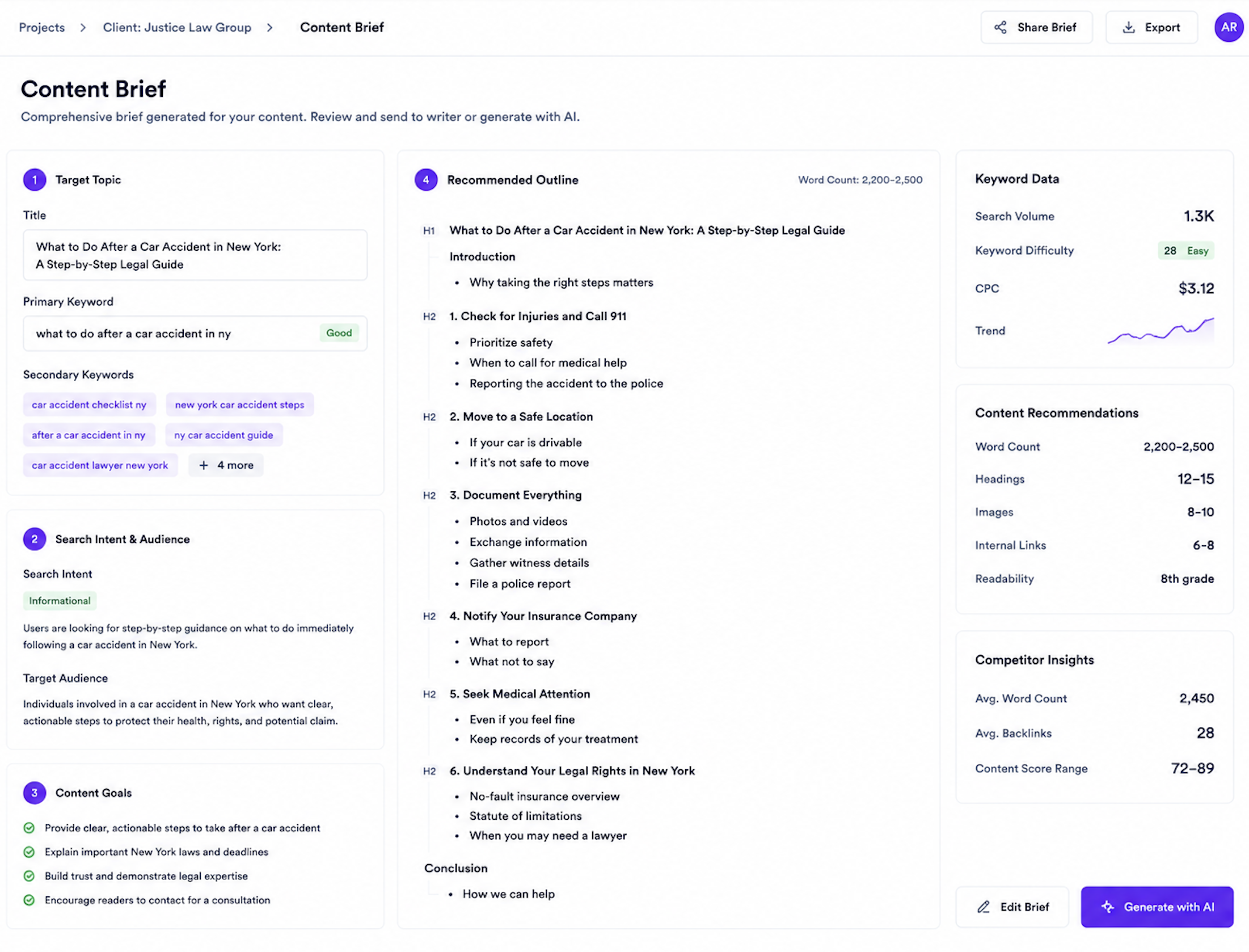
AI-assisted first drafts became one of the biggest changes to the workflow.
Once a topic and brief were approved, Junia AI could generate a structured article based on the client's target keywords and content requirements.
Strategists then reviewed and refined the output before publishing.
This changed where the team spent its time.
Instead of using hours assembling first drafts, they could focus more attention on the parts that required agency expertise: search intent, client positioning, accuracy, and editorial quality.
Standardizing research and content briefs
The agency also standardized how topics moved from research into production.
Keyword clusters were mapped into content opportunities, and briefs gave writers and strategists a consistent framework for each article.
That helped the team manage content across multiple clients without rebuilding the research process for every assignment.
The workflow became:
Keyword research → topic cluster → content brief → AI-assisted draft → editorial review → optimization → publish
The process was repeatable, but the strategy and final content remained specific to each client.
Making internal linking part of production
Internal linking had previously been easy to leave until the end of a project.
As publishing volume increased, that became increasingly difficult to manage manually.
Junia AI helped surface relevant internal linking opportunities during the content workflow, making it easier to connect new articles with existing client pages.
That meant internal linking became part of production rather than a separate cleanup task.
The results: 5.8X more content without hiring writers
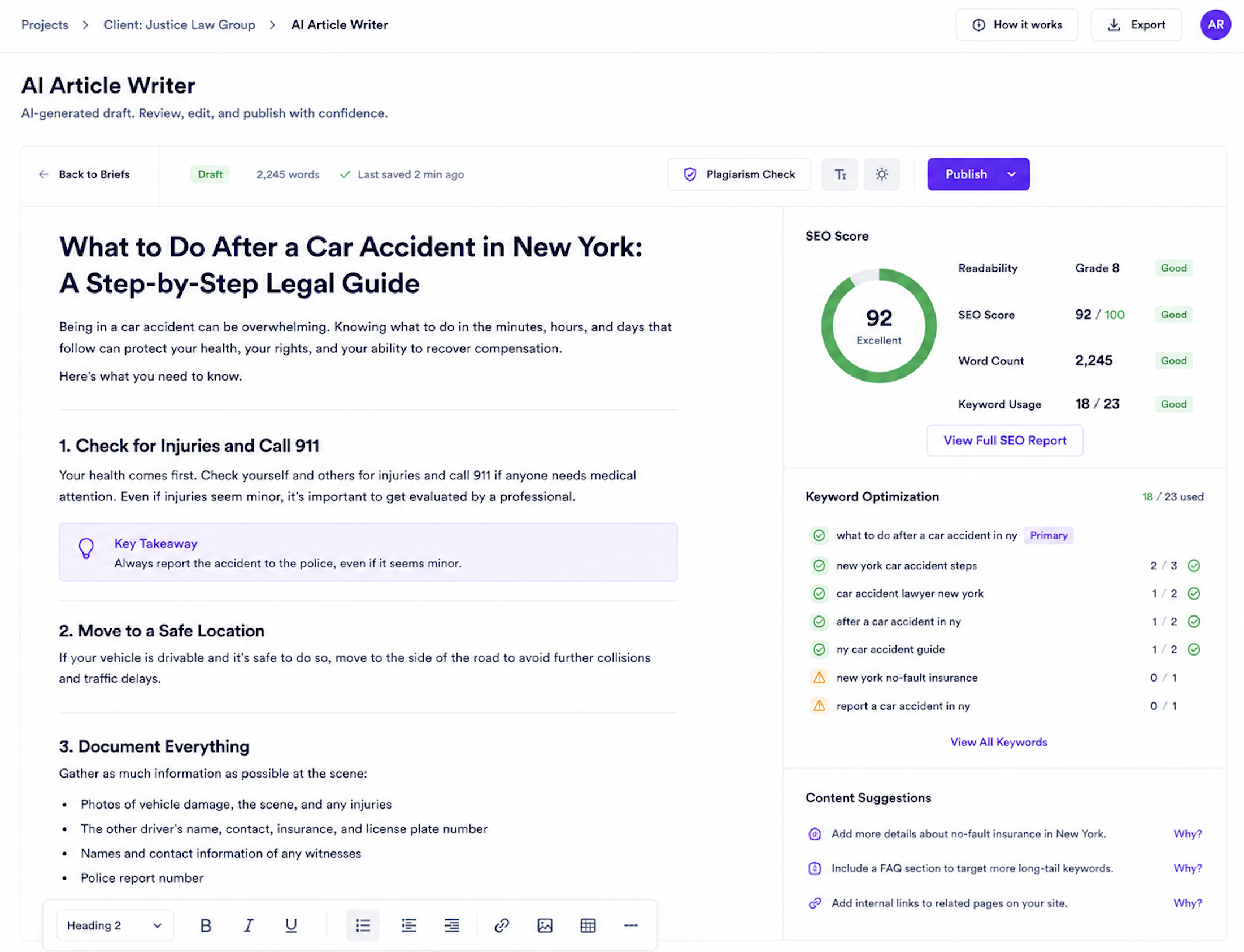
With more of the repetitive production process standardized, the agency substantially increased the amount of client content it could deliver.
Content output increased 5.8X without expanding the writing team.
At the same time, client organic traffic increased 92%.
The workflow produced three important outcomes:
- 5.8X higher client content output
- +92% organic traffic
- No additional writers required
The agency increased capacity without turning content production into a fully automated publishing operation.
Strategists still controlled what was created and what ultimately went live.
Why the strategy worked
The agency didn't use Junia AI to replace its SEO strategy.
It used Junia AI to remove production work that was preventing its strategists from executing that strategy at scale.
Research became easier to organize. Briefs became repeatable. First drafts took less manual effort. Internal linking became part of the workflow.
The result was a simpler production system:
Strategist decides what matters → Junia AI accelerates execution → strategist reviews and approves
By separating strategic decisions from repetitive production work, the agency was able to deliver 5.8X more client content without continuously adding writers.
What the team used
What they did with Junia
- Automated first-draft production
- Standardized keyword clustering
- Generated client-specific content briefs
- Automated internal linking recommendations


