

The challenge: 1,800 products, but limited organic discovery
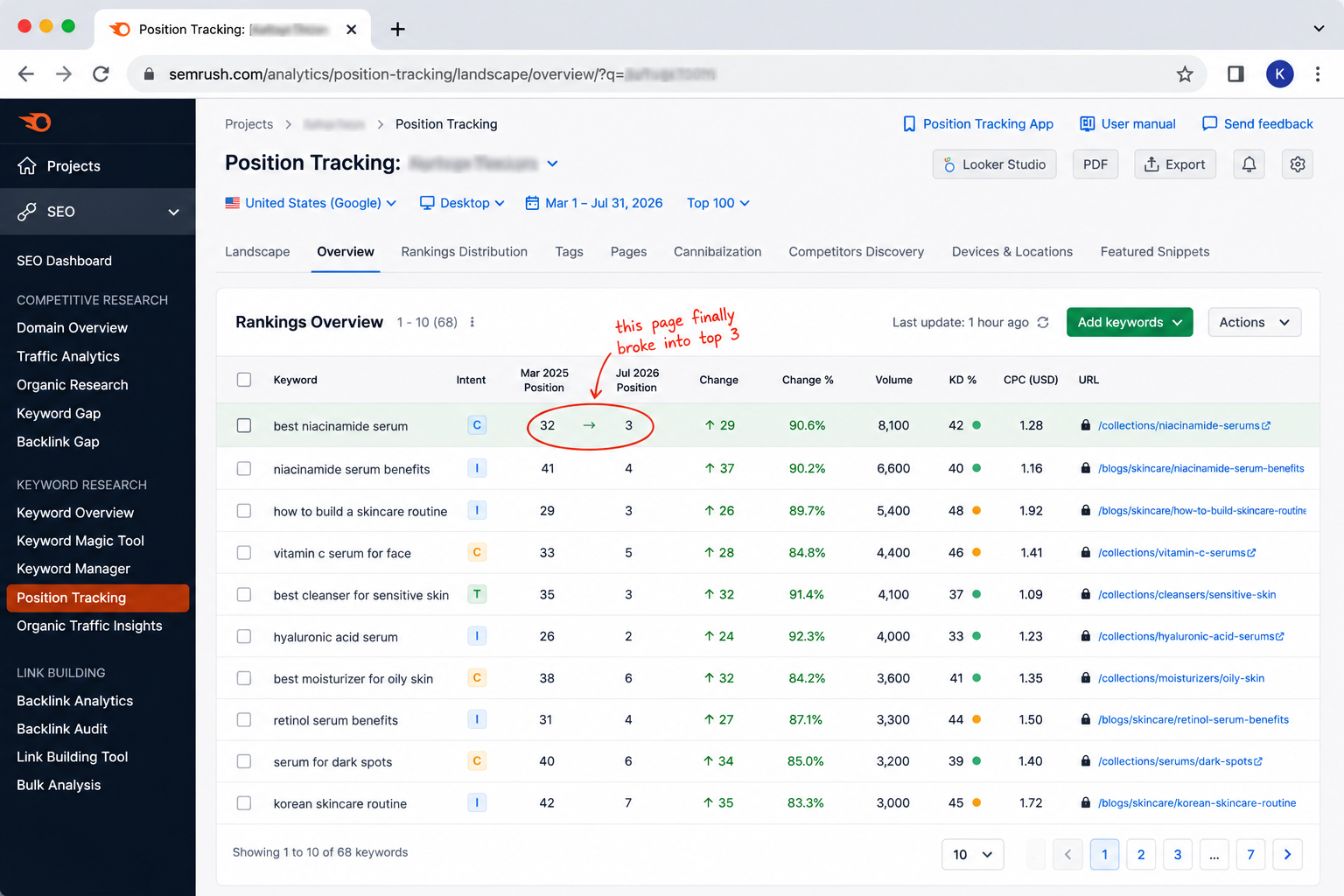
The store already had what most ecommerce businesses spend years building: a large catalog with more than 1,800 products.
The problem was that search engines—and, by extension, potential customers—weren't getting much value from that catalog.
Many collection pages contained little unique content. Products were organized primarily around merchandising rather than the way people searched. Informational content existed separately from commercial pages, leaving few natural paths from a question like "best cleanser for sensitive skin" to the products that could actually solve it.
The opportunity wasn't to add more products.
It was to turn the existing catalog into a search acquisition channel.
Turning the catalog into a search-first structure
The first step was reorganizing the site's content around search intent.
Using Junia AI, the team mapped products into collection clusters based on the ways customers searched: by skin type, concern, ingredient, routine, and product category.
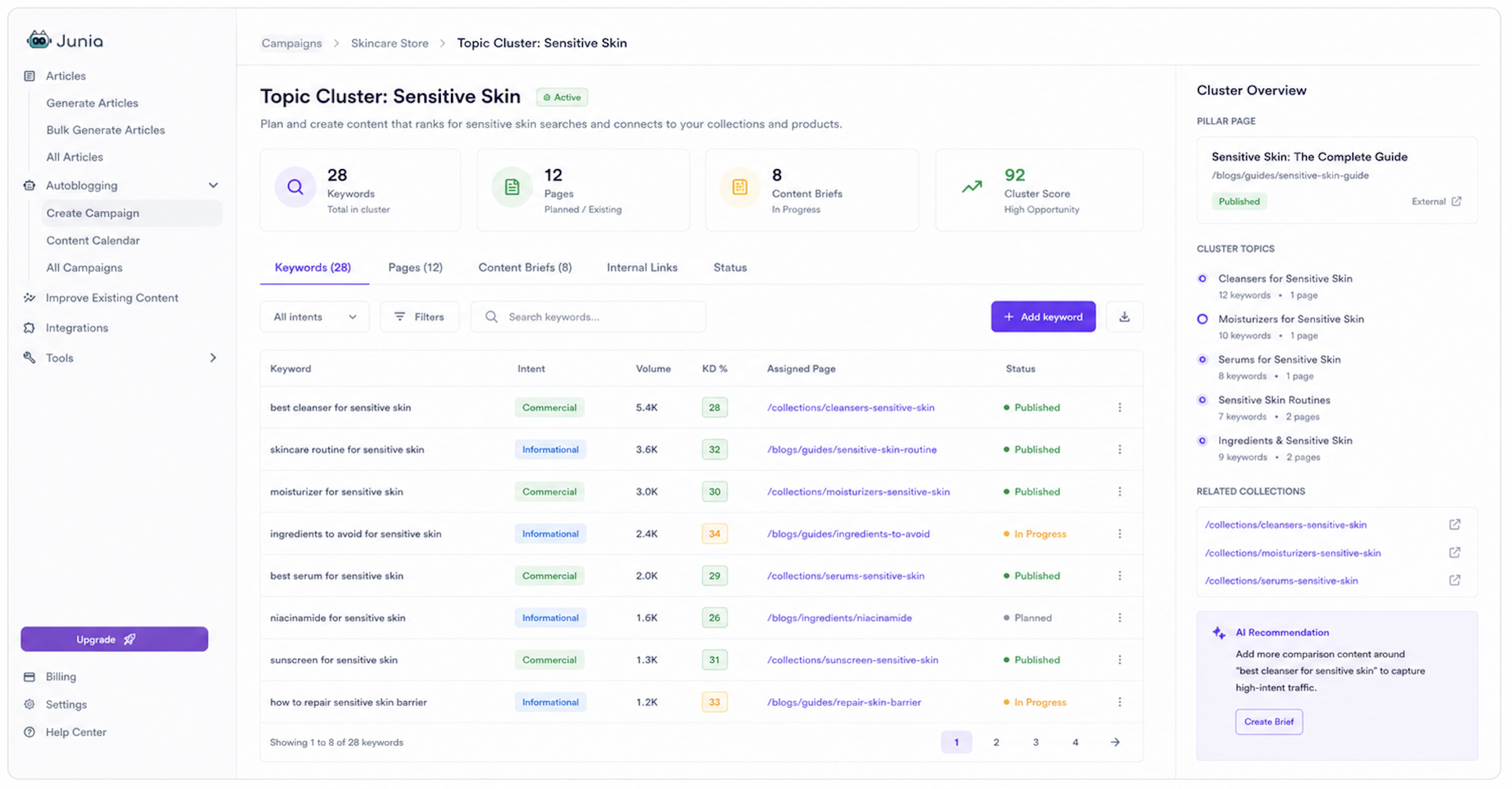
Instead of treating each collection as little more than a grid of products, the team began treating collections as search destinations in their own right.
That meant strengthening collection pages with unique, useful content while preserving their commercial purpose.
The new structure created clearer relationships between:
- buying guides
- collection pages
- individual products
- ingredients and concerns
- frequently asked questions
The goal was simple: someone entering the site through an informational search should have a logical path toward discovering the right product.
Scaling the content workflow with Junia AI
Doing this manually across a catalog of more than 1,800 products would have created a substantial content bottleneck.
Junia AI became the workflow connecting research, planning, content creation, optimization, publishing, and internal linking.
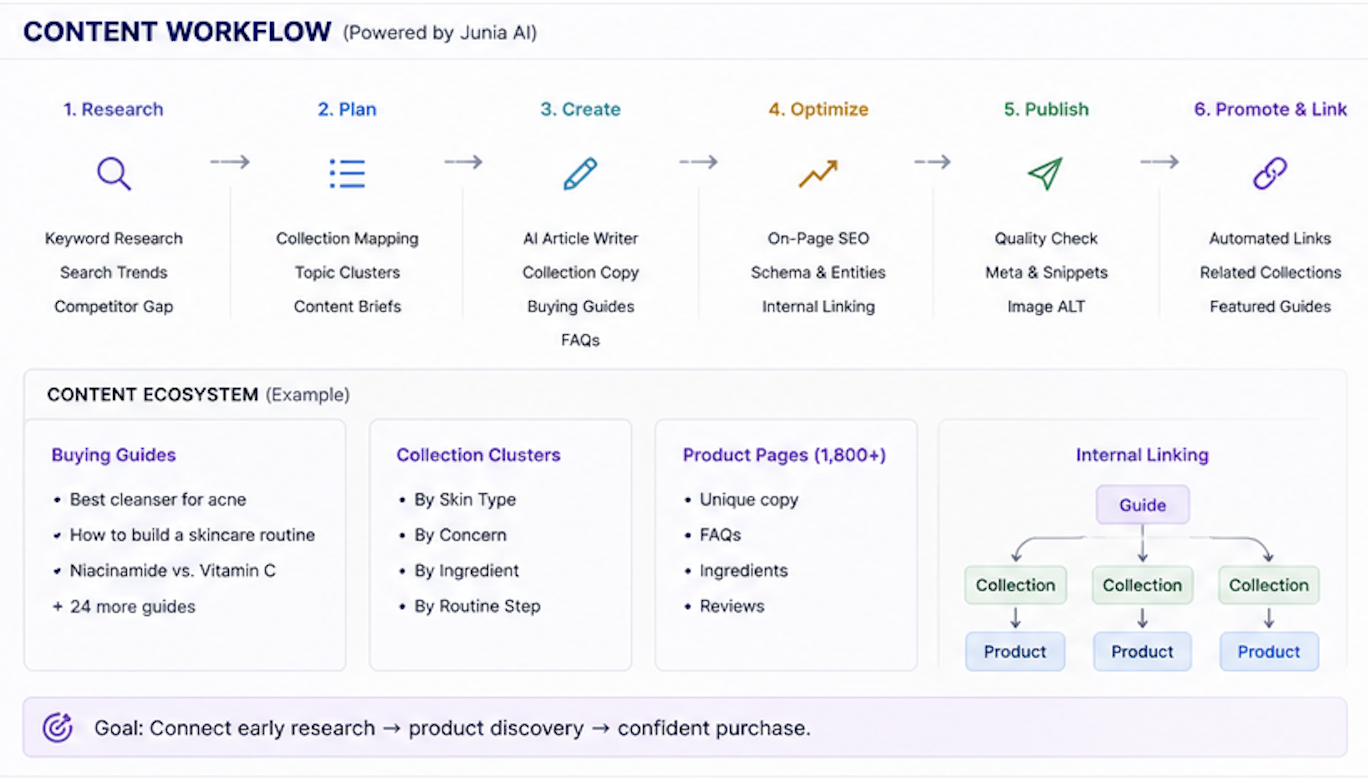
Keyword research helped identify the searches surrounding individual products and collections. Those terms were grouped into topic clusters and mapped to existing or new pages.
Junia AI was then used to create and optimize collection copy, buying guides, FAQs, and supporting informational content.
Rather than publishing isolated articles, each piece of content had a specific place in the wider ecommerce architecture.
A buying guide could introduce a customer to a problem. A collection page could narrow the available solutions. Product pages could then satisfy the final purchase intent.
Internal links connected those stages together.
Making thin collection pages useful
One of the largest opportunities was the store's collection pages.
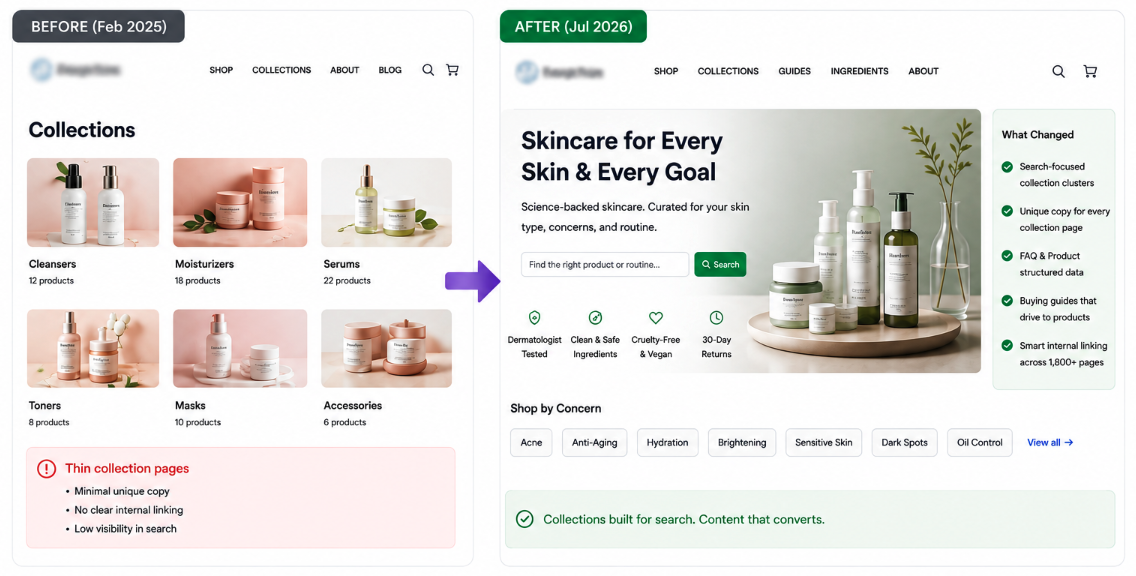
Previously, many were essentially product grids with minimal unique information. That made it difficult for search engines to understand why a collection deserved to rank for anything beyond very broad product terms.
The team added content that answered the questions shoppers were likely to have before choosing a product.
Depending on the collection, that included information about skin concerns, ingredients, product differences, routines, and frequently asked questions.
Product and FAQ structured data were also added where appropriate to make the content easier for search engines to interpret.
The important part was that these weren't turned into long articles disguised as category pages.
They remained shopping pages—but with enough context to become useful organic landing pages.
Building informational content around buying intent
Collection optimization addressed existing pages, but the store also needed ways to reach customers earlier in their search journey.
Buying guides filled that gap.
The team created content around searches such as skincare routines, ingredients, product comparisons, and specific skin concerns.
Those guides weren't treated as an isolated blog strategy.
Each guide was connected to the relevant collections and products, creating a path from research to discovery to purchase.
This allowed the store to compete for informational queries without separating that traffic from the commercial side of the website.
Search visibility expanded across the catalog
As the new structure matured, rankings improved across searches related to products, ingredients, routines, and skin concerns.
The change wasn't dependent on a single high-volume keyword. Hundreds of relevant searches began contributing traffic across the catalog.
This was particularly important for a store with such a large inventory.
Instead of relying on a handful of category pages to generate most organic traffic, the site developed a broader search footprint across collections, guides, and products.
The catalog itself was becoming the SEO engine.
The results: from 7K to 29K monthly organic visits
The combined effect of collection restructuring, stronger page content, buying guides, structured data, and internal linking produced a significant change in organic visibility.
Monthly organic visits increased from 7,000 to 29,000—a 318% increase.
More importantly, that growth came from making the store's existing inventory more discoverable rather than simply publishing a large volume of unrelated blog content.
The campaign ultimately produced three important outcomes:
- +318% organic traffic
- 29K monthly organic visits
- 1,800+ products connected to a stronger search architecture
The store went from having a large catalog that search engines struggled to understand to having an interconnected system of collections, products, and educational content designed around how customers actually search.
Why the strategy worked
The biggest change wasn't simply producing more content.
It was giving every type of content a purpose within the customer journey.
Informational searches led into buying guides. Buying guides pointed toward relevant collections. Collections helped customers narrow their options. Product pages completed the journey.
Junia AI made it practical to build and maintain those relationships across a catalog containing more than 1,800 products.
Instead of treating SEO as something that happened primarily on the blog, the team made SEO part of the ecommerce architecture itself.
For a large online store, that distinction matters.
Every collection can become an organic landing page. Every buying guide can introduce shoppers to relevant products. And every product can become part of a much larger network of search demand.
In this case, that shift helped turn an existing Shopify catalog into an acquisition channel generating 29,000 organic visits per month.
What the team used
What they did with Junia
- Mapped 1,800 products into search-focused collection clusters
- Generated unique copy for thin collection pages
- Added product and FAQ structured data
- Created buying guides and automated internal links


