
Free Sermon Generator
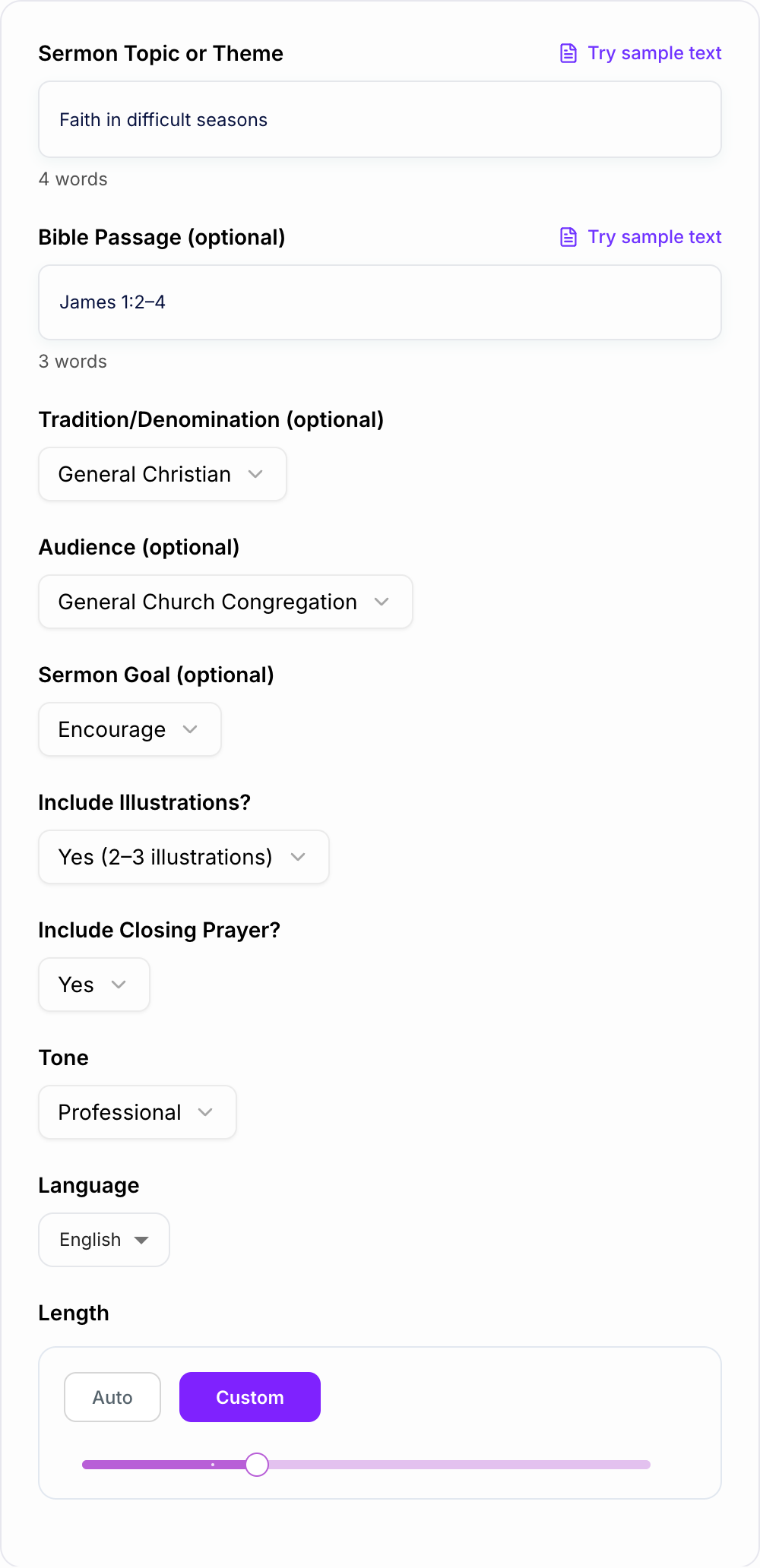
Generate sermon outlines, full manuscripts, youth messages, small-group lessons, expository structures, and series plans from a Bible passage or topic. Add audience, goal, tradition, illustrations, prayer, tone, and length to create a draft you can study, refine, and preach responsibly.
Sermon
Your sermon outline or manuscript will appear here...
How the AI Sermon Generator Works
Get results in seconds with a simple workflow.
Enter a Topic or Passage
Type a sermon topic (like prayer or faith) and/or a Bible passage. If you enter both, the tool will prioritize the passage while keeping the theme clear.
Choose Audience, Tone, and Length
Pick your audience (church, youth, small group, outreach), tone, and target length to shape the sermon style and depth.
Generate and Personalize for Your Congregation
Get a sermon outline or manuscript with points, cross-references, and application. Then customize illustrations, add local context, and refine your call to response.
See It in Action
Example of turning a simple topic into a structured sermon outline with a big idea, points, cross-references, and application.
Topic: Faith in difficult seasons
I need a sermon that helps people trust God when life is hard.
Title: Faith That Endures: Trusting God in Difficult Seasons Key Text: James 1:2–4 Big Idea: God uses trials to mature our faith when we trust Him with perseverance.
H2: Introduction
- Name the reality of hardship and the question: “Where is God in this?”
- Hook: the difference between pain that breaks us and pain God forms us through
H2: Point 1 — Trials Are Real (and God Isn’t Surprised)
- Explain “trials of various kinds” in context
- Cross-references: 1 Peter 1:6–7; John 16:33
- Application: stop interpreting suffering as abandonment
H2: Point 2 — Perseverance Has a Purpose
- Explain what perseverance produces: maturity, completeness
- Cross-references: Romans 5:3–5; Hebrews 12:11
- Application: choose faithful obedience one day at a time
H2: Point 3 — Ask God for Wisdom (Not Just Relief)
- Transition to James 1:5–6 (optional supporting text)
- Cross-references: Proverbs 3:5–6
- Application: a simple prayer practice for anxious weeks
H2: Conclusion
- Repeat big idea; invite response and hope
FAQ Q: Does faith mean I won’t feel pain? A: No—faith brings honesty and trust, not denial.
Closing Prayer (optional)
- Ask for endurance, wisdom, and comfort for those suffering
Why Use Our AI Sermon Generator?
Powered by the latest AI to deliver fast, accurate results.
Sermon Outlines or Full Manuscripts
Generate a structured sermon outline (big idea + points) or a complete sermon manuscript with smooth transitions—ideal for Sunday sermons, midweek services, and guest preaching.
Bible Passage-Based or Topic-Based Sermons
Start with a specific Bible passage (expository-style structure) or a sermon topic/theme. The tool builds a coherent message with supporting cross-references and clear application.
Clear Big Idea + Practical Application
Produces a strong central message (“big idea”), memorable main points, and practical application steps so listeners know what to believe and how to respond.
Illustrations, Examples, and Transitions
Add relatable sermon illustrations, modern examples, and connecting transitions to improve flow, attention, and clarity—without drifting from the text.
Audience and Ministry Context Options
Tailor sermons for youth, small groups, outreach, new believers, or a general congregation—helpful for pastors and ministry leaders planning weekly messages.
Pro Tips for Better Results
Get the most out of the AI Sermon Generator with these expert tips.
Anchor every point to the text
After generating, verify that each main point flows from the passage’s meaning and context. Tighten any point that feels inspirational but not text-driven.
Strengthen application with one clear next step
End each point with a concrete response (pray, reconcile, repent, serve, practice a habit) so listeners can act on the message during the week.
Swap generic illustrations for real-life ministry moments
Replace stock examples with a brief story, testimony, or local situation (keeping privacy) to make the sermon feel personal and credible.
Keep the big idea repeatable
Edit the big idea into a single sentence your congregation can remember. Repeat it in the introduction, mid-sermon transition, and conclusion.
Check cross-references for alignment
Cross-references should clarify—not hijack—the passage. Remove tangents and keep Scripture support focused on the sermon’s main idea.
Who Is This For?
Trusted by millions of students, writers, and professionals worldwide.
Generate Sermon Outlines and Manuscripts You Can Actually Preach
The AI Sermon Generator is built for the practical middle of sermon prep: you have a passage, theme, audience, or pastoral moment, and you need a structured draft you can refine with study, prayer, and your own voice.
Use it to generate an outline, full manuscript, youth sermon, small-group lesson, expository structure, or multi-week series plan. The goal is not to replace preparation. It is to get from scattered notes to a clear first structure faster.
What to Enter Before You Generate a Sermon
Start with the strongest anchor you have.
If you know the passage, enter it. A passage-based input usually produces a more faithful structure because the sermon points can follow the text instead of floating around a broad theme.
If you only know the topic, keep it focused:
faith in difficult seasonsforgiveness after betrayalprayer when God feels silentunity in a divided church
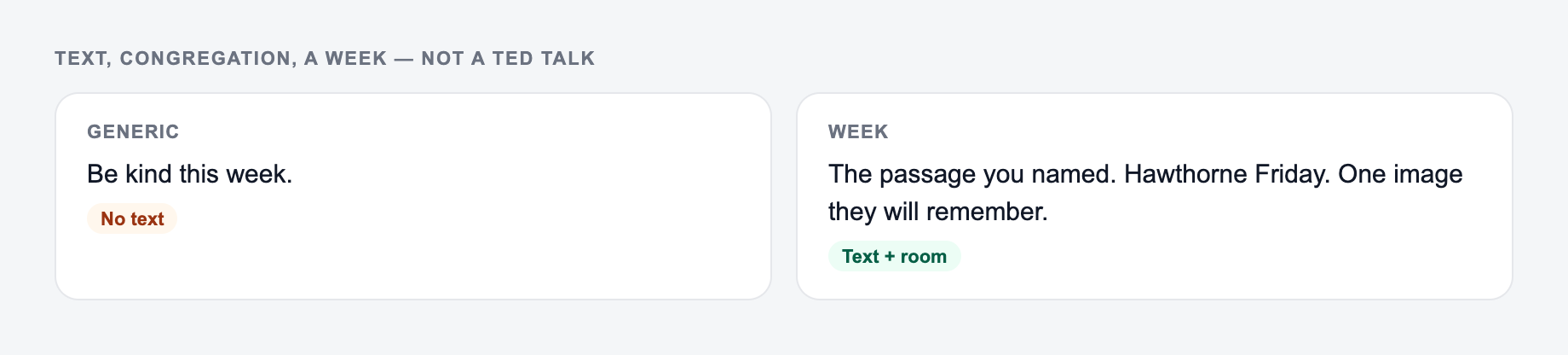
Then choose the audience and goal carefully. A youth message, outreach message, funeral reflection, small-group lesson, and Sunday sermon should not sound the same. The generator can only make that distinction if you set the audience and purpose before generating.
Which Sermon Mode to Choose
Choose the mode based on what you need next, not what sounds most complete.
Sermon Outline
Use this first when you are still shaping the message. The outline should give you a title, key text, big idea, main points, supporting references, application, and conclusion. It is easier to correct an outline than a full manuscript.
Full Manuscript
Use this after the structure feels sound. A manuscript can help with transitions, introductions, pastoral language, and flow, but you should still edit it aloud so it sounds like you and fits your congregation.
Youth Sermon
Use this when the message needs shorter sections, simpler language, relatable examples, and a clear challenge. Keep the topic narrow and avoid trying to cover too many theological ideas at once.
Small Group Lesson
Use this for teaching notes plus discussion questions. Review the questions carefully so they invite reflection instead of only asking for obvious answers.
Expository Sermon
Use this when the passage itself should drive the structure. After generation, check context, author intent, key terms, and cross-references before turning it into a manuscript.
Sermon Series Planner
Use this when you need a multi-week arc. Review whether each week has a distinct passage, big idea, application, and response direction so the series does not repeat the same point.
How to Review the Generated Sermon Draft
Answer these before you generate a second batch. A reroll will not fix a vague brief.
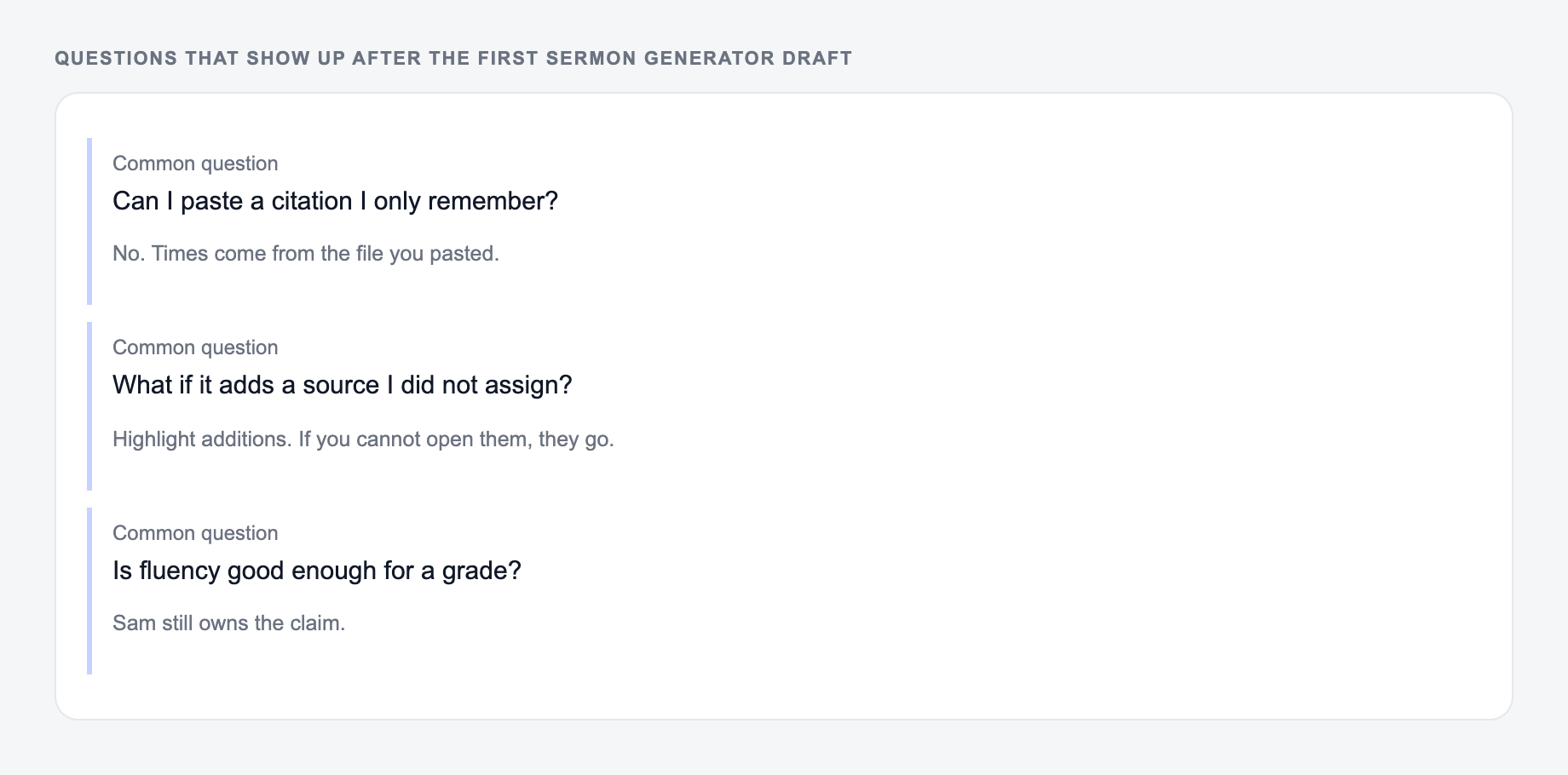
Treat the output as a draft, not a pulpit-ready final.
Check the message for:
- accurate Scripture references
- main points that actually come from the passage
- cross-references that support rather than distract
- illustrations that are true, appropriate, and not manipulative
- application that fits the audience's real life
- language that matches your tradition and convictions
- transitions that sound natural when spoken aloud
If a line sounds impressive but does not clearly serve the passage, cut it. If an illustration feels generic, replace it with something from real ministry life, history, testimony, or an everyday example your people will recognize.
A Practical Weekly Sermon Workflow
A repeatable workflow keeps the generator in the right role:
The text and congregation context belong on the form. The preacher still owns the claims.
Use the AI Sermon Generator to get a shape on the page. Then do the slow part: open the source, check the number, and cut unsourced certainty.
If the task is graded, clinical, cited, or public, the named writer still owns the claims.
- Read and mark the passage yourself.
- Generate a sermon outline first.
- Edit the big idea and main points until they fit the text.
- Generate a manuscript only after the outline is stable.
- Replace generic illustrations with stronger examples.
- Add pastoral details for your congregation.
- Read the sermon aloud and tighten anything that sounds stiff.
If you already use AI for writing, planning, or ministry communication, the broader Junia AI platform can support related drafting tasks while you keep sermon judgment grounded in Scripture, context, and pastoral care.
Common Sermon Generator Mistakes
The first mistake is asking for a full manuscript too early. Generate an outline first so you can correct the structure before the tool expands it.
The second mistake is entering only a broad theme. "Faith" is too wide. "Faith in difficult seasons from James 1:2-4 for a grieving congregation" gives the generator a real lane.
The third mistake is leaving illustrations untouched. AI illustrations often work as placeholders, but real examples usually carry more weight.
The fourth mistake is skipping theological review. Check the text, the tone, and the application before you preach or teach anything generated.
Accuracy caveats:
Before you read sermon generator output aloud:
- Quotes and verses match the text you opened
- No guest, date, or story you did not type
- It still sounds like something you would say
Final Sermon Review Checklist
Before using the generated sermon, confirm:
- the passage is handled responsibly
- the big idea is clear enough to repeat
- the points move in a logical order
- the application is concrete
- the tone fits the audience
- illustrations are accurate and appropriate
- the conclusion lands with clarity
- the sermon sounds like your voice when spoken aloud
Used that way, the Sermon Generator becomes a structured prep assistant: helpful for speed, clarity, and organization, while you remain responsible for the message.
Frequently Asked Questions
Is this sermon generator free to use?+
Yes. You can generate sermon outlines and sermon drafts for free. Some advanced modes (like expository depth or sermon series planning) may be marked as premium.
Can I generate a sermon from a Bible passage?+
Yes. Add a passage (for example, James 1:2–4) and the tool will build a sermon structure around it, including supporting cross-references and clear application points.
Does it include illustrations and application?+
Yes. You can choose to include 0–3 illustrations, and the output is designed to include practical application and response steps near the end of the sermon.
Will it match my audience (youth, small group, outreach)?+
Yes. Choose an audience setting and tone to adapt language level, examples, and how the message is presented—helpful for youth sermons, small-group lessons, and outreach messages.
Is the sermon theologically perfect?+
It’s a draft to speed up preparation, not a substitute for personal study and pastoral responsibility. Review Scripture references, adjust theology for your tradition, and refine applications for your congregation’s context.
Can I generate sermons in different languages?+
Yes. Select an output language to generate sermons for multilingual churches, mission contexts, or international ministry audiences.