
How to Paraphrase Without Plagiarizing

Thu
AI SEO Specialist, Full Stack Developer

Paraphrasing without plagiarizing is not about changing a few words and hoping it looks different enough.
Proper paraphrasing means you fully understand the original idea, rewrite it in your own structure and wording, and give credit when the situation calls for it. That is what keeps the meaning intact while still producing writing that feels original.
If you want a faster way to test fresh wording after you understand the source, a paraphrasing tool can help you generate cleaner rewrites. But the tool is only part of the process. The judgment still has to come from you.
What counts as plagiarism when paraphrasing?
People usually think plagiarism only means copying and pasting a paragraph word for word. The real line is broader than that.
You can still cross it when you:
- keep the original sentence structure and swap only a few terms
- reuse a distinctive phrase without quotation marks
- summarize someone else's argument too closely without attribution
- borrow ideas, data, or examples without citing the source when citation is expected
That is why proper paraphrasing is more than surface-level editing. The wording should be new, the structure should reflect your understanding, and the final version should fit the context you are writing for.
A simple 5-step method for proper paraphrasing
This is the safest workflow if your goal is to paraphrase without plagiarizing.
1. Read until you understand the point
Do not start rewriting sentence by sentence while you are still decoding the original. Read the passage, identify the core claim, and note any facts, dates, names, or qualifiers you must preserve.
2. Put the source aside
This forces you to restate the idea from understanding instead of mirroring the wording. If you keep staring at the source, you are much more likely to stay too close to it.
3. Rewrite the idea in your own structure
This is where real paraphrasing happens. Change the order of ideas if needed, combine or split sentences, and choose phrasing that sounds natural in your own draft.
4. Compare with the original
Now check two things:
- did you keep the meaning accurate?
- is the wording and structure genuinely different?
If it still looks like a lightly edited copy, rewrite it again.
5. Cite when required
Paraphrasing does not remove the need for attribution. In academic, research, or professional work, you still need to cite the original source when you are using someone else's ideas, evidence, or framework.
| Step | What to check | Common failure |
|---|---|---|
| Understand the source | You can explain the idea without looking at the original | You start rewriting too early |
| Rewrite from memory | The structure sounds like your own draft | You mirror the original sentence shape |
| Compare versions | Meaning stays accurate but wording changes substantially | You only swap a few words |
| Add attribution | The context-specific citation is present when needed | You assume paraphrasing removes the need to cite |
Paraphrasing examples: weak vs proper
The easiest way to spot the difference is to compare a weak rewrite with a real one. If you want more side-by-side paraphrasing examples, it helps to study both the structure and the wording, not just the final sentence.
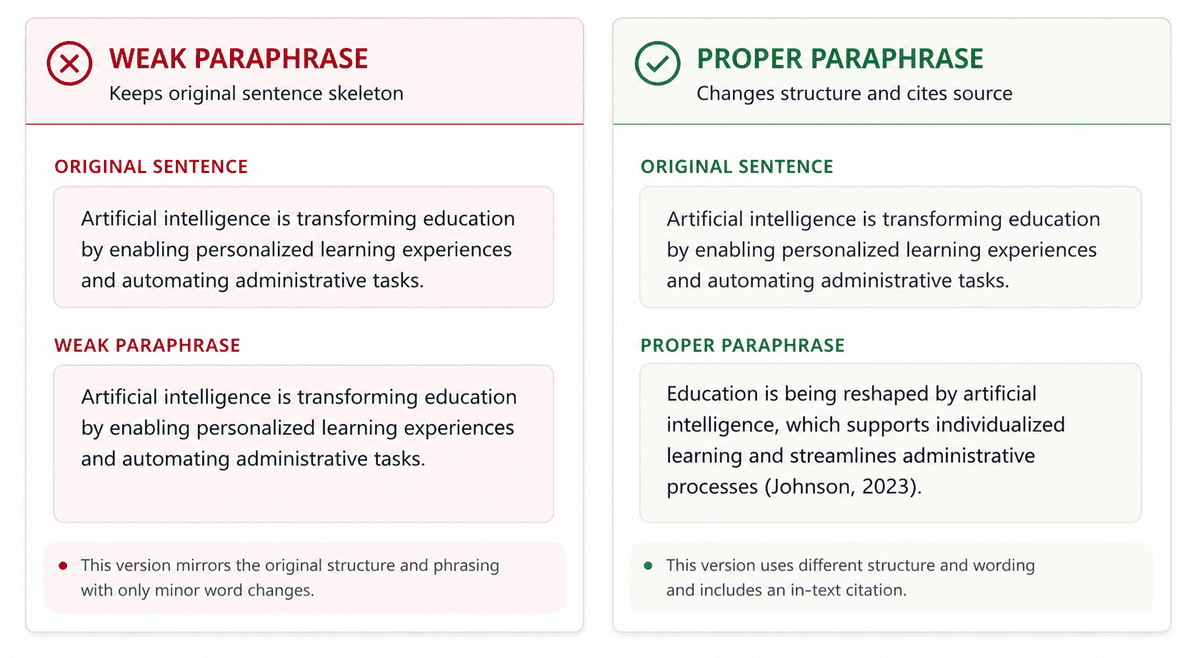
| Still plagiarism-risk | Safer paraphrase |
|---|---|
| Same sentence skeleton + synonym swaps | New structure that keeps the idea |
| No citation on a sourced claim | Attribute when the idea isn’t yours |
| AI rewrite left unchecked | You compare against the original |
Understanding first is non-negotiable. If you paraphrase before you get it, you will copy the skeleton.
How to Paraphrase in 5 Easy Steps | Scribbr
Original
Remote work can improve employee satisfaction, but it often requires clearer communication systems and stronger documentation practices to keep teams aligned.
Weak paraphrase
Working remotely can increase employee satisfaction, but it often needs clearer communication systems and stronger documentation practices to keep teams aligned.
This is too close. A few words changed, but the structure and phrasing are nearly identical.
Proper paraphrase
Remote teams are often happier with more flexible work arrangements, but that benefit usually depends on having well-defined communication habits and reliable internal documentation.
This version keeps the meaning while changing the sentence shape and wording more substantially.
When to cite even if you paraphrased well
Many people confuse originality of phrasing with ownership of ideas. They are not the same thing.
You should usually cite the source when you are paraphrasing:
- research findings
- statistics
- expert opinions
- proprietary frameworks
- classroom or academic source material
If you are unsure about citation rules, using a citation generator after the writing pass can save time, especially when you are working with multiple sources.
If you are trying to decide whether your draft needs paraphrasing, rewording, or summarizing, this comparison of paraphrasing vs rewording vs summarizing helps clarify the difference.
Common mistakes that still lead to plagiarism
Here are the mistakes that show up most often.
Changing words but keeping the skeleton
If your sentence follows the same structure as the original and replaces only a few nouns or verbs, it is still too close.
Paraphrasing before understanding
When people paraphrase too early, they tend to cling to the source wording because they do not yet have a clear mental version of the idea.
Forgetting attribution
A strong paraphrase can still need a citation. This is the most common gap in academic and research writing.
Letting AI output go through unchecked
AI can help you rephrase faster, but it can also preserve too much of the source or introduce subtle meaning drift. Review every output carefully, especially if the passage includes technical claims or nuanced wording.
How AI can help without crossing the line
AI is useful when you already know what the source means and want help exploring cleaner wording. It is not a shortcut around understanding or attribution.
A practical workflow is:
- Read the source and write your own rough version first.
- Use a paraphraser to test alternate phrasings.
- Compare the result against the source for similarity and meaning drift.
- Run a final pass with a grammar checker so the rewritten version is clean and accurate.
If your main goal is clarity rather than just difference, tools like a readability improver can also help you simplify clunky sentences after the paraphrasing step. If you need to tighten awkward phrasing manually, a rewording guide is often a better companion than asking AI to keep rewriting the same sentence.
Best practices for ethical paraphrasing
If you want a short checklist, use this:
- understand the original before rewriting
- restate ideas in a new structure
- preserve meaning, qualifiers, and facts
- cite the source when the context requires it
- review the final version for similarity, clarity, and tone
That combination is what makes paraphrasing both useful and ethical.
Final takeaway
The safest answer to "how to avoid plagiarism when paraphrasing" is simple: do not treat paraphrasing as word substitution.
Treat it as a writing process. Understand the source, rewrite from comprehension, cite when needed, and edit the result until it sounds like a real piece of original writing. That is how you paraphrase without plagiarizing.