
Paraphrasing Examples: Before and After Rewrites

Thu
AI SEO Specialist, Full Stack Developer

The fastest way to understand paraphrasing is to look at real before-and-after rewrites.
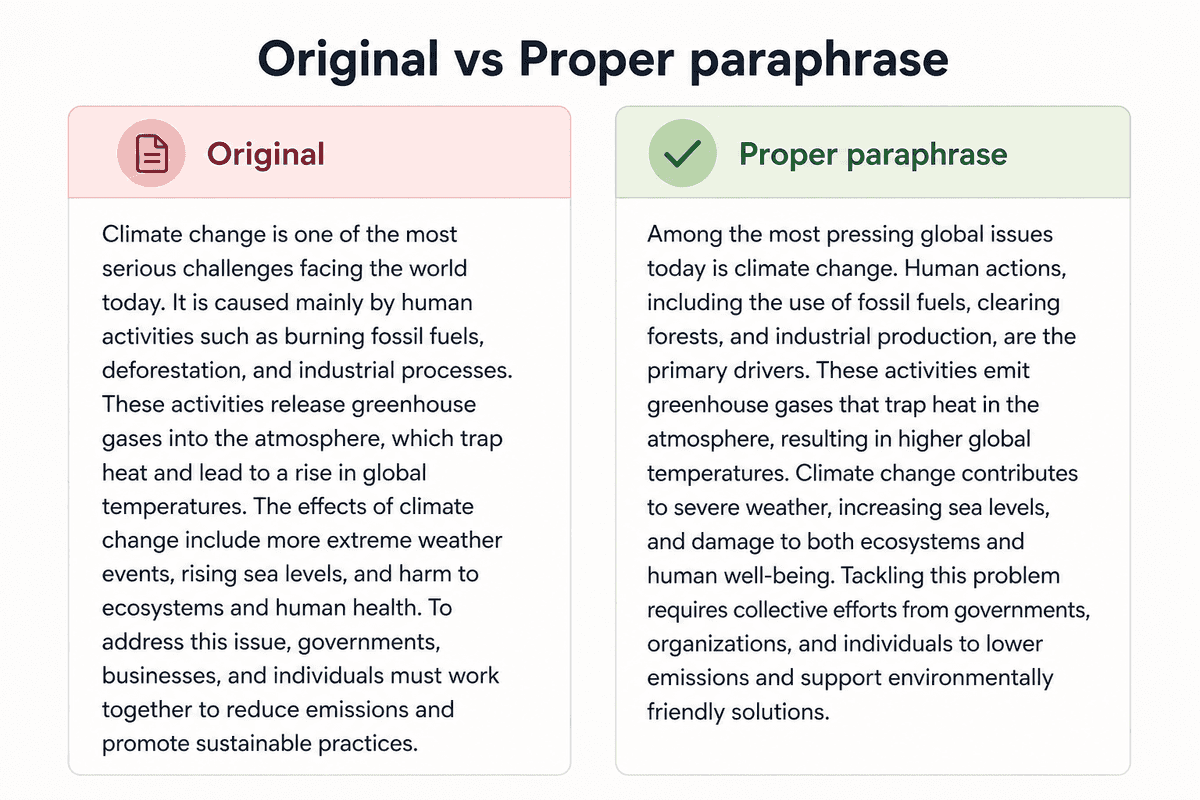
Good paraphrasing does not just replace a few words. It keeps the original meaning, changes the structure when needed, and makes the final version sound natural for a new context. If you want to paraphrase your own text, these examples will show you what a strong rewrite actually looks like.
What makes a paraphrasing example "good"?
Before the examples, it helps to know what to watch for.
| Good paraphrase | Still risky |
|---|---|
| New structure, same meaning | Synonym swap on same skeleton |
| Cite when idea isn’t yours | “I changed words” with no attribution |
Practice by putting the source away. If you can only rewrite while staring at it, you’re still copying.
How to Paraphrase in 5 Easy Steps | Scribbr
A useful paraphrase usually does three things at once:
- preserves the original idea
- changes wording and sentence structure enough to feel new
- improves clarity, tone, or flow for the intended reader
If the rewrite keeps the exact same skeleton and only swaps synonyms, it is not doing enough. If it changes the meaning, it is also failing.
Example 1: Sentence paraphrasing
Original
Small businesses can improve online visibility by publishing helpful content that answers customer questions clearly.
Paraphrased
Publishing practical content that directly addresses customer questions can help small businesses become easier to find online.
Why this works:
- the main idea stays intact
- the sentence structure changes
- the wording sounds natural instead of forced
Example 2: Simplifying complex wording
Original
The onboarding process should be optimized to reduce friction and improve early-stage user retention.
Paraphrased
Make the onboarding experience easier so new users can get started faster and are more likely to stick around.
This example shows that paraphrasing is often about clarity, not just difference. If your main goal is easier reading, a text simplifier can be useful after the first rewrite.
Example 3: Rewriting a paragraph in a more natural tone
Original
Content repurposing enables marketing teams to maximize the value of existing assets by adapting them for different channels, formats, and audience needs.
Paraphrased
Marketing teams can get more out of the content they already have by reshaping it for different platforms, formats, and audience expectations.
Why it works:
- "maximize the value of existing assets" becomes more direct
- the rewrite sounds less corporate
- the key message stays the same
Example 4: Academic-style paraphrasing
Original
Regular formative feedback can improve student performance by helping learners identify misunderstandings before final evaluation.
Paraphrased
Students often perform better when they receive ongoing feedback early enough to correct mistakes before a final assessment.
This is a good reminder that clean paraphrasing still requires citation in academic settings. If you are working with source-based writing, review this guide on how to paraphrase without plagiarizing before you submit anything.
Example 5: SEO-focused paraphrasing
Original
Improving internal links helps search engines discover important pages and understand how related topics connect across a website.
Paraphrased
Better internal linking makes it easier for search engines to find key pages and see the topical relationship between them across your site.
This version keeps the SEO concept while tightening the sentence. It is a useful example for content refresh work where you want to keep search intent but improve readability.
Example 6: Shortening wordy sentences
Original
Due to the fact that the team did not clearly define ownership, several tasks were delayed and communication became inconsistent.
Paraphrased
Because ownership was unclear, tasks slipped and team communication became uneven.
This kind of rewrite is not only different. It is better. The sentence is shorter, clearer, and easier to scan.
If you often run into bloated phrasing, combining paraphrasing with a sentence shortener can help you tighten the final draft.
Example 7: Adjusting tone for a different audience
Original
Our platform facilitates cross-functional collaboration through integrated workflow automation and centralized task visibility.
Paraphrased
Our platform helps teams work together by automating routine steps and keeping tasks visible in one place.
This is a classic tone shift. The second version says the same thing in plainer language, which often works better for product pages and blog content.
How to practice with paraphrasing examples
Reading examples is useful, but applying the pattern is what builds the skill.
Try this process:
- Read the original sentence or paragraph once or twice.
- Close the source and explain the idea in your own words.
- Compare your version with the original.
- Revise anything that still feels too close or changes the meaning.
You can also use a reworder when you want lighter wording changes, especially for short sentences where a full paraphrase may be unnecessary.
Common patterns you will notice
Across strong paraphrasing examples, a few habits show up repeatedly:
- verbs become more direct
- abstract phrases get translated into plain language
- long sentences are often split or compressed
- the order of information changes slightly to improve flow
Those shifts are what make the rewrite feel human-edited instead of mechanically altered.
When paraphrasing is not the right move
Sometimes the problem is not originality. It is tone, readability, or format.
| If you need to... | Use this approach |
|---|---|
| Keep the meaning but express it differently | Paraphrasing |
| Make a sentence shorter without changing much else | Rewording |
| Make AI-written text sound less stiff | Humanizing |
| Reduce complexity for a broader audience | Simplifying |
| Condense a long source into main points only | Summarizing |
If you mix those goals up, the rewrite often ends up weaker than the original. This is why it helps to understand the difference between paraphrasing, rewording, and summarizing before choosing a tool or workflow.
Final takeaway
The best paraphrasing examples are not the ones that look the most different at first glance. They are the ones that keep the same idea while making the writing clearer, smoother, and more useful for the next reader.
Study the structure, not just the vocabulary. That is the part that helps you build stronger rewrites in your own work.